 How to resolve AdBlock issue?
News
The new Reducing Alcohol Impaired Driving, or RAID, program will run from Oct. 1, 2018, to Sept. 30, 2019.
The RAID grant enables the CHP to conduct additional driving under the influence checkpoints, DUI saturation patrols and traffic safety education activities throughout California.
The primary goal of this effort is to make roadways safer by stopping DUI drivers and educating the public on the dangers of impaired driving. Additionally, the CHP will actively participate in California’s Drive Sober or Get Pulled Over efforts.
“Our goal with this aggressive education and enforcement campaign is to stop drivers from making the poor decision to drink and drive,” CHP Commissioner Warren Stanley said. “Most motorists are responsible people who do not drive under the influence. Please choose to put the lives of families and other motorists first.”
In 2016, California experienced 572 deaths and 12,450 injuries caused by impaired driving collisions within CHP jurisdiction.
While alcohol is a primary factor for many impaired driving collisions, the presence of drugs in fatal and injury collisions continues to increase.
Driving under the influence of alcohol, cannabis, prescription or illicit drugs, or any impairing combination of alcohol and drugs, is illegal. A driver’s judgment and ability to react are both impaired when driving high. Driving either drunk or high is a DUI.
The CHP urges drivers to think ahead before getting on the road if they plan to drink. Designate a sober driver, call a friend or family member, or use public transportation or a ride-hailing service.
There is always a better option than getting behind the wheel while impaired. The public is also reminded to call 9-1-1 if they see a suspected DUI driver. Be prepared to provide a location, direction of travel, and vehicle description.
Funding for this program was provided by a grant from the California Office of Traffic Safety through the National Highway Traffic Safety Administration.
The newly published data include 4,508 positions at 22 fairs and expositions, and 856 positions at 41 First 5 commissions.
California law requires cities, counties, and special districts to annually report compensation data to the state controller.
Controller Yee also maintains and publishes state government and California State University salary data.
No statutory requirement exists for superior courts, UC, community college districts, fairs and expositions, First 5 commissions, or K-12 education providers; their reporting is voluntary.
A list of entities that did not file or filed incomplete reports is available here.
The organizations in Lake County are compliant with the filing requirements, according to the Web site.
Users of the site can:
· View compensation levels on maps and search by region;
· Narrow results by name of employer or by job title; and
· Export custom reports or raw data.
As the chief fiscal officer of California, Controller Yee is responsible for accountability and disbursement of the state’s financial resources. Follow the Controller on Twitter at @CAController and on Facebook at California State Controller’s Office.

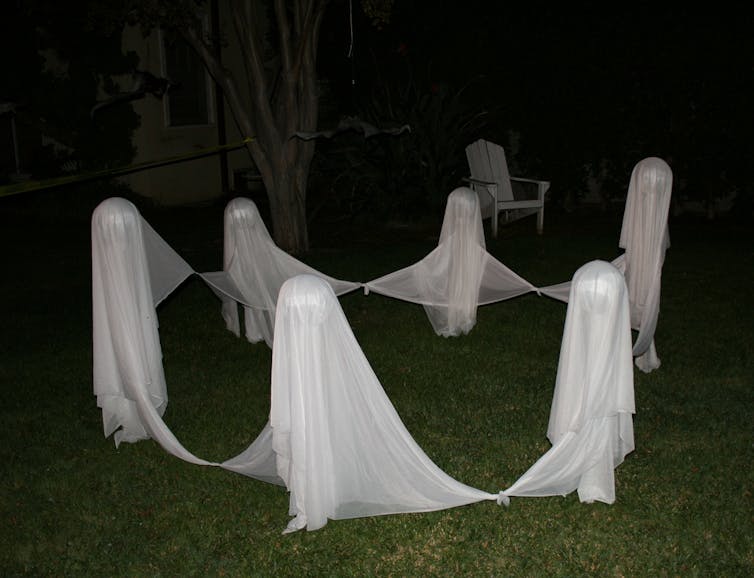
A Halloween ghost. Werner Reischel/Flickr.com, CC BY
Halloween is a time when ghosts and spooky decorations are on public display, reminding us of the realm of the dead. But could they also be instructing us in important lessons on how to lead moral lives?
Roots of Halloween
The origins of modern-day Halloween go back to “samhain,” a Celtic celebration for the beginning of the dark half of the year when, it was widely believed, the realm between the living and the dead overlapped and ghosts could be commonly encountered.
In 601 A.D., to help his drive to Christianize northern Europe, Pope Gregory I directed missionaries not to stop pagan celebrations, but rather to Christianize them.
Accordingly, over time, the celebrations of samhain became All Souls’ Day and All Saint’s Day, when speaking with the dead was considered religiously appropriate. All Saint’s Day was also known as All Hallows’ Day and the night before became All Hallows’ Evening, or “Hallowe’en.”
Christian ghosts
Not only did the pagan beliefs around spirits of the dead continue, but they also became part of many of early church practices.
Pope Gregory I himself suggested that people seeing ghosts should say masses for them. The dead, in this view, might require help from the living to make their journey towards Heaven.
During the Middle Ages, beliefs around souls trapped in purgatory led to the church’s increasing practice of selling indulgences – payments to the church to reduce penalties for sins. The widespread belief in ghosts turned the sale of indulgences into a lucrative practice for the church.
It was such beliefs that contributed to the Reformation, the division of Christianity into Protestantism and Catholicism led by German theologian Martin Luther. Indeed, Luther’s “95 Theses,” that he nailed to the All Saints Church in Wittenburg on Oct. 31, 1517, was largely a protest against the selling of indulgences.
Subsequently, ghosts became identified with “Catholic superstitions” in Protestant countries.
Debates, however, continued about the existence of ghosts and people increasingly turned to science to deal with the issue. By the 19th century, Spiritualism, a new movement which claimed that the dead could converse with the living, was fast becoming mainstream, and featured popular techniques such as seances, the ouija board, spirit photography and the like.
Although Spiritualism faded in cultural importance after World War I, many of its approaches can be seen in the “ghost hunters” of today, who often seek to prove the existence of ghosts using scientific techniques.
A wide, wide world of ghosts
These beliefs are not just part of the Christian world. Most, although not all, societies have a concept of “ghosts.” In Taiwan, for example, about 90 percent people report seeing ghosts.

Along with many Asian countries such as Japan, Korea, China and Vietnam, Taiwan celebrates a “Ghost Month,” which includes a central “Ghost Day,” when ghosts are believed to freely roam the world of the living. These festivals and beliefs are often tied to the Buddhist story of the Urabon Sutra, where Buddha instructs a young priest on how to help his mother whom he sees suffering as a “hungry ghost.”
As in many traditions, Taiwanese ghosts are seen either as “friendly” or “unfriendly.” The “friendly” ghosts are commonly ancestral or familial and welcomed into the home during the ghost festival. The “unfriendly” ghosts are those angry or “hungry” ghosts that haunt the living.
Role of ghosts in our lives
As a scholar who has studied and taught ghost stories for many years, I have found that ghosts generally haunt for good reasons. These could range from unsolved murders, lack of proper funerals, forced suicides, preventable tragedies and other ethical failures.
Ghosts, in this light, are often found seeking justice from beyond the grave. They could make such demands from individuals, or from societies as a whole. For example, in the U.S., sightings have been reported of African-American slaves and murdered Native Americans. Scholar Elizabeth Tucker details many of these reported sightings on university campuses, often tied in with sordid aspects of the campus’s past.
In this way, ghosts reveal the shadow side of ethics. Their sightings are often a reminder that ethics and morality transcend our lives and that ethical lapses can carry a heavy spiritual burden.
Yet ghost stories are also hopeful. In suggesting a life after death, they offer a chance to be in contact with those that have passed and therefore a chance for redemption – a way to atone for past wrongs.
This Halloween, along with the shrieks and shtick, you may want to take a few minutes to appreciate the role of ghosts in our haunted pasts and how they guide us to lead moral and ethical lives.
Tok Thompson, Associate Professor of Teaching, University of Southern California – Dornsife College of Letters, Arts and Sciences
This article is republished from The Conversation under a Creative Commons license. Read the original article.
The National Weather Service issued a red flag warning that’s in effect through Wednesday morning that warns of high winds and low humidity over the North Bay Mountains and portions of interior Northern California.
A red flag warning means that critical fire weather conditions are either occurring now or will shortly. A combination of strong winds, low relative humidity and warm temperatures can
contribute to extreme fire behavior, the National Weather Service reported.
Cal Fire said the combination of gusty winds and low humidity, along with very dry fuels will result in critical fire weather conditions.
In Lake County, the specific forecast anticipates winds with gusts in the low 20s during the day on Tuesday, with wind speeds peaking in the high 20s on Tuesday night. Winds are expected to be in the low teens on Wednesday.
Temperatures this week are forecast to be in the high 70s during the day and the high 40s at night, the National Weather Service reported.
In order to be prepared should fires occur in the red flag conditions, Cal Fire said it has staffed up and has increased resources at the ready.
That preparation includes staffing all hand crews and bulldozers 24 hours a day, adding emergency command center personnel as well as having additional personnel ready to fill command and control functions in the event of a major fire, Cal Fire reported.
To learn about what steps you can take to be ready in the case of wildlife, visit http://www.readyforwildfire.org/Prepare-For-Wildfire/.
Email Elizabeth Larson at
The Clearlake Police Department has operated a 24/7 dispatch center since the founding of the agency.
However, 911 calls are answered at the Lake County Sheriff’s Office and then transferred to the Clearlake Police Department.
City officials said this arrangement causes a delay and does not pass enhanced 911 information, such as caller location and call back number.
Clearlake Police Chief Andrew White took the proposal to pursue the PSAP status to the Clearlake City Council on Sept. 27 and received its unanimous approval, as Lake County News has reported.
The approval provides approximately $226,000 in funding across five years for the necessary equipment, support and connections.
When the new system is implemented, the Clearlake Police Department will answer landline and wireless 911 calls originating in the city, including new text-to-911 calls.
“The proposed solution will improve safety and responsiveness to the citizens of Clearlake. It will ensure they receive the same level of access to the 911 system as others enjoy throughout the state of California,” said Chief White.
White continued, “We are thankful the State 911 Office recognized our need and are working in support of making this a reality. The solution will also provide redundancies and enhance interoperability amongst our regional emergency response partners.”
City Manager Greg Folsom stated, “The city of Clearlake continues to achieve important milestones in implementing the city’s strategic plan to make the city cleaner, safer, and better. Approval by the state to become a public safety answering point is a huge win for Clearlake in our continued efforts to improve public safety. Once the new PSAP is operational, the Clearlake Police Department will have the latest technology for dispatching officers and will be able to more effectively serve our citizens.”
The new system is expected to be installed within the next six months. There will be additional information forthcoming as the installation date nears, city officials said.
The class will take place from 5 to 7 p.m. at the Clear Lake Area CHP office, located at 5700 Live Oak Drive in Kelseyville.
The CHP said a teenager is killed in a traffic collision every four hours nationwide. That equates to more than 1,870 teenagers killed each year. Another 184,000 teenagers are injured in traffic collisions.
These deaths and injuries can be substantially reduced or prevented by eliminating high-risk driving behaviors through education, and the CHP said its “Start Smart” program can help prevent these tragedies.
The Start Smart program focuses on providing comprehensive traffic safety education classes for teenagers and their parents.
Start Smart employs innovative techniques to capture the attention of teenagers and parents, providing a lasting experience.
The curriculum includes information on collision statistics, teen driver and passenger behaviors, graduated driver’s license laws, cultural changes in today’s society and the need for stronger parental involvement in a teenager’s driving experience.
Space is limited for this class. For more information or reservations, call Officer Efrain Cortez at the CHP office, 707-279-0103, or email