 How to resolve AdBlock issue?
News
The legislation, which will take an aggressive and in-depth approach to the state’s affordable housing crisis, will be introduced in the coming weeks as a series of bills.
The first bill introduced today – SB 5 – is focused on funding that will build affordable housing for working families and seniors and revitalize neighborhoods in communities big and small in every corner of the Golden State.
Sen. Jim Beall, chair of the Senate Transportation and Housing Committee, and Sen. Mike McGuire, chair of the Senate Governance and Finance Committee, are partnering to create innovative programs that won’t rely on one-size-fits-all approaches, but will incentivize communities of all sizes across California to advance solutions that address the housing crisis.
“All across our state, from rural cities of the North Coast to the bustling suburbs of greater Los Angeles, every community is facing an affordable housing crisis,” Sen. McGuire said. “Our affordable housing bills will help working families and seniors live and thrive in the communities they call home by providing funding and innovative solutions to one of this state’s most significant challenges. Senator Beall and I look forward to continuing to work with residents and community leaders across California on this critical legislation in the months to come.”
One of the hallmark bills of McGuire and Beall’s housing legislation will launch an updated approach to the funding for local governments that was lost with the dissolution of redevelopment agencies – which at the time was the largest single source of funds for affordable housing.
Beall and McGuire’s bill – The Affordable Housing and Neighborhood Revitalization Act – will support affordable housing, transit-oriented development, strong neighborhoods, and resiliency from sea-level rise, while providing rigorous state oversight and taxpayer protections to ensure that affordable housing construction occurs quickly and local governments are accountable for the expenditure of funds.
“When voters overwhelmingly passed Proposition 1, they sent a message to the Legislature that we are in a housing crisis, and that building more affordable homes is a statewide priority,” said Sen. Beall. “This bill supports their voice by establishing a replacement tool for redevelopment agencies through a state and local partnership funding mechanism to create affordable housing through all corners of the state. Its goal is to thoughtfully tackle housing by also alleviating poverty, creating jobs, and meeting our statewide environmental goals without impacting school funding. Today, we have an opportunity to establish a renewed partnership between the state and cities, with strict accountability measures, to ensure more affordable housing gets built.”
The affordable housing and neighborhood revitalization bill that Beall and McGuire are advancing will be part of a series of housing bills that will create inclusive neighborhoods by streamlining permitting and enabling strategic density without taking a one size fits all approach in communities, along with updating surplus property identification.
The aim of the legislation is to be responsive to the needs of cities and counties, while creating desperately needed housing opportunities for hard-working Californians.
McGuire and Beall are committed to continuing to work with stakeholders and residents from across California in the months to come.
“Housing California is pleased to see state lawmakers already putting forth bold ideas to incentivize and expand development of affordable homes and simultaneously address the inequity of state investment in families earning low incomes or experiencing homelessness,” said Lisa Hershey, executive director, Housing California. “Senators Jim Beall and Mike McGuire are proposing a creative solution to replace the $1 billion per year lost when California eliminated redevelopment funds for affordable homes. This proposal includes the assurance that the money will be used to construct affordable homes. State data reveals that the loss of redevelopment and expended housing bonds contributed to a dramatic 14 percent increase in homelessness statewide in just one year. We are thrilled to see such an innovative state and local partnership proposal early in this legislative session that will take a bite out of this devastating trend.”
“California’s lack of affordable housing, especially in metropolitan areas, is worsened by rising levels of income inequality. These are persistent challenges facing working families which require immediate solutions by policymakers,” said Cesar Diaz, State Building and Construction Trades Council, AFL-CIO. “We thank Senators Jim Beall and Mike McGuire for this legislative proposal to establish a permanent source of funding for affordable housing projects that will provide economic relief to working families while also creating good paying construction jobs in communities throughout our state.”
“The League of California Cities applauds Sen. Beall and Sen. McGuire’s leadership in the effort to restore a more robust form of tax increment financing tool that cities have lacked since the elimination of redevelopment,” said Carolyn Coleman, executive director, League of California Cities. “This effort will help restore and make available resources to communities to help build transit-oriented development, affordable housing, repair infrastructure and revitalize our neighborhoods and downtowns.”
“California’s housing shortage is staggering. This is a clear crisis that has to be addressed and we believe this bill is a solid start. We applaud Senators Beall and McGuire and we look forward to working with them to help not just the homeless but the growing number of working people and their families who can no longer afford even modest housing,” said Daniel M. Curtin, director, California Conference of Carpenters.
The breakfast will feature hotcakes, along with choices of sausage, eggs, biscuits and gravy. Beverages include juice and coffee. You may also order the deluxe version, by simply requesting “the works.”
Operation Tango Mike volunteers will take orders and serve patrons.
Santa and Mrs. Claus will be at the event, so bring your camera!
The event will run from 8 to 11 a.m. at the Kelseyville Lions Club, 4335 Sylar Lane, with a suggested donation of $8.
Proceeds benefit Operation Tango Mike in the ongoing effort to ship monthly care packages to deployed military personnel.
Operation Tango Mike is approaching 16 years of supporting the troops and having shipped nearly 21,000 care packages.
Currently, monthly shipping fees alone average $1,900. Coupled with the expense of care package supplies, the all-volunteer non-profit spends nearly $4,000 per month to send the much needed and appreciated care packages.
For further information call 707-349-2838 or e-mail
According to the AOTA, with increasing age come changes in physical, mental, and sensory abilities that can challenge a person’s continued ability to drive safely.
Family and friends play a major role in identifying changes in driving behavior and beginning discussions about older driver safety.
It is important to start these conversations early and discuss any needed changes in driving habits before it becomes a problem, allowing older drivers to be actively involved in the planning.
“Driving also means independence and the thought of losing that can be troublesome for many,” CHP Commissioner Warren Stanley said. “As a friend or family member, having the discussion with an aging driver about how long it is safe for them to continue driving can be difficult, but it is necessary.”
Last year, more than 3,400 fatal collisions were recorded in California. Preliminary data from the CHP’s Statewide Integrated Traffic Records System indicates drivers aged 65 and older were involved in 13.5 percent of the fatal collisions in California in 2017.
As part of our efforts to help California’s seniors drive safely for as long as they can, the CHP offers a free, two-hour Age Well, Drive Smart course.
Through this program, seniors can sharpen their driving skills, refresh their knowledge of the rules of the road, and learn how to adjust to typical age-related physical and mental changes.
Information about the free class is available at CHP Area offices throughout the state or at www.chp.ca.gov .
The CHP’s Clear Lake Area office can be contacted at 707-279-0103.
 www.shutterstock.com
Beginning on the evening of Dec. 2, Jews will celebrate the eight-day festival of Hanukkah, perhaps the best-known and certainly the most visible Jewish holiday.
While critics sometimes identify Christmas as promoting the prevalence in America today of what one might refer to as Hanukkah kitsch, this assessment misses the social and theological significance of Hanukkah within Judaism itself.
Let’s consider the origin and development of Hanukkah over the past more than 2,000 years.
Early history
Though it is 2,200 years old, Hanukkah is one of Judaism’s newest holidays, an annual Jewish celebration that does not even appear in the Hebrew Bible.
The historical event that is the basis for Hanukkah is told, rather, in the post-biblical Books of the Maccabees, which appear in the Catholic biblical canon but are not even considered part of the Bible by Jews and most Protestant denominations.
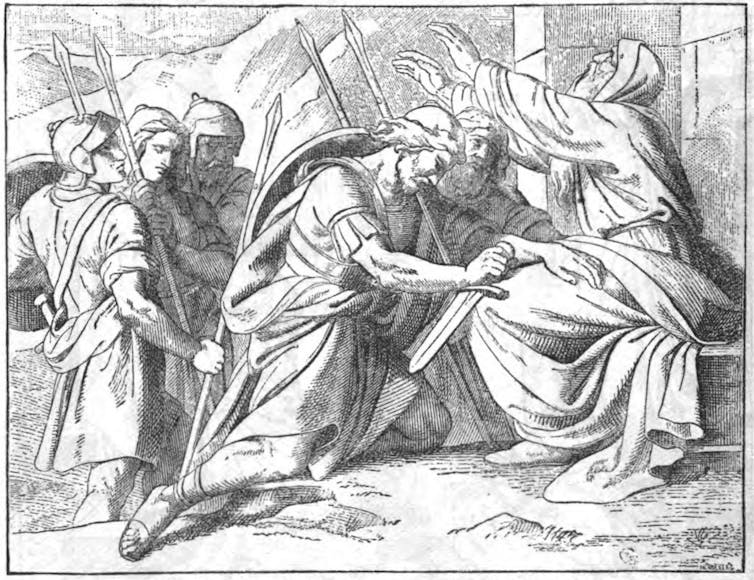

Based on the Greco-Roman model of celebrating a military triumph, Hanukkah was instituted in 164 B.C. to celebrate the victory of the Maccabees, a ragtag army of Jews, against the much more powerful army of King Antiochus IV of Syria.
In 168 B.C., Antiochus outlawed Jewish practice and forced Jews to adopt pagan rituals and assimilate into Greek culture.
The Maccabees revolted against this persecution. They captured Jerusalem from Antiochus’s control, removed from the Jerusalem Temple symbols of pagan worship that Antiochus had introduced and restarted the sacrificial worship, ordained by God in the Hebrew Bible, that Antiochus had violated.
Hanukkah, meaning “dedication,” marked this military victory with a celebration that lasted eight days and was modeled on the festival of Tabernacles (Sukkot) that had been banned by Antiochus.
How Hanukkah evolved
The military triumph, however, was short-lived. The Maccabees’ descendants – the Hasmonean dynasty – routinely violated their own Jewish law and tradition.
Even more significantly, the following centuries witnessed the devastation that would be caused when Jews tried again to accomplish what the Maccabees had done. By now, Rome controlled the land of Israel. In A.D. 68-70 and again in A.D. 133-135, the Jews mounted passionate revolts to rid their land of this foreign and oppressing power.
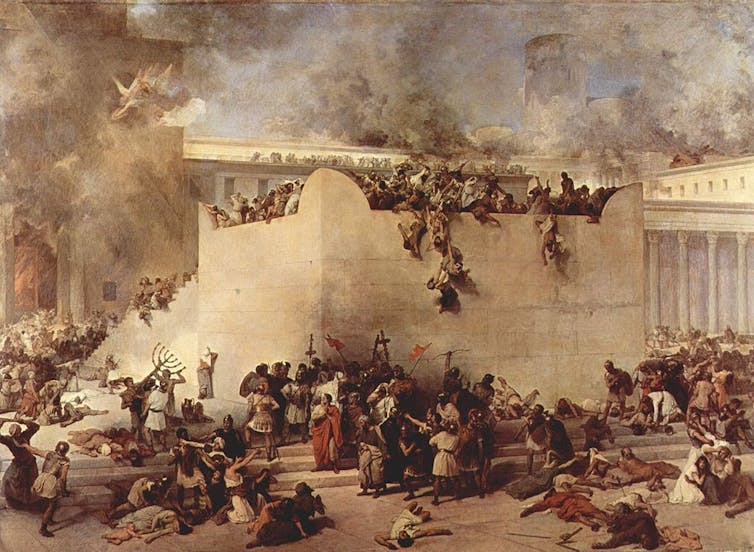

The first of these revolts ended in the destruction of the Second Jerusalem Temple, the preeminent center of Jewish worship, which had stood for 600 years. As a result of the second revolt, the Jewish homeland was devastated and countless Jews were put to death.
War no longer seemed an effective solution to the Jews’ tribulations on the stage of history.
In response, a new ideology deemphasized the idea that Jews should or could change their destiny through military action. What was required, rabbis asserted, was not battle but perfect observance of God’s moral and ritual law. This would lead to God’s intervention in history to restore the Jewish people’s control over their own land and destiny.
In this context, rabbis rethought Hanukkah’s origins as the celebration of a military victory. Instead, they said, Hanukkah should be seen as commemorating a miracle that occurred during the Maccabees’ rededication of the temple: The story now told was how a jar of temple oil sufficient for only one day had sustained the temple’s eternal lamp for a full eight days, until additional ritually appropriate oil could be produced.
The earliest version of this story appears in the Talmud, in a document completed in the sixth century A.D. From that period on, rather than directly commemorating the Maccabees’ victory, Hanukkah celebrated God’s miracle.
This is symbolized by the kindling of an eight-branched candelabra (“Menorah” or “Hanukkiah”), with one candle lit on the holiday’s first night and an additional candle added each night until, on the final night of the festival, all eight branches are lit. The ninth candle in the Hanukkiah is used to light the others.
Throughout the medieval period, however, Hanukkah remained a minor Jewish festival.
What Hanukkah means today
How then to understand what happened to Hanukkah in the past hundred years, during which it has achieved prominence in Jewish life, both in America and around the world?

The point is that even as the holiday’s prior iterations reflected the distinctive needs of successive ages, so Jews today have reinterpreted Hanukkah in light of contemporary circumstances – a point that is detailed in religion scholar Dianne Ashton’s book, “Hanukkah in America.”
Ashton demonstrates while Hanukkah has evolved in tandem with the extravagance of the American Christmas season, there is much more to this story.
Hanukkah today responds to Jews’ desire to see their history as consequential, as reflecting the value of religious freedom that Jews share with all other Americans. Hanukkah, with its bright decorations, songs, and family- and community-focused celebrations, also fulfills American Jews’ need to reengage disaffected Jews and to keep Jewish children excited about Judaism.
Poignantly, telling a story of persecution and then redemption, Hanukkah today provides a historical paradigm that can help modern Jews think about the Holocaust and the emergence of Zionism.
In short, Hanukkah is as powerful a commemoration as it is today because it responds to a host of factors pertinent to contemporary Jewish history and life.
Over two millennia, Hanukkah has evolved to narrate the story of the Maccabees in ways that meet the distinctive needs of successive generations of Jews. Each generation tells the story as it needs to hear it, in response to the eternal values of Judaism but also as is appropriate to each period’s distinctive cultural forces, ideologies and experiences.
Alan Avery-Peck, Kraft-Hiatt Professor in Judaic Studies, College of the Holy Cross
This article is republished from The Conversation under a Creative Commons license. Read the original article.
The public hearing has been rescheduled for 10 a.m. Tuesday, Dec. 11.
More information about the ordinance, which has caused concern around the county, can be found here.
The board will meet beginning at 9 a.m. Tuesday, Dec. 4, in the board chambers on the first floor of the Lake County Courthouse, 255 N. Forbes St., Lakeport.
The meeting can be watched live on Channel 8 and online at https://countyoflake.legistar.com/Calendar.aspx. Accompanying board documents, the agenda and archived board meeting videos also are available at that link.
At 9:30 a.m., the board will hold a public hearing to consider draft ordinance No. 18-1007, adding Article VIII to Chapter 13 of the Lake County Code Regarding hazardous vegetation abatement in the county’s unincorporated portions. Properties in the cities of Clearlake and Lakeport would not be included.
The brief report on the item from County Counsel Anita Grant said the ordinance was initiated by Board Chair Jim Steele, whose term is up at the end of this year.
At its Nov. 6 meeting, the board considered a hazardous vegetation draft ordinance, No. 18-985, that appears to be identical to this newest ordinance.
The 16-page draft ordinance to be considered Tuesday cites the last several years of wildland fire disasters and the county’s anticipated participation in a community risk reduction authority as reasons to enact the new rules.
State law, specifically Public Resources Code section 4291, establishes defensible space requirements for owners of improved parcels who must maintain 100 feet – or to the limit of their property line – of defensible space around structures.
The draft ordinance states that Public Resources Code section 4291 may be extended beyond the property line by adoption of a local ordinance which applies specifically to unimproved parcels that are adjacent to improved properties “if an extra hazardous fire condition exists in that an owner of improved property is at risk because of fuel levels on an adjacent unimproved property and it is impossible for the improved property owner to obtain the full 100 feet of defensible space …”
The document’s findings and purpose acknowledges that Public Resources Code section 4291 “does not address hazardous vegetation abatement on unimproved parcels and the potential impact that hazardous vegetation on an unimproved parcel could have on an adjacent parcel.”
As such, the proposed ordinance seeks to “extend and supplement state law” in order to ensure defensible space is maintained on unimproved parcels adjacent to improved parcels – of five acres or less in residential areas – and along emergency access and evacuation routes, and fire access easements.
It requires removal of hazardous trees or vegetation within 100 feet of a structure – or greater as determined by the county fire official or their designated representative – as well as 100 feet from a neighboring property line or along roadways that are primary ingress and egress routes.
A minimum 10-foot-wide strip of land beyond the shoulder of roadways to a height to of 15 feet along an unimproved parcel’s boundary must be cleared.
If structures are built on a parcel after the ordinance goes into effect, the owner, occupant or any other person in control of that property shall be responsible for 50 percent of the abatement cost on the unimproved parcel.
The ordinance allows the “county fire official” to mandate larger areas of fuel management based on terrain and conditions.
Just who that county fire official would be is not stated, as the position is not included in the document’s definitions.
The county fire official is given significant authority and latitude for action in the ordinance. That individual can conduct voluntary compliance efforts and conduct inspections, send abatement letters, and even skip right to an administrative or criminal citation over abatement with some parcels.
Abatement letters will give property owners 30 calendar days from the notice of abatement to remove the vegetation. The letters will be delivered personally to the legal owners or by certified mail.
The ordinance includes an appeal process, with appeals to be submitted to the clerk of the Board of Supervisors within 30 days of the abatement notice, with a hearing to be held within 30 days of the appeal filing. The Board of Supervisors is the abatement hearing body.
If the parcel is abated, the costs – which can include everything from payments to a county fire protection district, costs for a contractor, site inspections and boundary determinations to measurements, clerical, personnal, consultants and other administrative costs – shall be charged to the property owner. If they don’t pay within 30 days of notification, the costs will be recorded against the property.
The ordinance also states that anyone who violates or fails to comply with it shall be guilty of a misdemeanor – unless the district attorney or county counsel decides to charge it as an infraction. Anyone convicted of a misdemeanor can face fines of between $100 and $1,000, up to a year in the county jail or both.
Infractions carry fines of $100 for a first violation, $200 for a second and $500 for each additional violation.
The ordinance also allows the county fire official to take civil action against property owners.
Also on the agenda Tuesday, in an untimed item, District Attorney Don Anderson is due to give a report on his expenditures in response to allegations of impropriety lodged against him by Supervisor Rob Brown.
The board had discussed the matter previously at its Nov. 20 meeting, which Anderson did not attend, as Lake County News has reported.
The full agenda follows.
CONSENT AGENDA
6.1: Approve Amendment to the Travel Policy Section 15 Subsection 4.1.C increasing the threshold for lodging expenses requiring county administrative officer approval from “in excess of $125 per night before taxes” to “in excess of $175 per night before taxes.”
6.2: Authorize the county administrative officer to execute side letters with Lake County Employee Association Units 3, 4, 5 and 10, Lake County Correctional Officers Association Unit 6, Lake County Deputy District Attorney Association Unit 8 and Lake County Deputy Sheriff Association Unit 16 to increase maximum monthly County contribution for insurance coverage from $800 per month to $1,000 per month for employees who enroll in a County sponsored medical, dental, vision insurance plan, effective Jan. 1, 2019.
6.3: Adopt Resolution of the Board of Supervisors of the County of Lake adopting an amended conflict of interest code for the county of Lake.
6.4: Adopt Resolution of the Board of Supervisors of the County of Lake approving conflict of interest codes of certain local agencies located wholly within the county.
6.5: Adopt resolution amending Resolution No. 2018-73, establishing position allocations for Fiscal Year 2018-2019, Budget Unit No. 1121, Auditor-Controller/County Clerk.
6.6: Adopt resolution authorizing the Konocti Unified School District to Issue its general obligation bonds, election of 2016, Series 2019, in an aggregate principal amount not to exceed $9,500,000 without further action of the Board of Supervisors or officers of the county.
6.7: Adopt resolution approving the application and certification statement for the State Department of Health Care Services, CMS Branch’s California Children’s Services Administration Plan Renewal Grant for FY 2018-2019 and authorize the board chair to sign said certification statement .
6.8: adopt resolution approving the application and certification statement for the State Department of Health Services, CMS Branch’s Child Health & Disability Program, Health Care Program for Children in Foster Care Program and monitoring oversight of foster children treated with psychotropic meds grant for fy 2018-2019 and authorize the board chair to sign said certification statement .
6.9: (a) Waive the competitive bid process under Ordinance No. 2406, Section 38.2 as it is not in the public interest due to the unique nature of the goods; and (b) approve the Special Districts administrator acting as the assistant purchasing agent to issue and sign a purchase order in an amount not to exceed $88,000 to Smith & Loveless Inc. for the purchase of a Everlast Series 1000 pumping station.
6.10: Adopt resolution authorizing the director of Watershed Protection District to sign a notice of completion for work performed under the agreement dated Sept. 6, 2018, for the Levee Patrol Road Gravel Repair Project. Bid No. 18-01.
6.11: Approve advance application submission of FY2019 State Homeland Security grant application in the amount of $139,563.
6.12: (a) Approve Submission of FY2018 State Homeland Security grant application in the amount of $139,563; (b) authorize the sheriff to sign the grant application and grants management assessment; and (c) authorize the chairman of the board or county administrative officer to sign the Grant Assurances, Governing Body Resolution and Federal Funding Accountability and Transparency Act financial disclosure.
6.13: Approve bid award to Rogue Jet Boatworks in the amount of $95,371 for the purchase of an aluminum patrol/rescue boat.
6.14: Approve the second amendment to the contract between the county of Lake and Regional Housing Authority for housing consultant services in the amount of $117,518, from July 1, 2017 to June 30, 2019, and authorize the chair to sign.
6.15: Adopt resolution amending the resolution establishing a geothermal impact mitigation fund and combining the Anderson Spring and Cobb Valley Committees into the Geothermal Advisory Committee.
TIMED ITEMS
7.2: 9:13 a.m.: Consideration of continuing a proclamation of a local health emergency by the Lake County health officer due to the Pawnee fire incident.
7.3, 9:14 a.m.: (a) Consideration of continuing a proclamation of a local health emergency by the Lake County health officer due to the Mendocino Complex fire.
7.4, 9:15 a.m.: Consideration of continuing a proclamation of a local emergency due to the Mendocino Complex fire incident (River and Ranch fires); and and (b) update on the Mendocino Complex - River and Ranch fires recovery.
7.5, 9:16 a.m.: Consideration of continuing a proclamation of a local emergency due to the Pawnee fire incident.
7.6, 9:17 a.m.: Consideration of continuing a proclamation of a local emergency due to the Sulphur fire incident.
7.7, 9:18 a.m.: Consideration of continuing a proclamation of a local emergency due to Clayton fire.
7.8, 9:19 a.m.: Consideration of continuing a proclamation of a local emergency due to the atmospheric river storm.
7.9, 9:30 a.m.: Public hearing, consideration of a draft ordinance adding Article VIII to Chapter 13 of the Lake County Code Regarding hazardous vegetation abatement.
UNTIMED ITEMS
8.2: Continued from Nov. 20, (a) consideration of report from the district attorney on internal controls used with respect to county credit cards, expenses, reimbursements, mileage and maintenance of county vehicles, necessary to protect the public trust; and (b) consideration of report from the district attorney on his use of limited county resources and justification to attend conferences and training himself, despite leaving office 12/31/18, with possible direction to the county administrative officer (CAO)/CalCard administrator to review and approve his expense requests in advance and/or revoke his privilege to use a CalCard.
8.3: Consideration of resolution declaring the Board of Supervisors intent to sell property not required for public use, located at 8695 Soda Bay Road, Kelseyville, California (APN 009-002-430), Pursuant to Government Code Section 25520 Et Seq.
8.4: Consideration of adoption of vehicle policy.
8.5: Consideration of fiscal crisis management plan.
8.6: Second reading, as amended, consideration of ordinance amendment, AM 18-02 to amend Chapter 21 of the Lake County Zoning Ordinance to allow Type N and P Cannabis Manufacturing License in the "C2, C3, M1, M2, and PDC" Districts subject to obtaining a Minor Use Permit, Type 6 Non-Volatile Cannabis Manufacturing License in the "APZ, A, TPZ, C3, M1, M2, and PDC" Districts subject to obtaining a Major Use Permit, Type 7 Volatile Cannabis Manufacturing License in the "M2" District subject to obtaining a Major Use Permit, Type 11 Cannabis Distributor License in the "C3, M1, M2, and PDC" Districts subject to obtaining a Major Use Permit, Type 13 Cannabis Distributor Transport Only License in the "C2, C3, M1, M2, and PDC" Districts subject to obtaining a Major Use Permit, Type 13 Cannabis Distributor Transport Only, Cannabis Self -Distribution License in the "APZ, A, TPZ, RL, RR, SR, C2, C3, M1, M2, and PDC" Districts subject to obtaining a Minor Use Permit, Cannabis Processor License in the "APZ, A, TPZ, and RL" Districts subject to obtaining a Major Use Permit, Type 8 Cannabis Testing Laboratory in the "C2, C3, M1, M2 AND PDC" Districts subject to obtaining a Minor Use Permit.
8.7: Second reading, as amended, consideration of an ordinance amending Article II of Chapter 13 of the Lake County Code regarding the abatement of garbage and refuse and establishing fines and penalties for the accumulation of garbage and other refuse.
CLOSED SESSION
9.1: Public employee appointment pursuant to Gov. Code Section 54957(b)(1): Appointment of interim registrar of voters.
9.2: Conference with legal counsel: Significant exposure to litigation pursuant to Gov. Code Sec. 54956.9(d)(2)(e)(3): California River Watch.
Email Elizabeth Larson at
120418 Lake County Board of Supervisors - Draft Ordinance No. 18-1007 - Hazardous vegetation abatement ordi... by LakeCoNews on Scribd