LAKE COUNTY, Calif. – Christmas trees are a popular holiday decoration this time of year, but fire officials warn that Californians must take several steps to ensure they don’t become an increased fire hazard inside the home.
In mere seconds, a fire can spark and quickly engulf a Christmas tree.
Christmas tree safety begins when you purchase your tree. When selecting a tree from a sales lot, do the “tap test,” lift the tree up and tap it on the ground. If any needles fall off, it’s already too dry and you should look for another tree.
Cut trees can need as much as a gallon of water a day to help keep them from drying out too fast. Having your tree located too close to heat sources dries the tree quicker, making it a greater fire hazard.
Here are some additional fire safety tips:
– Choose a fresh tree with green needles. – Recut the trunk at least 2 inches above the old cut as soon as you get it home. This allows it to continue to pull moisture into its foliage. – Keep the trunk in water immediately after it is recut. Moisture is the key to keeping the tree fresh and thereby enhancing its fire resistance. If the tree will be kept outside for a few days, stand it in a bucket of water until you are ready to bring it indoors. – Check the water levels daily. Never let the water level go below the bottom of the trunk. – Commercial floral preservatives can also be added to the water to help keep the tree fresh. – Locate any tree at least 3 feet away from sources of heat. Avoid placing any tree, live or artificial, near a heater outlet, wood stove or fireplace. If tree does dry out and become a hazard remove it from the home even if it's not yet Christmas. It’s not worth the risk. – Never place tree where it blocks exits. – Use only UL approved and properly operating/maintain lights on trees. Don't overload outlets or light sets by connecting too many together. Use multi plug circuit type plug to prevent heat buildup. – Remove the tree immediately after the holidays. Even a properly cared for live tree will eventually die. Take it to a recycle center or leave for your refuse collector.
LAKE COUNTY, Calif. – Lake County Animal Care and Control’s shelter remains filled with dogs waiting to join new families.
Dogs available for adoption this week include mixes of cane corso, chow chow, Chihuahua, dachshund, Labrador Retriever, pit bull, Pomeranian, shepherd and terrier.
Dogs that are adopted from Lake County Animal Care and Control are either neutered or spayed, microchipped and, if old enough, given a rabies shot and county license before being released to their new owner. License fees do not apply to residents of the cities of Lakeport or Clearlake.
If you're looking for a new companion, visit the shelter. There are many great pets hoping you'll choose them.
The following dogs at the Lake County Animal Care and Control shelter have been cleared for adoption (additional dogs on the animal control Web site not listed are still “on hold”).
This male Labrador Retriever is in kennel No. 3, ID No. 11270. Photo courtesy of Lake County Animal Care and Control. Male Labrador Retriever
This male Labrador Retriever has a short black coat with white markings.
He already has been neutered.
He’s in kennel No. 3, ID No. 11270.
This male Labrador Retriever is in kennel No. 4, ID No. 11246. Photo courtesy of Lake County Animal Care and Control. Male Labrador Retriever
This male Labrador Retriever has a short tan and white coat.
He already has been neutered.
He’s in kennel No. 4, ID No. 11246.
“Forest” is a male shepherd in kennel No. 5, ID No. 11453. Photo courtesy of Lake County Animal Care and Control. ‘Forest’
“Forest” is a male shepherd with a short brown brindle coat.
He’s in kennel No. 5, ID No. 11453.
This male Pomeranian is in kennel No. 7, ID No. 11377. Photo courtesy of Lake County Animal Care and Control. Male Pomeranian
This male Pomeranian has a long red coat.
He already has been neutered.
He’s in kennel No. 7, ID No. 11377.
“Raider” is a male pit bull terrier mix in kennel No. 9a, ID No. 11429. Photo courtesy of Lake County Animal Care and Control. ‘Raider’
“Raider” is a male pit bull terrier mix.
He has a short black and white coat.
He’s in kennel No. 9a, ID No. 11429.
“Lona” is a female pit bull terrier in kennel No. 9b, ID No. 11430. Photo courtesy of Lake County Animal Care and Control. ‘Lona’
“Lona” is a female pit bull terrier with a short black and white coat.
She’s in kennel No. 9b, ID No. 11430.
This male terrier in kennel No. 10, ID No. 11427. Photo courtesy of Lake County Animal Care and Control. Male terrier
This male terrier has a short brown and brindle coat.
He’s in kennel No. 10, ID No. 11427.
This male pit bull is in kennel No. 12, ID No. 7002. Photo courtesy of Lake County Animal Care and Control. Male pit bull
This male pit bull has a short brown brindle coat.
He already has been neutered.
He’s in kennel No. 12, ID No. 7002.
This female Labrador Retriever in kennel No. 13, ID No. 11424. Photo courtesy of Lake County Animal Care and Control. Female Labrador Retriever
This female Labrador Retriever has a short brown coat.
He’s in kennel No. 13, ID No. 11424.
“Zara” is a female pit bull-Chihuahua mix in kennel No. 14, ID No. 11337. Photo courtesy of Lake County Animal Care and Control. ‘Zara’
“Zara” is a female pit bull-Chihuahua mix with a short brown and brindle coat.
She has already been altered.
She is in kennel No. 14, ID No. 11337.
This male Chihuahua is in kennel No. 15, ID No. 11375. Photo courtesy of Lake County Animal Care and Control. Male Chihuahua
This male Chihuahua has a short black coat.
He’s in kennel No. 15, ID No. 11375.
This male Chihuahua is in kennel No. 16a, ID No. 11321. Photo courtesy of Lake County Animal Care and Control. Male Chihuahua
This male Chihuahua has a short tan and white coat.
He already has been neutered.
He’s in kennel No. 16a, ID No. 11321.
This male Chihuahua-dachshund mix is in kennel No. 16b, ID No. 11322. Photo courtesy of Lake County Animal Care and Control. Chihuahua-dachshund mix
This male Chihuahua-dachshund mix has a medium-length brown and black coat.
He already has been neutered.
He’s in kennel No. 16b, ID No. 11322.
This female Labrador Retriever is in kennel No. 18, ID No. 11239. Photo courtesy of Lake County Animal Care and Control. Female Labrador Retriever
This female Labrador Retriever has a medium-length black coat with white markings.
She already has been spayed.
She’s in kennel No. 18, ID No. 11239.
This young male shepherd is in kennel No. 20, ID No. 11385. Photo courtesy of Lake County Animal Care and Control. Male shepherd
This young male shepherd has a short brindle coat with white markings.
He’s in kennel No. 20, ID No. 11385.
This female Labrador Retriever is in kennel No. 26, ID No. 11399. Photo courtesy of Lake County Animal Care and Control. Female Labrador Retriever
This female Labrador Retriever has a shaved black coat.
She’s in kennel No. 26, ID No. 11399.
This female chow chow-shepherd mix is in kennel No. 28, ID No. 11421. Photo courtesy of Lake County Animal Care and Control. Chow chow-shepherd mix
This female chow chow-shepherd mix has a medium-length orange coat.
She’s in kennel No. 28, ID No. 11421.
“Hazel” is a female cane corso mastiff-pit bull terrier mix in kennel No. 30, ID No. 11439. Photo courtesy of Lake County Animal Care and Control. ‘Hazel’
“Hazel” Is a female cane corso mastiff-pit bull terrier mix.
She has a short blue coat.
She’s in kennel No. 30, ID No. 11439.
This male pit bull terrier is in kennel No. 33, ID No. 11345. Photo courtesy of Lake County Animal Care and Control. Male pit bull terrier
This male pit bull terrier has a short gray and brown coat.
He’s in kennel No. 33, ID No. 11345.
This female pit bull terrier is in kennel No. 34, ID No. 11428. Photo courtesy of Lake County Animal Care and Control.
Female pit bull terrier
This female pit bull terrier has a short tan and white coat.
She’s in kennel No. 34, ID No. 11428.
Lake County Animal Care and Control is located at 4949 Helbush in Lakeport, next to the Hill Road Correctional Facility.
Office hours are Monday through Friday, 11 a.m. to 5 p.m., and 11 a.m. to 3 p.m., Saturday. The shelter is open from 11 a.m. to 4 p.m. Monday through Friday and on Saturday from 11 a.m. to 3 p.m.
For more information call Lake County Animal Care and Control at 707-263-0278.
Email Elizabeth Larson at This email address is being protected from spambots. You need JavaScript enabled to view it.. Follow her on Twitter, @ERLarson, or Lake County News, @LakeCoNews.
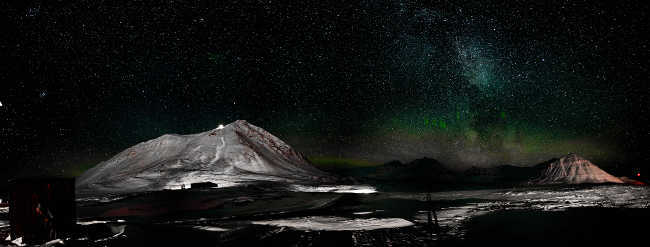
Long-exposure photograph of the night sky over Ny-Ålesund, Svalbard. Photo by Chris Pirner. On a frigid morning in early December, a team of NASA rocket scientists will huddle in the control room in Ny-Ålesund, Svalbard, a remote archipelago off the northern coast of Norway.
Here at the world’s northernmost rocket range, operated by Norway’s Andøya Space Center, the clock may read 8 a.m., but the Sun won’t be up – by that time, it won’t have peeked over the horizon in more than a month.
For a month’s time, Ny-Ålesund will be home to the rocket team behind NASA’s VISIONS-2 mission, short for Visualizing Ion Outflow via Neutral Atom Sensing-2.
They have ventured to this extreme place for an up-close look at atmospheric escape, the process whereby Earth is slowly leaking its atmosphere into space.
Understanding atmospheric escape on Earth has applications all over the Universe – from predicting which far off planets might be habitable, to piecing together how Mars became the desolate, exposed landscape it is today. VISIONS-2 is scheduled to launch no earlier than Dec. 4, 2018.
Led by Doug Rowland of NASA’s Goddard Space Flight Center in Greenbelt, Maryland, VISIONS-2 is a sounding rocket mission, a type of suborbital rocket that makes brief, targeted flights into space before falling back to Earth just a few minutes later.
Sounding rockets are unique among scientific spacecraft for their superior dexterity: They can be carted to remote locations, where they are aimed and shot into short-lived events – like the sudden formation of the aurora borealis – at a moment’s notice.
The aurora borealis is of keen interest to the VISIONS-2 team, but not just for its otherworldly glow. The aurora play are fundamental drivers in the process of atmospheric escape, whereby planets, including Earth, gradually leak their atmosphere into space.
“The Earth is losing weight,” said Thomas Moore, a Goddard space physicist who specializes in atmospheric escape. “There have been enough observations to know that anywhere from a hundred to several hundred tons of atmosphere are going into space every day.”
(Not to worry – at that rate, Moore estimates, Earth will retain its atmosphere for a billion or so years.)
We’ve suspected that Earth was losing atmosphere since at least 1904, when Sir James Jeans first published his work The Dynamical Theory of Gases, laying the theoretical foundations for atmospheric escape. But there’s one element draining away that still presents a mystery. Scientists had long thought that oxygen, weighing in at 16 times the mass of hydrogen, was too heavy to escape Earth’s gravity.
“To escape Earth, oxygen would require something like 100 times the energy that it typically has,” said Rowland, the mission’s principal investigator. “Only the tiniest fraction should ever make it.” But when scientists finally went up and looked in the ’60s and ’70s, that’s not what they found. In fact, near-Earth space is teeming with much more Earth-borne oxygen than anyone had expected.
“But how did it get up there? You need processes that energize that oxygen enough to escape,” said Rowland.
The aurora, it turns out, is one such process. The aurora are formed when energetic electrons, accelerated in the electric and magnetic fields in near-Earth space, crash into and excite atmospheric gases, which emit bright hues of red, green, and yellow as they relax back to a lower energy state.
But these unruly electrons also create a cascade of havoc in the process, including driving electric currents that heat the upper atmosphere in splotchy patches. In some cases, that heating is sufficient to give stray oxygen atoms enough energy to escape.
“It’s like putting a heating element into your soup – eventually, it’s going to start boiling,” said Rowland.
VISIONS-1, the current mission’s precursor, launched from the Poker Flat Research Range in Alaska in 2013, where they studied oxygen outflow from aurora that form on Earth’s night side, the part of the planet that is temporarily pointed away from the Sun. For the VISIONS-2 mission, the team will travel to a unique part of the globe where dayside aurora can be found.
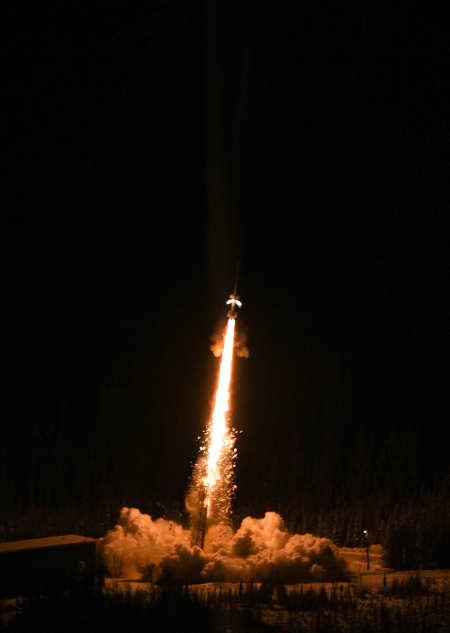
VISIONS-1 launches from the Poker Flat Research Range in Alaska on Feb. 6, 2013. Credits: NASA/Goddard/Chris Perry.
Once a day, Svalbard passes under an unusual feature in Earth’s magnetosphere known as the polar cusp.
The polar cusps form at both the North and South poles on the Sun-facing side of the planet, and they are the only places where particles from the solar wind can stream directly into our atmosphere.
The cusps are like magnetic bridges between Earth and space, where energetic electrons from the Sun crash into atmospheric particles and create a dayside aurora.
VISIONS-2 will fly two rockets into the northern polar cusp, where it will use an imaging technique to map oxygen outflow from the aurora.
Using this technique, VISIONS-2 takes a different approach from many other missions, which attempt to combine data from many outflow events. Instead, VISIONS-2 hopes to acquire a great deal of data about a single oxygen outflow event. Not all outflow events are the same, but understanding one in great detail would provide significant scientific value.
“It’s like if you’re trying to study tornados, you could just measure the winds as various tornadoes fly by at different distances from your house,” said Rowland. “You’d get a picture of what an ‘average’ tornado looks like. What we want to do instead is to comprehensively observe one tornado, to understand how it works in detail.”
VISIONS-2 is all about checking whether and how the process for the heating and energizing of oxygen on the dayside aurora – within the polar cusp – is the same as those discovered on the night side. It’s far from a foregone conclusion, as the dayside and nightside display some marked differences.
“The ion outflow in the cusp is more steady and lower energy, while that in the nightside is more bursty and can be higher energy,” Rowland explained. “In addition, the environment is different between the cusp and nightside, so we’re looking for commonalities and differences.”
VISIONS-2 won’t be the only rocket to launch from this remote location: It is the first of nine sounding rockets launching over the next 14 months as part of the Grand Challenge Initiative – Cusp.
Drawing researchers from the United States, Canada, Norway, the UK and Japan, the Grand Challenge is an international collaboration to explore the northern polar cusp, hopefully cracking the code of this unusual portal between Earth and space.
VISIONS-2 is scheduled to launch from Ny-Ålesund, Svalbard rocket range in December 2018. The launch window extends from Dec. 4 through 18.
Miles Hatfield works for NASA’s Goddard Space Flight Center, Greenbelt, Md.
Earth’s magnetosphere, showing the northern and southern polar cusps (illustration). Credits: Andøya Space Center/Trond Abrahamsen.
Anderson Marsh Interpretive Association Board members Henry Bornstein and Gae Henry with Santa and Mrs. Claus. Photo by Roberta Lyons. LOWER LAKE, Calif. – Anderson Marsh Interpretive Association invites everyone to the annual “Christmas at the Ranch” open house at Anderson Marsh State Historic Park.
The community event will happen on Saturday, Dec. 8, from 10 a.m. until 2 p.m.
It’s free of charge, with free parking.
This event has been held at the State Park for almost 30 years and is a favorite holiday tradition for many families.
The public is invited to enjoy the atmosphere of the cozy ranch house at the park, with crackling fires in both rooms and delicious holiday goodies, including homemade cookies and other baked treats, hot apple cider and coffee.
State Park docents will be on hand to answer questions about the Park and the Anderson ranch house.
Santa Claus will be there to greet children and their parents.
This fun holiday tradition features local musicians singing and playing Christmas carols. The atmosphere is casual and friendly, and visitors are encouraged to sing along.
The entertainment starts at 10 a.m. with the popular David Neft on the piano playing Christmas favorites and encouraging the audience to join in. At 11 a.m. Harry Lyons, Rick McCann and other local musicians will take the stage.
The day will also feature local folk singer Joan Moss and some of her friends with Scott Serena and AMIA board members like Don Coffin, Gae Henry and Henry Bornstein contributing.
The event is presented by the Anderson Marsh Interpretive Association, a nonprofit association cooperating with the California Department of Parks and Recreation to promote educational and interpretive activities at Anderson Marsh State Historic Park.
AMIA board members and volunteers will be available to answer questions about the Ranch House and how Christmas was celebrated in Victorian days.
Join AMIA for a festive day at Anderson Marsh State Historic Park, located off of Highway 53 between Lower Lake and Clearlake.
For more information about the event, visit www.andersonmarsh.org, contact AMIA at This email address is being protected from spambots. You need JavaScript enabled to view it. or call 707-995-2658.
As the statewide coordinator for the AMBER, Silver, and Blue Alert programs, the California Highway Patrol understands that time is of the essence and is using technology to help expedite the recovery process.
“Whether a child or at-risk adult has gone missing or a dangerous suspect is on the run, time and details are vital,” said CHP Commissioner Warren Stanley. “Using technology gives everyone involved in the process another tool to reach the appropriate audience with the information.”
As part of the various notification procedures when an alert occurs, the CHP’s Emergency Notification and Tactical Alert Center, or ENTAC, will distribute the critical information to cell phones in the affected geographic area through the Wireless Emergency Alerts program, also known as WEA.
As a result, millions of consumers with WEA-capable devices and services are armed with potentially lifesaving information.
Due to the limited number of characters available through the WEA, the CHP is now embedding a link in each message that will direct the user to the public-facing Web site at https://www.chp.ca.gov/news-alerts.
Once there, the user will find all active alerts, along with access to related flyers that can be downloaded and distributed.
Social media is also being used to help expedite and grow the audience for alerts distributed by the CHP.
The public, media and law enforcement are encouraged to follow a new Twitter account managed by ENTAC – @CHPAlerts. Posts from this account will be limited to active AMBER, Silver, and Blue Alerts.
Since July 2002, the CHP has issued nearly 300 AMBER Alerts for abducted children.
Less than a decade later, in January 2011, California enacted the Blue Alert system to apprehend individuals wanted following the violent attack of a law enforcement officer; eight Blue Alerts have been issued to date.
Two years later, the Silver Alert system went online in California and there have been nearly 1,400 alerts issued for missing, at-risk adults since January 2013.
This week, California Gov. Edmund G. Brown Jr. issued two executive orders to further assist communities recovering from devastating fires.
One helps ensure students displaced by this month’s Camp, Woolsey and Hill fires are able to return to school as soon as possible and another extends the state’s prohibition on price gouging during emergencies for counties recovering from July’s Mendocino Complex, Carr and Klamathon fires, as well as counties impacted by numerous wildfires last year, including the Tubbs, Nuns, Atlas and Thomas fires.
The order related to the Camp, Woolsey and Hill fires includes provisions to facilitate the use of temporary school facilities and waivers for requirements related to class size, outdoor physical education and school district residency.
The full text of the executive orders signed today can be found here and here.
Earlier this month, the governor secured a presidential major disaster declaration to bolster the statewide emergency response and issued an executive order to streamline recovery efforts.
Gov. Brown also met with residents impacted by wildfire in Butte and Ventura counties, joined the President to discuss recovery efforts and survey Camp and Woolsey fire damage and held briefings on the ongoing response with top federal, state and local fire and emergency management officials at the Incident Command Post in Camarillo and Chico and at the State Operations Center in Mather.
A state of emergency has been declared in Los Angeles, Ventura and Butte counties and California secured direct federal assistance to further support the impacted communities – within 24 hours of making the request. F
Federal Disaster Unemployment Assistance benefits have also been made available for workers, business owners and self-employed individuals who lost jobs or had work hours substantially reduced due to the wildfires in Butte, Los Angeles and Ventura counties.
Information on the resources available to residents impacted by the fires can be found at http://wildfirerecovery.org/.
 How to resolve AdBlock issue?