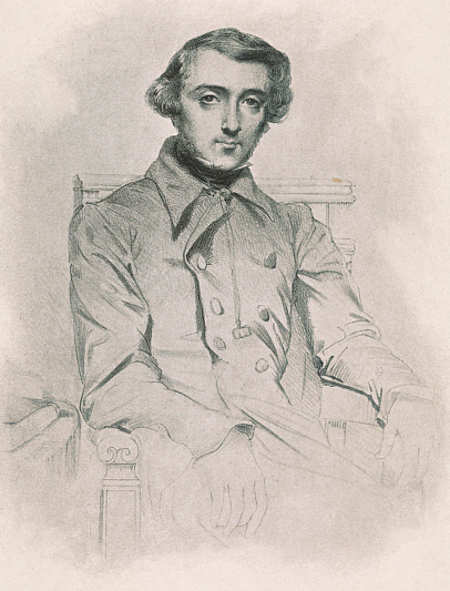
Portrait of Alexis de Tocqueville, after an 1848 lithograph by Theodore Chasseriau. Library of Congress Prints and Photographs Division Washington, D.C. 20540 USA, http://hdl.loc.gov/loc.pnp/pp.print . Have you ever noticed how it sometimes take an outside perspective to illuminate a complex situation? Sometimes it’s just impossible to see clearly when you’re neck deep in the quagmire yourself.
In the decades immediately after America’s last war with England (the War of 1812), Americans finally had time to truly consider who they were as a people.
You have to remember, that as the 1820s and 1830s passed by, the generation who had created this nation was beginning to die, leaving their children and grandchildren the responsibility of defining who exactly Americans were.
John Adams once famously said, “I must study politics and war that my sons may have liberty to study mathematics and philosophy. My sons ought to study mathematics and philosophy, geography, natural history, naval architecture, navigation, commerce, and agriculture, in order to give their children a right to study painting, poetry, music, architecture, statuary, tapestry, and porcelain.”
When the French diplomat and sociologist Alexis de Tocqueville traveled to America in 1831, the Americans he met were those second and third generations who were the beneficiaries of the John Adamses and George Washingtons.
De Tocqueville came to America with the intention of studying its prisons, of all things, and during the nine months he travelled by stagecoach, steamship and horseback, he did indeed visit many prisons. He even had time to interview every prisoner in the Eastern State Penitentiary in Washington D.C.
And while his subsequently report on his findings might have been informative to some in France, “On the Penitentiary System in the United States and Its Application in France” was certainly not an engaging read. In fact, Gustave de Beaumont, who had accompanied his friend on the trip, had largely written it, leaving de Tocqueville to write about a far more interesting topic: America.
In 1835, de Tocqueville published the first volume of “Democracy in America.” The book provided a broad analysis of the politics and culture the young Frenchman found in his travels through the country.
Much of what he saw in American life impressed de Tocqueville. He admired the individualism of America’s citizens, and was surprised at the stability of the country’s economy. He also noted the irony of the freedom-loving nation’s mistreatment of American Indians and its embrace of slavery. In particular, he was fascinated with the depth to which politics permeated all aspects of American life.
In one passage he states:
“The political activity which pervades the United States must be seen in order to be understood. No sooner do you set foot upon the American soil than you are stunned by the kind of tumult … Everything is in motion around you; here, the people of one quarter of a town are met to decide upon the building of a church; there, the election of a representative is going on; a little further the delegates of a district are posting to the town to consult upon some local improvements; or in another place the laborers of a village quit their plows to deliberate upon the project of a road or a public school.”
The second volume of his treatise on the American people and their society was published in 1839. Already, the royalties from the first volume had allowed de Tocqueville to pay off debts and rebuilt his family estate in Normandy. Shortly after the second volume appeared, he entered politics as a deputy in the French assembly.
There are many diamonds of insight to be found in de Tocqueville’s treatise. In the end, his book revealed as much about America as it did some of the underlying frustrations experienced in European society at the time.
For instance, in his first volume, de Tocqueville remarks – in a spark of insight that anyone in government who has had to host a public forum can commiserate with – that, “meetings are called for the sole purpose of declaring their disapprobation of the line of conduct pursued by the government.”
This final observation was especially intriguing to de Tocqueville, who had traveled to America in the first place partially because his political career had been cut short when Louis-Philippe ascended the French throne in 1830. French monarchs did not take kindly to opposition, and de Tocqueville had already become known as rather vocal in his opinions.
A decade after the publication of his second volume, a wave of revolutions swept Europe, and once again France was caught up in the tumult. When he refused to support Louis Napoleon’s coup in early December, 1851, de Tocqueville was thrown in prison (a prison I’m sure that was modeled after his helpful treatise on the subject).
His experiences in French politics and revolutions lead him to study his own society in an attempt to understand how France had reached the point it found itself in during the tumultuous decade of the 1850s. In 1856, he published “The Old Regime and the French Revolution,” which traced the origins of the original French Revolution to the corruption of the aristocracy and the disillusionment of the French people. A second volume on the topic was cut short in 1859 when de Tocqueville died of tuberculosis.
In the end, Alexis de Tocqueville hadn’t been able to as decisively cut to the core of French society as he had done in America. After all, some things are just too complicated to be properly comprehended from the inside. Sometimes you need an outside perspective.
Antone Pierucci is curator of history at the Riverside County Park and Open Space District and a freelance writer whose work has been featured in such magazines as Archaeology and Wild West as well as regional California newspapers.
LAKE COUNTY, Calif. – Lake County Animal Care and Control kennels feature a new group of dogs for adoption this week.
Dogs available for adoption this week include mixes of cane corso mastiff, Chihuahua, English Bulldog, Labrador Retriever and pit bull.
Dogs that are adopted from Lake County Animal Care and Control are either neutered or spayed, microchipped and, if old enough, given a rabies shot and county license before being released to their new owner. License fees do not apply to residents of the cities of Lakeport or Clearlake.
If you're looking for a new companion, visit the shelter. There are many great pets hoping you'll choose them.
The following dogs at the Lake County Animal Care and Control shelter have been cleared for adoption (additional dogs on the animal control Web site not listed are still “on hold”).
This male Chihuahua is in kennel No. 7a, ID No. 11490. Photo courtesy of Lake County Animal Care and Control. Male Chihuahua
This male Chihuahua has a short black and tan coat.
He’s in kennel No. 7a, ID No. 11490.
This male Chihuahua is in kennel No. 7b, ID No. 11492. Photo courtesy of Lake County Animal Care and Control. Male Chihuahua
This male Chihuahua has a short tan coat.
He’s in kennel No. 7b, ID No. 11492.
This male Chihuahua is in kennel No. 7c, ID No. 11494. Photo courtesy of Lake County Animal Care and Control. Male Chihuahua
This male Chihuahua has a short black and tan coat.
He’s in kennel No. 7c, ID No. 11494.
This female Chihuahua is in kennel No. 8a, ID No. 11491. Photo courtesy of Lake County Animal Care and Control. Female Chihuahua
This female Chihuahua has a short tricolor coat.
She’s in kennel No. 8a, ID No. 11491.
This male Chihuahua is in kennel No. 8b, ID No. 11493. Photo courtesy of Lake County Animal Care and Control. Male Chihuahua
This male Chihuahua has a short tan and black coat.
He’s in kennel No. 8b, ID No. 11493.
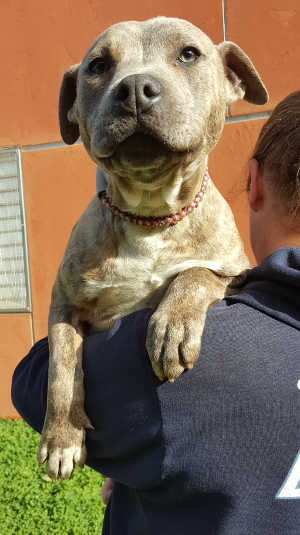
This male pit bull is in kennel No. 12, ID No. 7002. Photo courtesy of Lake County Animal Care and Control. Male pit bull
This male pit bull has a short brown brindle coat.
He already has been neutered.
He’s in kennel No. 12, ID No. 7002.
This male English Bulldog is in kennel No. 24a, ID No. 11481. Photo courtesy of Lake County Animal Care and Control. English Bulldog
This male English Bulldog has a short brindle coat.
He’s in kennel No. 24a, ID No. 11481.
“Hazel” is a female cane corso mastiff-pit bull terrier mix in kennel No. 30, ID No. 11439. Photo courtesy of Lake County Animal Care and Control. ‘Hazel’
“Hazel” Is a female cane corso mastiff-pit bull terrier mix.
She has a short blue coat.
She’s in kennel No. 30, ID No. 11439.
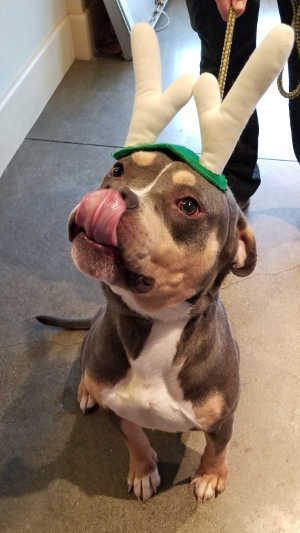
This male pit bull terrier is in kennel No. 33, ID No. 11345. Photo courtesy of Lake County Animal Care and Control. Male pit bull terrier
This male pit bull terrier has a short gray and brown coat.
He’s in kennel No. 33, ID No. 11345.
Lake County Animal Care and Control is located at 4949 Helbush in Lakeport, next to the Hill Road Correctional Facility.
Office hours are Monday through Friday, 11 a.m. to 5 p.m., and 11 a.m. to 3 p.m., Saturday. The shelter is open from 11 a.m. to 4 p.m. Monday through Friday and on Saturday from 11 a.m. to 3 p.m.
For more information call Lake County Animal Care and Control at 707-263-0278.
Email Elizabeth Larson at This email address is being protected from spambots. You need JavaScript enabled to view it.. Follow her on Twitter, @ERLarson, or Lake County News, @LakeCoNews.
NASA's Interior Exploration using Seismic Investigations, Geodesy and Heat Transport (InSight) lander, which touched down on Mars just 12 days ago, has provided the first ever "sounds" of Martian winds on the Red Planet.
InSight sensors captured a haunting low rumble caused by vibrations from the wind, estimated to be blowing between 10 to 15 mph (5 to 7 meters a second) on Dec. 1, from northwest to southeast. The winds were consistent with the direction of dust devil streaks in the landing area, which were observed from orbit.
"Capturing this audio was an unplanned treat," said Bruce Banerdt, InSight principal investigator at NASA's Jet Propulsion Laboratory (JPL) in Pasadena, California. "But one of the things our mission is dedicated to is measuring motion on Mars, and naturally that includes motion caused by sound waves."
Two very sensitive sensors on the spacecraft detected these wind vibrations: an air pressure sensor inside the lander and a seismometer sitting on the lander's deck, awaiting deployment by InSight’s robotic arm.
The two instruments recorded the wind noise in different ways. The air pressure sensor, part of the Auxiliary Payload Sensor Subsystem (APSS), which will collect meteorological data, recorded these air vibrations directly.
The seismometer recorded lander vibrations caused by the wind moving over the spacecraft's solar panels, which are each 7 feet (2.2 meters) in diameter and stick out from the sides of the lander like a giant pair of ears.
This is the only phase of the mission during which the seismometer, called the Seismic Experiment for Interior Structure (SEIS), will be capable of detecting vibrations generated directly by the lander.
In a few weeks, it will be placed on the Martian surface by InSight's robotic arm, then covered by a domed shield to protect it from wind and temperature changes. It still will detect the lander's movement, though channeled through the Martian surface.
For now, it’s recording vibrational data that scientists later will be able to use to cancel out noise from the lander when SEIS is on the surface, allowing them to detect better actual marsquakes.
When earthquakes occur on Earth, their vibrations, which bounce around inside our planet, make it “ring” similar to how a bell creates sound. InSight will see if tremors, or marsquakes, have a similar effect on Mars.
SEIS will detect these vibrations that will tell us about the Red Planet’s deep interior. Scientists hope this will lead to new information on the formation of the planets in our solar system, perhaps even of our own planet.
SEIS, provided by the French Space Agency CNES, includes two sets of seismometers. Those contributed by the French will be used once SEIS is deployed from the deck of the lander.
But SEIS also includes short period silicon sensors developed by Imperial College London with electronics from Oxford University in the United Kingdom. These sensors can work while on the deck of the lander and are capable of detecting vibrations up to frequencies of nearly 50 hertz, at the lower range of human hearing.
“The InSight lander acts like a giant ear,” said Tom Pike, InSight science team member and sensor designer at Imperial College London. "The solar panels on the lander's sides respond to pressure fluctuations of the wind. It's like InSight is cupping its ears and hearing the Mars wind beating on it. When we looked at the direction of the lander vibrations coming from the solar panels, it matches the expected wind direction at our landing site."
Pike compared the effect to a flag in the wind. As a flag breaks up the wind, it creates oscillations in air pressure that the human ear perceives as flapping. Separately, APSS records changes in pressure directly from the thin Martian air.
"That's literally what sound is – changes in air pressure," said Don Banfield InSight's science lead for APSS from Cornell University in Ithaca, New York. "You hear that whenever you speak to someone across the room."
Unlike the vibrations recorded by the short period sensors, audio from APSS is about 10 hertz, below the range of human hearing.
The raw audio sample from the seismometer was released unaltered; a second version was raised two octaves to be more perceptible to the human ear – especially when heard through laptop or mobile speakers. The second audio sample from APSS was sped up by a factor of 100, which shifted it up in frequency.
An even clearer sound from Mars is yet to come. In just a couple years, NASA's Mars 2020 rover is scheduled to land with two microphones on board. The first, provided by JPL, is included specifically to record, for the first time, the sound of a Mars landing. The second is part of the SuperCam and will be able to detect the sound of the instrument's laser as it zaps different materials. This will help identify these materials based on the change in sound frequency.
LAKEPORT, Calif. – A group of community members gathered on Friday morning in Lakeport’s Library Park to remember the attack on Pearl Harbor 77 years before, to honor those who died and those who survived and later made their homes in Lake County.
Clearlake Oaks residents Ronnie and Janeane Bogner hosted the event held at the Pearl Harbor Survivors Association memorial mast in Library Park.
The last local Pearl Harbor survivors – 93-year-old Bill Slater of Lakeport – died on Dec. 31, 2017.
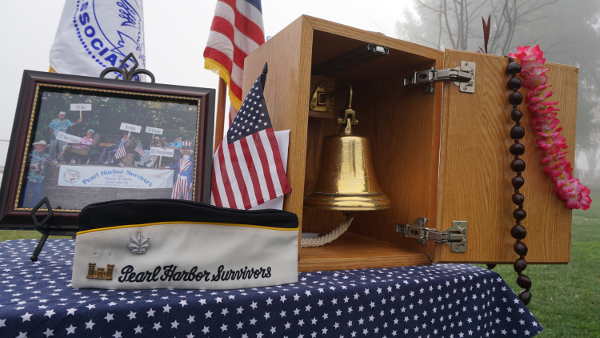
During the foggy Friday morning event, the events of the day were recounted, local survivors such as Slater, Henry Anderson, Clarence “Bud” Boner, Chuck Bower, Deam Darrow. Floyd Eddy, Jim Harris, Fred Leighton, Walter Urmann and dozens of others were remembered, and their names read, with a gold bell – on which all of their names are engraved – rung for each name.
The Lake County Military Funeral Honors Team also performed honors, including a gun volley and the playing of “Taps.”
Statewide, Dec. 7 was marked as Pearl Harbor Remembrance Day, according to a proclamation issued Friday by Gov. Jerry Brown.
See the local ceremony in the video above.
Email Elizabeth Larson at This email address is being protected from spambots. You need JavaScript enabled to view it.. Follow her on Twitter, @ERLarson, or Lake County News, @LakeCoNews.
Mementos from late Pearl Harbor survivors are shown here along with a bell with the names of Pearl Harbor survivors who had made Lake County, Calif., their home, which was rung for each of them during a ceremony on Friday, December 7, 2018. Photo by Elizabeth Larson/Lake County News.
LAKE COUNTY, Calif. – Recent rains and cooler temperatures across the region have lowered the threat of wildfires, allowing Cal Fire’s Sonoma Lake Napa Unit to transition out of peak fire season.
The transition takes effect at 10 a.m. Monday, Dec. 10, in Sonoma, Lake, Napa, Colusa, Yolo and Solano counties.
Due to drought like conditions that persisted throughout 2018 in California, Cal Fire continues to maintain staffing to meet any future threat, as well as having the ability to strategically move resources to areas that remain at a higher wildfire threat level.
Cal Fire officials said the agency will also continue to monitor weather conditions closely and will maintain the ability to increase staffing should the weather conditions change or if there is a need to support wildfires and or any other emergencies in other areas of the state.
During the cooler winter months, Cal Fire will continue to actively focus efforts on fire prevention and fuels treatment activities as guided by the State’s Strategic Fire Plan and localized Unit fire plans. These will be done through public education, prescribed burns and various types of fuel reduction. These activities are aimed at reducing the impacts of large, damaging wildfires and improving overall forest health.
Cal Fire said 2018 has been an extremely active fire year, even more so than in 2017. This year California has seen the deadliest, the most destructive, the largest wildfire and most acres burned throughout the state in California’s recorded history. The Mendocino Complex, which burned mostly in Lake County, charred more than 450,000 acres to make it the largest wildland fire in state history.
Statewide, Cal Fire and firefighters from many local agencies battled more than 6,228 wildfires within the State Responsibility Area that burned over 876,225 acres. This is over 650 more wildfires this year than normal.
In the Sonoma Lake Napa Unit, Cal Fire responded to 463 wildfires that charred 111,995 acres. Cal Fire said that does not count acreage that burned on federal lands; a large portion of the Mendocino Complex acreage was in the Mendocino National Forest.
Residents are urged to still take precautions outdoors in order to prevent sparking a wildfire. A leading cause of wildfires this time of year is from escaped debris burning.
Before you burn, ensure it’s a permissive burn day by contacting your local air quality district and then make sure you have any and all required burn permits.
During burning make sure that piles of debris are no larger than four feet in diameter, provide a 10-foot clearance down to bare mineral soil around the burn pile and that a responsible adult is in attendance at all times with a water source and a shovel.
NORTH COAST, Calif. – This week, Assemblymember Cecilia Aguiar-Curry (D-Winters) and several of her Assembly colleagues introduced ACA 1, a constitutional amendment which would give local governments improved options for funding critical infrastructure projects, including broadband expansion, local roads, and affordable housing projects.
This bill is important, because it will empower local communities to address local priorities without needing to rely on state and federal funding initiatives.
ACA 1 would reduce the local vote threshold for approval of bond and special tax measures from a two-thirds vote to a 55 percent majority.
This is the same vote threshold that currently applies to all local school district measures. By making this change, ACA 1 puts housing and infrastructure projects on par with school proposals, so that cities, counties, and special districts have a practical financing tool to address community needs.
“As a former mayor of Winters and board member of regional water, housing, and transportation agencies, I have seen first-hand the deterioration of our once world-class infrastructure,” said Aguiar-Curry. “That is why I introduced ACA 1 on the first day of the legislative session. This proposal will empower California communities to take action at the local level to improve their economies, neighborhoods, and residents’ quality of life. Plus, with discussions underway in Washington D.C. about a federal infrastructure initiative, ACA 1 will give California’s local governments another tool to provide matching-dollars for federal grants to fully take advantage of new funding streams.”
In practice, local officials propose a local bond or special tax, and then the voters in that community decide whether they support the idea or not.
The voters would still need to overwhelmingly – with 55 percent of the vote – support a bond or special tax in order for it to be approved. Local officials will still control which priorities they recommend to voters, and local voters will still control how and where their infrastructure bond or tax dollars would be spent.
“Local communities deserve a fair chance at making sure that their residents can afford to pay the rent or buy a home,” said Assemblymember David Chiu (D-San Francisco), coauthor of ACA 1 and Chair of the Assembly Housing and Community Development Committee. “California’s housing affordability crisis requires real investment across the entire state, and I applaud Assemblymember Aguiar-Curry for helping us get there.”
“Local voices are central to the conversation about what investments are necessary to support local businesses and improve residents’ quality of life,” said Aguiar-Curry. “Our city councilmembers, county supervisors, and special district representatives are elected to advance our cities, counties, towns, and neighborhoods. There’s no greater impact they can have than targeting public investments to where people need them most. It’s time our constitution allowed them greater ability to do that.”
For every dollar spent on infrastructure, there is a return benefit of several dollars back to our economy from the related construction jobs and activities.
These critical projects include fixing streets and roads, constructing public safety facilities for police and fire departments, upgrading water and flood control systems, deploying broadband for internet connectivity, and maintaining parks.
Not only do these construction and maintenance efforts improve communities and residents’ quality of life, they also create new local jobs.
“We need a renewed effort at every level of government to support our economy with modern, safe infrastructure. ACA 1 will empower local officials to ask their voters to approve their vision for how and when to invest in these projects,” said Aguiar-Curry. “Local communities know their priorities best. This constitutional amendment will offer an improved tool for local leaders to prioritize projects and determine how to best pay for them.”
Since 2001, over 2,200 local revenue measures have been placed before voters. Nearly 80 percent of all two-thirds supermajority measures garnered more than 55 percent “yes” votes, but ultimately failed passage because they fell slightly short of the current two-thirds vote threshold.
If this amendment became law, those measures would have passed. Because this measure would change the Constitution, the proposal would need to be placed on the ballot for approval in the next statewide election, should the Legislature pass it.
ACA 1 is coauthored by Assemblymembers Chiu, Eggman, Eduardo Garcia, Gloria, McCarty, Mullin, Santiago, and Ting. The bill will be heard in its first policy committee hearing in early 2019.
Aguiar-Curry represents the Fourth Assembly District, which includes all of Lake and Napa Counties, all of Yolo County except West Sacramento, and parts of Colusa County, Solano County and Sonoma County. Visit her Web site at www.asm.ca.gov/aguiar-curry.
 How to resolve AdBlock issue?