 How to resolve AdBlock issue?
News
For the second time in history, a human-made object has reached the space between the stars. NASA’s Voyager 2 probe now has exited the heliosphere – the protective bubble of particles and magnetic fields created by the Sun.
Comparing data from different instruments aboard the trailblazing spacecraft, mission scientists determined the probe crossed the outer edge of the heliosphere on Nov. 5.
This boundary, called the heliopause, is where the tenuous, hot solar wind meets the cold, dense interstellar medium. Its twin, Voyager 1, crossed this boundary in 2012, but Voyager 2 carries a working instrument that will provide first-of-its-kind observations of the nature of this gateway into interstellar space.
Voyager 2 now is slightly more than 11 billion miles (18 billion kilometers) from Earth. Mission operators still can communicate with Voyager 2 as it enters this new phase of its journey, but information – moving at the speed of light – takes about 16.5 hours to travel from the spacecraft to Earth. By comparison, light traveling from the Sun takes about eight minutes to reach Earth.
The most compelling evidence of Voyager 2’s exit from the heliosphere came from its onboard Plasma Science Experiment, or PLS, an instrument that stopped working on Voyager 1 in 1980, long before that probe crossed the heliopause.
Until recently, the space surrounding Voyager 2 was filled predominantly with plasma flowing out from our Sun. This outflow, called the solar wind, creates a bubble – the heliosphere – that envelopes the planets in our solar system.
The PLS uses the electrical current of the plasma to detect the speed, density, temperature, pressure and flux of the solar wind.
The PLS aboard Voyager 2 observed a steep decline in the speed of the solar wind particles on Nov. 5. Since that date, the plasma instrument has observed no solar wind flow in the environment around Voyager 2, which makes mission scientists confident the probe has left the heliosphere.
In addition to the plasma data, Voyager’s science team members have seen evidence from three other onboard instruments – the cosmic ray subsystem, the low energy charged particle instrument and the magnetometer – that is consistent with the conclusion that Voyager 2 has crossed the heliopause.
Voyager’s team members are eager to continue to study the data from these other onboard instruments to get a clearer picture of the environment through which Voyager 2 is traveling.
“There is still a lot to learn about the region of interstellar space immediately beyond the heliopause,” said Ed Stone, Voyager project scientist based at Caltech in Pasadena, California.
Together, the two Voyagers provide a detailed glimpse of how our heliosphere interacts with the constant interstellar wind flowing from beyond. Their observations complement data from NASA’s Interstellar Boundary Explorer, a mission that is remotely sensing that boundary. NASA also is preparing an additional mission – the upcoming Interstellar Mapping and Acceleration Probe, due to launch in 2024 – to capitalize on the Voyagers’ observations.
“Voyager has a very special place for us in our heliophysics fleet,” said Nicola Fox, director of the Heliophysics Division at NASA Headquarters. “Our studies start at the Sun and extend out to everything the solar wind touches. To have the Voyagers sending back information about the edge of the Sun’s influence gives us an unprecedented glimpse of truly uncharted territory.”
While the probes have left the heliosphere, Voyager 1 and Voyager 2 have not yet left the solar system, and won’t be leaving anytime soon.
The boundary of the solar system is considered to be beyond the outer edge of the Oort Cloud, a collection of small objects that are still under the influence of the Sun’s gravity.
The width of the Oort Cloud is not known precisely, but it is estimated to begin at about 1,000 astronomical units, or AU, from the Sun and to extend to about 100,000 AU. One AU is the distance from the Sun to Earth.
It will take about 300 years for Voyager 2 to reach the inner edge of the Oort Cloud and possibly 30,000 years to fly beyond it.
The Voyager probes are powered using heat from the decay of radioactive material, contained in a device called a radioisotope thermal generator, or RTG. The power output of the RTGs diminishes by about four watts per year, which means that various parts of the Voyagers, including the cameras on both spacecraft, have been turned off over time to manage power.
“I think we’re all happy and relieved that the Voyager probes have both operated long enough to make it past this milestone,” said Suzanne Dodd, Voyager project manager at NASA’s Jet Propulsion Laboratory in Pasadena, California. “This is what we've all been waiting for. Now we’re looking forward to what we’ll be able to learn from having both probes outside the heliopause.”
Voyager 2 launched in 1977, 16 days before Voyager 1, and both have traveled well beyond their original destinations. The spacecraft were built to last five years and conduct close-up studies of Jupiter and Saturn.
However, as the mission continued, additional flybys of the two outermost giant planets, Uranus and Neptune, proved possible.
As the spacecraft flew across the solar system, remote-control reprogramming was used to endow the Voyagers with greater capabilities than they possessed when they left Earth.
Their two-planet mission became a four-planet mission. Their five-year lifespans have stretched to 41 years, making Voyager 2 NASA’s longest running mission.
The Voyager story has impacted not only generations of current and future scientists and engineers, but also Earth's culture, including film, art and music. Each spacecraft carries a Golden Record of Earth sounds, pictures and messages. Since the spacecraft could last billions of years, these circular time capsules could one day be the only traces of human civilization.
Voyager’s mission controllers communicate with the probes using NASA’s Deep Space Network, or DSN, a global system for communicating with interplanetary spacecraft. The DSN consists of three clusters of antennas in Goldstone, California; Madrid, Spain; and Canberra, Australia.
The Voyager Interstellar Mission is a part of NASA’s Heliophysics System Observatory, sponsored by the Heliophysics Division of NASA’s Science Mission Directorate in Washington. JPL built and operates the twin Voyager spacecraft.
NASA’s DSN, managed by JPL, is an international network of antennas that supports interplanetary spacecraft missions and radio and radar astronomy observations for the exploration of the solar system and the universe. The network also supports selected Earth-orbiting missions.
The Commonwealth Scientific and Industrial Research Organisation, Australia’s national science agency, operates both the Canberra Deep Space Communication Complex, part of the DSN, and the Parkes Observatory, which NASA has been using to downlink data from Voyager 2 since Nov. 8.
For more information about the Voyager mission, visit https://www.nasa.gov/voyager. More information about NASA’s Heliophysics missions is available online at https://www.nasa.gov/sunearth.

CLEARLAKE, Calif. – On Thursday night council the Clearlake City Council bid farewell to one of its members, two council members took their oaths and the mayor and vice mayor were chosen for 2019.
At the start of the meeting, the council honored outgoing Mayor Bruno Sabatier.
Sabatier, now at the end of his first term, leaves the council to take a seat on the Board of Supervisors as the District 2 representative. He will succeed longtime Supervisor Jeff Smith.
Sabatier’s vice mayor, Phil Harris, and City Manager Greg Folsom lauded Sabatier for his work on the council and presented him with a plaque.
He thanked the community for giving him the opportunity to serve on the council.
“This has been the best experience I’ve ever had in my life,” said Sabatier.
He thanked each of the council members individually for their help, from Joyce Overton’s mentoring and assistance in creating the Power to the Youth event, Nick Bennett’s kindness and welcoming spirit, Harris’ leadership and friendship, and Cremer’s willingness to work together and share a different perspective in a friendly way.
“I think that you’re a perfect replacement,” he told Dirk Slooten, who along with Cremer was elected to the council last month.
Sabatier returned to the dais briefly for some final business, including the swearing-in of new police personnel.
Then City Clerk Melissa Swanson presented a resolution accepting the official canvass results that certify the election results, which the council approved.
Swanson then administered the oath of office to Cremer and Slooten.
Cremer was appointed earlier this year to fill a vacancy on the council that resulted from the resignation of Russell Perdock. He ran successfully to keep his seat.
Slooten, a native of the Netherlands, retired businessman and a longtime city planning commissioner, is, like Cremer, active in the Clearlake Rotary Club. He was the top vote getter in the November election.
As Rotarians, both Cremer and Slooten have been active in raising funds for fire recovery.
After the two men took their oaths, Sabatier stepped down from the dais and Cremer and Slooten took their seats.
During the course of two-hour meeting, the council held two public hearings on commercial cannabis operations, picked a city photo contest winner, discussed an automated license plate recognition program and a contract for a transportation improvement program study.

The council also held the first reading of an ordinance to amend the Clearlake Municipal Code regarding sidewalk vendors and door-to-door sales and city code regulating itinerant businesses, and approved an amendment to the contract with Foster Morrison to add the Lake County Fire Protection District to the Clearlake Local Hazard Mitigation Plan and the fourth amendment to the employment services agreement for City Manager Greg Folsom.
At the end of the meeting, when it came time to choose the coming year’s leadership, Slooten moved to appoint Bennett as mayor and Cremer as vice mayor.
Harris, who chaired the meeting following Sabatier’s departure, seconded the motion, which was approved unanimously.
The terms of the mayor and vice mayor are for a 12-month period commencing on Jan. 1, unless otherwise decided by a majority of the council.
As the meeting drew to a close, Folsom thanked the council and staff for a great year.
“I think we got a lot accomplished this year,” said Folsom. “We’re really proud of everything that we’ve done. I think that we’ve really made a difference in the way that clearlake’s going and the way that Clearlake's being perceived throughout the county.”
He also thanked Sabatier again for what he had done for the city.
Bennett said Sabatier had set a high mark. “I will try to reach it.”
He also offered praise for city staff and fellow council members and how they work together in their efforts to improve the community.
“We are really blessed with what we have here,” Bennett said.
Folsom said later, “During my career in Clearlake I’ve had the good fortune and great privilege of working with excellent council members who take their responsibilities seriously and who have a unified vision of improving this city. Bruno Sabatier, Russ Perdock and Denise Loustalot have all been great to work with as mayors and I’m looking forward to working with our next mayor, Nick Bennett, next vice mayor, Russ Cremer, and the rest of the council in continuing the momentum that we have built in improving the city of Clearlake.”
Email Elizabeth Larson at
.
.
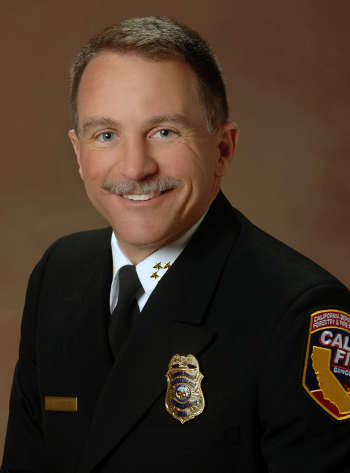
Cal Fire announced on Friday that its director is stepping down.
Chief Ken Pimlott announced his retirement, effective Dec. 14.
Chief Pimlott was appointed to director on July 12, 2011, by Gov. Edmund G. Brown Jr. after serving as the acting director since November 2010.
Chief Pimlott has 30 years of fire service experience with Cal Fire. He began his career at age 17 as a reserve firefighter in Contra Costa County.
Prior to being appointed to director, Chief Pimlott was the deputy director of fire protection, responsible for Cal Fire's Statewide Fire Protection Programs.
The agency reported that Chief Pimlott brought extensive knowledge and experience, as well as exceptional leadership to the department during his tenure.
“While serving as director, Chief Pimlott accomplished a long list of achievements that will set the stage for Cal Fire moving forward,” said Acting Director Chief Thom Porter. “For all that Chief Pimlott has accomplished, we are thankful for his service to Cal Fire and to the citizens of California.”
Chief Thom Porter has been announced as acting director on the heels of Chief Pimlott’s retirement.
Chief Porter is currently serving as chief of strategic planning. He was appointed Southern Region Chief on June 1, 2015, by Chief Pimlott. He began his career with Cal Fire in 1999, as a Forester I in the Forestry Assistance Program at the Southern Operations Center.
In 2001, he transferred to the San Diego Unit where he worked as the Urban and Community Forestry and then Unit Forester, responsible for the unit vegetation management and pre-fire programs. Chief Porter promoted to Forester II in 2002, leading the multi-agency collaborative Forest Area Safety Taskforce and Border Area Fire Council.
Chief Porter promoted to Forestry and Fire Protection Administrator in 2008, and was assigned to the Southern Operations Center in Riverside, where he coordinated the regional delivery of the department's Resource Management Programs, including fuels management grant programs.
In 2012, he promoted to unit chief of the San Diego Unit, where he was also the county fire authority fire chief. Chief Porter promoted to assistant region chief for the Southern Region on Dec. 1, 2013.
Prior to his Cal Fire career, Chief Porter worked as a forester in the timber industry in Washington, Oregon and California, developing timber harvesting plans, including planning and directing prescribed burning and company safety programs in all three states.
He holds a bachelor’s degree in forest management from the University of California Berkeley and is a Registered Professional Forester.
California Insurance Commissioner Dave Jones this week announced the results of claims data collected by the Department of Insurance from insurers processing fire related insurance claims for tens of thousands of policyholders.
While the numbers are expected to climb, as more claims are filed and processed, the preliminary claims data reflects $9.05 billion in actual losses for commercial and residential coverage, personal and commercial vehicles, and agricultural and other coverages.
"The devastating wildfires of 2018 were the deadliest and costliest wildfire catastrophes in California's history," said Insurance Commissioner Dave Jones. "The tragic deaths of 88 people and over $9 billion in insured losses to date are shocking numbers-behind the insured loss numbers are thousands of people who've been traumatized by unfathomable loss."
The announcement reflects the actual insured losses reported by insurers to date. The department will update loss figures in the coming months as insurers report more data. It is anticipated that, as both insurers and policyholders continue to access burn areas and claims are amended, insured losses will rise.
Commissioner Jones visited towns and neighborhoods burned by the wildfires and took immediate action to assist wildfire survivors by dispatching his consumer services team to every local assistance center to personally meet with consumers and help them begin the claims process and answer questions about department resources.
Jones also issued a formal notice to insurers asking them to expedite claims, by cutting through red tape, issuing checks immediately for four months of out of pocket costs, and doing all they can do to help policyholders who are likely to have little or no documentation that insurers normally require.
Jones also issued a declaration of an emergency, which allows the insurers to tap out-of-state claims adjusters from their other offices to deal with the huge volume of claims. This is an important step in increasing the claims processing capacity for insurers and helping speed the recovery and rebuilding process.
At the same time, Jones issued a formal notice to insurers that they are responsible for making sure out of state staff are trained in California's stronger consumer protection laws.
Jones deployed detectives from the Department of Insurance to the burned communities to deter scam artists who prey on vulnerable fire survivors. Jones also issued an important caution for wildfire survivors.
Be careful to check the license of contractors who solicit your business-this is done quickly on the Contractors State License Board using a smart device.
Jones also noted that public adjusters are restricted from soliciting business from residents until seven days after evacuation orders are lifted.
Consumers that have any questions or difficulty with their insurer should contact the department's consumer services team at 800-927-4357 or at the Local Assistance Centers.
In the wake of the 2017 fires, the Department was able to obtain over $52 million for fire survivors in addition to amounts the insurers were already paying for claims.
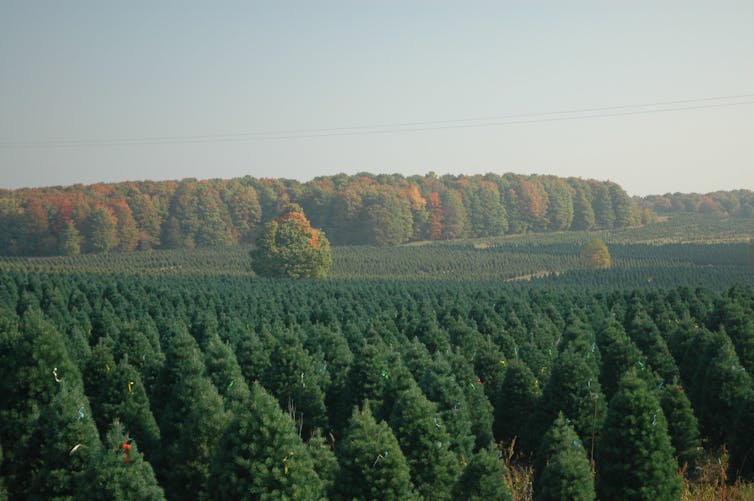 Scotch pines on a Christmas tree farm in northern Michigan. Bert Cregg, CC BY-ND
Environmentally conscious consumers often ask me whether a real Christmas tree or an artificial one is the more sustainable choice. As a horticulture and forestry researcher, I know this question is also a concern for the Christmas tree industry, which is wary of losing market share to artificial trees.
And they have good reason: Of the 48.5 million Christmas trees Americans purchased in 2017, 45 percent were artificial, and that share is growing. Many factors can influence this choice, but the bottom line is that both real and artificial Christmas trees have negligible environmental impacts. Which option “wins” in terms of carbon footprint depends entirely on assumptions about how long consumers would keep an artificial tree versus how far they would drive each year to purchase a real tree.
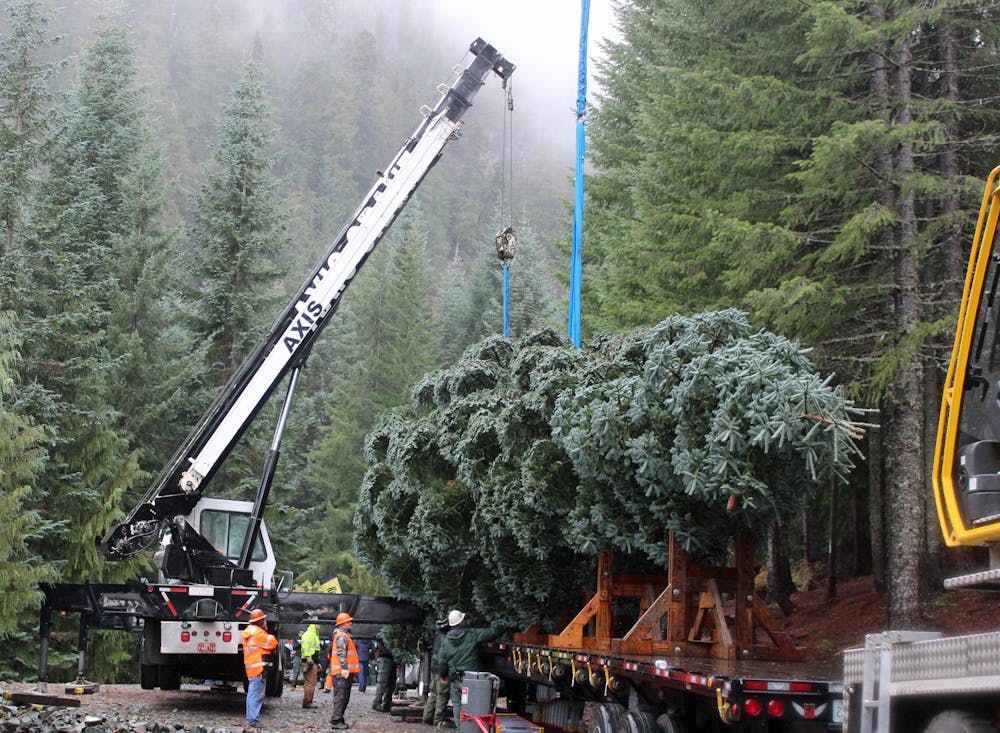
From seedling to wood chipper
Many consumers believe real Christmas trees are harvested from wild forest stands and that this process contributes to deforestation. In fact, the vast majority of Christmas trees are grown on farms for that express purpose.
To estimate the total impact of something like a Christmas tree, researchers use a method called life cycle assessment to develop a “cradle to grave” accounting of inputs and outputs required to produce, use and dispose of it. For natural Christmas trees, this covers everything from planting seedlings to harvesting the trees and disposing of them, including equipment use, fertilizer and pesticide applications, and water consumption for irrigation.
Life cycle assessments often will also estimate a system’s carbon footprint. Fuel use is the biggest source of greenhouse gas emissions in Christmas tree production. Using 1 gallon of gas or diesel to power a tractor or delivery truck releases 20 to 22 pounds (9 to 10 kilograms) of carbon dioxide into the atmosphere.
On the positive side, Christmas trees absorb and store carbon from the atmosphere as they grow, which helps to offset emissions from operations. Carbon represents about 50 percent of the dry weight of the wood in a tree at harvest. According to recent estimates, Christmas tree-sized conifers store roughly 20 pounds of carbon dioxide in their above-ground tissue and likely store similar amounts below ground in their roots.
However, using 1 gallon of gasoline produces about the same amount of carbon dioxide, so if a family drives 10 miles each way to get their real tree, they likely have already offset the carbon sequestered by the tree. Buying a tree closer to home or at a tree lot along your daily commute can reduce or eliminate this impact.
And natural trees have other impacts. In 2009, Scientific American specifically called out the Christmas tree industry for greenwashing, because growers’ press releases touted carbon uptake from Christmas tree plantations while ignoring pesticide use and carbon dioxide emissions from plantation management, harvesting and shipping.
Is synthetic better?
Artificial trees have a different set of impacts. Although many people think shipping trees from factories in China takes a lot of energy, ocean shipping is actually very efficient. The largest energy use in artificial trees is in manufacturing.
Producing the polyvinyl chloride and metals that are used to make artificial trees generates greenhouse gas emissions and other pollutants. China is working to reduce pollution from its chemical industry, but this may drive up the prices of those materials and the goods made from them.
Moreover, to consider sustainability from a broader perspective, production of real Christmas trees supports local communities and economies in the United States, whereas purchasing artificial trees principally supports manufacturers in China.

Going head to head
Recently the American Christmas Tree Association, which represents artificial tree manufacturers, commissioned a life cycle assessment comparing real and artificial Christmas trees. The analysis considered environmental aspects of sustainability, but did not examine social or economic impacts.
The report concluded that the environmental ‘break-even’ point between a real Christmas tree and an artificial tree was 4.7 years. In other words, consumers would need to keep artificial trees for five years to offset the environmental impact of purchasing a real tree each year.
One major shortcoming of this analysis was that it ignored the contribution of tree roots – which farmers typically leave in the ground after harvest – to soil carbon storage. This omission could have a significant impact on the break-even analysis, given that increasing soil organic matter by just one percent can sequester 11,600 pounds of carbon per acre.
Reuse or recycle your tree
Consumers can’t affect how farmers grow their live trees or how manufacturers produce artificial versions, but they can control what happens after Christmas to the trees they purchase. For artificial trees, that means reusing them as many times as possible. For natural trees, it means recycling them.
This is essential to optimize the carbon footprint of a real tree. Grinding used Christmas trees and using them for mulch returns organic matter to the soil, and can contribute to building soil carbon. Many public works departments across the United States routinely collect and chip used Christmas trees after the holidays. If local tree recycling is not available, trees can be chipped and added to compost piles. They also can be placed in backyards or ponds to provide bird or fish habitat.
In contrast, if a used tree is tossed into a bonfire, all of its carbon content is immediately returned to the air as carbon dioxide. This also applies to culled trees on tree farms. And if used trees are placed in landfills, their carbon content will ultimately return to atmosphere as methane because of the way materials buried in landfills break down. Methane is a greenhouse gas 21 times more potent than carbon dioxide over a century, so this is the most environmentally harmful way to dispose of a used tree.
All kinds of factors influence choices about Christmas trees, from fresh trees’ scent to family traditions, travel plans and the desire to support farmers or buy locally. Regardless of your choice, the key to relieving environmental angst is planning to reuse or recycle your tree. Then you can focus on gifts to put under it.
Bert Cregg, Professor of Horticulture and Forestry, Michigan State University
This article is republished from The Conversation under a Creative Commons license. Read the original article.
Recently analyzed data from NASA’s Origins, Spectral Interpretation, Resource Identification, Security-Regolith Explorer, or OSIRIS-REx, mission has revealed water locked inside the clays that make up its scientific target, the asteroid Bennu.
During the mission’s approach phase, between mid-August and early December, the spacecraft traveled 1.4 million miles (2.2 million km) on its journey from Earth to arrive at a location 12 miles (19 km) from Bennu on Dec. 3.
During this time, the science team on Earth aimed three of the spacecraft’s instruments towards Bennu and began making the mission’s first scientific observations of the asteroid. OSIRIS-REx is NASA’s first asteroid sample return mission.
Data obtained from the spacecraft’s two spectrometers, the OSIRIS-REx Visible and Infrared Spectrometer, or OVIRS, and the OSIRIS-REx Thermal Emission Spectrometer, reveal the presence of molecules that contain oxygen and hydrogen atoms bonded together, known as “hydroxyls.”
The team suspects that these hydroxyl groups exist globally across the asteroid in water-bearing clay minerals, meaning that at some point, Bennu’s rocky material interacted with water. While Bennu itself is too small to have ever hosted liquid water, the finding does indicate that liquid water was present at some time on Bennu’s parent body, a much larger asteroid.
“The presence of hydrated minerals across the asteroid confirms that Bennu, a remnant from early in the formation of the solar system, is an excellent specimen for the OSIRIS-REx mission to study the composition of primitive volatiles and organics,” said Amy Simon, OVIRS deputy instrument scientist at NASA’s Goddard Space Flight Center in Greenbelt, Maryland. “When samples of this material are returned by the mission to Earth in 2023, scientists will receive a treasure trove of new information about the history and evolution of our solar system.”
Additionally, data obtained from the OSIRIS-REx Camera Suite, or OCAMS, corroborate ground-based telescopic observations of Bennu and confirm the original model developed in 2013 by OSIRIS-REx Science Team Chief Michael Nolan and collaborators. That model closely predicted the asteroid’s actual shape, with Bennu’s diameter, rotation rate, inclination, and overall shape presented almost exactly as projected.
One outlier from the predicted shape model is the size of the large boulder near Bennu’s south pole. The ground-based shape model calculated this boulder to be at least 33 feet (10 meters) in height. Preliminary calculations from OCAMS observations show that the boulder is closer to 164 feet (50 meters) in height, with a width of approximately 180 feet (55 meters).
Bennu’s surface material is a mix of very rocky, boulder-filled regions and a few relatively smooth regions that lack boulders. However, the quantity of boulders on the surface is higher than expected. The team will make further observations at closer ranges to more accurately assess where a sample can be taken on Bennu to later be returned to Earth.
“Our initial data show that the team picked the right asteroid as the target of the OSIRIS-REx mission. We have not discovered any insurmountable issues at Bennu so far,” said Dante Lauretta, OSIRIS-REx principal investigator at the University of Arizona, Tucson. “The spacecraft is healthy and the science instruments are working better than required. It is time now for our adventure to begin.”
The mission currently is performing a preliminary survey of the asteroid, flying the spacecraft in passes over Bennu’s north pole, equator, and south pole at ranges as close as 4.4 miles (7 km) to better determine the asteroid’s mass.
The mission’s scientists and engineers must know the mass of the asteroid in order to design the spacecraft’s insertion into orbit because mass affects the asteroid’s gravitational pull on the spacecraft. Knowing Bennu’s mass will also help the science team understand the asteroid’s structure and composition.
This survey also provides the first opportunity for the OSIRIS-REx Laser Altimeter (OLA), an instrument contributed by the Canadian Space Agency, to make observations, now that the spacecraft is in proximity to Bennu.
The spacecraft’s first orbital insertion is scheduled for Dec. 31, and OSIRIS-REx will remain in orbit until mid-February 2019, when it exits to initiate another series of flybys for the next survey phase. During the first orbital phase, the spacecraft will orbit the asteroid at a range of 0.9 miles (1.4 km) to 1.24 miles (2.0 km) from the center of Bennu — setting new records for the smallest body ever orbited by a spacecraft and the closest orbit of a planetary body by any spacecraft.
For more information about OSIRIS-REx, visit https://www.nasa.gov/osiris-rex.