 How to resolve AdBlock issue?
News
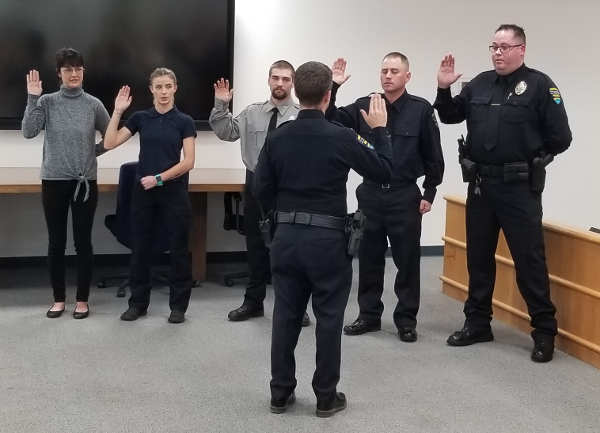
CLEARLAKE, Calif. – At the Clearlake City Council meeting on Thursday, Dec. 13, in front of a large crowd, Police Chief Andrew White swore in four new employees and one newly promoted employee.
For many years the Clearlake Police Department has operated with just one lieutenant.
Chief White is beginning to reorganize the police department with one of the first steps being the promotion of Sgt. Tim Hobbs to lieutenant.
Among his new duties, Lt. Hobbs will be responsible for support services, including Code Enforcement and Animal Control.
In addition to swearing in Lieutenant Hobbs, Robert West was sworn in as a police officer, Garrett Copas was sworn in as a Code Enforcement officer, Sabrinna LaCoy was sworn in as a police dispatcher and Charmaine Weldon was sworn in as a kennel technician.
“This is a very important day for the Clearlake Police Department as we are adding officers and employees at all levels within the police department,” said Chief White.
On Friday White also administered the oath to Steven Diaz, a new police officer, at his police academy graduation.
With the addition of Diaz, “We will be up to fully budgeted staffing in all areas of the police department for the first time in quite a while,” White said.
“This is a very exciting way to finish out the calendar year for the city of Clearlake. Congratulations to Lt. Hobbs for promoting into this important command staff position,” said City Manager Greg Folsom.
“We continue to add quality personnel throughout our police department and we are pleased to have Officer West, Dispatcher LaCoy, Code Enforcement Officer Copas and Kennel Technician Weldon join our Clearlake team. With the addition of these new staff members we will be working hard in 2019 to make Clearlake a cleaner, safer city,” Folsom said.

LAKEPORT, Calif. – The new “Country Air” quilt block has been added to the Lake County Quilt Trail.
It was installed on the Country Air Properties office building at 460 S. Main St. in Lakeport.
Country Air Properties was founded in 1980 and has been serving Lake County's real estate needs ever since. Phil Smoley is owner/broker of Country Air Properties. To learn more about Country Air Properties go to www.countryair.com.
The Lake County Quilt Trail is an agricultural and tourism project designed to promote community pride.
The 4-foot by 4-foot quilt block was drawn and painted by the Lake County Quilt Trail team, a group of dedicated volunteer quilters, graphic artists, painters, writers and carpenters.
For more information about the Lake County Quilt Trail visit its Web site or Facebook page.
UPPER LAKE, Calif. – A student seriously injured in a car wreck earlier this year had the chance to return to his school for a visit earlier this month.
Kellen Smith has been fighting for months to recover from his injuries, which include severe brain trauma.
On that journey, he’s had the love and support of his family – parents Mike and Shannon Smith, and sister Annalise – and friends across the county and beyond.
So it was a big, heartwarming surprise when he returned to visit his friends at Upper Lake High School on Friday, Dec. 7, for the first time after three and a half months.
“It’s been a rough go,” but the love, support and positive messages have made a huge difference, Mike Smith told the students that day.
His mother said his prognosis for a full recovery is good, and the work is continuing.
In the video above, Kellen and his family speak about his road to recovery and he visits with his school friends.
Email Elizabeth Larson at
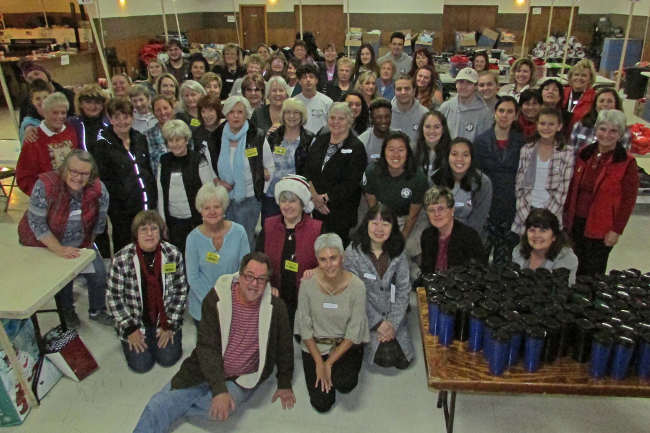
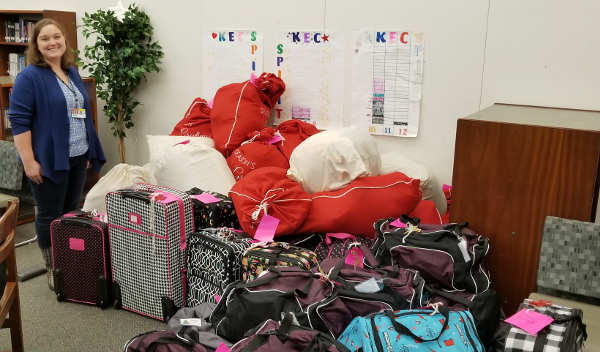
LAKE COUNTY, Calif. – Totes4Teens delivered holiday Totes for Lake County teens to various agencies and high schools on Nov. 27.
The deliveries made 146 teens very happy for this holiday season. As a recipient student from a Totes4Teens local continuation high school said, “No one has ever done such a nice thing for me in my life.”
Totes4Teens is an all-volunteer organization that serves more than 130 teens each year with holiday gifts sent in a duffel bag or suitcase and Santa bag.
The group works with Lake County’s Child Protective Services director and local continuation high school principals to identify teens with the greatest needs.
The totes are actually a large duffel bag (or suitcase) and Santa utility bag filled with essential items for teens in need throughout Lake County.
The essential items consist of warm clothing like a coat or jacket, scarves and hats, socks, T-shirts and pajamas.
Totes4Teens volunteers personally make most of the hats and scarves. The duffel bag is filled to capacity with school supplies, toiletries in a zippered bag, soap wrapped in a hand knit wash cloth, filled Christmas stocking, a gift each for an adult female and an adult male, large insulated lunch box and hot and cold tumblers, pre-stamped cards for conventional mailing and more.
The Santa bag includes a size-appropriate sleeping bag, fleece blanket (made by Soroptimists of Clearlake), pillow with unique custom-made pillowcases, sports balls and bath towel.
Although 146 teens received these Totes, many more are left out due to lack of funds and capacity.
Totes4Teens raises funds strictly within Lake County from individuals and businesses. Volunteers shop for bargains throughout the year, but the best deals can usually be found right after Christmas, so funds are needed in December to support purchasing activity for the next year.
The goal is to buy new and best quality available within the budget. Volunteers from AmeriCorps this year said they were impressed with the quality of all the items accumulated.
Since 2005, Totes4Teens has donated to 1,949 teens. The community’s support is most appreciated, not only by members of the team but by the many teens who are so thankful to know their community cares about them.
For more information, please visit www.totes4teens.org.
The only ones who hate rainy, cold weather more than children who have to stay indoors, cooped up, are their parents who have to endure that caged energy.
It’s even worse for teachers, who don’t even have the benefit of parental love and affection to mitigate their frustration at the frenzied little monsters, who unaccountably possess their classrooms on dark winter days.
Adversity, they say, is the mother of invention.
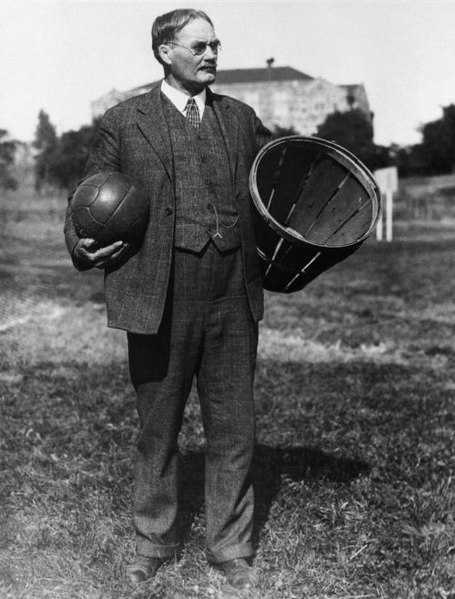
That certainly was the case during a cold December in 1891 Massachusetts, when James Naismith, a physical educator at the YMCA’s School for Christian Workers in Springfield, faced down a room of energetic youth.
It was snowing outside – hard. There was no way he was going to able to get his students to release their energy in the usual manner – you know, running long distances and other devices of torture that remain the object of pain in P.E. classes to this day.
The director of the physical education department tasked Naismith with the job of coming up with a game that the young boys could play indoors. Something that included plenty of running, of course, and good competition. Naismith had two weeks before presenting a polished final product.
Naismith himself had come from McGill University only recently, having left the Canadian college as the athletics director. The YMCA offered him a wider reach, since the youth organization had a national and, increasingly, international, reach. Hoping to impress his new employer, Naismith went right to work on his new task.
He tinkered with a few different ideas for several days before he remembered a game from his childhood. “Duck on a Rock,” was a game that included one of the most cherished activities of any young boy: throwing rocks.
In this game, the object was to knock a large rock from off the other team’s boulder before they did the same to yours. With a stone in hand, the boys would run around, passing the rock from one teammate to the other, before getting close enough to the opponents’ side to throw it and – ping! – knock off the opponents’ big rock. Simple, destructive and competitive – perfect.
Of course, Naismith couldn’t have his boys throwing rocks around inside the gymnasium, so he made some adjustments.
Naismith had the school custodian nail two peach baskets to the railing of a 10-foot-high balcony that ran around the school gymnasium. Since his class had 18 students, he divided them up into two teams of nine and explained to the players that they would score points by throwing the soccer ball into the opposing team’s basket.
“The first words were not very encouraging,” remembered Naismith years later, “when one of the class made the remark, ‘Humph, a new game.’ I asked the boys to tri it once as a favor to me. They started, and after the ball was first thrown up there was no need for further coaxing.”
The game was an instant favorite. Now it needed a name. One of the students suggested “Naismithball” as an option but, thankfully, that was voted down in favor of “basketball.”
Over the next decade or so, some things were refined in the new sport. For instance, in the first edition, the baskets didn’t have holes in them, so each time a team scored a point, they’d have to climb up and retrieve their ball.
Naismith wrote a rulebook on his new sport and the YMCA began marketing the game across the country to all of its branch locations. Shortly thereafter, they presented the game internationally in 1904 when they presented the game as a demonstration sport during the Summer Olympics in St. Louis.
By then James Naismith had moved on from the YMCA. More interested in physical education, Naismith went back to school and in 1898 earned a medical degree.
He wasn’t just going to let his invention go at that, however. After school, he went to the University of Kansas where he founded a basketball program. Over the next four decades, Naismith would initiate a long line of prestigious basketball coaches and players, including Phog Allen, who would eventually famously coach rock star players-turned coaches Dean Smith, Adolph Rupp and Ralph Miller.
Naismith would live long enough to see his sport officially join the Olympics and to see the birth of the NCAA tournament in 1939.
He died that year, at the age of 78, having forever made his mark in the field of sports and – more importantly – giving parents and teachers everywhere an outlet for their caged-in kids on stormy winter days.
Antone Pierucci is curator of history at the Riverside County Park and Open Space District and a freelance writer whose work has been featured in such magazines as Archaeology and Wild West as well as regional California newspapers.
Santa Claus will soon be coming to town, bringing gifts to children.
Santa has several aliases, depending on the part of the world you live in. The English call him Father Christmas, the French know him as Père Noël, and Kris Kringle seems be a version of the Christkind, or Christ Child, who leaves treats for good German Lutherans.
In the Netherlands, he arrives in town on a steamboat or horse from Spain. On the night of Dec. 5, Dutch children put their shoes on the hearth – these days near the central heating duct – hoping that he will fill them with sweet rewards rather than a reprimand for poor behavior. The Dutch call him Sinterklaas – which has come into American English as ‘Santa Claus’ – short for Sint Nicolaas or St. Nicholas.
St. Nicholas and Santa Claus are historically the same man. But unlike the jolly figure who purportedly flies on a sleigh from the North Pole, the saint came originally from the balmy Mediterranean coast.
Who was St. Nicholas really?
As a historian of religions who has written books about ancient saints, I caution against reading accounts of saints’ lives as factual history. However, the earliest stories of St. Nicholas seem to correlate with histories and church documents of the period.
According to these early medieval texts, Nicholas was born around 260 A.D. into a Christian family. His birthplace was near the town of Myra, now called Demre, on the southwest coast of modern Turkey. At the time, Christianity was illegal under the Roman empire.
He studied to be a priest and spent time in prison for his beliefs. However, after Emperor Constantine legalized Christianity, Nicholas was elected Bishop of Myra.
During his lifetime, he became famous for defending his people against imperial taxes and other forms of oppression. According to the earliest document about Nicholas, from the fifth century, he prevented three loyal generals from unjust execution for treason.
A ninth-century Greek legend claims he revived three scholars who had been murdered and stashed in a pickling tub. He also saved three girls whose poverty-stricken father wanted to sell them into prostitution.
After his death, people believed that Nicholas continued to work miracles. His burial place, below the floor of his church, became a popular destination for pilgrims who begged Nicholas to relay their petitions to God.
Proof that Nicholas was listening, they believed, was in the “manna” – holy oil or water – that dripped from the tomb. Pilgrims took this manna home in little bottles or used rags to sop up the moisture that dripped from the saint’s tomb in its subterranean crypt. This was a common pilgrimage practice at Christian shrines.
Visitors to the coastal town of Myra spread Nicholas’ fame along sea routes across the Mediterranean. From there, word passed to the Latin West, and upriver to Russia. Soon, pilgrims from all over Christendom were journeying to Myra to seek the gifts of protection and healing from the saint, who was said to be especially attentive to children.
Italians steal the body
This pilgrimage was disrupted in the 11th century when Seljuk Turks invaded Anatolia. Christians feared that the Muslims who now governed Demre would disregard the saint’s tomb. So, one crew of pious Italian Christians decided to take action.
In 1087, three ships laden with grain set out from Bari, on Italy’s southeast coast, bound for Antioch. However, according to a monk named Nicephorus who wrote immediately after the event, their real mission was to steal St. Nicholas’ body.
In Antioch they heard a rumor that the Venetians too were planning a similar heist. The Barian sailors hastily sold off their grain and headed for Myra in search of St. Nicholas’ church. Priestly custodians there became suspicious when the sailors asked to see the saint’s body.
The Barians claimed that the pope had a vision directing him to fetch Nicholas to Italy. When the priests refused, they offered gold for the relics, but the offer “was tossed aside like dung.” Done with arguing, the Barians caught and bound the priests. Suddenly, a phial of manna fell to the pavement and broke. It seemed that St. Nicholas spoke to them: “It is my will that I leave here with you.”
So, the Barians broke through marble floor with picks and hammers. A delicious aroma filled the church as they opened the tomb. They found the bones swimming in a small sea of manna. They carefully wrapped the relics in a silk case brought for the purpose.
Nicephorus describes how they fled to their ship, pursued by outraged priests and a howling crowd of citizens demanding that they “give back the father who has by his protection kept us safe from visible foes.”
Yet the crew made it back to the harbor at Bari, where the townsfolk and clergy processed, singing joyous hymns, to greet the saint.
St. Nicholas gets a reputation
A new church was built for Nicholas in the court of the governor of Bari. A few years later, Pope Urban II — the one who would preach the First Crusade – formally enshrined the relics of the saint.
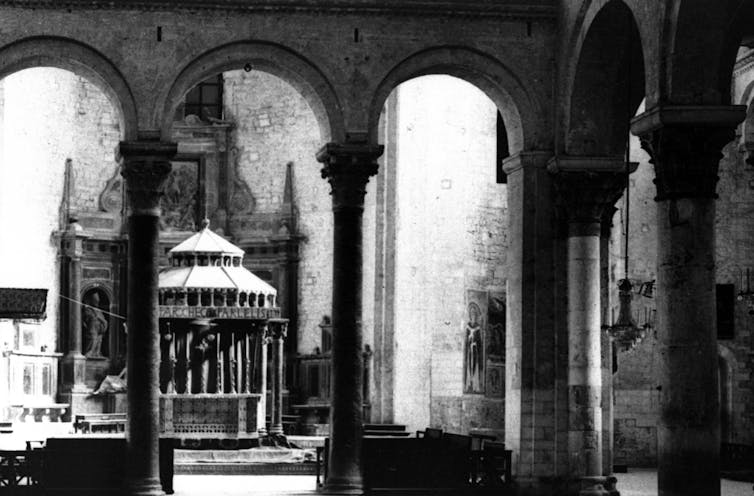
The Barians believed that manna continued to ooze from Nicholas’ coffin. And going by the claim on the basilica’s website, the belief persists to this day.
Within a decade of the saint’s arrival in 1087, the Basilica di San Nicola was one of Europe’s most popular pilgrimage destinations. May 9 is still celebrated as the day that Nicholas moved shrines or was “translated.”
For at least five centuries, the region, which includes Bari and its saint, was caught in constant wars for possession of southern Italy. In 1500, Bari fell into the hands of King Ferdinand of Aragon, whose marriage to Queen Isabella of Spain created a global naval power.
Because Nicholas was a patron saint of sailors, Spanish sailors and explorers carried stories of the saint wherever they went: Mexico, the Caribbean, Florida and other ports around the world.
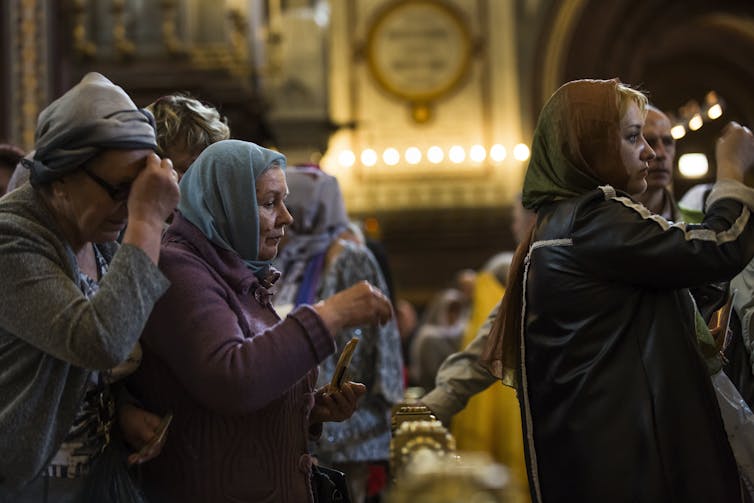
Even the Dutch, who rebelled against Catholic Spain and formed a Calvinist republic in 1581, somehow maintained their devotion to Sinterklass. In other parts of Europe, St. Nicholas lost his feast day but his concern for children helped link him to the gift-giving tradition of another December feast day: Christmas.
How true is this story?
In the 1950s, Italian scientists examined the bones enshrined in the Basilica di San Nicola, seeking evidence of authenticity.
They found the skull and incomplete skeleton of a man, dating to around the fourth century. More recent technology has allowed experts to use the bones to reconstruct Nicholas’ face – he looks like an old Greek man with a broad, worn face. He lacks the rosy cheeks and Anglo-Germanic features of modern Christmas decorations, but like the Santa Claus of greeting cards, he was probably bald.
Turkish archaeologists now claim that the Italians stole the wrong body and that Nicholas’ remains never left Demre. They have discovered another sarcophagus dating to the fourth century in the same church, which they claim contains the saint.
Meanwhile, historians have suggested that the story of Nicholas’ translation is a fiction purposely created to advertise a new pilgrimage center in the 11th century. Although relic theft was common in the Middle Ages, grave-robbers often made mistakes or lied about the authenticity and source of their bones. Nothing in the shrine at Bari proves that the bones inside belong to the fourth-century Bishop Nicholas.
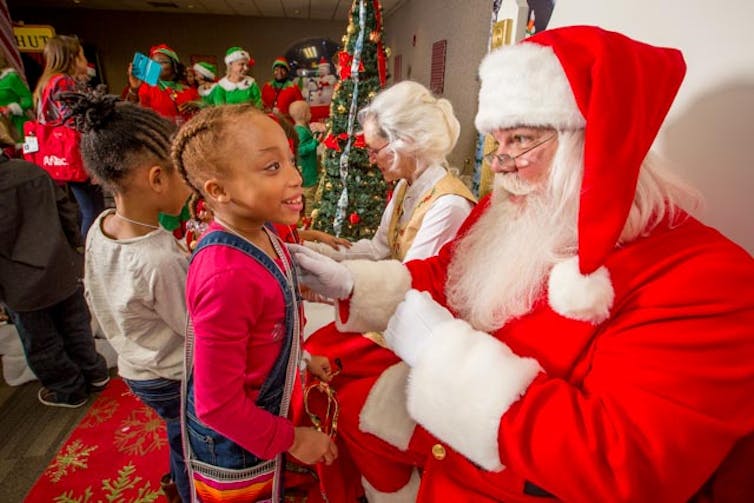
Still, this holiday season, when you tell your children about Santa Claus, why not include the tale of Santa’s well-traveled bones? And don’t forget the manna, which is believed to still flow in Bari.
Lisa Bitel, Professor of History & Religion, University of Southern California – Dornsife College of Letters, Arts and Sciences
This article is republished from The Conversation under a Creative Commons license. Read the original article.