LAKEPORT, Calif. – The supervisors this week will consider approving the purchases of several backup generators for key county facilities in the event that public safety power shutoffs occur.
The board will meet beginning at 9 a.m. Tuesday, July 9, in the board chambers on the first floor of the Lake County Courthouse, 255 N. Forbes St., Lakeport.
The meeting can be watched live on Channel 8 and online. Accompanying board documents, the agenda and archived board meeting videos also are available at that link.
Late last month, the board got estimates from county staff about the costs to purchase backup generators and the necessary electrical upgrades should Pacific Gas and Electric cut power to the county as part of its public safety power shutoffs, as Lake County News has reported.
In untimed items on Tuesday, the board will consider staff recommendations for what facilities should have power backup capabilities and several proposed generator purchases.
In a memo to the board, Public Services Director Lars Ewing explained that only certain county-owned or operated facilities have “standby power generation capabilities sufficient to sustain day-to-day operations when prime power is not available.”
Last month, the board requested that the county’s Space Committee convene to discuss additional facilities that should have backup generators.
Ewing said the committee met on June 27 and recommended that the Agriculture Center, Animal Control, Behavioral Health, Child Support Services, Social Services and Victim-Witness should have backup power.
“In light of differing funding sources and budget organizations, each department proposing a backup generator has prepared a separate memorandum justifying their needs as well as recommending the necessary budget adjustments to accomplish the project,” Ewing wrote.
The board will be asked to approve the purchase and installation of the following facilities, in the listed amounts, at Tuesday’s meeting:
– Animal Care and Control shelter: $75,000. – Lake County Behavioral Health Services: $85,000 . – Child Support Services: $85,000. – Department of Social Services: $175,000. – Sheriff/Central Dispatch, Hunter repeater site: $15,000. – Victim-Witness: $35,000.
The full agenda follows.
CONSENT AGENDA
5.1: Adopt proclamation commending and congratulating the Lake County Rodeo Association on the occasion of its 90th anniversary.
5.2: Approve minutes of the Board of Supervisors meetings held June 18, 2019 and June 24, 2019.
5.3: (a) Adopt resolution correcting Resolution 2019-80 establishing position allocations for Fiscal Year 2019-20, Budget Unit No.1231, County Counsel; and (b) adopt resolution amending Resolution 2019-80 and Resolution 2019-88 establishing position allocations for Fiscal Year 2019-20, Budget Unit No. 2602, Building and Safety.
5.4: Approve and authorize the chair to sign a letter requesting Gov. Newsom Sign AB 632.
5.5: (a) Waive the formal bidding process, pursuant to Lake County Code Section 38.2, as it is not in the public interest due to the unique nature of goods or services; and (b) approve the agreement between the county of Lake and Hilltop Recovery Services for substance use disorder residential services for FY 2019-20, for a contract maximum of $131,400 and authorize the board chair to sign the agreement.
5.6: (a) Waive the formal bidding process, pursuant to Lake County Code Section 38.2, as it is not in the public interest due to the unique nature of goods or services; and (b) approve the agreement between the county of Lake and Hilltop Recovery Services for substance use disorder intensive outpatient program and outpatient drug free services for FY 2019-20, for a contract maximum of $150,000 and authorize the board chair to sign the agreement.
5.7: Approve long distance travel for two staff members to the Western Interstate Child Support Enforcement Council in Spokane, Washington.
5.8: (a) Waive the formal bidding process, pursuant to Lake County Code Section 38.2, as it is not in the public interest due to the unique nature of goods or services; and (b) approve the agreement between the county of Lake and the Healthy Start Program for the Oral Health Program provided by county of Lake Public Health Division for Fiscal Year 2018-19, 2019-20, 2020-21, 2021-22 and authorize the Health Services director to sign the agreement.
5.9: (a) Waive the formal bidding process pursuant to Lake County Code Section 38.2, as it is not in the public interest due to the unique nature of goods or services; and (b) approve the agreement between the county of Lake and Ellis Planning Associates Inc. for the Fiscal Year 2019-2020 for a contract maximum of $49,720.00 and authorize the board chair to sign the agreement.
5.10: Adopt resolution approving county of Lake Health Services Department to submit a renewal application and certification statement for the Maternal, Child and Adolescent Health Grant with the State of California, Department of Public Health for Fiscal Year 2019 through 2020, in the amount of $284,341.02 and authorizing the board chair to sign said certification.
5.11: Approve county employee health plans – EIA Health Renewal for 2020 Benefit Plan Year and authorize Human Resources dIrector to take steps to implement those recommendations.
5.12: Adopt resolution authorizing the Public Works director to sign the notice of completion for the Mockingbird Lane at Robinson Creek Bridge Replacement Project, Bid no. 18-01.
5.13: Adopt resolution delegating to the Public Works director the ministerial authority to obtain temporary construction easement required for Bartlett Springs Road at Cache Creek Bridge Rehabilitation Project.
5.14: (a) Resubmission of the FY17 and FY18 Edward Byrne Justice Assistance Grant certifications and assurances and (b) disclosure of lobbying activities.
5.15: Approve reciprocal intrastate transportation of prisoners services agreement with the county of Los Angeles and the county of Lake.
5.16: Approve long distance travel to attend a national level educational event facilitated by the North American Council on Adoptable Children in Las Vegas, Nevada. Estimated cost for all three staff persons to attend is approximately $4,000. The entire cost of the conference, transportation, lodging and meals will be paid for through the Chabot-Las Positas Community College District contract. Staff will travel between July 16 and July 21, 2019.
TIMED ITEMS
6.2, 9:10 a.m.: Presentation of proclamation commending and congratulating the Lake County Rodeo Association on the occasion of its 90th anniversary.
6.3, 9:15 a.m.: Consideration of memorandum of understanding between the Habematolel Pomo of Upper Lake and the Lake County Sheriff’s Office.
6.4, 9:30 a.m.: Hearing, nuisance abatement hearing request for Andrew Markel, 15284 Humboldt Ext., Cobb, CA, APN# 051-042-004.
UNTIMED ITEMS
7.2: Consideration of advisory board appointments: Geothermal Advisory Committee.
7.3: Consideration of memorandum of understanding by and between the lake county Correctional Officers Association and the county of Lake for July 9, 2019, to Dec. 31, 2019.
7.4: Consideration of resolution amending Resolution No. 2018-132 establishing position allocations for Fiscal Year 2018-1019, Budget Unit No. 2301, Sheriff-Jail Facilities.
7.5: Continued from June 4, Class K Housing in Lake County, Limited Density Owner-Built Rural Dwellings Regulations and Draft Ordinance (request to postpone this item from July 9 to July 23).
7.6: Sitting as Lake County Sanitation District Board of Directors, consideration of Contract Change Order #1 for the relocation of sewer facilities in Middletown Force, Bid No. 18-23; Contract Change Order #1 amount is $29,664.97; revised contract amount $371,113.97.
7.7: Sitting as Lake County Sanitation District Board of Directors, consideration of Contract Change Order #2 for the relocation of sewer facilities in Middletown, Bid No. 18-23; Contract Change Order #2 amount is $(2,964.00); Revised Contract Amount $368,149.97.
7.8: Sitting as Lake County Sanitation District Board of Directors, consideration of Contract Change Order #4 with KJ Woods, for Anderson Springs sewer collection system for an increase of $31,993.31 and a revised contract amount of $6,998,034.48.
7.9: Consideration of the provision of backup power at county buildings.
7.10: Consideration of A) waiving the formal bidding process as it would produce no economic benefit to the county, b) authorizing the Public Services director to issue a purchase order for a backup generator for the Animal Care and Control shelter located at 4949 Helbush Drive, Lakeport, and C) approving budget transfer in Budget Unit 2703, Animal Care and Control to Object Code 62-74, to purchase and install a backup generator in the amount of $75,000.
7.11: Consideration of A) waiving the formal bidding process as it would produce no economic benefit to the county, b) authorizing the Public Services director to issue a purchase order for a backup generator for the Lake County Behavioral Health Services facility located at 7000B South Center Drive, Clearlake, and C) approving budget transfer in Budget Unit 4014, Behavior Health, to Object Code 62.74 to purchase and install a backup generator in the amount of $85,000.
7.12: Consideration of a) waiving the formal bidding process as it would produce no economic benefit to the county, b) authorizing the Public Services director to issue a purchase order for a backup generator for the Child Support Services office located at 3980 Gard St., Kelseyville and C) approving a budget transfer in Budget Unit 2112, Child Support Services to Object Code 62-74 to purchase and install a backup generator in the amount of $85,000.
7.13: Consideration of A) waiving the formal bidding process as it would produce no economic benefit to the county; b) authorizing the Public Services director to issue a purchase order to Leete Generators for $70,907.31 for a standby emergency generator for the Department of Social Services office located at 15975 Anderson Ranch Parkway, Lower Lake; and C) approving budget transfer in Budget Unit 5011, Social Services Administration, to Object Code 62-74 to Purchase and install a 350kW generator in the amount of $175,000.
7.14: Consideration of a budget transfer in the Sheriff/Central Dispatch Budget 2202 for the purchase of a back-up generator at the Hunter repeater site due to anticipated public safety power shut-off with authorization to expend these funds prior to the approval of final budgets.
7.15: Consideration of a Budget Transfer in Budget Unit 2113, Victim Witness to purchase and install a backup generator in the amount of $35,000 at the Victim Witness Office located at 420 Second St., Lakeport.
CLOSED SESSION
8.1: Public employee evaluation:: County Librarian Christopher Veach.
8.2: Conference with legal counsel: Decision whether to Initiate Litigation Pursuant to Gov. Code sec. 54956.9(d)(4): One potential case.
Email Elizabeth Larson at This email address is being protected from spambots. You need JavaScript enabled to view it. . Follow her on Twitter, @ERLarson, or Lake County News, @LakeCoNews.
CLEARLAKE, Calif. – The Clearlake City Council has decided to put off the purchase of a new street sweeper and instead work with the city’s franchise waste hauler, which is offering to step up to help.
The council held the discussion at its June 27 meeting. Originally, the council and staff had begun discussing equipment purchases earlier this spring, as Lake County News has reported.
The discussion begins in the video above at the 33:25 minute mark.
Thanks to Measure V road sales tax proceeds, the city has ramped up road projects and has been able to purchase new equipment.
Public Works Superintendent Mike Baker went over potential costs for a street sweeper. The least expensive was a used 2012 model for $128,199, while the most expensive, a 2019 sweeper, was priced at $438,000.
Staff said the city is working with its franchise waste hauler, C&S Waste Solutions, which already is doing 18 miles of street sweeping as part of its contract with the city. The company is willing to increase that to 23 miles at no additional cost, and work with the city to add other streets in the future.
Street sweeping is important, Baker explained, because it’s necessary to do as part of road repair preparation. He said it took his crew several days to sweep and clean to do pothole repairs.
While the city can afford to purchase a street sweeper, Baker recommended continuing to work with C&S Waste Solutions instead. “I think that would be a good move.”
City Manager Alan Flora said the company also has indicated a willingness to do sweeping more frequently, on a weekly basis. However, that weekly sweeping would cost the city $41,000 a year. The sweeping costs could also be worked into the franchise rate and passed along to customers in the future.
Flora said staff had hoped to see more reasonable prices for street sweepers. He said one of this year’s road projects is $200,000, and they would rather be paying for asphalt than equipment.
He also noted during the discussion that C&S Waste Solutions recently purchased its own new street sweeper.
The council reached consensus to take C&S Waste Solutions up on its offer for free monthly street sweeping, with staff to return at a later time with a report on conditions and whether more frequent sweeping should be considered.
Email Elizabeth Larson at This email address is being protected from spambots. You need JavaScript enabled to view it.. Follow her on Twitter, @ERLarson, or Lake County News, @LakeCoNews.
LAKE COUNTY, Calif. – Lake County Animal Care and Control has an adult cat and several kittens waiting to be adopted this week.
The following cats at the Lake County Animal Care and Control shelter have been cleared for adoption.
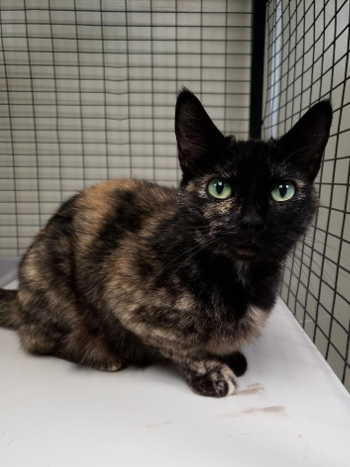
This female domestic short hair cat is in cat room kennel No. 3, ID No. 12415. Photo courtesy of Lake County Animal Care and Control. Domestic short hair
This female domestic short hair cat has a tortoiseshell coat and green eyes.
She is in cat room kennel No. 3, ID No. 12415.
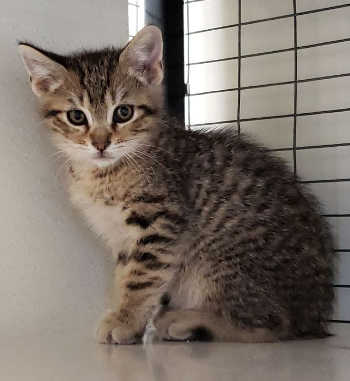
This brown tabby kitten is in cat room kennel No. 43a, ID No. 12332. Photo courtesy of Lake County Animal Care and Control. Brown tabby kitten
This brown tabby kitten has a short coat and green eyes.
He’s in cat room kennel No. 43a, ID No. 12332.
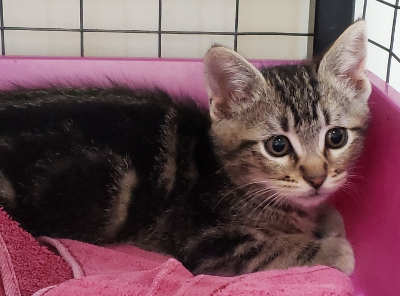
This male tabby kitten is in cat room kennel No. 43b, ID No. 12333. Photo courtesy of Lake County Animal Care and Control. Brown tabby kitten
This male tabby kitten has a short brown and black coat and gold eyes.
He’s in cat room kennel No. 43b, ID No. 12333.
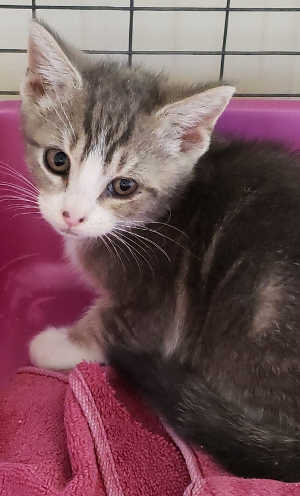
This male gray tabby kitten is in kennel No. 43c, ID No. 12338. Photo courtesy of Lake County Animal Care and Control. Gray tabby kitten
This male gray tabby kitten has a short coat and gold eyes.
He’s in kennel No. 43c, ID No. 12338.
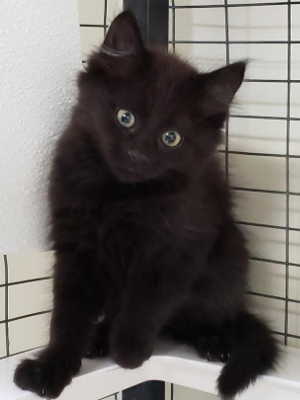
This female domestic medium hair kitten is in cat room kennel No. 79c, ID No. 12380. Photo courtesy of Lake County Animal Care and Control. Domestic medium hair kitten
This female domestic medium hair kitten has an all-black coat and gold eyes.
She is in cat room kennel No. 79c, ID No. 12380.
Lake County Animal Care and Control is located at 4949 Helbush in Lakeport, next to the Hill Road Correctional Facility.
Office hours are Monday through Friday, 11 a.m. to 5 p.m., and 11 a.m. to 3 p.m., Saturday. The shelter is open from 11 a.m. to 4 p.m. Monday through Friday and on Saturday from 11 a.m. to 3 p.m.
For more information call Lake County Animal Care and Control at 707-263-0278.
Email Elizabeth Larson at This email address is being protected from spambots. You need JavaScript enabled to view it. . Follow her on Twitter, @ERLarson, or Lake County News, @LakeCoNews.
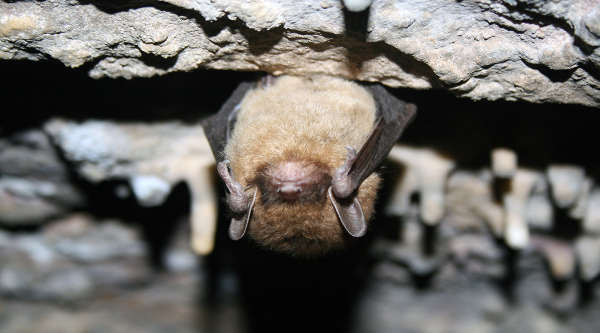
A hibernating, healthy little brown bat by Ann Froschauer/USFWS.
The fungus that causes White-nose Syndrome, or WNS, a deadly disease of bats, has been detected in low levels in California for the first time.
Fungal DNA of Pseudogymnoascus destructans, or Pd, was detected in samples collected this spring from bats on private land in the Plumas County town of Chester.
The California Department of Fish and Wildlife and U.S. Fish and Wildlife Service have been preparing for possible detection of the fungus with partner organizations since 2009. While there is currently no indication the disease itself is affecting bat populations in California, the lab tests suggest Pd is here.
WNS awakens bats during hibernation, causing them to use energy reserves needed to survive winter, when insects they rely upon for food are not available.
The fungus was first detected in New York in 2006 and spread incrementally. Bats that have contracted the disease have now been confirmed in 33 states and seven Canadian provinces. Including the recent California discovery, the fungus alone has now been detected in a total of five states.
WNS has killed millions of bats in the U.S., including more than 90 percent of the bats in some hibernation colonies. Since bats usually produce only one offspring per year, it could take decades for some populations to recover from a major die-off.
“WNS is considered one of the deadliest wildlife diseases, having killed over six million North American bats since it was discovered,” said CDFW Wildlife Veterinarian and Epidemiologist Dr. Deana Clifford. “WNS doesn’t affect human health or pets, but the ecological impacts of bat die-offs may indirectly impact agricultural systems through loss of the natural pesticide effect and nutrient cycling of bats.”
Until spring 2016, the westernmost occurrence of Pd was in eastern Nebraska. In March of that year WNS was confirmed in Washington state – 1,300 miles west of the nearest known location of the fungus.
How it got there is unknown; Pd spreads through physical contact with an infected bat or Pd in the environment. Because spores are persistent, people can also spread the fungus from infected areas to non-infected areas on their shoes, clothes or gear.
Surveillance for WNS has been supported by a national program administered by the U.S. Geological Survey National Wildlife Health Center in Wisconsin in collaboration with the Fish and Wildlife Service, Northern Arizona University and Bat Conservation International.
CDFW has worked with the National Park Service Klamath Network and others to collect swab samples from bats around California since 2016. The samples tested for the DNA signature of Pd were negative until 2018, when one sample from a little brown bat maternity colony in Chester suggested the fungus may be present at low levels. In 2019, the same site and another in Chester yielded three bats with similar low-level detections.
Dr. Alice Chung-MacCoubrey of the National Park Service Klamath Network, who led the surveillance work at Chester and several other northern California sites, said, “The detection of Pd at Chester, even at these low levels, is troubling. It has now been detected in two successive years at two different sites and with testing by both the National Wildlife Health Center lab and the Northern Arizona University lab. In other parts of North America affected by WNS, low-level Pd detections preceded detection of the disease itself by one to four years.”
“Detection of Pd at the levels reported in Chester are possible thanks to advanced tools and surveillance networks in place today that we did not have in the years right after WNS was discovered,” said Jeremy Coleman, National White-nose Syndrome coordinator for the Fish and Wildlife Service, which leads the national response to the disease. “These very early indications that Pd is present allow for a more proactive response by local partners than what has been possible before. Just how long we’ll have before WNS emerges in California’s bats is a big unknown.”
CDFW leads the California WNS Steering Committee, a multi-agency scientific research group that has been monitoring WNS nationally since 2009. The Committee includes the Fish and Wildlife Service, National Park Service, U.S. Forest Service, US Geological Survey, BCI, California State Parks, U.S. Department of Defense and National Speleological Society.
They developed a WNS response plan for California that outlines actions to be taken if the fungus or disease arrives in California.
“It is critically important for CDFW and our partners to follow up on these detections,” said CDFW Wildlife Ecologist Dr. Scott Osborn. “In the coming months and years, we will intensify surveillance for WNS, monitor impacts on bat populations, and assist with research on disease management. We hope disease treatment and prevention techniques currently in development will be available soon.”
Meanwhile, Osborn asks all Californians to be vigilant and cooperate with management actions that may be taken to slow the spread of WNS. People can assist with surveillance by reporting unusual behavior they see in bats. Sick or dying bats observed during winter in the colder regions of the state should be reported to CDFW at www.wildlife.ca.gov/conservation/laboratories/wildlife-investigations/monitoring/wns/report .
According to Osborn, caving organizations like the National Speleological Society have helped collect important information about California’s underground bat roosts.
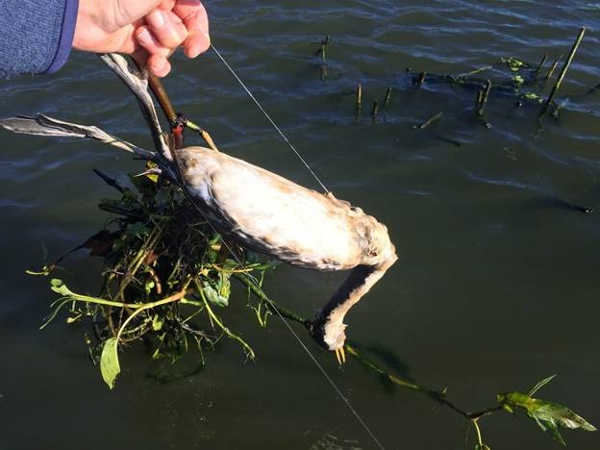
A Western Grebe hooked and dragging a fishing line and bobber at Anderson Marsh on May 2, 2018. Photo by Gae Henry. LAKE COUNTY, Calif. – It’s a picture perfect morning on Clear Lake. A thin veil of mist rises above the placid lake as a cackling flock of geese flaps overhead.
The carp are spawning, splashing as they writhe at the surface. A courting pair of grebes noisily patters across the water.
You deftly cast your fishing line from your boat out toward the tules and slowly reel it in. Suddenly you feel a strong tug as your rod bends sharply toward the water.
With heart racing and adrenaline pumping, you struggle to reel in your catch, which feels bigger than usual. But instead of a fish, a big black-and-white bird emerges a few feet from your boat and desperately flaps on the surface as it struggles to swim away from you.
Oh no, it’s a grebe! What do you do?
It’s fun being outdoors and fishing on Clear Lake is your favorite hobby, but the last thing you want to catch is a bird.
Nevertheless, fishing is like driving a car: If you drive often enough you will inevitably hit a squirrel or some other animal, and if you go fishing regularly you will eventually hook a fish-eating bird.
Clear Lake is a fabulous place for fishing. Loaded with nutrients, the lake naturally provides an abundance of food for fish, and the fish provide food for fish-eating birds.
Wherever there are fish, there are fish-eating birds. As a consequence, fishermen occasionally snag a fish-eating bird on Clear Lake. And other birds occasionally become entangled in carelessly discarded fishing line.
Recently we have begun compiling a list of incidents of birds hooked or entangled in fishing gear on Clear Lake, based on our own personal experiences and those related to us by birders and fishermen.
So far we have tallied 35 birds of 11 species snagged by fishing gear at Clear Lake. All but two were fish-eating birds.
The Western Grebe and Clark’s Grebes are the most vulnerable birds, accounting for nearly half of the records.
The double-crested cormorant and American white pelican are also frequently snagged by fishing gear. Nearly two-thirds of the birds were found alive; some defied attempts at rescue whereas others were captured, unentangled and released. It was too late for more than a third of the birds that were already dead when discovered.
We would like to expand our list of incidents for a research project that we are working on. If you happen to have witnessed a bird hooked or entangled in fishing gear at Clear Lake and have not spoken with us about it, please send us information on (1) the identity (or a description) of the bird, (2) whether the bird was on land or water, (3) what part of the bird was hooked or entangled, and (4) the date and location (which are less important than the other details, but useful to avoid duplicate reports of the same incident). You may contact Floyd Hayes at 707-337-0053 or This email address is being protected from spambots. You need JavaScript enabled to view it. .
Getting back to your unwanted bycatch, what are you going to do? The unfortunate bird is struggling, it’s convinced you’re going to eat it and it has a perilously sharp beak.
Your first impulse is to cut the line and release the hapless bird so you can get back to fishing. But please, please, please resist the urge!
Cutting the line is almost certainly a death sentence – a slow and painful death – for the beguiled bird. The hook may lodge in its beak, neck or stomach, preventing the bird from eating, and the line may get tangled in vegetation, ensnaring the bird.
Instead of cutting the line, here are a few tips for safely rescuing the bird provided by long-time Clear Lake resident Gary Hill and other fishermen who I have spoken to.
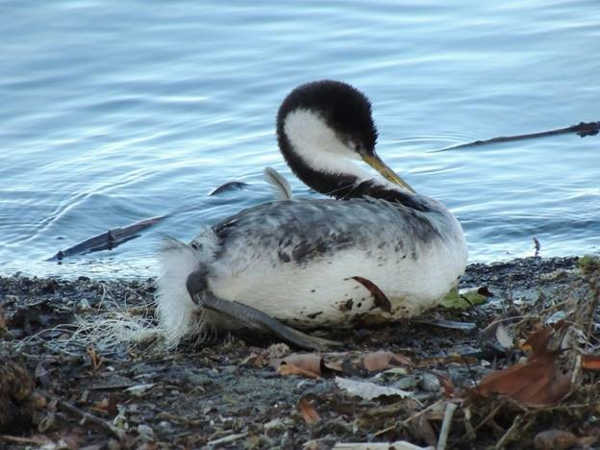
A Western Grebe entangled in fishing line at Lakeport, Calif., on December 8, 2012. Photo by Bryan McIntosh.
First, reel the bird in slowly and evenly, without jerking on the line. Reel the bird in all the way to the tip of the fishing pole, but leave the bird in the water because a bird pulled out of the water is more likely to injure itself or you, or both. If a companion is with you, ask for assistance.
Hold the bird under water (but not for more than a minute to prevent drowning) and reach down with your free hand to grab its neck just behind the head or, if it’s a pelican, grab its beak.
Once you have grabbed the bird by its neck or beak, gently fold the wings and hold them firmly against the body so it cannot flap, and pull the bird out of the water. You may need to grab the legs as well.
Be very careful to keep its beak away from your eyes; if you have glasses or sunglasses, wear them for protection. Gently covering the head of the bird with a towel, hat or shirt can help calm it down and make it easier to extract the hook.
If the barb is not imbedded in its flesh, simply cut the hook with side-cutting pliers so the barb falls out and back out the barbless end of the hook. If the barb is embedded within the flesh, push it through until it emerges and then cut it off with side-cutting pliers. If you lack side-cutting pliers, try to remove the hook as gently as possible without tearing too much flesh.
If the bird is entangled in fishing line, gently untangle it. If necessary, the line can be cut with a knife or scissors. Be sure to save the line for discarding it later in a fishing line recycling tube at any of the public boat ramps. Avoid discarding the fishing line in the lake or along the shore, which may result in another bird or other animal getting entangled and perhaps dying.
Once unhooked or untangled, the bird can be released if it appears feisty and otherwise healthy. Release it by gently placing it in the water or on the ground and allow it to depart on its own accord. It may take a minute or more for the bird to assess the situation before taking off.
If the bird appears injured, consider taking it to the Wasson Memorial Veterinary Clinic at 3083 Highway 175 in Lakeport.
To prevent bird bycatch, avoid casting your line where birds are swimming or flying nearby. And to prevent entanglement, remove any discarded fishing line that you find and dispose of it properly.
There are 23 fishing line recycle bins at all the shoreline public parks and a number of resorts. All were constructed and installed by volunteers with the local Redbud Audubon chapter.
Redbud Audubon has shipped more than 33 pounds of the collected fishing line to a recycling manufacturer in the Midwest to make new products.
About the authors: Floyd E. Hayes has a PhD in biology and is a professor at Pacific Union College in Angwin. He specializes in studying the ecology, behavior and biogeography of Neotropical birds but also works for Redbud Audubon Society on our Western and Clarke’s Grebe monitoring project on Clear Lake. Marilyn Waits is a longtime member of the board of directors for the Redbud Audubon Society. She served as president of Redbud Audubon for 6 years and continues to serve on the board. She is the head of Redbud Audubon’s Grebe Project which is going into its 6th year of studying the Western and Clarkes Grebes on Clear Lake.
A Western Grebe fatally entangled in fishing line at Anderson Marsh in Lower Lake, Calif., on June 11, 2017. Photo by Floyd Hayes.
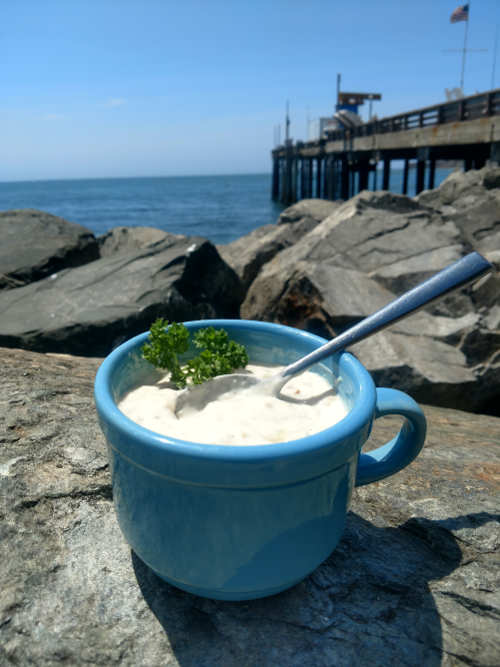
Some food historians theorize that New England clam chowder, pictured here, was introduced by French or Nova Scotian settlers. Photo by Esther Oertel.
New England comes to mind at this time of year when we celebrate the birth of our nation.
Though the Constitution was drafted in Philadelphia and the Bill of Rights in New York (neither of which are in New England), the beginnings of the American Revolution were forged in Boston Harbor when British tea was thrown out of the ships docked there.
And, of course, “the shot heard round the world,” the first gunfire exchange of the war, took place in Lexington, Massachusetts.
There’s another reason I think of New England: childhood vacations on Cape Cod.
Even now, I can smell the salt air and feel the excitement of traversing picturesque towns along the Cape on our way to its very tip.
Friends were generous with their small vacation home, and I spent countless summer weeks there with family from a very young age.
There were many meals made in that rustic little house, first by my mother, and then by me.
I’ll never forget the first time I saw live lobster (bought at the wharf just minutes earlier) being lowered into a large stock pot of boiling water on that kitchen stove. Horrifying, yes, but after tasting of it, lobster became a favorite of mine for decades.
As we got older, my father made sure we spent time fishing on Cape Cod Bay. True to name, cod is what we pulled out of the water.
It was with that cod that I first learned to made fish cakes, improvised and without a recipe.
On the trail through dunes from the house to the beach, shrubs filled with beach plums, sour little native fruits, were prolific.
Looking back, I wish I had made batches of jam or jelly with them as is done throughout the coast where they grow from Maine to Maryland.
Other fruits indigenous to New England are cranberries, which grow naturally in Massachusetts (and are cultivated extensively there to meet the Thanksgiving demand), and blueberries, with Maine being the U.S. state that produces the most in the wild.
European colonists brought apples to North America, and New England’s long, hot summers and crisp fall days provide a perfect environment for them.
Colonists old and young drank hard apple cider, as apples were plentiful and cider didn’t spoil like milk.
Today, for the most part, New England’s apple industry is family-owned, and farm stands and pick-your-own orchards are common.
Much of the cuisine of New England has been influenced by the food of Native Americans. Crops such as corn were mixed with the British recipes that the Pilgrims brought with them.
Prior to being taught to plant and harvest corn by Native Americans, the Pilgrims thought of it as animal fodder. It soon became an important mainstay of their diet.
Cornmeal pancakes known as Johnny (or Jonny) cakes are popular throughout New England, especially in Rhode Island, and can be traced back to the Pawtuxet tribe near Plymouth Rock.
The origin of the name is a mystery (there is no Johnny) and may have come from the term “journey cake” because of their portability.
I fell in love when I ate my first Johnny Cake at a small tearoom in Petaluma some years ago.
I’m in good company in this regard, as Benjamin Franklin was quite a fan of them and is reputed to have said they were “better than a Yorkshire muffin.”
Indian pudding, a steamed mixture of cornmeal, milk, and molasses, was once popular, but fell out of favor as packaged puddings became common. Even so, many New Englanders continue to keep this traditional dish on their Thanksgiving table.
Originally, Native Americans provided the cornmeal to settlers for these and other dishes.
As children, my brother and I always enjoyed receiving maple sugar as a treat, and I owe a debt of gratitude to the Native Americans who taught colonists to harvest the sap from maple trees.
Native Americans cut notches in the trees to access the sap, but colonists later learned to drill holes instead.
Sap was boiled down to create syrup and sugar, the latter being more popular as it was easier to store.
Another influence in New England cooking is their participation in the triangular trade between Europe, Africa, and the Americas in the 18th and 19th centuries. (Sadly, this practice often included bringing slaves from Africa to the Americas.)
From such trade, molasses and rum became common ingredients in cooking. Rum, in fact, was so popular there prior to Prohibition that some of the best rum distilleries are in New England.
Molasses is used today in such dishes as Boston baked beans and Boston brown bread.
Over time, immigrants from Ireland, Portugal, and Italy added their culinary influences to New England.
Portuguese chourico, for example, is a sausage commonly served there in sandwiches, stews, and for breakfast, and the Italian submarine sandwich is said to have originated in Maine.
Five of the six New England states border the Atlantic, so seafood is common throughout the area and a bulwark of their diet.
The quintessential New England clambake derives from a seaside cooking practice by Native American tribes from Massachusetts, Maine, and Connecticut. For more than 2000 years, clams and lobsters were cooked in sand pits; without cooking pots, the earth was their vessel.
The tradition of steaming seafood at the beach is still enjoyed. (Recipes also exist for doing a clambake at home.) Seafood such as lobsters, crab, mussels, and clams are steamed in seaweed over hot rocks and coals in the sand. Corn on the cob, potatoes, carrots, and onions, are often added to the mix.
A tradition rooted in England is still popular today: the boiled dinner. This hearty and warming cold-weather dish is made of boiled brisket with potatoes and vegetables such as turnips, carrots, beets and cabbage.
Corned beef hash was created in New England as a way to repurpose leftovers from the prior evening’s boiled dinner. It’s said, in fact, that a boiled dinner isn’t complete until hash is served the next day.
Red flannel hash is a popular version made with beets subbing for some of the potatoes and is often served with eggs on top.
New England clam chowder, thick and creamy with a milk or cream base, is the most well-known and popular variety of clam chowder. While it’s most closely associated with Massachusetts and Maine (and occasionally referred to as Boston chowder), food historians believe that French or Nova Scotian settlers introduced it to the area.
Boston’s Union Oyster House, the oldest continuously operating restaurant in the United States, has been serving it since 1836.
While the six New England states share a common culinary background, each has foods and traditions that set them apart.
Maine
Lobster (and lobster roll sandwiches) can be found throughout New England; however, Maine’s lobster industry is the most prominent, having been in existence for more than 400 years. Now a delicacy, lobster was once cheap due to their abundance along the Maine coast.
The whoopie pie is Maine’s official state treat. The origin of these large cake-like chocolate cookies filled with marshmallow cream is in dispute, with Pennsylvania and Maine both claiming the honor.
As mentioned before, wild blueberries are prolific here, so it’s no surprise that blueberry pie is Maine’s official state pie.
New Hampshire
New Hampshire has a small but productive coastline in its southeast corner, so fish and shellfish are quite popular there.
New England is known for clam chowder, but corn chowder is king in the Granite State. Various recipes for this soup abound, and an annual corn chowder festival in Portsmouth has a contest for the best one.
Vermont
Vermont produces much of the world’s maple syrup, second only to Quebec, Canada.
Since they share a significant border, the influence of French Canada can be seen in the state. Two Canadian dishes, poutine (French fries and cheese curds topped with brown gravy) and tourtierre (a Canadian meat pie), are enjoyed here.
Vermont is known for its dairy farms, and ice cream is popular. (It’s probably no coincidence that Ben & Jerry’s Ice Cream is located there.)
“Creemee” is the moniker for soft serve ice cream in Vermont and can be found in almost every town.
Vermont has been a leader in the farm-to-table movement, with small farms supplying food to local restaurants long before it was a national trend.
Massachusetts
Massachusetts was once known for its cod; sadly, the fish that my brother and I pulled out of Cape Cod Bay decades ago is now scarce. Restaurants that have cod dishes on their menu often serve imported Icelandic cod.
Boston baked beans, dry beans slow cooked with molasses and bacon (salt pork in Colonial times), is a dish traced back to Native Americans, who cooked dry beans with molasses and bear fat in pits in the earth. Traditionally this bean dish is baked in a ceramic bean pot, but it can be made in a slow cooker.
Boston brown bread is a steamed dark bread traditionally cooked in a coffee can. Among its ingredients are molasses and rye flour.
Another traditional bread from Massachusetts is Anadama bread, which has cornmeal and molasses added to a traditional bread recipe. Strangely, it’s said that the name derives from a Gloucester fisherman’s curse on this wife, Anna.
Boston cream pie was created in 1956 for the opening of Parker’s Restaurant, which is also the birthplace of the Parker roll.
And lastly, marshmallow crème, a sandwich spread, was made popular by Paul Revere’s great-great-great granddaughter, Emma Curtis. Curtis published a recipe for a peanut butter and marshmallow crème sandwich during World War I. Dubbed the Liberty Sandwich, it was renamed the fluffernutter in 1960, and in recent years it became the Massachusetts state sandwich.
Connecticut
With its location between New York and Boston, Connecticut offers a blend of northeast culinary traditions, from New York pizza to New England seafood.
A Connecticut spin on pizza is to omit the mozzarella cheese and lightly sprinkle Romano cheese over red sauce. The New Haven inventor of this version was also reportedly the first to put littleneck clams on pizza.
Louis’ Lunch in New Haven, in business since 1895, was recognized by the Library of Congress as the 1900 birthplace of the hamburger sandwich.
Rhode Island
Rhode Island has its own version of clam chowder. Unlike the New England style soup, quahog clams (also known as hard clams) are used. The chowder has thin, clear broth rather than cream, so the taste of the clams comes through. For this reason, it’s called a “seafood lover’s chowder.”
The official state drink is coffee milk, which consists of milk mixed with a sweet coffee syrup.
Johnny cakes are especially popular here.
As you now know, Johnny cakes are also especially popular with me, and therefore will be the subject of today’s recipe. This recipe is from cookbook author Diana Rattay and is published on The Spruce Eats website.
Before I delve into that, however, I’d like to share with you a funny little fact.
I’ve been in two hurricanes in my life. They occurred 15 years apart, both while I was at the same Cape Cod vacation house.
The first, Hurricane Esther (my first name), was when I was four years old. While glued to the radio for information, my family thought it was funny when things such as “Esther is five miles from the coast” were announced.
I was in the second hurricane at age 19. Oddly, it was Hurricane Belle, which is my middle name.
I’m thankful that both ended up bringing nothing more than heavy wind and rain when passing over the little white cottage in Truro, Massachusetts.
And now, the recipe.
Cornmeal Johnnycakes
1 ¼ cups milk 1 tablespoon butter ½ cup flour 1 cup cornmeal 2 tablespoons granulated sugar 1 teaspoon baking powder 1 teaspoon salt 1 egg, lightly beaten
Heat the milk with the butter until the mixture begins to simmer.
Combine the dry ingredients and whisk to blend.
Add the hot milk mixture to the dry ingredients and mix to blend.
Whisk in the beaten egg.
Drop onto a hot, greased griddle or an iron skillet and fry until golden brown on both sides.
Serve hot with butter and syrup as with pancakes or serve them as bread with butter.
Esther Oertel is a writer and passionate home cook from a family of chefs. She grew up in a restaurant, where she began creating recipes from a young age. She’s taught culinary classes in a variety of venues in Lake County and previously wrote “The Veggie Girl” column for Lake County News. Most recently she’s taught culinary classes at Sur La Table in Santa Rosa, Calif. She lives in Middletown, Calif.
 How to resolve AdBlock issue?