 How to resolve AdBlock issue?
News
LAKE COUNTY, Calif. – Community members are invited to participate in a project that’s looking at traffic calming measures on Highway 20 in four Northshore communities, with an interactive map offered as a way for area residents to record their concerns.
The Lake Area Planning Council and the Sacramento-based firm W-Trans are working on the Highway 20 project as well as one for the 11th Street corridor in Lakeport.
Initial meetings on both projects took place in May, as Lake County News has reported.
At those first meetings, community members were able to meet with planning staff and point out problem spots on maps.
Steve Weinberger, the principal in charge, said the Lake Area Planning Council hired W-Trans to complete the Highway 20 Northshore Community Traffic Calming Plan and Engineered Feasibility Study.
He said the plan and study cover the Northshore communities of Clearlake Oaks, Glenhaven, Nice and Lucerne.
The study RFP says the purpose is to “analyze current conditions and formulate potential projects including bicycle, pedestrian and transit-friendly options that are bicycle friendly options intended to improve the attractiveness and overall livability of the unincorporated towns.”
Based on the input so far from the community, Weinberger said there are consistent concerns about speeding and using the center turn lane which runs through most of the communities – except for Glenhaven – “which is not the way it should be used.”
People also are commenting about the difficulty crossing the street and highway, he said.
Input from the public will take place for another month, with Weinberger and his colleagues then turning to the work of using public input to refine the draft plan.
As such, he said the next month to month and a half “is pretty critical” for people to weigh in on the project Web site.
“We’ve gathered all the information we can except for public input,” he said.
In September they will host another public presentation on recommended alternatives and still a third round of public workshops, likely in December, to fine tune recommendations.
Weinberger said the firm wants to sit down and review initial ideas with Caltrans to make sure the agency is on board, which is key because Caltrans would have to take the lead on the final recommendations and find the necessary funding to carry them out.
He said the final report is scheduled to be wrapped up at the end of February, with the goal of presenting it to the Lake Area Planning Council for final approval in the spring.
In the case of the three-lane portions of Highway 20, Weinberger said the plan now calls for no loss of lanes, although there may be some areas where the lanes are narrowed by about a foot, but they will still meet standards.
In Glenhaven, where the highway is only two lanes, Weinberger said he couldn’t give a definitive answer, saying it remains to be determined if it stays two lanes.
He said that no intersections in the study area are likely to require traffic signals based on the qualifying statistical warrants.
They also are trying to include recommendations that stop the center lane – known formally as the “center two-way left turn lane” – from being used as a passing lane, which violates California Vehicle Code.
Other recommendations will include making crosswalks safer with measures including improved lighting, bringing down traffic speeds, and looking at the potential for striping bike lanes in the existing road shoulders, he said.
Weinberger said there was a previous state Highway 20 beautification plan, which included a number of recommendations Clearlake Oaks, Lucerne and Nice.
He said that plan mentions bike lanes, but the ultimate result was that the recommendations for new parks on the Northshore were carried out.
There were a number of other traffic recommendations that didn’t get done. “So we’re circling back to that beautification plan to see if anything recommended then was appropriate,” he said.
In Clearlake Oaks, where a large Safe Routes to School project recently was completed, there are new sidewalks, bike lanes and street lighting.
Weinberger said additional improvements the plan is looking at for Clearlake Oaks include enhancements to existing crosswalks. “We are taking a close look at every marked sidewalk” to find ways of increasing safety for pedestrians.
He said they expect to make recommendations on what is believed to be the longest crosswalk in the study area, where Acorn intersects with Highway 20 near Nylander Park in Clearlake Oaks. That crosswalk is about 100 feet long.
Barry Bergman, a senior planner for W-Trans, said the current work will build on previous studies done.
He said they are encouraging community members to get involved and share their input.
Residents are out in the community every day, know where the problem spots are and can point them out, he said.
“That kind of information is really useful,” Bergman said.
To take part, click on the map above or visit https://wikimapping.com/Highway20.html .
Email Elizabeth Larson at
Staff had recommended generator purchases and installations totaling $470,000 for six departments: Animal Care and Control shelter, $75,000; Lake County Behavioral Health Services, $85,000; Child Support Services, $85,000; Department of Social Services, $175,000; Sheriff/Central Dispatch, Hunter repeater site, $15,000; and Victim-Witness: $35,000.
The board decided to put all of them out to a two-week bid process, with the exception of the generator and installation for the sheriff’s office’s Hunter repeater site, which was approved to go forward.
County Administrative Officer Carol Huchingson said that, when county department heads sat down to discuss backup power for county facilities in the event Pacific Gas and Electric goes through with the power shutoffs, they didn’t immediately start with generators because of the “incredible expense.”
However, she said that during a roundtable discussion with all department heads contributing, it became apparent that the loss of business operations during a shutoff – including the lack of services provided to the public, employees not being able to work and those combined costs and losses in the county’s communities – would quickly outweigh the cost of generator power.
“To my surprise, quite honestly, we moved in the direction of scoping our generator needs and pricing what that would cost,” she said.
Deputy County Administrative Officer Susan Parker gave the report to the board for Public Services Director Lars Ewing, who was out of town on Tuesday.
She said the county’s Space Committee, which deals with facilities questions, convened on June 27, with Supervisor Rob Brown and Supervisor Moke Simon participating, and the committee recommended backup power for the six listed departments.
Brown said that on Monday he and Supervisor Bruno Sabatier had discussed the generators and why they weren’t put out to bid. Parker said it was a matter of timing and turnaround, because the noticing requirements for the bid process would lengthen the time.
Brown said the county has known about the power shutoffs for a year, but now it’s become an emergency.
“This is a big hoax by PG&E to begin with. I’m not saying they’re not going to shut the power off, I’m saying I don’t think they need to. I think it’s all a crock that we have to live with,” Brown said, comparing it to Y2K, the swine flu and measles scares. “It’s really BS. But we have to deal with it. That’s our job, to have to face it.”
Brown said the board has an obligation to the taxpaying public to make sure the matter is handled properly. “There’s a process in place for a reason and I think we really need to honor that.”
County Counsel Anita Grant said the board can do an expedited bid process. Brown asked if it could be two weeks long. Grant said he would have to ask it that would be practically possible
“But legally, would that be OK?” Brown asked.
Grant said the board could determine a two-week expedited bid process, just like it could decide to have no process at all. But staff would have to tell them if it’s workable.
Simon said he thought Ewing did a good job at the Space Committee meeting of explaining why he though the generator purchases – without the bid process – was the best path forward. “I thought that he had a good plan rolled out.”
Simon said that most of the cost won’t be paid for by the general fund, with the departments having available money for the generator purchases.
He added that Ewing’s plan was part of making the county self-sufficient.
Sabatier said that the board had $470,000 of potential generators to consider, after having approved a $200,000 purchase for the courthouse – done at a special meeting last month – and $40,000 for the sheriff’s office, for a total of $730,000. None of that, he pointed out, has gone through a bidding process.
“I can’t move forward, personally, without doing a formal bidding process. That is too much money. Yes, some of that comes from the state, but who pays the state? We all do. It’s all tax dollars, it’s all coming from us at one point or another,” Sabatier said.
Sabatier also was concerned about piecemealing the purchases, which he said prevents the county from getting a reduced overall cost.
If the board had moved forward with voting on the separate generator purchases, Sabatier said he planned to vote no on them “because I don’t think that is the right process to do, for that kind of money.”
Deputy Public Services Director Kati Galvani, who was asked to come in and speak to the board, said she was confident that, in Ewing’s absence, she and other staff could get the bid information together.
During the discussion, Brown also said that, in response to concerns about cooling centers in case of shutoffs, “It is being worked on” by PG&E.
Huchingson said County Librarian Christopher Veach intends to operate the libraries without power if he can do so safely.
“So it would be like a trip back in time, where people use books,” Huchingson said, adding there won’t be wifi.
Simon moved for an expedited bidding process for the generator purchases, which the board approved.
The board gave the go ahead for the $15,000 purchase and installation of the Hunter repeater site backup generator, which was presented by Undersheriff Chris Macedo.
Macedo said the site, which was damaged in last year’s Mendocino Complex, has had power outages before, which have necessitated the use of small, 1,000-watt generators to keep it running for emergency communications.
Email Elizabeth Larson at
“California is grateful for President Trump’s approval of our request and the ongoing efforts of local, state and federal emergency responders to protect communities across the region,” Newsom said.
The emergency declaration supplements state and local efforts in providing emergency services for the protection of lives, property and public health and safety.
Previously, the governor declared a state of emergency in Kern and San Bernardino counties and toured the impacted area to meet with first responders, elected leaders and residents impacted by the earthquakes.
Last week, the Governor’s Office of Emergency Services activated the State Operations Center in Mather to its highest level. It is coordinating with local, state and federal emergency response officials to address all emergency management needs.

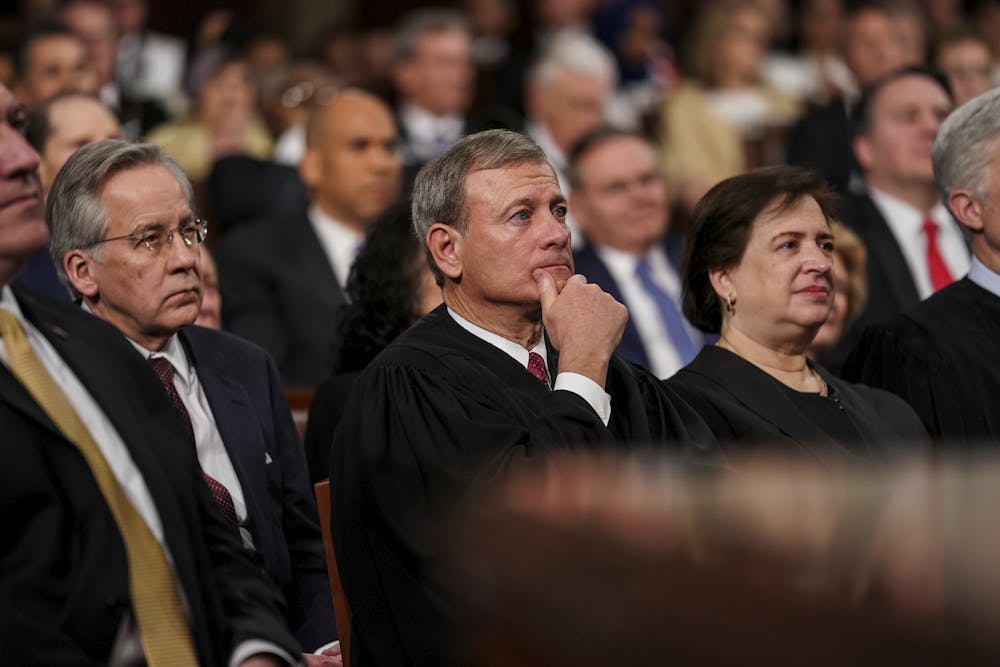
The week before Independence Day, Chief Justice John Roberts gave the United States two extraordinary rulings on the nature of American democracy. Both cases are about fair elections, and both outcomes are all about John Roberts.
The first enshrines the partisan manipulation of voting districts, what’s called “gerrymandering,” as a practice beyond the control of the courts.
The second ruling challenged the Trump administration to speak openly about its views on citizenship and representation. The administration declined and departed the field abruptly on July 2. However, President Trump tweeted the next day that he is “absolutely moving forward” with the census citizenship question, so the controversy will continue.
A right to fair elections?
The text of the Constitution protects many rights, but voting in an election with fair rules is not one of them.
The two cases this year – on the census in Department of Commerce v. New York and on gerrymandering in Rucho v. Common Cause – challenged the Supreme Court to change this.
The justices did not.
From my perspective as a student of constitutional politics – and co-editor of an annual series on the Supreme Court’s major decisions – the cases are intimately connected.
The Constitution commands a count of the population every 10 years so that we can know how many representatives in Congress and votes in the Electoral College each state receives for the following decade.
Then those same data are used by each state to establish the new boundaries of its legislative districts. The data are also used to determine how much money the federal government sends states for a variety of mandated programs.
In 2021 the redistricting will happen again, there may be lawsuits in response, and so on. Count, redistrict, sue, vote, repeat.
This process of counting people and then dividing them into districts is the heart of how we turn the democratic ideal – representation of the people – into the selection of leaders through elections. But what that process should look like is anything but clear, because it raises problematic questions about who is represented and how.
The irony of gerrymandering
The gerrymandering case is about whether the political party in control of a state legislature can alter the electoral maps to make it harder for their party to be removed from office.
To many, this sounds like a clear violation of representative democracy. But has a right been violated? If not, then allocating electoral districts remains a power assigned to the political branches, which means the courts have little role in it.
The core problem the Supreme Court faces in dealing with even blatant gerrymandering is that the Constitution does not identify a clear right to fair elections. It speaks of rights to freedom of speech, religion and the press, but it does not mention freedom from manipulation in counting Americans or allocating them to electoral districts.
The irony of the court’s ruling is that gerrymandering can only be solved by voters showing disapproval of the politicians who shifted the rules, but those shifts are what make it harder for voters to do that.
The politics of the census
While previous Supreme Court rulings left room for future challenges to gerrymandering (better measures, worse examples), the recent decision seems to be definitive. I believe the practice will surely increase in the future, insulated from judicial challenge.
But the prospects for the 2020 census are not so clear.
The census case is about whether including a citizenship question violates the constitutional command to conduct an accurate count.
Underneath this question is the debate over who gets to be represented in our system. Is it everyone living in the United States? Or is it just citizens?
If “the people” are to be represented, defining those people in the current political age has proved to be deeply divisive. But it must be done if the census is to count the people who count.
The plaintiffs contend that the commerce secretary, Wilbur Ross, intentionally added the citizenship question to discourage recent Hispanic immigrants from filling out the census form. They offer an analysis from the Census Bureau concluding that including the question will lower the response rate by noncitizens by about 5%, resulting in millions of people being uncounted, unrepresented and unfunded in federal government programs.

The commander-in-chief justice
Roberts wrote the court’s opinions in both cases, the fifth justice in each 5-4 decision.
In the gerrymandering case, Roberts joined with the other four conservatives against intervention by the court. In the census case, he did not really decide at all. While the four liberal justices were willing to reject the citizenship question outright, (which they made clear in a separate concurring opinion), Roberts would only go so far as demanding more information first.
With the acquiescence of the four liberal justices, Roberts returned the case to the Commerce Department for a response, because “the evidence tells a story that does not match the explanation” given by the commerce secretary. He concludes that “what was provided was more of a distraction” than a true account. Therefore the administration would need to provide a new explanation for why it included the citizenship question.
This gave the Trump administration the option of offering a new justification or dropping the question.
In one sense, Roberts demanded that the court be told the truth. If the Trump administration wants a citizenship question because they simply want to know who is a citizen or because they believe representation should rely on citizenship, they would have to say so. Only then would Roberts rule on whether asking about citizenship violates the Constitution.
In another sense, Roberts made the decision his own. If the Trump administration does abandon the question, Roberts will have called out their misrepresentation of the question’s purpose and forced their abdication.
And if the administration does respond with a new justification, the other eight justices are all on record canceling each other out 4-4, setting him up to have the final say. (That could happen in an emergency session of the court this summer. It could also be delayed until October when the court reconvenes, which would degrade the census further.)
Who won the two most important cases of 2019? In one way of keeping score, the advocates of fair elections lost one and sent the other into extra innings.
The undisputed winner is the influence of John Roberts.
Morgan Marietta, Associate Professor of Political Science, University of Massachusetts Lowell
This article is republished from The Conversation under a Creative Commons license. Read the original article.
The council will meet beginning at 6 p.m. Thursday, July 11, in the council chambers at Clearlake City Hall, 14050 Olympic Drive.
Clearlake Police Chief Andrew White is asking for the council’s authorization for a five-year purchase agreement with Axon for the Taser 7 Certification Plan for 24 full-time, sworn officers.
White said the cost of the program is $17,704.42 per year, for a total purchase cost of $88,522.10, which includes a trade-in credit of $5,000.40 for old Taser units.
He’s also asking for authorization to add additional users as necessary, and to waive the competitive bidding process.
The contract includes virtual reality, scenario-based training, which White said in his report “is a new technology designed to better prepare the officers for dealing with mentally ill subjects. According to Axon, 7-10% of all police encounters involve mentally ill subjects and 25-50% of all fatal police shootings involved subjects with untreated severe mental illness. The modules in the training program support de-escalation curricula and were developed with law enforcement, crisis intervention and mental health experts.”
The council also will discuss the gravel roads chip seal project, get an update on the paving rehabilitation work on Highlands Harbor Drive and Harbor Lane and consider an amendment of the award of construction contract with Darren Taylor Construction for the Meadowbrook Area Pavement Rehabilitation Project in the amount of $1,175,131.00 for the Base bid, bid alternate No. 1 and also include bid alternate No. 2 and authorize the city manager to approve up to 10 percent for additional unforeseen contract amendments.
Also on Thursday, the council will present a certificate of appreciation to the Lakeshore Lions Club in recognition of the group’s presentation of the 62nd annual Redbud Parade and July 4 celebration.
On the consent agenda – items considered noncontroversial and usually accepted as a slate on one vote – are warrant registers; adoption of Resolution No. 2019-33 accepting liability for worker’s compensation for peace officers injured in the line of duty while out of state; minutes of the May and June meetings; and continuation of a declaration of local emergency issued on Oct. 9, 2017, and ratified by council action Oct. 12, 2017.
Email Elizabeth Larson at
The commission will meet beginning at 5:30 p.m. Wednesday, July 10, in the council chambers at Lakeport City Hall, 225 Park St.
On the agenda is an application from Lake County Tribal Health for an architectural and design review that allows a 680 square foot addition in the rear of the organization’s building at 925 Bevins Court.
Commissioners also will review proposed changes to the city’s Urgency Ordinance 921 (2019) adding chapter 17.41 of title 17 of the Lakeport Municipal Code establishing regulations for wireless communication facilities.
In other business, the commission will receive an update from city staff on the Proposition 68 park grant application for a new park at 800 and 810 N. Main St., the former location of Natural High School.
Email Elizabeth Larson at
071019 Lakeport Planning Commission agenda by LakeCoNews on Scribd