LAKE COUNTY, Calif. – Lake County Animal Care and Control has a new group of canines available to new homes this week.
Dogs available for adoption this week include mixes of cattle dog, Chihuahua, German Shepherd, husky, Labrador Retriever and Pomeranian.
Dogs that are adopted from Lake County Animal Care and Control are either neutered or spayed, microchipped and, if old enough, given a rabies shot and county license before being released to their new owner. License fees do not apply to residents of the cities of Lakeport or Clearlake.
If you're looking for a new companion, visit the shelter. There are many great pets hoping you'll choose them.
The following dogs at the Lake County Animal Care and Control shelter have been cleared for adoption (additional dogs on the animal control Web site not listed are still “on hold”).
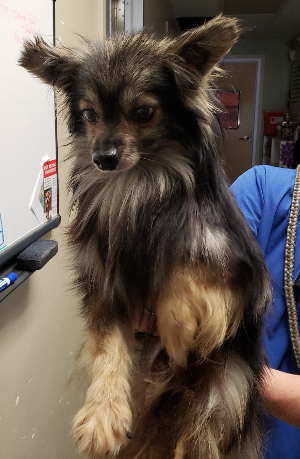
This senior male Pomeranian-Chihuahua mix is in kennel No. 18, ID No. 12404. Photo courtesy of Lake County Animal Care and Control. Senior male Pomeranian-Chihuahua mix
This senior male Pomeranian-Chihuahua mix has a long black and brown coat.
He is in kennel No. 18, ID No. 12404.
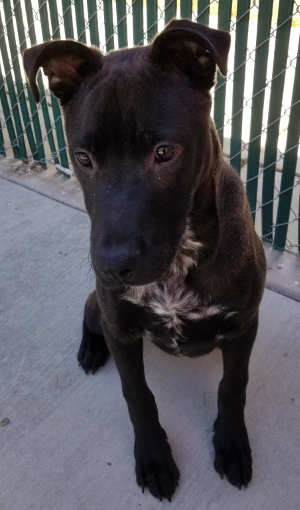
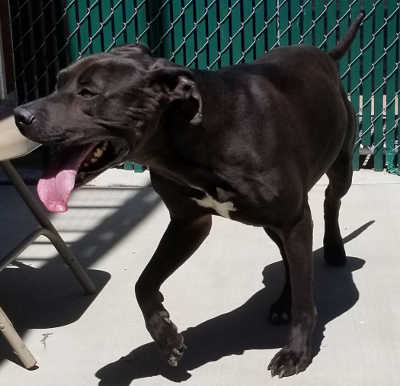
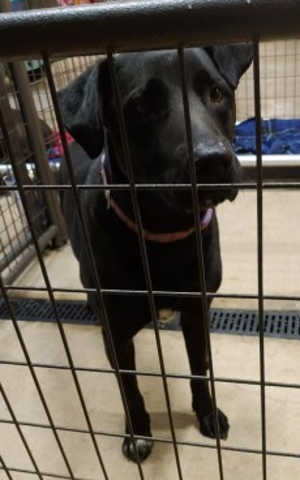
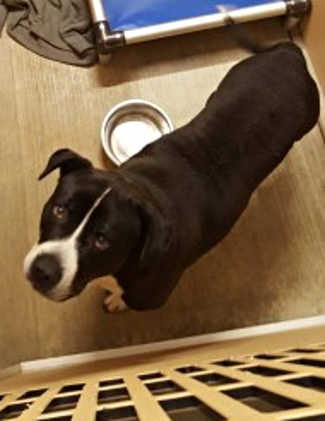
“Bear” is a male Labrador Retriever in kennel No. 19, ID No. 12205. Photo courtesy of Lake County Animal Care and Control. ‘Bear’
“Bear” is a male Labrador Retriever with a short black coat with white markings.
He has been neutered.
He’s in kennel No. 19, ID No. 12205.
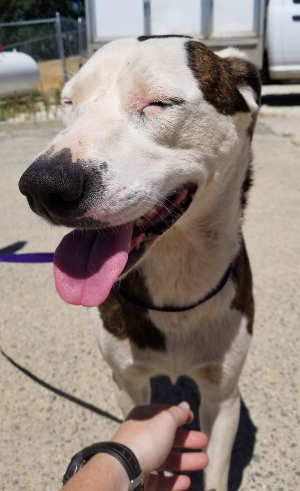
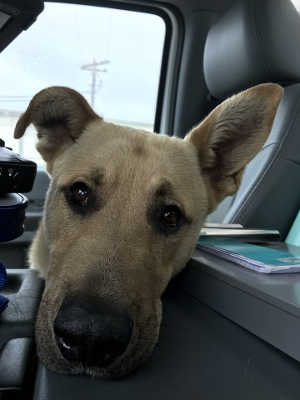
“Sweet Pea” is a female cattle dog mix in kennel No. 23, ID No. 12461. Photo courtesy of Lake County Animal Care and Control. ‘Sweet Pea’
“Sweet Pea” is a female cattle dog mix with a short brindle and white coat.
She’s in kennel No. 23, ID No. 12461.
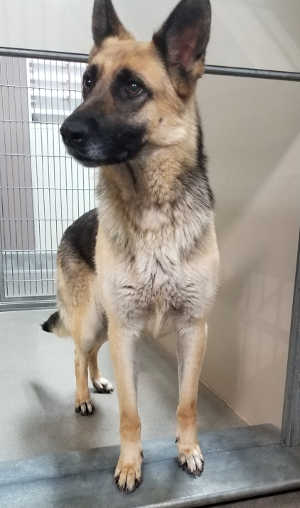
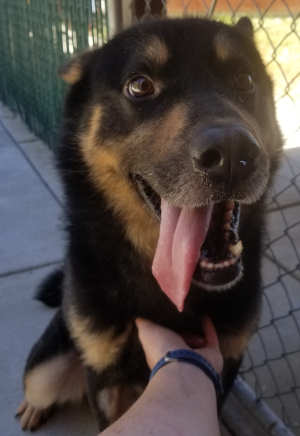
This a female German Shepherd is in kennel No. 24, ID No. 12376. Photo courtesy of Lake County Animal Care and Control. Female German Shepherd
This a female German Shepherd has a medium-length black and brown coat.
She’s in kennel No. 24, ID No. 12376.
“Koda” is a male German Shepherd-husky mix in kennel No. 25, ID No. 12406. Photo courtesy of Lake County Animal Care and Control. ‘Koda’
“Koda” is a male German Shepherd-husky mix with a medium-length black and brown coat.
He is in kennel No. 25, ID No. 12406.
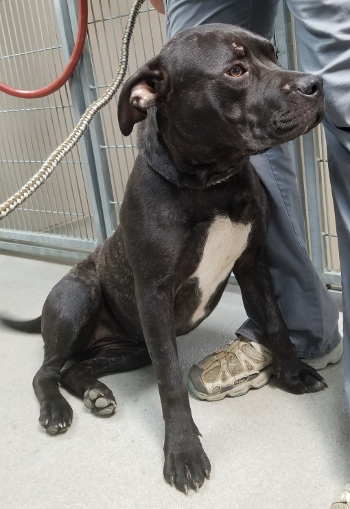
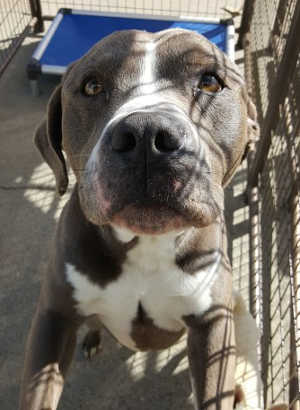
“Cash” is a male pit bull terrier mix in kennel No. 27, ID No. 12413. Photo courtesy of Lake County Animal Care and Control. ‘Cash’
“Cash” is a male pit bull terrier mix with a short black and white coat.
He has been neutered.
He’s in kennel No. 27, ID No. 12413.
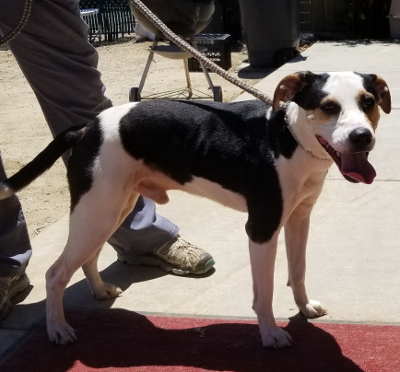
“Buddy” is a male pit bull terrier mix in kennel No. 31, ID No. 12508. Photo courtesy of Lake County Animal Care and Control. ‘Buddy’
“Buddy” is a male pit bull terrier mix with a short tricolor coat.
He’s in kennel No. 31, ID No. 12508.
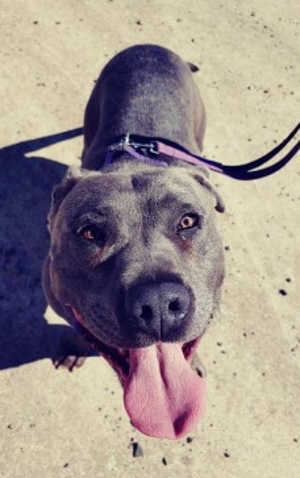
This female pit bull terrier is in kennel No. 33, ID No. 12511. Photo courtesy of Lake County Animal Care and Control. Female pit bull
This female pit bull terrier has a short brindle coat.
She is in kennel No. 33, ID No. 12511.
Lake County Animal Care and Control is located at 4949 Helbush in Lakeport, next to the Hill Road Correctional Facility.
Office hours are Monday through Friday, 11 a.m. to 5 p.m., and 11 a.m. to 3 p.m., Saturday. The shelter is open from 11 a.m. to 4 p.m., Monday through Friday and on Saturday from 11 a.m. to 3 p.m.
For more information call Lake County Animal Care and Control at 707-263-0278.
Email Elizabeth Larson at This email address is being protected from spambots. You need JavaScript enabled to view it.. Follow her on Twitter, @ERLarson, or Lake County News, @LakeCoNews.
As first responders continue to assess the extent of damage from two significant earthquakes on successive days near the Southern California town of Ridgecrest, Gov. Gavin Newsom on Saturday requested a presidential emergency declaration for direct federal assistance to further support the communities impacted by the earthquakes.
A 6.4-magnitude quake hit Thursday morning, and a 7.1-magnitude occurred on Friday evening.
Seismologist Dr. Lucy Jones said the first of the two major quakes was a foreshock to the larger one on Friday.
She also reported on Twitter that more than 3,000 quakes have so far occurred in what is called the “Searles Valley sequence.”
On Thursday, Gov. Newsom declared a state of emergency. On the same day, the California Governor’s Office of Emergency Services activated the State Operations Center.
Gov. Newsom’s request to the president and federal emergency management agency for a presidential emergency declaration can be found here.
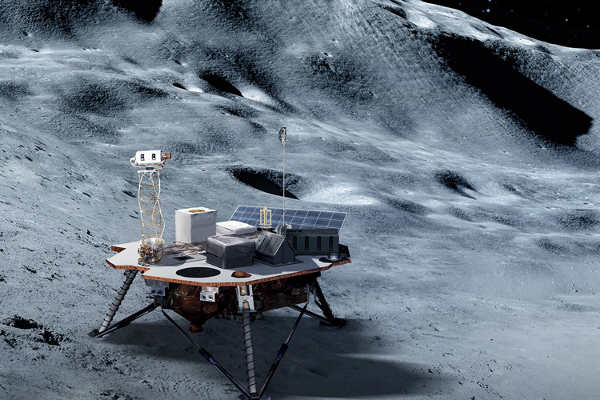
Commercial landers like this will carry science and technology payloads, including one built by UC Berkeley, to the lunar surface, paving the way for NASA astronauts to land on the moon by 2024. Image courtesy of NASA. BERKELEY, Calif. – Scavenging spare parts and grabbing off-the-shelf hardware, University of California, Berkeley, space scientists are in a sprint to build scientific instruments that will land on the moon in a mere two years.
NASA announced on Monday that it has selected 12 scientific payloads to fly aboard three lunar landing missions within the next few years.
One of them will be the Lunar Surface Electromagnetics Experiment, or LuSEE, which will be built under the direction of Stuart Bale, a UC Berkeley professor of physics and a veteran of several past NASA missions, including the Parker Solar Probe that was launched last August.
The science and technology experiments will explore the moon’s surface environment in advance of upcoming human missions and are part of NASA's collaboration with commercial partners to launch payloads — and, by 2024, humans — to the moon.
Bale and his colleagues at UC Berkeley’s Space Sciences Laboratory have less than $6 million to cover the costs, which means they will be co-opting spare parts originally built for the Parker Solar Probe and other spacecraft, including STEREO, which launched in 2006 and is still providing stereo views of the sun, and the 2013 MAVEN, which is now orbiting Mars.
The LuSEE will make comprehensive measurements of electromagnetic phenomena on the surface of the moon and erect a simple radio telescope — the first operational telescope on the moon.
“NASA wanted instruments that are ready to go, because the schedule is really aggressive. We are talking about pulling something together and delivering it in about 18 months, which is fast,” Bale said. “We proposed a re-flight of our Parker Solar Probe instrumentation, which works like a charm, and the team is still together to get it tuned up. We’re good at building experiments quickly and that work.”
“Berkeley is going to put an experiment on the surface of the moon,” Bale added. “That is pretty cool, I think.”
The experiment is not expected to last longer than one lunar day — about two weeks — because the batteries will discharge during the two weeks of night. But Bale is hoping it will survive the lunar darkness and live to observe another lunar day.
“The thermal environment is really nasty on the dark side, so we will land at morning, when the sun comes up on the moon, spend two weeks — one lunar daylight — observing like crazy, and when it becomes night, the lander goes into the dark and the batteries will run down because there is no solar input to recharge them. They are not required to wake up on the other side.”
The missions are part of NASA’s Commercial Lunar Payload Services program, which on May 31 commissioned three upstart companies to build lunar landers to return NASA to the moon 50 years after America last landed a spacecraft there: the Apollo 17 manned mission in 1972. These landers will carry the 12 payloads, seven of which will focus on answering questions in planetary science and heliophysics, and five on demonstrating new technologies.
"These new lunar payloads represent cutting-edge innovations that will help us get to know the moon as we never have before, as we prepare to land humans on the moon and, eventually, Mars," said Thomas Zurbuchen, associate administrator of the agency's science mission directorate in Washington, D.C. "Each one brings something new to the moon and can take advantage of early flights through our commercial partnership program."
One of the three landers will carry LuSEE, which will measure the moon’s fluctuating magnetic field and the dust kicked up by light and electrons coming from the sun.
Dust could be a big problem for future moon colonists, Bale said. Harrison Schmitt, who crewed Apollo 17, suffered an allergic reaction to moon dust, as did a doctor who unloaded Schmitt’s spacesuit upon return to Earth. The fine dust was also a nuisance inside the Apollo landers, because it is electrically charged and sticks to everything.
The moon’s surface is electrostatically charged, too, which could cause problems for structures and humans on the moon. Apollo astronauts saw fountains of dust thrown into the air at the day-night boundary of the moon, presumably because of voltage differences between the lit and unlit portions of the moon. The voltage differences can also charge up objects on the surface, leading to sparking.
Bale is interested in how the electrostatic environment on the surface changes as the sun moves across the sky and how that changing electrostatic environment affects the dust. Magnetometers on board will measure changes in the magnetic field, which have to date only been measured indirectly by spacecraft orbiting the moon, using instruments built at the Space Sciences Laboratory.
The LuSEE will also carry the first U.S. radio telescope on the moon, a simple dipole antenna that is like a rabbit-ear TV antenna. The antenna will be identical to the one aboard the Parker Solar Probe, which so far has been able to record radio emissions from the Milky Way Galaxy in frequency ranges not possible to detect on Earth, because such wavelengths are blocked by ions in the atmosphere.
“I am sure we will see the sun — solar flares, type 3 radio storms, coronal mass ejections — but also Jupiter and other planets, which we already see with the solar probe,” Bale said. “And we will see a lot of emissions from Earth. We propose to do a survey of the radio environment on the surface of the moon in preparation, someday, for a more advanced radio telescope.”
Such a solar array on the moon could answer questions about the early history of the universe, including the “epoch of reionization,” when the first stars began to form in the universe, about 400 million years after the Big Bang.
Robert Sanders writes for the UC Berkeley News Center.
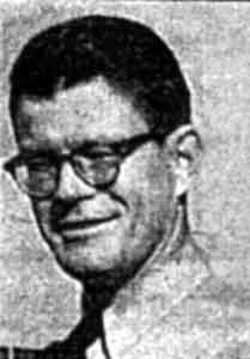
Army Sgt. 1st Class Elden C. Justus. Courtesy photo. LAKE COUNTY, Calif. – A motorcade bearing the remains of a North Coast Korean War soldier identified and returned to US officials in April after being missing for nearly 70 years will pass through Lake County on Monday.
Officials are transporting the remains of Army Sgt. 1st Class Elden C. Justus along Interstate 5 to Highway 20 en route to his final resting place in Arcata, where burial will take place on July 11.
The Lake County Sheriff’s Office said the motorcade is expected to reach Clearlake Oaks between 4 to 4:30 p.m. on Monday, July 8.
Lake County Sheriff’s deputies will join other law enforcement agencies from throughout the county to honor Justus, and the public is welcome to join them in honoring the fallen soldier as his motorcade travels through Lake County.
The Military Funeral Honors Team also will be on hand, stationed in Upper Lake across from Judy’s Junction restaurant, and will conduct a 21-gun volley in Justus’ honor.
Justus’ homecoming comes 69 years after he was reported missing in action.
Justus was killed near Hagaru-ri in North Korea on Dec. 6, 1950, according to a June obituary published in the Eureka Times-Standard. “He was last seen directing his men in repulsing an enemy attack while covering for the withdrawal of American troops from the battlefield.”
Initially, when he disappeared, it wasn’t known whether he had been killed according to his first obituary, published in the Eureka Times-Standard in January 1954.
The Defense POW/MIA Accounting Agency, or DPAA, said Justus’ remains were accounted for on April 16 after being recovered from a communal gravesite in North Korea 15 years ago.
Justus was born in New Mexico and raised in Arcata, graduating from Arcata High School. He enlisted in the Army in 1945, serving four years in Germany before being sent to Korea, according to his 1954 obituary.
In late November 1950, Justus, 23, was a member of Headquarters Battery, 57th Field Artillery Battalion, 7th Infantry Division, the DPAA said.
At that time, 2,500 U.S. and 700 South Korean soldiers assembled into the 31st Regimental Combat Team, which was deployed east of the Chosin Reservoir, North Korea, when it was engaged by overwhelming numbers of Chinese forces, according to the DPAA report.
By Dec. 6, the U.S. Army evacuated approximately 1,500 wounded service members; the remaining soldiers had been either captured or killed in enemy territory, officials said.
When Justus could not be accounted for by his unit at the end of the battle, the DPAA said he was reported missing in action as of Dec. 6, 1950.
His January 1954 obituary said Justus was declared dead by the U.S. Army as of Dec. 31, 1953.
Work that began decades later would lead to the eventual recovery and identification of Justus’ remains.
From April 28 to May 10, 2004, the Joint POW/MIA Accounting Command, a predecessor to DPAA, conducted joint recovery operations with the North Korean People’s Army in the vicinity of the Chosin River, officials said.
DPAA said the recovery team excavated two sites, recovering the remains of at least five individuals.
The Democratic People’s Republic of Korea, or North Korea, unilaterally turned over the remains to the UNC Military Armistice Commission, where they were subsequently accessioned to the laboratory, the DPAA said.
In order to identify Justus’ remains, scientists from DPAA used dental and anthropological analysis, as well as material evidence. Additionally, scientists from the Armed Forces DNA Identification Laboratory used mitochondrial DNA and autosomal DNA analysis.
At the time of his death, Justus left behind a wife, Ruth; children, Jack and Lois; his mother, Lois Childs; and his sister, Edna Smith. Today, his survivors include his adult children, grandchildren and great-grandchildren.
After his remains arrive in Arcata on Monday, they will lie in honor at Paul's Chapel for public visitation on July 9 and 10. His funeral will take place at 11 a.m. July 11 at the Eureka Elks Lodge, and he will be interred at the Greenwood Cemetery in Arcata.
While the search for Justus has now reached its conclusion, the DPAA said 7,652 Americans still remain unaccounted for from the Korean War.
Using modern technology, identifications continue to be made from remains that were previously returned by Korean officials, recovered from Korea by American recovery teams or disinterred from unknown graves, officials said.
Justus’ name is recorded on the Courts of the Missing at the National Memorial Cemetery of the Pacific, in Honolulu, along with the others who are missing from the Korean War, according to the DPAA report.
The DPAA said a rosette will be placed next to his name to indicate he has been accounted for.
Email Elizabeth Larson at This email address is being protected from spambots. You need JavaScript enabled to view it.. Follow her on Twitter, @ERLarson, or Lake County News, @LakeCoNews.
CLEARLAKE, Calif. – Clearlake Animal Control has several new dogs joining its lineup of canines available for adoption this week.
The kennels also have many dogs that need to be reunited with their owners. To find the lost/found pet section, click here.
The following dogs are ready for adoption.
“Buddy.” Photo courtesy of Clearlake Animal Control. ‘Buddy’
“Buddy” is a male Labrador Retriever mix with a short black coat with white markings.
He is No. 2332.
“Cadbury.” Photo courtesy of Clearlake Animal Control. ‘Cadbury’
“Cadbury” is a female Staffordshire Bull Terrier mix with a smooth medium-length beige coat.
She is No. 1215.
“Frank.” Photo courtesy of Clearlake Animal Control. ‘Frank’
“Frank” is a male American Staffordshire Terrier mix with a short black and white coat.
He is No. 2345.
“Hamilton.” Photo courtesy of Clearlake Animal Control. ‘Hamilton’
“Hamilton” is a male German Shepherd with a medium-length brown and black coat.
He is No. 2177.
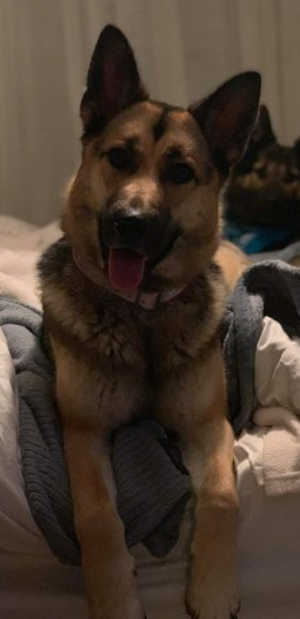
“Lexi.” Photo courtesy of Clearlake Animal Control. ‘Lexi’
“Lexi” is a female German Shepherd with a medium-length black and tan coat.
She is No. 2262.
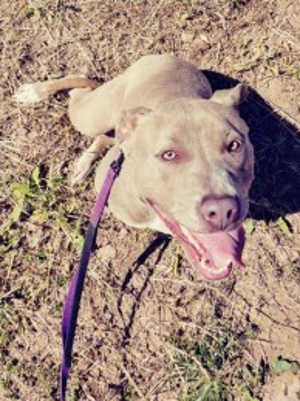
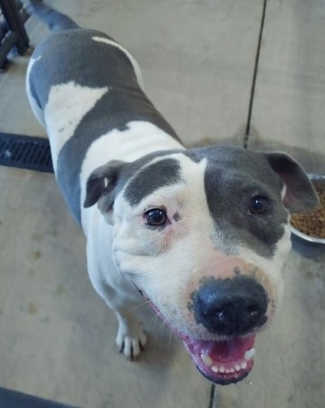
“Lola.” Photo courtesy of Clearlake Animal Control. ‘Lola’
“Lola” is a female American Staffordshire Terrier mix with a short white and gray coat.
She is No. 2416.
“Snowflake.” Photo courtesy of Clearlake Animal Control. ‘Snowflake’
“Snowflake” is a male Chihuahua with a white coat.
He is No. 1864.
“Tyson.” Photo courtesy of Clearlake Animal Control. ‘Tyson’
“Tyson” is a male American Staffordshire terrier mix with a medium-length gray and white coat.
He is No. 1863.
“Wynn.” Photo courtesy of Clearlake Animal Control. ‘Wynn’
“Wynn” is a male American Staffordshire Terrier with a short brindle coat.
Staff said he is a lovely fellow who has been at the shelter for several months.. He loves affection and is available for adoption or through the foster to adopt program.
He’s believed to be about 6 to 7 years old.
He is No. 969.
Clearlake Animal Control’s shelter is located at 6820 Old Highway 53, off Airport Road.
Hours of operation area noon to 4 p.m. Tuesday through Saturday. The shelter is closed Sundays, Mondays and major holidays; the shelter offers appointments on the days it’s closed to accommodate people.
Call the Clearlake Animal Control shelter at 707-273-9440, or email This email address is being protected from spambots. You need JavaScript enabled to view it. to inquire about adoptions.
Visit Clearlake Animal Control on Facebook or at the city’s Web site.
Email Elizabeth Larson at This email address is being protected from spambots. You need JavaScript enabled to view it. . Follow her on Twitter, @ERLarson, or Lake County News, @LakeCoNews.
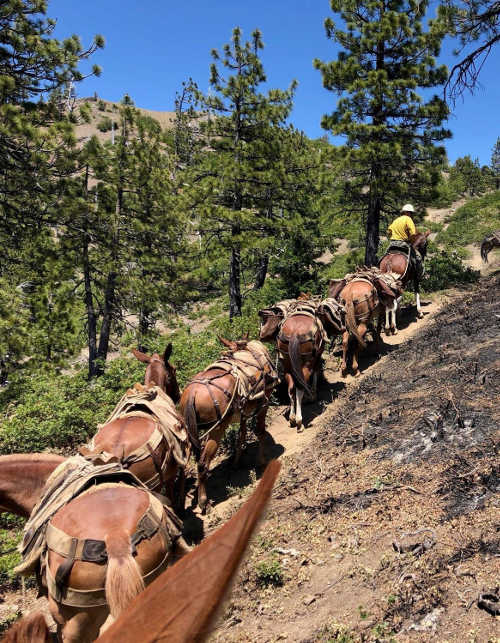
Firefighters packing into the Yolla Bolly Wilderness in Northern California to fight the East fire. Photo courtesy of the Mendocino National Forest. MENDOCINO NATIONAL FOREST, Calif. – Mendocino National Forest officials work is continuing to contain the East fire in the Yolla Bolly Wilderness, with growth flat and containment rising.
The fire continues to smolder deep in the No Name drainage, 23 miles northeast of Covelo. It is holding steady at 410 acres and is now 65 percent percent contained, officials said.
Forest officials said the fire is spreading into an area with sparse vegetation and slowing down naturally on its own; minimal activity is expected.
After several days of brushing trail and hauling supplies, a pack train and a California Conservation Corps crew was in place at the East fire basecamp on Buck Ridge as of Friday morning.
Using pack mules and the CCCs to support personnel on the East Fire reduces the need for helicopter use on the incident. Officials said the last helicopter was released Thursday.
Personnel on the incident are monitoring the fire and brushing the trail on East Ridge south toward Lucky Lake. Forest officials said this trail work will provide access for personnel to regularly check on the fire to ensure it stays within the designated confinement area as summer heats up and the vegetation gets drier,
“The confinement strategy we chose for this incident has required little active suppression since it started June 17, which has helped reduce risk and exposure to our firefighters and allowed fire to play its natural role on the landscape,” said Incident Commander Terry Warlick. “We will continue to evaluate the situation and assess the long-term weather outlook to meet our management objectives on this incident.”
 How to resolve AdBlock issue?