 How to resolve AdBlock issue?
News

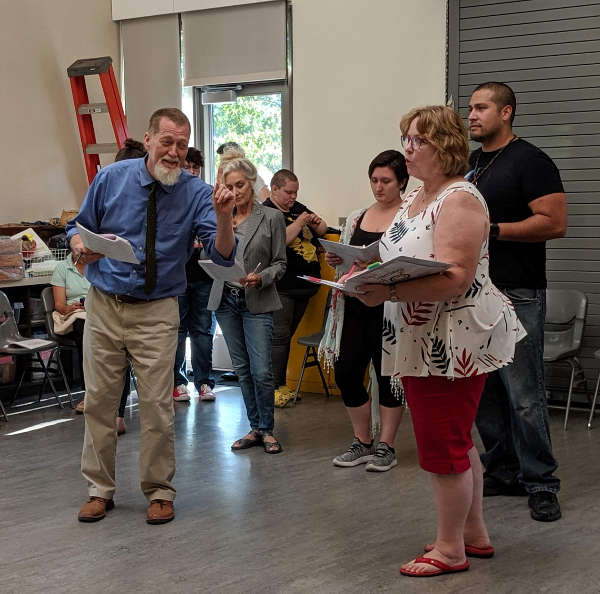
LAKE COUNTY, Calif. – The fourth annual Shakespeare at the Lake is expanding into another community and adding new performances.
This year’s play is “The Taming of the Shrew,” with the actors and crew now in the final weeks of fine-tuning the production.
The play is set outside in Lakeport at Library Park with beautiful Clear Lake as the backdrop. It is a joint effort each year between Mendocino College Lake Center and the Lake County Theatre Co.
This year, the Clear Lake Chamber of Commerce is also stepping in to help a long-held dream of director, John Tomlinson, come to fruition. A second weekend of free performances will be held in Clearlake at Austin Park in what is hoped to be the first of many years.
Performances run Saturday, July 27, and Sunday, July 28, in Lakeport at Library Park, and Friday, Aug. 2, Saturday, Aug. 3, and Sunday, Aug. 4 in Clearlake at Austin Park. All shows start at 6:30 p.m. Food, beverages and wine will be for sale.
The performances are free to the public.
The production would not be possible without the support of the Lake County Friends of Mendocino College who find the sponsors for the show each year.
Tomlinson has always been a big fan of Shakespeare outdoors.
“The first play I was in was ‘Much Ado About Nothing’ in a Shakespeare in the Park presentation in Santa Barbara. When it comes to Shakespeare at the Lake here in Lake County, I mainly think of two big moments,” he said.
“Word had gotten around a little bit in our theater community that I wanted to do an outdoor Shakespeare production. So one day I was helping out as a volunteer at a booth during the Kelseyville Pear Festival. Dr. Richard Smith, who was a big part of organizing the Pear Festival at that time, was sitting next to me at the booth. We'd been chatting for a while, when out of the blue he said he was interested in producing this outdoor Shakespeare he had heard about. I made a good decision that day and I said, ‘Yes,’” Tomlinson said.
“So we started meeting over coffee and talking about making this happen. We decided that a co-production between Lake County Theatre Co. and Mendocino College would provide the best mix of resources to help such a project happen. So that was big moment No. 1, teaming up with Richard, and creating a co-production,” he explained.
Tomlinson said they took the idea to the school administration and to the theater company, and they were both agreeable.
The next issue was a venue. “At one point we dreamed about our future home being at Library Park, just the two of us, and we dismissed it out of hand, feeling it was something we would not know how to accomplish,” Tomlinson said.
However, he said they had begun meetings with Steve Hexenbaugh, interim dean, at the Mendocino College Lake Center. At one of those meetings, Hexenbaug suggested they do the show at Library Park. “And it turns out Steve did know how to get into meetings with the right people and make this happen,” said Tomlinson. “That was the second big moment.”
Tomlinson added, “And now I'd say, we've got big moment No. 3 happening this year. I dream one day of having four weekends of Shakespeare on all sides of the lake, completely free of charge. A big step toward that dream has happened this year, with our first presentation in Clearlake scheduled for the first weekend of August.”
Tomlinson was the Stars of Lake County Arts Award of the Year-Professional for 2016 and Shakespeare at the Lake was the Best Idea of the Year Stars of Lake County 2016 award recipient.
Bring a beach chair and a friend or two to see this free production.
For more information visit http://LCTC.us .
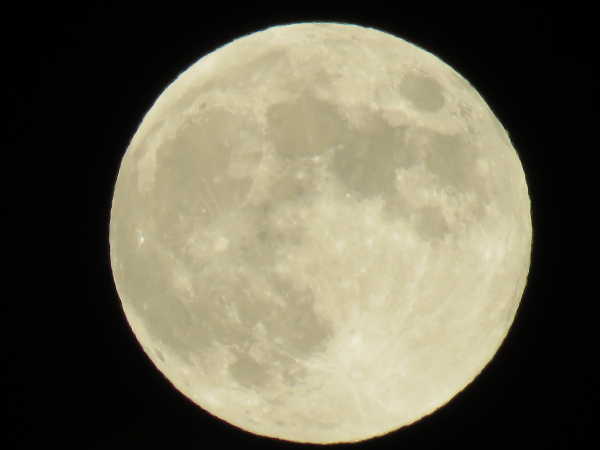
"Here men from the planet Earth first set foot upon the moon July 1969, A.D. We came in peace for all mankind." – From the plaque left on the moon by Apollo astronauts
LAKE COUNTY, Calif. – One of the many advantages to living in beautiful Lake County is the fact that we boast our very own observatory.
I had the good fortune to attend another of Taylor Observatory's informative and entertaining evening events recently.
Tim Gill, talented mathematician, who works with Kelseyville Unified School District, gave a fascinating talk on celestial navigation techniques over time.
Not only did he thoroughly describe the workings of a sextant, but also discussed earlier navigational methods, such as the Polynesian hand method, the Arab Kamal and the quadrant- all unknown to me prior to his talk.
Space expert Eduardo Alatorre guided us through the fascinating dome show on ancient mythology and constellations.
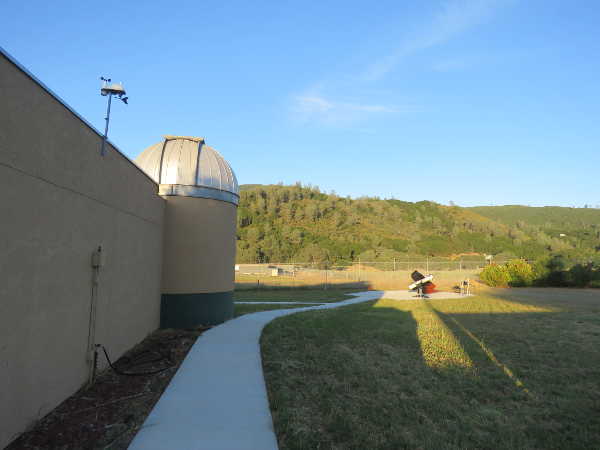
Bill Haddon, president of the Friends of the Taylor Observatory gave a brief overview of upcoming events to be hosted at Taylor Observatory, one of which is to be held on Saturday, July 20.
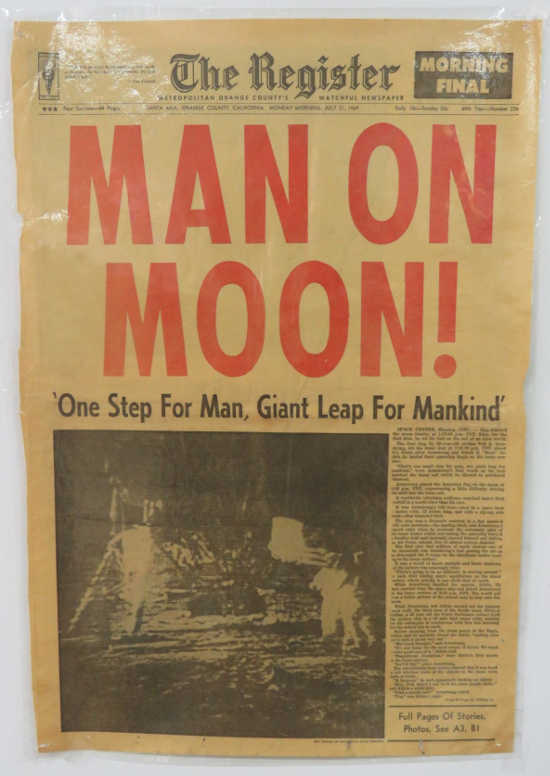
Then, the presentation titled, "The 50th Anniversary of Apollo 11" will be held, which leads me to ask, "Can you believe that July 20, 2019, marks 50 years since humans landed on the moon on July 20, 1969?”
I, like millions of others, watched the lunar landing on TV and, running outdoors to peer up at the moon, was struck with wonder and awe.
Throughout my decades-long teaching career I enjoyed learning right along with my fourth graders, and one of the most exciting subjects to study was science. Several times we were able to compare NASA's national treasures, the lunar samples, to rocks found here in Lake County. I trained at NASA Ames Research Center to handle the lunar samples before signing my life away to obtain and interpret them in the classroom.
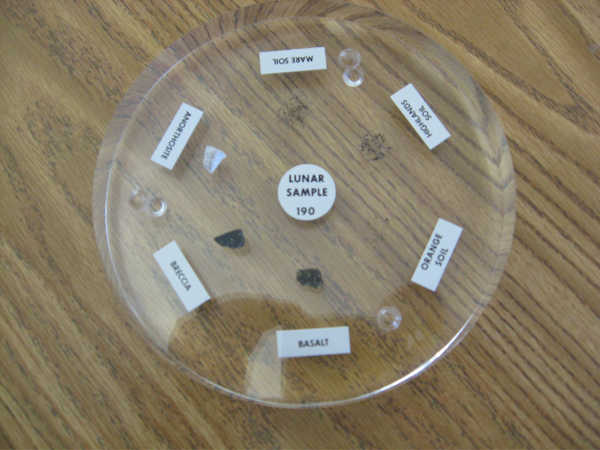
As I mentioned in the now defunct Middletown Times Star, the lunar samples, small rocks and soils obtained from the over 800 pounds of rocks brought back to Earth from some of the six manned moon missions which spanned the years 1969-1973 were encased in a clear, plastic disc so that they would not oxidize.
The rocks and soils were viewed via a computer microscope. The six samples included Mare Soil, the fragments of which were produced by meteorites hitting basalts. The Mare Soil held grains of the minerals feldspar and pyroxene and were collected by the Apollo 17 mission, the last mission by humans to the moon.
Breccia was viewed, which was collected by the Apollo 15 astronauts near Hadley Rille, a canyon-like depression on the moon. Breccias are made of fragments of other rocks that were smashed by meteorite bombardment on the moon.
We viewed Orange Soil, which is a mixture of dark red-orange and black spheres returned by Apollo 17 astronauts when they used a shovel to collect this unique soil at the moon's Mare Serenitatis.
Orange Soil originated more than 3.5 billion years ago from volcanic lava sprays. When the debris was in flight, it cooled to form the tiny glass spheres.
Anorthosite is a breathtakingly beautiful white rock comprised mainly of feldspar crystals. This sample was retrieved from the moon's Descartes region in the light colored highlands of the center of the moon by Apollo 16 astronauts. Anorthosite's crystals were once pale gray, but when meteorites bombarded the moon and broke the crust into fragments, the feldspar was 'shocked' and shattered, turning the crystals white.
We viewed Highland Soil which was collected by the Apollo 16 astronauts near the moon's center, on highlands between dare “mare” areas. This soil is composed of particles of rocks, mineral grains and glass melted during the meteorite impacts on the moon's surface long ago. The glasses included in the Highland Soil are many colors, such as brown, pale green, grey, and black.
The other lunar sample in the disc was Basalt. Basalt formed when lava spilled onto the moon's surface and cooled, then crystallized. The grains in the basalt were pyroxene, feldspar, olivine and iron titanium oxide. The sample was collected in August 1971 by the Apollo 15 astronauts at the east edge of Mare Imbrium, the large circular area on the moon's upper left surface.
Students learned that 12 men walked on the moon from 1969-1973, and there were six manned landings. All moon rocks are igneous. Moon rocks are similar to Earth rocks, but Moon rocks contain no water and Earth rocks do. It is easy for scientists to tell them apart under a microscope and by analyzing their chemistry.
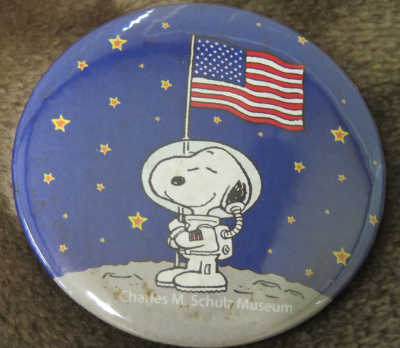
Another moon musing that I shared in the Lake County News, in 2009 I had a rare opportunity to shake hands with the great Apollo 10 astronauts Commander Thomas Stafford and Lunar Module pilot Eugene Cernan. It was an honor to briefly meet the esteemed astronauts at the Charles M. Schulz Museum in Santa Rosa then.
The famed astronauts were in Santa Rosa to kick off an exhibit "To the Moon: Snoopy Soars with NASA" which ran in 2009. The last astronaut on the moon, Eugene Cernan, passed away at age 82 on January 16, 2017.
These brave men belonged to a special club – the rare men blessed with vivid memories of having voyaged to the moon and back. They viewed our fragile blue planet from their unique vantage points, in awe of what they witnessed.
When Gene Cernan saw Earth from the moon he is reported to have said that he was looking out from "God's front porch." According to the Santa Rosa Press Democrat, in 2009, Cernan also stated, "If we could put everybody on that spot for five minutes, the Earth would be a different place."
Be sure to take advantage of one of our county's treasures, Taylor Observatory.
Friends of Taylor Observatory is collaborating with many stakeholders to obtain Dark Sky Certification from the International Dark Sky Association.
According to The Friends of Taylor Observatory's Web site, the Dark Sky initiative's goals are "To preserve our ability to see a spectacular night sky... to foster an astronomy tourism industry ... and to preserve our wonderful Lake County dark skies for future generations of students."
To learn more visit the Web sites for the Friends of Taylor Observatory,the International Dark-Sky Association or NASA.
Kathleen Scavone, M.A., is a retired educator, potter, freelance writer and author of “Anderson Marsh State Historic Park: A Walking History, Prehistory, Flora, and Fauna Tour of a California State Park” and “Native Americans of Lake County.”
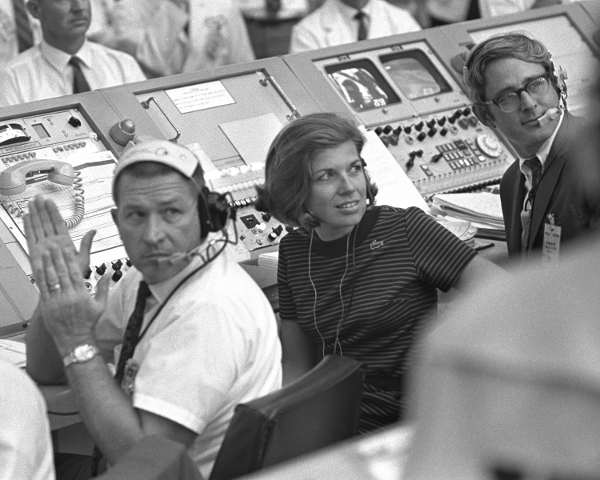
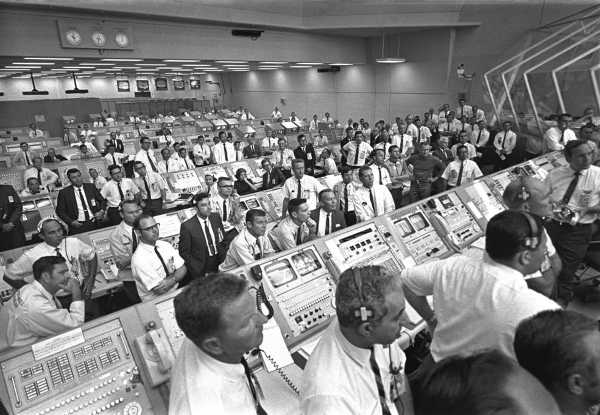
As the Apollo 11 mission lifted off on the Saturn V rocket, propelling humanity to the surface of the Moon for the very first time, members of the launch firing team inside Launch Control Center watched through a window.
The room was crowded with men in white shirts and dark ties, watching attentively as the rocket thrust into the sky. But among them sat one woman, seated to the left of center in the third row in the image below. In fact, this was the only woman in the launch firing room for the Apollo 11 liftoff.
This is JoAnn Morgan, the instrumentation controller for Apollo 11.
Today, this is what Morgan is most known for. But her career at NASA spanned over 45 years, and she continued to break ceiling after ceiling for women involved with the space program.
In addition to being the first woman at NASA to win a Sloan Fellowship, she was the first woman division chief, the first woman senior executive at Kennedy Space Center (KSC), the first woman associate director for KSC, the first woman director of Safety and Mission Assurance… and the list goes on, as this feature will show.
So, let’s begin to answer a question that has become crucial to understanding women’s contributions to the Moon landing and NASA at large: Who is JoAnn Morgan?
‘A precocious little kid’
As a child, Morgan was a self-described “precocious little kid.” She loved math, science and especially music — so much so, that she was convinced she would grow up to become a piano teacher. But that trajectory quickly changed after her father uprooted the entire family from their close-knit community in Alabama, and moved everybody to Titusville, Florida.
The move was jarring for the whole family. Morgan, a high school junior, was plucked out of a school she had been attending since the third grade and felt as if she had been “plopped down” somewhere completely new.
Morgan noticed many differences between her new Florida home and where she had come from. The main one? Rockets.
Rockets blasted off just across the river from her high school so often, that watching them with her friends felt just like “watching fireworks on the beach.” But to say they were the main inspiration for Morgan’s eventual career at NASA? That would be way off the mark. If anything, the rocket launches were just background noise. They were little more than flashes of light in the peripheral.
‘The opportunity for new knowledge’
Those rockets began to mean something much more to Morgan on Jan. 31, 1958, the day Explorer 1 was launched into space — the first satellite to do so from the United States. Satellites were not as ubiquitous as they are today. At this point in history, the Soviet Union’s Sputnik and Sputnik 2 were the only two satellites successfully launched into orbit.
Explorer 1 was instrumental in discovering what has become known as the Van Allen radiation belt. The Explorer 1 instrumentation reacted to what appeared to be radiation, and thus Dr. James Van Allen theorized that charged particles were trapped in space by Earth’s magnetic field.
This was the discovery that inspired Morgan to be a part of the space program. The roaring of the nearby rocket launches was nothing compared to this.
“I thought to myself, this is profound knowledge that concerns everyone on our planet,” she says. “This is an important discovery, and I want to be a part of this team. I was compelled to do it because of the new knowledge, the opportunity for new knowledge.”
The opportunity came when Morgan spotted an advertisement for two open positions with the Army Ballistic Missile Agency. The ad listed two Engineer’s Aide positions available for two students over the summer.
“Thank God it said ‘students’ and not ‘boys’” says Morgan, “otherwise I wouldn’t have applied.”
‘I’ve got rocket fuel in my blood’
With Morgan’s strengths in math and science, it was no wonder when she got the internship. From there, things moved pretty quickly: “Graduation from high school was on the weekend, and I went to work for the Army on Monday. I worked on my first launch on Friday night.”
At age 17, Morgan began work during the summers as a University of Florida trainee for the Army at Cape Canaveral Air Force Station. This program was quickly rolled into a brand-new space exploration agency that had just been forged in response to early Soviet achievements: a little agency called the National Aeronautics and Space Administration, also known as NASA.
Apollo chief designer Wernher von Braun and Kennedy Space Center Director Kurt Debus
Saturn 500F begins its rollout to Launch Complex 39A, with its chief designer Wernher von Braun and Kennedy Space Center Director Kurt Debus in attendance.
As Morgan worked in the summers for the new NASA, and during the school year chipped away at a Bachelor of Arts in mathematics from Jacksonville State University, her potential did not go unnoticed. Dr. Wernher von Braun, chief architect of the Saturn V rocket that propelled Apollo spacecraft to the Moon, and members of his team recognized the level at which Morgan could contribute to the human spaceflight program.
“All of my mentors were men,” says Morgan. “That’s just a plain fact and that needs to be acknowledged.”
Dr. Kurt Debus, the first director of KSC, looked at Morgan’s coursework and saw that she had experience writing technical papers, working with data systems and building computer components (which were also not as ubiquitous as they are today.) He provided Morgan with a pathway to certification, and a couple of courses later, she was certified as a Measurement and Instrumentation Engineer and a Data Systems Engineer, and was employed as a Junior Engineer on their team.
“It was just meant to be for me to be in the launching business,” she says. “I’ve got rocket fuel in my blood.”
And from all appearances, that was the perfect summation. Morgan was a talented mathematician, a fantastic communicator and a bona fide engineer — but that didn’t stop prejudice, especially in the sixties.
‘You don’t ask an engineer to make coffee’
Morgan heard later from colleagues that when she was hired to join the team, her immediate supervisor, Jim White, called everyone for a meeting — except her. As the room filled with men, White explained to the crew:
“This is a young lady who wants to be an engineer. You’re to treat her like an engineer. But she’s not your buddy. You call her Ms. Hardin. You’re not to be familiar.”
“Well, can we ask her to make coffee?” someone asked.
“No,” White said. “You don’t ask an engineer to make coffee.”
White wanted to make it perfectly clear to the team: Morgan was a serious engineer, and her being a woman did nothing to affect that. By speaking candidly with the team, White intended to establish an environment of respect for Morgan. However, this was not always how it played out.
‘JoAnn, you are welcome here’
There was a seemingly infinite amount of obstacles that Morgan was forced to overcome — everything from obscene phone calls at her station to needing a security guard to clear out the men’s only restroom.
“You have to realize that everywhere I went — if I went to a procedure review, if I went to a post-test critique, almost every single part of my daily work — I’d be the only woman in the room,” reflects Morgan. “I had a sense of loneliness in a way, but on the other side of that coin, I wanted to do the best job I could.”
“A startling moment” for Morgan came when a test supervisor saw her sitting down at Blockhouse 34 to plug in her headset to acquire test results.
“The supervisor came and just whacked me over the back — actually hit me in the back! He said ‘we don’t have women in here!’ He had this ugly look on his face and I thought, uh-oh.”
Morgan called Karl Sendler, the man who developed the launch processing systems for the Apollo program and had ordered the test results, and said, “Uh…this test supervisor said women aren’t allowed here.”
He replied: “Oh, don’t listen to him! Plug in your headset and get those test results to me as soon as you can.”
In response to the test supervisor’s treatment of Morgan, others came forward to make it known that she was accepted. Rocco Petrone, who presided over the development of the Saturn 5 lunar launch vehicle and operation, later tapped Morgan on the shoulder.
“JoAnn, you are welcome here,” he said.
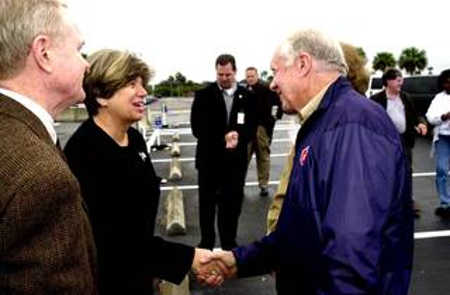
‘You are our best communicator’
In spite of working for all of the Mercury, Gemini and Apollo programs, and being promoted to a senior engineer, Morgan was still not permitted in the firing room at liftoff — until Apollo 11, when “Karl Sendler went to bat for me.”
Without her realizing, Sendler had had to go all the way to the top to ask permission from Debus. When Sendler called Morgan into his office to share the good news, he was “practically gleeful”:
“You are our best communicator,” he said. “You’re going to be on the console for Apollo 11!”
The added bonus was the fact that Morgan wouldn’t have to work the night shift, 3pm to 3am. For the first time, she would get off work at 3 in the afternoon and spend time with her husband who, as a schoolteacher and bandmaster, she rarely got to see. As soon as the launch was over, he would whisk her off to Captiva Island on a boat trip to celebrate.
“I was just thrilled,” she says. “My life was coming together. I would get to be there for the launch, feel the shockwave hit, and then — I got to go on vacation!”
‘It absolutely made my career’
To be the instrumentation controller in the launch room for the Apollo 11 liftoff was as huge as a deal as it sounds. The launch is the beginning of the mission, and after the first couple of critical events the launch team is devoted to — including launch and translunar injection — Mission Control team in Texas would take over and the launch team would have zero control.
For Morgan, to be there at that pivotal point in history was ground-breaking: “It was very validating. It absolutely made my career.”
Perhaps the best part was finally being able to feel the vibrations of the shockwave. Up until then, Morgan had always been at a telemetry station or a display room or an upper antennae site for launch, and would have to hear from other people about what the vibrations felt like. Now, Morgan finally had the chance to experience them for herself.
'There’s a whole wealth of knowledge NASA can achieve'
Much like the Saturn V rocket, Morgan’s career took off. She was the first NASA woman to win a Sloan Fellowship, which she used to earn a Master of Science degree in management from Stanford University in California.
When she returned to NASA, she became a divisions chief of the Computer Systems division. This was in the seventies, when the agency was transitioning from using old, giant computers to many smaller computers. The change was supplemented with the fact that she was the first woman to have that role: “So, people were having to change and adapt to me and the new technology. So that was a lot to choke on for some people! A double whammy!”
It was difficult, but Morgan once again proved she was capable. She was “the manager with the velvet glove.” She combined her Southerner, gentlewoman personality with her training at Stanford to inspire change and move people down the road.
From there, Morgan excelled in many other roles, including deputy of Expendable Launch Vehicles, director of Payload Projects Management and director of Safety and Mission Assurance. She was one of the last two people who verified the space shuttle was ready to launch and the first woman at KSC to serve in an executive position, associate director of the center.
But what excited Morgan the most about her contributions was the same thing that inspired her to join the space program in the first place: the scientific discoveries.
“My last mission was those two little plucky Mars rovers, [Spirit and Opportunity]. That was a lot of fun — getting people to understand there’s a whole future out there, there’s a whole wealth of knowledge NASA can achieve.”
To this day, Morgan is still one of the most decorated women at KSC. Her numerous awards and recognitions include an achievement award for her work during the activation of Apollo Launch Complex 39, four exceptional service medals and two outstanding leadership medals. She also received the Kurt H. Debus Award, as well as two meritorious executive awards from President Bill Clinton. In 1995, she was inducted into the Florida Women's Hall of Fame.
After serving as the director of External Relations and Business Development, she retired from NASA in August 2003.
“I hope that photos like the ones I’m in don’t exist anymore.”
Florida Governor Jeb Bush appointed Morgan to be a state university trustee. She had already worked on boards at the University of Florida's Aerospace Engineering, University of Central Florida's College of Engineering and the University of West Florida's Institute for Human and Machine Cognition (IHMC).
While serving as a trustee, Morgan realized how important it was to encourage more women to pursue careers and college programs in STEM. Today, she sponsors endowments and scholarships at seven universities and provides internships at IHMC.
“Even though I’m almost 80 years old, I’m not giving up,” she says.
Morgan encourages young people to stick with STEM careers even when they are hard work, because the rewards will be worth it in the end.
“There is such a great variety of work to do within the NASA family: government, contractors, university partnerships — there will be a place for you to fit in,” says Morgan. “I had fun. I had wonderful people to work with. You’re just not going to have a dull day.”
Morgan is especially excited about seeing more women involved with the upcoming Artemis missions to return humans to the Moon and eventually make it to Mars. She remembers clearly when Dr. von Braun described to her in person about the goal to go to Mars — although, he had calculated that we would have already made it there by now.
“So, we’re behind, by JoAnn Morgan time.”
People today are reflecting on the 50th anniversary of Apollo 11, looking back on photos of the only woman in the launch firing room and remembering Morgan as an emblem of inspiration for women in STEM. However, Morgan’s takeaway message is to not look at those photos in admiration, but in determination to see those photos “depart from our culture.”
“I look at that picture of the firing room where I’m the only woman. And I hope all the pictures now that show people working on the missions to the Moon and onto Mars, in rooms like Mission Control or Launch Control or wherever — that there will always be several women. I hope that photos like the ones I’m in don’t exist anymore.”
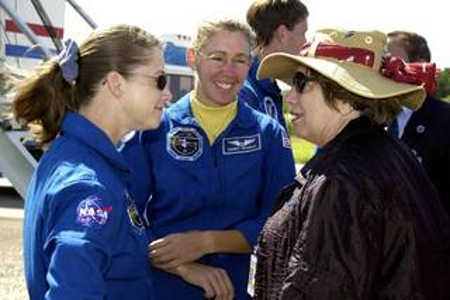
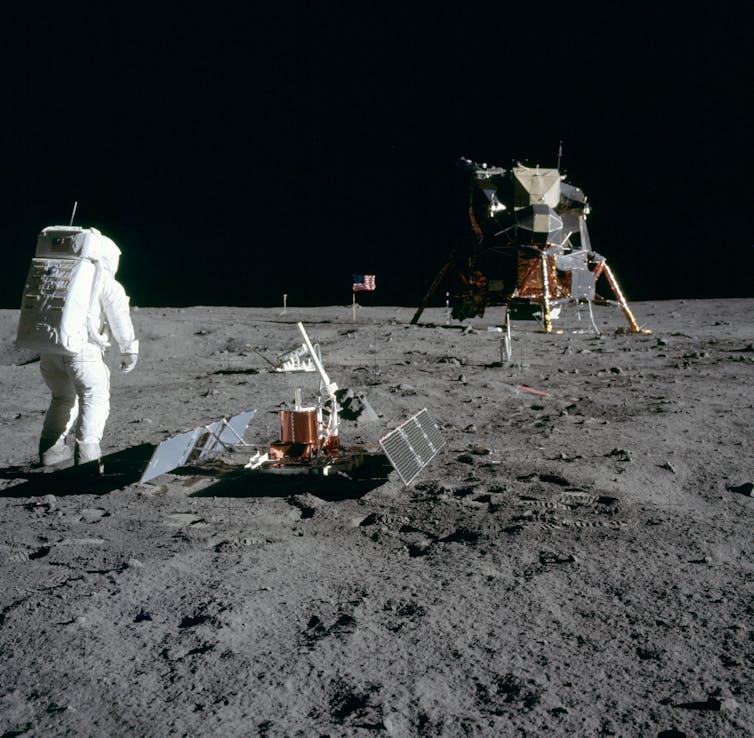

Much of the technology common in daily life today originates from the drive to put a human being on the Moon. This effort reached its pinnacle when Neil Armstrong stepped off the Eagle landing module onto the lunar surface 50 years ago.
As a NASA airborne astronomy ambassador and director of the University of Wisconsin-Milwaukee Manfred Olson Planetarium, I know that the technologies behind weather forecasting, GPS and even smartphones can trace their origins to the race to the Moon.
1. Rockets
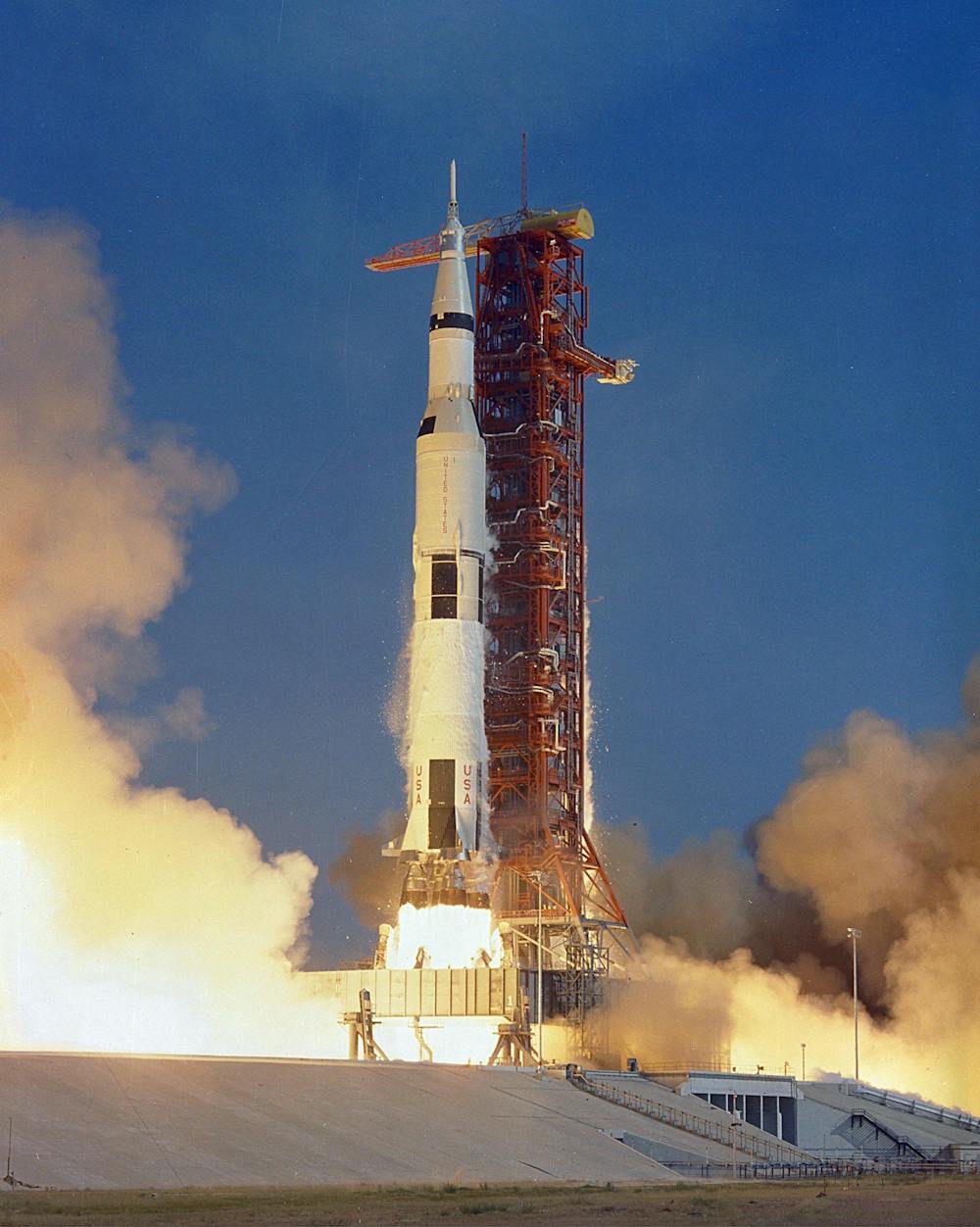
October 4, 1957 marked the dawn of the Space Age, when the Soviet Union launched Sputnik 1, the first human-made satellite. The Soviets were the first to make powerful launch vehicles by adapting World War II-era long-range missiles, especially the German V-2.
From there, space propulsion and satellite technology moved fast: Luna 1 escaped the Earth’s gravitational field to fly past the Moon on January 4, 1959; Vostok 1 carried the first human, Yuri Gagarin, into space on April 12, 1961; and Telstar, the first commercial satellite, sent TV signals across the Atlantic Ocean on July 10, 1962.
The 1969 lunar landing also harnessed the expertise of German scientists, such as Wernher von Braun, to send massive payloads into space. The F-1 engines in Saturn V, the Apollo program’s launch vehicle, burned a total of 2,800 tons of fuel at a rate of 12.9 tons per second.
Saturn V still stands as the most powerful rocket ever built, but rockets today are far cheaper to launch. For example, whereas Saturn V cost US$185 million, which translates into over $1 billion in 2019, today’s Falcon Heavy launch costs only $90 million. Those rockets are how satellites, astronauts and other spacecraft get off the Earth’s surface, to continue bringing back information and insights from other worlds.
2. Satellites
The quest for enough thrust to land a man on the Moon led to the building of vehicles powerful enough to launch payloads to heights of 21,200 to 22,600 miles (34,100 to 36,440 km) above the Earth’s surface. At such altitudes, satellites’ orbiting speed aligns with how fast the planet spins – so satellites remain over a fixed point, in what is called geosynchronous orbit. Geosynchronous satellites are responsible for communications, providing both internet connectivity and TV programming.
At the beginning of 2019, there were 4,987 satellites orbiting Earth; in 2018 alone, there were more than 382 orbital launches worldwide. Of the currently operational satellites, approximately 40% of payloads enable communications, 36% observe the Earth, 11% demonstrate technologies, 7% improve navigation and positioning and 6% advance space and earth science.
3. Miniaturization
Space missions – back then and even today – have strict limits on how big and how heavy their equipment can be, because so much energy is required to lift off and achieve orbit. These constraints pushed the space industry to find ways to make smaller and lighter versions of almost everything: Even the walls of the lunar landing module were reduced to the thickness of two sheets of paper.
From the late 1940s to the late 1960s, the weight and energy consumption of electronics was reduced by a factor of several hundred at least – from the 30 tons and 160 kilowatts of the Electric Numerical Integrator and Computer to the 70 pounds and 70 watts of the Apollo guidance computer. This weight difference is equivalent to that between a humpback whale and an armadillo.
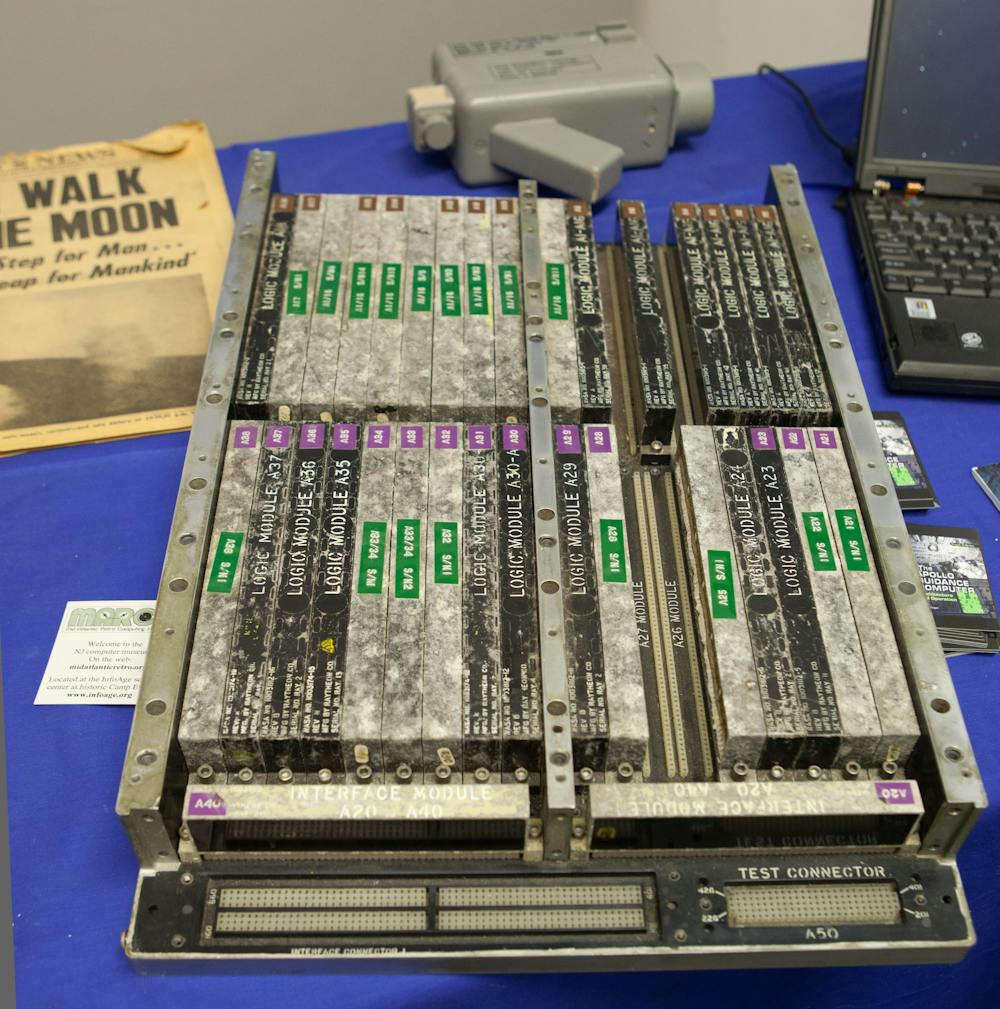

Manned missions required more complex systems than earlier, unmanned ones. For example, in 1951, the Universal Automatic Computer was capable of 1,905 instructions per second, whereas the Saturn V’s guidance system performed 12,190 instructions per second. The trend toward nimble electronics has continued, with modern hand-held devices routinely capable of performing instructions 120 million times faster than the guidance system that enabled the liftoff of Apollo 11. The need to miniaturize computers for space exploration in the 1960s motivated the entire industry to design smaller, faster and more energy-efficient computers, which have affected practically every facet of life today, from communications to health and from manufacturing to transportation.
4. Global network of ground stations
Communicating with vehicles and people in space was just as important as getting them up there in the first place. An important breakthrough associated with the 1969 lunar landing was the construction of a global network of ground stations, called the Deep Space Network, to let controllers on Earth communicate constantly with missions in highly elliptical Earth orbits or beyond. This continuity was possible because the ground facilities were placed strategically 120 degrees apart in longitude so that each spacecraft would be in range of one of the ground stations at all times.
Because of the spacecraft’s limited power capacity, large antennas were built on Earth to simulate “big ears” to hear weak messages and to act as “big mouths” to broadcast loud commands. In fact, the Deep Space Network was used to communicate with the astronauts on Apollo 11 and was used to relay the first dramatic TV images of Neil Armstrong stepping onto the Moon. The network was also critical for the survival of the crew on Apollo 13 because they needed guidance from ground personnel without wasting their precious power on communications.
Several dozen missions use the Deep Space Network as part of the continuing exploration of our solar system and beyond. In addition, the Deep Space Network permits communications with satellites that are on highly elliptical orbits, to monitor the poles and deliver radio signals.
5. Looking back at Earth
Getting to space has allowed people to turn their research efforts toward Earth. In August 1959, the unmanned satellite Explorer VI took the first crude photos of Earth from space on a mission researching the upper atmosphere, in preparation for the Apollo program.
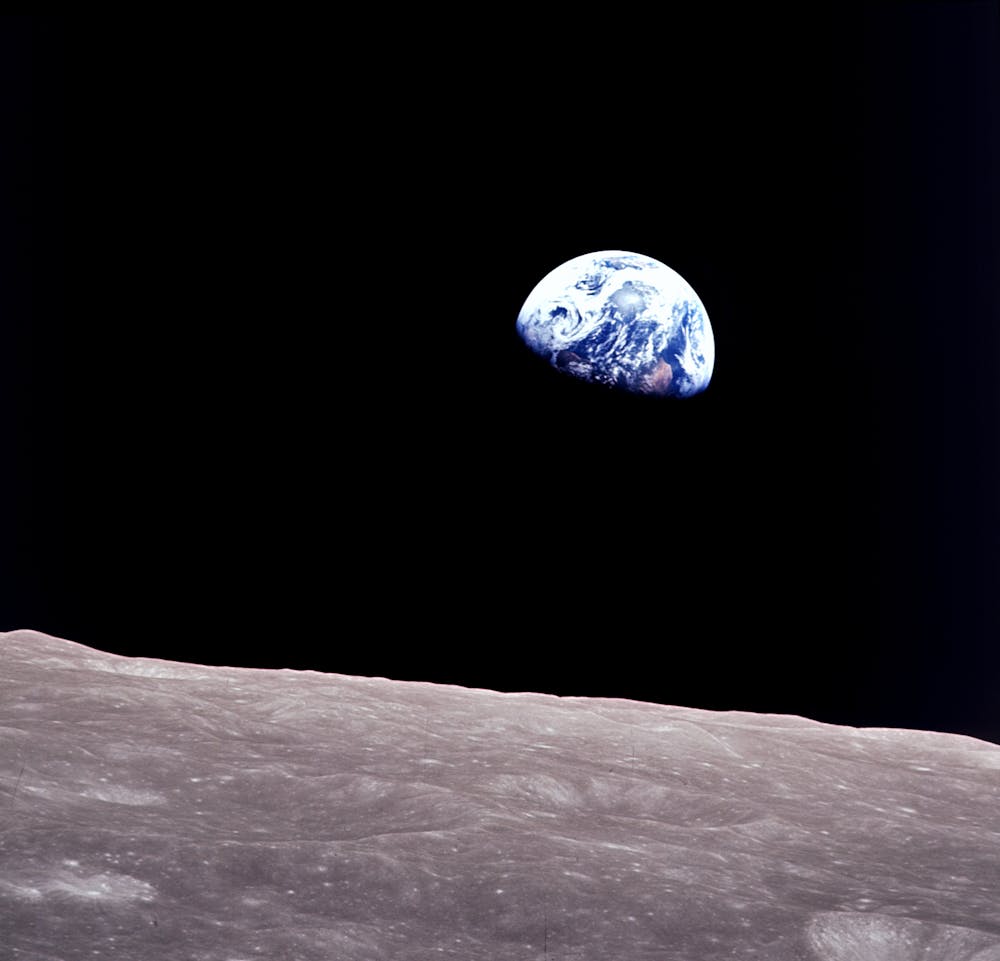
Almost a decade later, the crew of Apollo 8 took a famous picture of the Earth rising over the lunar landscape, aptly named “Earthrise.” This image helped people understand our planet as a unique shared world and boosted the environmental movement.
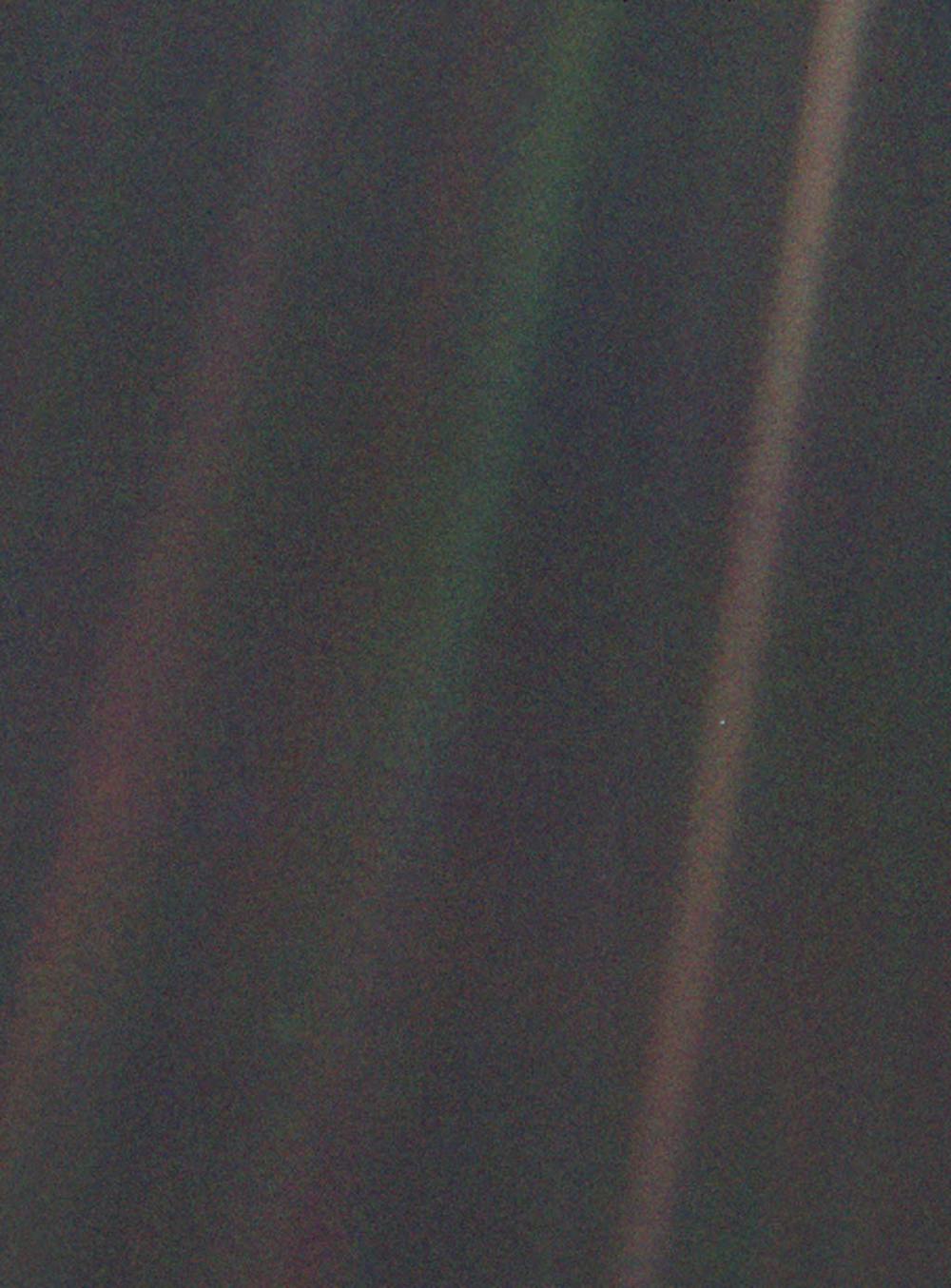
Understanding of our planet’s role in the universe deepened with Voyager 1’s “pale blue dot” photo – an image received by the Deep Space Network.
People and our machines have been taking pictures of the Earth from space ever since. Views of Earth from space guide people both globally and locally. What started in the early 1960s as a U.S. Navy satellite system to track its Polaris submarines to within 600 feet (185 meters) has blossomed into the Global Positioning System network of satellites providing location services worldwide.
Images from a series of Earth-observing satellites called Landsat are used to determine crop health, identify algae blooms and find potential oil deposits. Other uses include identifying which types of forest management are most effective in slowing the spread of wildfires or recognizing global changes such as glacier coverage and urban development.
As we learn more about our own planet and about exoplanets – planets around other stars – we become more aware of how precious our planet is. Efforts to preserve Earth itself may yet find help from fuel cells, another technology from the Apollo program. These storage systems for hydrogen and oxygen in the Apollo Service Module, which contained life-support systems and supplies for the lunar landing missions, generated power and produced potable water for the astronauts. Much cleaner energy sources than traditional combustion engines, fuel cells may play a part in transforming global energy production to fight climate change.
We can only wonder what innovations from the effort to send people to other planets will affect earthlings 50 years after the first Marswalk.
Editor’s note: This article has been updated to correct the description of the placement of the Deep Space Network ground stations.
Jean Creighton, Planetarium Director, NASA Airborne Astronomy Ambassador, University of Wisconsin-Milwaukee
This article is republished from The Conversation under a Creative Commons license. Read the original article.
Dogs available for adoption this week include mixes of Akita, border collie, boxer, German Shepherd, Labrador Retriever, mastiff and spaniel.
Dogs that are adopted from Lake County Animal Care and Control are either neutered or spayed, microchipped and, if old enough, given a rabies shot and county license before being released to their new owner. License fees do not apply to residents of the cities of Lakeport or Clearlake.
If you're looking for a new companion, visit the shelter. There are many great pets hoping you'll choose them.
The following dogs at the Lake County Animal Care and Control shelter have been cleared for adoption (additional dogs on the animal control Web site not listed are still “on hold”).
‘Sadie’
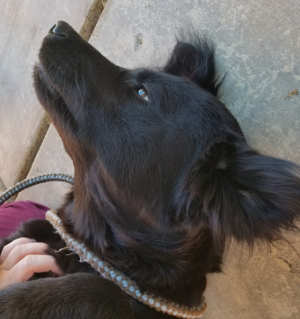
“Sadie” is a female spaniel with a long black coat.
She already has been spayed.
She’s in kennel No. 18, ID No. 12542.
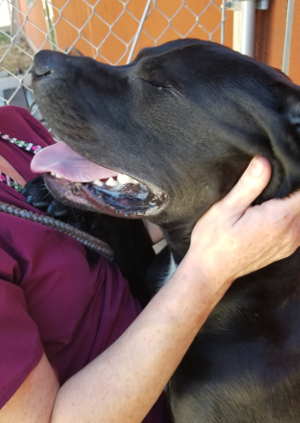
Male pit bull-mastiff
This male pit bull-mastiff has a short black coat.
He’s in kennel No. 21, ID No. 12515.

Female pit bull
This female pit bull has a short black and white coat.
She’s in kennel No. 22, ID No. 12516.

Female German Shepherd
This a female German Shepherd has a medium-length black and brown coat.
She’s in kennel No. 24, ID No. 12376.

‘Cash’
“Cash” is a male pit bull terrier mix with a short black and white coat.
He has been neutered.
He’s in kennel No. 27, ID No. 12413.

‘Mia’
“Mia” is a female Akita with a tricolor coat.
She has already been spayed.
Mia is in kennel No. 28, ID No. 12543.

‘Chucky’
“Chucky” is a male pit bull terrier with a short black and white coat.
He already has been neutered.
He’s in kennel No. 29, ID No. 12523.

Female border collie
This female border collie has a medium-length black and white coat.
She’s in kennel No. 30, ID No. 12522.

‘Buddy’
“Buddy” is a male pit bull terrier mix with a short tricolor coat.
He’s in kennel No. 31, ID No. 12508.

Male boxer
This male boxer has a short black coat.
He’s in kennel No. 32, ID No. 12512.
Lake County Animal Care and Control is located at 4949 Helbush in Lakeport, next to the Hill Road Correctional Facility.
Office hours are Monday through Friday, 11 a.m. to 5 p.m., and 11 a.m. to 3 p.m., Saturday. The shelter is open from 11 a.m. to 4 p.m., Monday through Friday and on Saturday from 11 a.m. to 3 p.m.
Visit the shelter online at http://www.co.lake.ca.us/Government/Directory/Animal_Care_And_Control.htm .
For more information call Lake County Animal Care and Control at 707-263-0278.
Email Elizabeth Larson at
The first of the two fires occurred before 10 a.m. Saturday on Pomo Road at Lakeshore and Woodland.
Lake County Fire Chief Willie Sapeta said a three-story structure was on fire, with firefighters making a “pretty good save” and saving 50 to 75 percent of the structure.
The house wasn’t habitable afterward, and the cause and origin remains under investigation, he said.
He said six engines, a water tender, two medic units and two company officers were part of the response.
Police closed Pomo Road in the fire area while firefighters were at work.
Then, at about 1:30 p.m., Lake County Fire, Northshore Fire and Cal Fire were dispatched to a wildland fire behind the McDonald’s restaurant off Dam Road.
The second fire also prompted police to again issue a road closure notice, this time for Dam Road from the Dam Road Extension to Lake Street. They also closed the parking lots at McDonald’s and Tractor Supply Co.
First units on scene reported the fire was a spot of about 75 by 75 feet, according to radio reports.
Sapeta said the fire burned a total of about two acres.
Firefighters had prepared for evacuations at the nearby Cache Creek Apartments, but didn’t need to initiate them, Sapeta said.
He said the fire spotted a little bit. Firefighters were still checking spots in the fire area into the evening, according to radio reports.
The response included seven engines, two dozers, two crews, one helicopter and two aircraft, he said.
Sapeta said the Dam Road fire’s cause and origin also are not yet determined.
Email Elizabeth Larson at