 How to resolve AdBlock issue?
News
- Details
- Written by: Kara Manke

BERKELEY — Forests’ ability to survive and adapt to the disruptions wrought by climate change may depend, in part, on the eddies and swirls of global wind currents, suggests a new study by researchers at the University of California, Berkeley.
Unlike animals, the trees that make up our planet’s forests can’t uproot and find new terrain if conditions get tough. Instead, many trees produce seeds and pollen that are designed to be carried away by the wind, an adaptation that helps them colonize new territories and maximize how far they can spread their genes.
The new study compared global wind patterns with previously published genetic data of nearly 100 tree and shrub species collected from forests around the world, finding significant correlations between wind speed and direction and genetic diversity throughout our planet’s forests.
The findings are the first to show that wind may not only influence the spread of an individual tree or species’ genes, but it can also help shape genetic diversity and direct the flow of gene variants across entire forests and landscapes.
Understanding how genetic variants move throughout a species range will become increasingly important as climate change alters the conditions of local habitats, the researchers say.
“How trees move and how plants move, in general, is a big area of uncertainty in plant ecology because it's hard to study plant movements directly — they happen as a result small, rare movements of seeds and pollen,” said study lead author Matthew Kling, a postdoctoral researcher in integrative biology at UC Berkeley. “However, to predict how species distributions, and plant ecology, in general, will respond to climate change, we need to understand how these species are going to be able to move long distances to track the movement of natural resources and climate conditions over time.”
While animals, birds and insects can also disperse pollen and seeds, wind’s strong directionality makes it particularly important for understanding how different tree species will respond to climate change, said study senior author David Ackerly, a professor and dean of UC Berkeley’s Rausser College of Natural Resources.
“As the world warms, many plants and animals will need to move to places with suitable habitat in the future to survive,” Ackerly said. “Wind dispersal has a particularly interesting connection to climate change because wind can either push the genes or organisms in the right direction, toward more suitable habitat, or in the opposite direction. It may be the only terrestrial dispersal vector that can be aligned with or against the direction of climate change.”
Any way the wind blows
Despite the fickle nature of daily weather conditions, large-scale global wind patterns are largely determined by Earth’s shape, rotation and the locations of the continents, and are believed to be relatively stable over millennial timescales. These wind patterns are not likely to be dramatically altered by climate change, Kling said.
To examine whether these global prevailing winds have shaped the genetic diversity of modern-day forests, Kling compared current planetary wind models — compiled from 30 years of global wind data — with genetic data from 72 publications covering 97 tree and shrub species and 1,940 plant populations worldwide.
Kling’s analysis revealed three key ways that global wind patterns are shaping forests’ genetic diversity.
First, tree populations that are connected by stronger wind currents tend to be more genetically similar than tree populations that are not as connected.
Second, tree populations that are more downwind, or farther in the direction that the wind blows, tend to have more genetic diversity in general.
Finally, genetic variants are more likely to disperse in the direction of the wind.
Though these patterns can only be statistically validated by looking at many populations of trees throughout the world, they can sometimes be evident when examining the genetic diversity of a single tree species across its habitat range, Kling said.
For example, the island scrub oak, or Quercus pacifica, is native to the Channel Islands in Southern California, where prevailing winds tend to blow to the southeast.
Kling’s analysis showed that scrub oak populations on islands that are connected by higher wind speeds are more genetically similar to each other.
Genetic variants also appear to have dispersed more frequently to the islands in the southward and eastward directions than the reverse, leading to greater genetic diversity to the south and east.
Kling hopes that recognizing these patterns will help conservationists and ecologists better understand how well tree and plant species in different regions of the globe will adapt to a warming world.
“Populations in different portions of a species range have evolved over time to be well-adapted to the climate in that specific part of the range, and as climate changes, they can become out of sync with those conditions,” Kling said. “Understanding how quickly genetic variants from elsewhere in the species range can get where they are needed is important for understanding how quickly the species will respond to climate change, and how vulnerable, versus resilient, a given population might be.”
This research was supported by a National Science Foundation Graduate Research Fellowship.
Kara Manke writes for the UC Berkeley News Center.
- Details
- Written by: Elizabeth Larson
Dogs available for adoption this week include mixes of Belgian Malinois, chihuahua, corgi, dachshund, German Shepherd, husky, pit bull, Rottweiler and Scottish Terrier.
Dogs that are adopted from Lake County Animal Care and Control are either neutered or spayed, microchipped and, if old enough, given a rabies shot and county license before being released to their new owner. License fees do not apply to residents of the cities of Lakeport or Clearlake.
The following dogs at the Lake County Animal Care and Control shelter have been cleared for adoption (additional dogs on the animal control website not listed are still “on hold”).
Call Lake County Animal Care and Control at 707-263-0278 or visit the shelter online at http://www.co.lake.ca.us/Government/Directory/Animal_Care_And_Control.htm for information on visiting or adopting.

‘Abigail’
“Abigail” is a young female pit bull terrier with a short tan and white coat.
She is in kennel No. 19, ID No. 14552.

Male Belgian Malinois
This young male Belgian Malinois has a short black and tan coat.
He is in kennel No. 20, ID No. 14521.

Chihuahua-Dachshund mix
This male Chihuahua-Dachshund mix has a short tan and white coat.
He is in kennel No. 21, ID No. 14553.

Female pit bull terrier
This female pit bull terrier has a short blue and white coat.
She is in kennel No. 22, ID No. 14486.

Corgi-shepherd mix
This male corgi-shepherd mix has a short brown and brindle coat.
He is in kennel No. 23, ID No. 14561.

Female pit bull terrier
This female pit bull terrier has a short black and white coat.
She is in kennel No. 24, ID No. 14536.

‘Ella’
“Ella” is a female German Shepherd with a medium-length tan coat.
She is in kennel No. 25, ID No. 14510.

Female pit bull terrier
This female pit bull terrier has a short red and white coat.
She is in kennel No. 26, ID No. 14550.

Rottweiler-pit bull mix
This female Rottweiler-pit bull mix has a short black coat.
She has been spayed.
She is in kennel No. 27, ID No. 14551.

‘Brutus’
“Brutus” is a male pit bull terrier with a short gray and white coat.
He is in kennel No. 28, ID No. 14507.
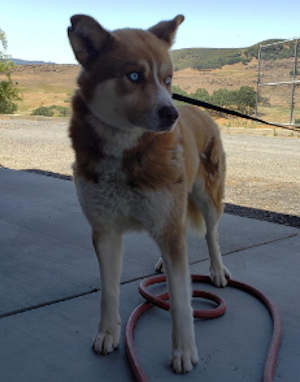
‘Apollo’
“Apollo” is a male husky mix with a medium-length red and white coat and blue eyes.
He is in kennel No. 31, ID No. 14569.

‘Ghost’
“Ghost” is as male husky mix with a white coat and blue eyes.
He has been neutered.
He’s in kennel No. 32, ID No. 14563.

‘Bonnie Blue’
“Bonnie Blue” is a female Scottish Terrier with a long tan coat.
She is in kennel No. 34, ID No. 14560.
Email Elizabeth Larson at
- Details
- Written by: NATIONAL AERONAUTICS AND SPACE ADMINISTRATION
A new video gives viewers the sensation of standing on the Red Planet and seeing the action firsthand.
When NASA’s Ingenuity Mars Helicopter took to the Martian skies on its third flight on April 25, the agency’s Perseverance rover was there to capture the historic moment.
Now NASA engineers have rendered the flight in 3D, lending dramatic depth to the flight as the helicopter ascends, hovers, then zooms laterally off-screen before returning for a pinpoint landing.
Seeing the sequence is a bit like standing on the Martian surface next to Perseverance and watching the flight firsthand.
Located on the rover’s mast, or “head,” the zoomable dual-camera Mastcam-Z imager provided the view. Along with producing images that enable the public to follow the rover’s daily discoveries, the cameras provide key data to help engineers navigate and scientists choose interesting rocks to study.
Justin Maki, an imaging scientist at NASA’s Jet Propulsion Laboratory in Southern California, led the team that stitched the images into a video. The frames of the video were reprojected to optimize viewing in an anaglyph, or an image seen in 3D when viewed with color-filtered glasses (you can create your own 3D glasses in a few minutes).
Maki’s been creating 3D imaging of Mars since his days as a graduate student processing images from NASA’s Sojourner, the first Mars rover in 1997. But this is the first time he’s created actual 3D video of an aircraft flying on Mars.
“The Mastcam-Z video capability was inherited from the Mars Science Laboratory MARDI (MArs Descent Imager) camera,” Maki said. “To be reusing this capability on a new mission by acquiring 3D video of a helicopter flying above the surface of Mars is just spectacular.” The videos of the helicopter are the most extensive 3D video yet from the Mastcam-Z team.
The rover’s drivers and robotic-arm operators use a more sophisticated 3D system to understand exactly how things are positioned on Mars before planning the rover’s movements.
But, according to Maki, team members have also been viewing still 3D images for rover-drive planning.
“A helicopter flying on Mars opens a new era for Mars exploration. It’s a great demonstration of a new technology for exploration,” he added. “With each flight we open up more possibilities.”
The April 25 flight brought with it several other firsts, with Ingenuity rising 16 feet, then flying downrange 164 feet. That was a record until Ingenuity traveled 873 feet on its fourth flight, on April 30.
For its fifth flight, on May 7, Ingenuity completed its first one-way trip, traveling 423 feet, then reaching an altitude of 33 feet above its new landing field.
The flights began as a technology demonstration intended to prove that powered, controlled flight on Mars is possible. Now they will serve as an operations demonstration, exploring how aerial scouting and other functions could benefit future exploration of Mars.
More about Perseverance
Arizona State University in Tempe leads the operations of the Mastcam-Z instrument, working in collaboration with Malin Space Science Systems in San Diego.
A key objective for Perseverance’s mission on Mars is astrobiology, including the search for signs of ancient microbial life. The rover will characterize the planet’s geology and past climate, pave the way for human exploration of the Red Planet, and be the first mission to collect and cache Martian rock and regolith (broken rock and dust).
Subsequent NASA missions, in cooperation with ESA (European Space Agency), would send spacecraft to Mars to collect these sealed samples from the surface and return them to Earth for in-depth analysis.
The Mars 2020 Perseverance mission is part of NASA’s Moon to Mars exploration approach, which includes Artemis missions to the Moon that will help prepare for human exploration of the Red Planet.
JPL, which is managed for NASA by Caltech in Pasadena, California, built and manages operations of the Perseverance rover.
For more about Perseverance visit www.mars.nasa.gov/mars2020/ and www.nasa.gov/perseverance.
- Details
- Written by: Lake County News reports
Assemblymember Cecilia Aguiar-Curry announced the governor’s renewed commitment to research on and revitalization of Clear Lake through the Blue Ribbon Committee established by her AB 707.
Newsom’s focus on climate change includes $371 million from the general fund to be used over two years “to facilitate groundwater recharge and capture of flood flows by repairing canals damaged by subsidence, support the state cost-share of critical federal urban flood risk reduction projects, and advance detailed, watershed-scale studies of likely climate effects to give local water managers better data for local decision-making, including rehabilitation strategies at Clear Lake,” the budget summary explained.
“Clear Lake is a beautiful and valuable natural resource in Northern California. The regional economy and the well-being of Lake County’s residents and wildlife depend on its health,” Aguiar-Curry said.
“Sec. Wade Crowfoot and the members of the committee have done amazing work during the past few years to propose several initiatives to rehabilitate the lake and lakeshore. The governor's commitment to the recommendations by our Blue Ribbon Committee and my request to the Assembly Budget Committee will usher in the next phase of research and projects,” Aguiar-Curry said.
In addition to continuing to generate data on lake quality and health, the funding will support projects to restore indigenous plant populations, provide fish passage, rehabilitate or remove dilapidated shoreline structures, and remove acres of invasive shoreline vegetation that prevent access to the lake, restrict water flows and provide breeding grounds for West Nile-carrying mosquitoes.
Members of the Blue Ribbon Committee were outlined in AB 707 and include significant participation from local officials, Lake County tribal nations, local experts and community members.
Aguiar-Curry represents the Fourth Assembly District, which includes all of Lake and Napa Counties, parts of Colusa, Solano and Sonoma counties, and all of Yolo County except West Sacramento.