 How to resolve AdBlock issue?
News
- Details
- Written by: Lake County News reports
The restrictions are for public lands managed by the Central Coast, Mother Lode and Ukiah field offices due to dry conditions and wildland fire danger.
These seasonal restrictions are in addition to the year-round statewide fire prevention order, issued on April 28, 2020, and will remain in effect until further notice.
BLM-managed public lands affected by the restrictions are primarily located in Amador, Calaveras, Colusa, El Dorado, western Fresno, Glenn, Lake, Marin, Mariposa, Mendocino, Monterey, Napa, Nevada, Placer, Sacramento, San Benito, Santa Cruz, Solano, Sonoma, Tuolumne, Yolo and Yuba counties.
The fire restrictions will also apply at popular recreational areas along the American, South Yuba and Merced rivers, as well as at Panoche, Tumey and Griswold hills; Berryessa Snow Mountain National Monument; North Cow Mountain Rifle Range; and Indian Valley Management Area.
Campfires and target shooting are also always prohibited at Fort Ord National Monument due to munitions hazards and public safety.
Fire prevention orders for the Central Coast, Mother Lode and Ukiah field offices are available online.
On average, human-caused wildfires make up 95% of all wildfires in California.
Records show recreational target shooting has sparked more than half the wildland fires within some field office boundaries in the last decade.
Many of these wildfires occur close in proximity to roadways, communities and recreational areas, posing considerable threat to public safety.
Taking individual responsibility to reduce wildfire risk while recreating on public lands, around homes and communities, before a fire occurs, can help keep property, the public, and wildland firefighters safe.
In 2020, approximately 275 wildland fires burned nearly 200,000 acres of BLM-managed public lands in California.
An increase in wildfire severity is expected based on forecast climate scenarios, as well as an expansion of wildfire season over much of the western United States.
The following restrictions will remain in place until the fire danger subsides:
— No campfires, barbecues or open fires, except in a developed campground. Portable stoves with gas, jellied petroleum, or pressurized liquid fuel are allowed with a valid California campfire permit available free at all BLM, U.S. Forest Service and Cal Fire offices, or at https://www.readyforwildfire.org/prevent-wildfire/campfire-safety/ .
— No target shooting — hot bullet fragments, exploding targets and metal from recreational shooting can spark a wildfire. Use of firearms for hunting is still allowed. Hunters must abide by state of California laws and regulations. Visit www.wheretoshoot.org for alternative recreational target shooting locations.
— No motorized vehicles off BLM designated roads or trails.
— No tools powered by internal combustion engines off BLM designated roads or trails (such as chain saws or lawn mowers).
— No smoking, except within an enclosed vehicle or building, at a developed recreation site, or other designated areas.
— No welding or operating acetylene or other torch with open flame.
Anyone found guilty of violating a fire prevention order may be fined not more than $100,000 and/or imprisonment for not more than 12 months. Restitution for total fire suppression and damage costs incurred may be borne by the trespasser.
To learn how you can do your part to prevent wildland fires visit www.readyforwildfire.org.
A listing of fire restrictions throughout BLM California is available at https://go.usa.gov/xmUEG.
For specific questions, please contact the Central Coast Field Office at 831-582-2200, Mother Lode Field Office at 916-941-3101 or the Ukiah Field Office at 707-468-4000.
- Details
- Written by: Elizabeth Larson
The council will meet in closed session at 5:15 p.m. to discuss labor negotiations before the public portion of the meeting begins at 6 p.m. Tuesday, May 18.
The agenda can be found here.
To speak on an agenda item, access the meeting remotely here or join by phone by calling toll-free 669-900-9128 or 346-248-7799. The webinar ID is 973 6820 1787, access code is 477973; the audio pin will be shown after joining the webinar. Those phoning in without using the web link will be in “listen mode” only and will not be able to participate or comment.
Comments can be submitted by email to
Indicate in the email subject line "for public comment" and list the item number of the agenda item that is the topic of the comment. Comments that read to the council will be subject to the three minute time limitation (approximately 350 words). Written comments that are only to be provided to the council and not read at the meeting will be distributed to the council prior to the meeting.
On Tuesday, the council will present proclamations designating the week of May 22 through 28 as Safe Boating Week and the month of May as California Tourism Month.
The Lake County Tourism Improvement District Board also will give the council an update.
The council also will get a formal introduction to new Lakeport Fire Protection District Fire Chief Jeffery Thomas, who started work with the district at the start of April.
On Tuesday, Police Chief Brad Rasmussen will present the Illegal Fireworks Operation Plan for the 30-day period — June 17 through July 16 — surrounding July 4.
Finance Director Nick Walker will present staff’s recommendation to adopt a proposed resolution which would approve the future issuance of one or more series of pension obligation bonds, approve a form of indenture of trust pursuant to which the bonds would be issued and authorize the commencement of a judicial validation action related to the issuance of pension obligation bonds.
“If the resolution is adopted, City staff would return to the City Council for a future approval of the final terms of any series of bonds, following the conclusion of the validation action, and prior to actual issuance,” Walker said in his written report.
Walker said the city’s unfunded accrued liability for its CalPERS Miscellaneous and Safety Plans has grown 22%, from $6.9 million to about $8.4 million.
That unfunded accrued liability represents the shortfall or gap between what is needed to pay retiree benefits versus how much in current assets the city actually has in its accounts with CalPERS, Walker said.
Walker explained that, combined with remaining principal on the lease agreement with Umpqua Bank that the city entered into in 2015 to restructure a portion of its then-existing unfunded accrued liability, the city has about $10.4 million in pension liability on its balance sheet.
He said Mayor Kenny Parlet is also being asked to appoint two council members to a Unfunded Accrued Liability Policy and Restructuring Ad Hoc Committee for policy recommendations and evaluating restructuring options.
On the consent agenda – items considered noncontroversial and usually accepted as a slate on one vote – are ordinances, minutes of the regular council meeting on May 4; the May 10 warrant register; approval of event application 2021-006, with staff recommendations, for the 2021 Old Time Machines Car Show on Aug. 14; approval of event application 2021-009, with staff recommendations, for the Lakeport Inside Out events to be held on the second Thursday of each month through Oct. 14; approval of event application 2021-010, with staff recommendations, for the 2021 Fourth of July Arts & Crafts Fair on July 4, 2021; approval of event application 2021-011, with staff recommendations, for the 2021 Taste of Lake County event on Aug. 28; approval of event application 2021-012, with staff recommendations, for the 2021 Pumpkin and Dia de los Muertos Festival on Oct. 2; approval of event application 2021-013, with staff recommendations, for the 2021 Trick or Treat Main Street event on Oct. 29; Approval of event application 2021-014, with staff recommendations, for the 2021 Dickens’ Faire on Nov. 27, 2021; review and filing of the draft minutes of the Measure Z Advisory Committee meeting of April 21; and rejection of all bids for the standby water generator procurement because doing so best serves the interests of the city.
Email Elizabeth Larson at
- Details
- Written by: Elizabeth Larson
The meeting will begin at 9 a.m. Tuesday, May 18, in the board chambers on the first floor of the Lake County Courthouse, 255 N. Forbes St., Lakeport.
The meeting can be watched live on Channel 8, online at https://countyoflake.legistar.com/Calendar.aspx and on the county’s Facebook page. Accompanying board documents, the agenda and archived board meeting videos also are available at that link.
To participate in real-time, join the Zoom meeting by clicking this link.
The meeting ID is 987 0009 0403, pass code 439955. The meeting also can be accessed via one tap mobile at +16699006833,,98700090403#,,,,*439955#.
All interested members of the public that do not have internet access or a Mediacom cable subscription are encouraged to call 669-900-6833, and enter the Zoom meeting ID and pass code information above.
To submit a written comment on any agenda item please visit https://countyoflake.legistar.com/Calendar.aspx and click on the eComment feature linked to the meeting date. If a comment is submitted after the meeting begins, it may not be read during the meeting but will become a part of the record.
At 9:06 a.m., the board will present a proclamation designating the week of May 22 through 28 as National Safe Boating Week
At 9:45 a.m., Sen. Mike McGuire will give the board a presentation on the Smart Start Bright Future Initiative, which focuses on supportives services for county children.
In untimed items, the board will consider several assessment appeals for properties around Lake County.
The full agenda follows.
CONSENT AGENDA
5.1: Adopt proclamation designating the week of May 22 through 28, 2021, as National Safe Boating Week in Lake County.
5.2: Adopt resolution authorizing the standard agreement between the county of Lake and the Mental Health Services Oversight and Accountability Commission for the period beginning upon Contract Execution through March 31, 2025, and authorize the Behavioral Health Services director to sign the standard agreement and grant award claim form.
5.3: Appoint the Public Services director and Public Works director, or their designees, to serve as the negotiating team relative to the purchase of property for the Eastlake Landfill Expansion Project.
5.4: Adopt resolution authorizing the Public Works director to sign the notice of completion for the Clayton Creek Road at Clayton Creek Bridge Replacement Project; Federal Aid Project No. BRLO-5914(077); Bid No. 20-10.
5.5: Approve fifth amendment to the lease agreement between county of Lake and NL Family Trust/KLA Family Trust for the property located at 1216, 1222 and 1228 S. Main Street in Lakeport, for the amount of $20,890.32 per fiscal year, from July 1, 2021 to June 30, 2022, and authorize the chair to sign.
5.6: Approve lease agreement between county of Lake and Schall Investments Corp. for the property located at 805 and 809 S. Main Street, Lakeport, in the amount of $34,020 Per fiscal year, from July 1, 2021 to June 30, 2022, and authorize the chair to sign.
5.7: Approve letter of support to the Senate Budget and Fiscal Review Sub. No. 3 and Assembly Budget Sub. No. 1 California State General Fund Request; from the County Welfare Directors Association who is co-sponsoring a budget request with Children Now to Invest $50 Million State Funds in Year 1, and $100 million on going, to support statewide implementation of the prevention services provisions of the Family First Prevention Services Act for child welfare services and authorize the chair to sign.
TIMED ITEMS
6.2, 9:06 a.m.: Presentation of proclamation designating the week of May 22 through May 28, 2021, as National Safe Boating Week in Lake County.
6.3, 9:45 a.m.: Presentation to the board regarding the Smart Start Bright Future Initiative.
UNTIMED ITEMS
8.1: Approve stipulation on the following assessment appeal applications: Appeal Number 09-2019 Locke, Appeal Number 27-2019 and 28-2019 Nguyen, Appeal Number 42-2019 Ireland, Appeal Number 43-2019 Sperling.
8.2: Accept request for withdrawal on the following assessment appeal applications: Appeal Number 20-2019 American Tower, Appeal Number 22-2019 Brookes, Appeal Number 26-2019 Flores, Appeal Number 32-2019 to 34-2019 Turner, Appeal Number 35-2019 Dolgen, Appeal Number 36-2019 Mather, Appeal Number 39-2019 Aitchison and Appeal Number 40-2019 Shannon Wine.
8.3: Continue the following assessment appeal applications: Appeal Numbers 01-2019, 04-2019, 05-2019, 06-2019, 07-2019, 08-2019, 10-2019, 11-2019, 12-2019, 13-2019, 14-2019, and 15-2019 Weston, Appeal Number 23-2019 Weese, Appeal Numbers 37-2019 and 38-2019 Safeway, Appeal Number 41-2019 Worldmark.
8.4: Deny the following assessment appeal applications on timeliness, as no request for hearing received: Appeal Number 18-2019 Rachynsky, Appeal Number 25-2019 Dunker, Appeal Numbers 29-2019, 30-2019 and 31-2019 Shekou Management.
CLOSED SESSION
9.1: Conference with legal counsel: Existing litigation pursuant to Gov. Code section 54956.9(d)(1) -Center for Biological Diversity v. County of Lake, et al.
9.2: Conference with legal counsel: Existing litigation pursuant to Gov. Code section 54956.9(d)(1) – California Native Plant Society v. County of Lake, et al.
9.3: Public employee appointment pursuant to Gov. Code Section 54957(b)(1): Appointment of Public Health officer.
9.4: Conference with legal counsel: Significant exposure to litigation pursuant to Gov. Code section 54956.9 (d)(2), (e)(1) – One potential case.
Email Elizabeth Larson at
- Details
- Written by: Mojtaba Sadegh, Boise State University; Amir AghaKouchak, University of California, Irvine, and John Abatzoglou, University of California, Merced
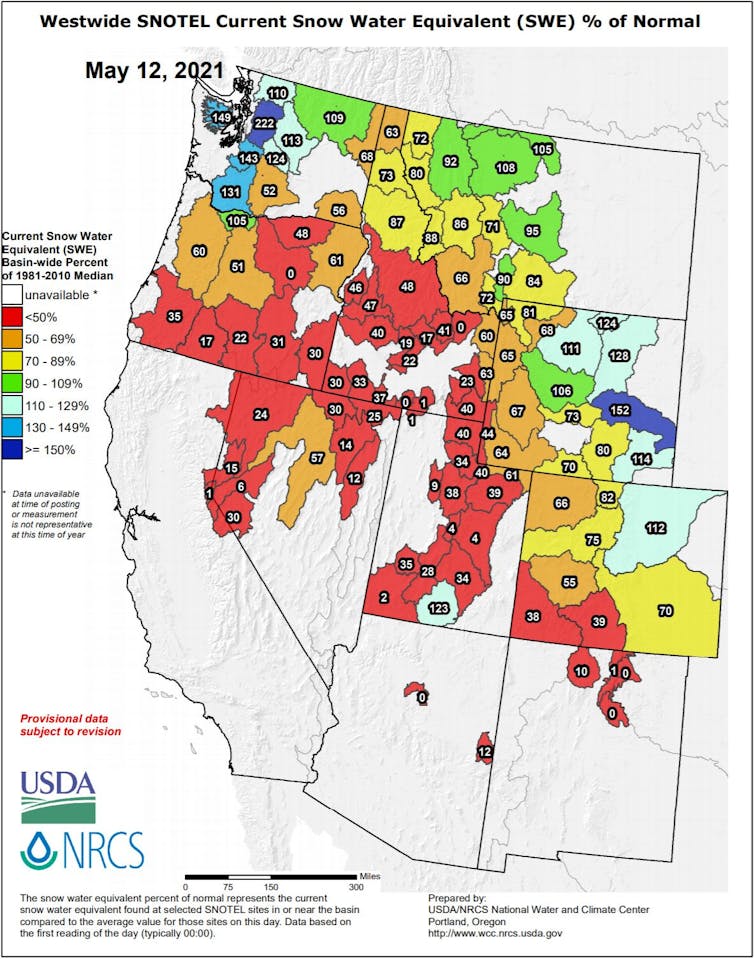
Just about every indicator of drought is flashing red across the western U.S. after a dry winter and warm early spring. The snowpack is at less than half of normal in much of the region. Reservoirs are being drawn down, river levels are dropping and soils are drying out.
It’s only May, and states are already considering water use restrictions to make the supply last longer. California’s governor declared a drought emergency in 41 of 58 counties. In Utah, irrigation water providers are increasing fines for overuse. Some Idaho ranchers are talking about selling off livestock because rivers and reservoirs they rely on are dangerously low and irrigation demand for farms is only just beginning.
Scientists are also closely watching the impact that the rapid warming and drying is having on trees, worried that water stress could lead to widespread tree deaths. Dead and drying vegetation means more fuel for what is already expected to be another dangerous fire season.
U.S. Interior Secretary Deb Haaland and Agriculture Secretary Tom Vilsack told reporters on May 13, 2021, that federal fire officials had warned them to prepare for an extremely active fire year. “We used to call it fire season, but wildland fires now extend throughout the entire year, burning hotter and growing more catastrophic in drier conditions due to climate change,” Vilsack said.
As climate scientists, we track these changes. Right now, about 84% of the western U.S. is under some level of drought, and there is no sign of relief.
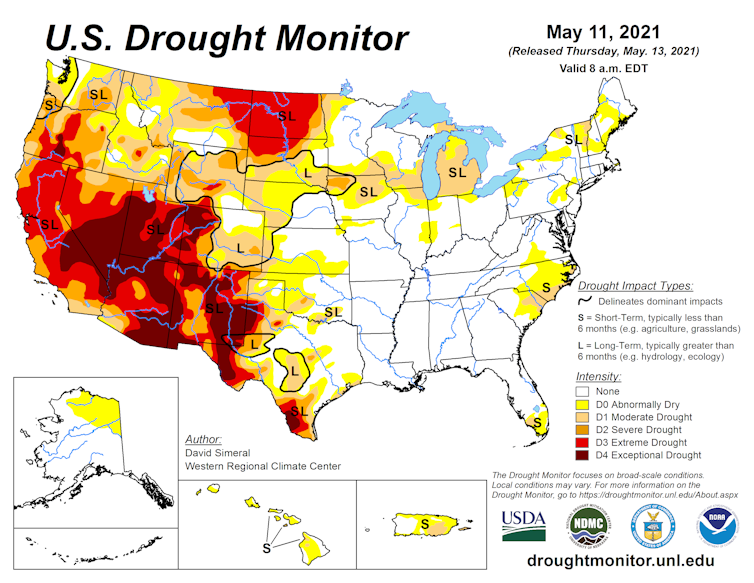
The many faces of drought
Several types of drought are converging in the West this year, and all are at or near record levels.
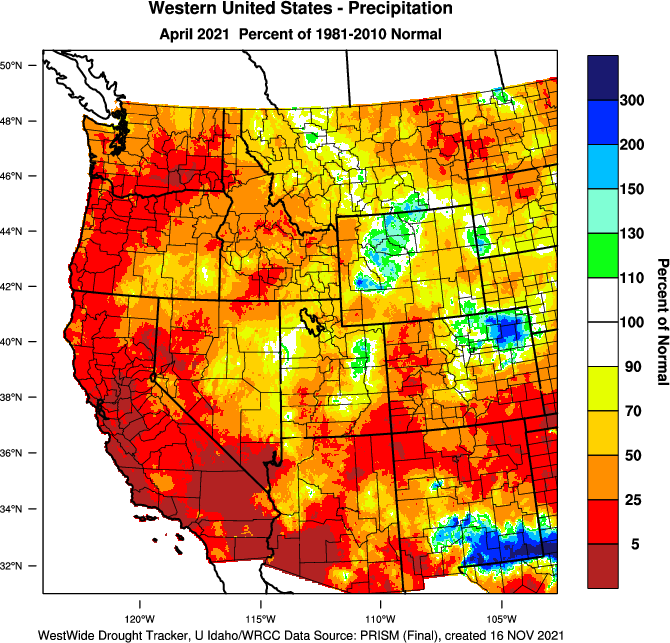
When too little rain and snow falls, it’s known as meteorological drought. In April, precipitation across large parts of the West was less than 10% of normal, and the lack of rain continued into May.
Rivers, lakes, streams and groundwater can get into what’s known as hydrological drought when their water levels fall. Many states are now warning about low streamflow after a winter with less-than-normal snowfall and warm spring temperatures in early 2021 speeding up melting. The U.S. Bureau of Reclamation said Lake Mead, a giant Colorado River reservoir that provides water for millions of people, is on pace to fall to levels in June that could trigger the first federal water shortage declaration, with water use restrictions across the region.
Dwindling soil moisture leads to another problem, known as agricultural drought. The average soil moisture levels in the western U.S. in April were at or near their lowest levels in over 120 years of observations.
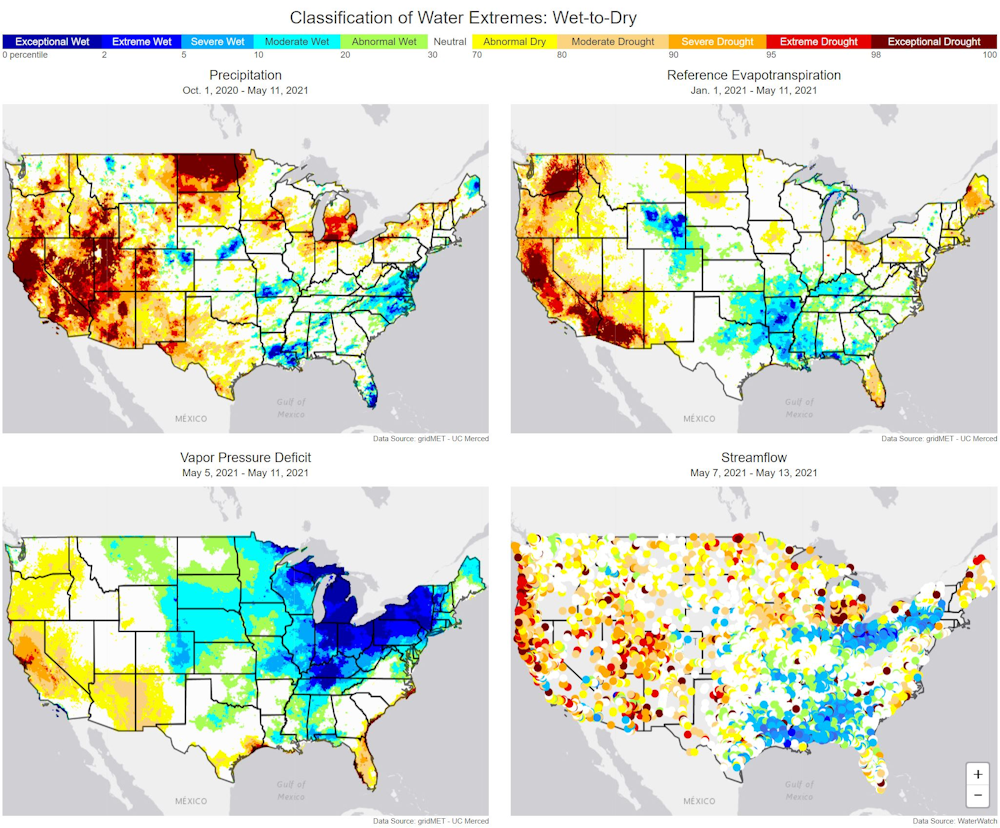
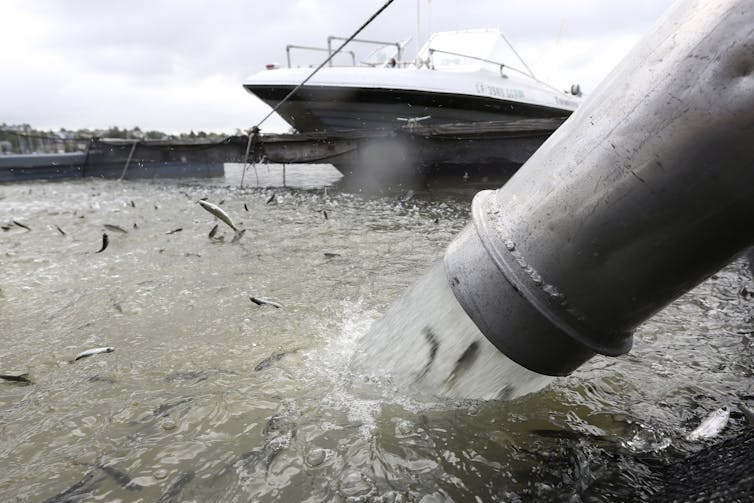
These factors can all drive ecosystems beyond their thresholds – into a condition called ecological drought – and the results can be dangerous and costly. Fish hatcheries in Northern California have started trucking their salmon to the Pacific Ocean, rather than releasing them into rivers, because the river water is expected to be at historic low levels and too warm for young salmon to tolerate.
Snow drought
One of the West’s biggest water problems this year is the low snowpack.
The western U.S. is critically dependent on winter snow slowly melting in the mountains and providing a steady supply of water during the dry summer months. But the amount of water in snowpack is on the decline here and across much of the world as global temperatures rise.
Several states are already seeing how that can play out. Federal scientists in Utah warned in early May that more water from the snowpack is sinking into the dry ground where it fell this year, rather than running off to supply streams and rivers. With the state’s snowpack at 52% of normal, streamflows are expected to be well below normal through the summer, with some places at less than 20%.
Anthropogenic drought
It’s important to understand that drought today isn’t only about nature.
More people are moving into the U.S. West, increasing demand for water and irrigated farmland. And global warming – driven by human activities like the burning of fossil fuels – is now fueling more widespread and intense droughts in the region. These two factors act as additional straws pulling water from an already scarce resource.
As demand for water has increased, the West is pumping out more groundwater for irrigation and other needs. Centuries-old groundwater reserves in aquifers can provide resilience against droughts if they are used sustainably. But groundwater reserves recharge slowly, and the West is seeing a decline in those resources, mostly because water use for agriculture outpaces their recharge. Water levels in some wells have dropped at a rate of 6.5 feet (2 meters) per year.
The result is that these regions are less able to manage droughts when nature does bring hot, dry conditions.
Rising global temperatures also play several roles in drought. They influence whether precipitation falls as snow or rain, how quickly snow melts and, importantly, how quickly the land, trees and vegetation dry out.
Extreme heat and droughts can intensify one another. Solar radiation causes water to evaporate, drying the soil and air. With less moisture, the soil and air then heat up, which dries the soil even more. The result is extremely dry trees and grasses that can quickly burn when fires break out, and also thirstier soils that demand more irrigation.
Alarmingly, the trigger for the drying and warming cycle has been changing. In the 1930s, lack of precipitation used to trigger this cycle, but excess heat has initiated the process in recent decades. As global warming increases temperatures, soil moisture evaporates earlier and at larger rates, drying out soils and triggering the warming and drying cycle.
Fire warnings ahead
Hot, dry conditions in the West last year fueled a record-breaking wildfire season that burned over 15,900 square miles (41,270 square kilometers), including the largest fires on record in Colorado and California.
As drought persists, the chance of large, disastrous fires increases. The seasonal outlook of warmer and drier-than-normal conditions for summer and fire season outlooks by federal agencies suggest another tough, long fire year is ahead.
[Get the best of The Conversation, every weekend. Sign up for our weekly newsletter.]
This article was updated with a statement from Secretaries Deb Haaland and Tom Vilsack.
Mojtaba Sadegh, Assistant Professor of Civil Engineering, Boise State University; Amir AghaKouchak, Associate Professor of Civil & Environmental Engineering, University of California, Irvine, and John Abatzoglou, Associate Professor of Engineering, University of California, Merced
This article is republished from The Conversation under a Creative Commons license. Read the original article.