 How to resolve AdBlock issue?
News
- Details
- Written by: Elizabeth Larson
Every 10 years, the commission redraws those state and federal district boundaries based on the latest census data.
The resulting district boundaries will determine how funding and other resources are allocated to communities.
The commission’s work is separate from a process now getting underway to redraw the Lake County Board of Supervisors’ district boundaries. At its May 11 meeting, the board approved a contract with the firm Prentice Long that’s not to exceed $35,000 to provide consulting on the county process.
Seated in August, the state commission has 14 members, including five Republicans, five Democrats and four members with no party affiliation.
Derric Taylor is one of the Republican commissioners. He’s an investigator with the Los Angeles County Sheriff’s Department and is an active volunteer in the Los Angeles and San Gabriel Valley areas.
Although he’s a Southern California resident, Taylor is working on outreach to counties on California’s North Coast, including Lake.
A married father of three, Taylor said he became interested in joining the commission because it’s a way of modeling how to be a good citizen for his children.
It’s also great to be a witness to the democratic process, he said.
“We’re working for everybody,” he said of the commissioners, noting he doesn’t make decisions solely for his outreach zones and that it’s his duty to consider the people of the entire state. “I’m standing up for all Californians.”
The commissioners are 14 very diverse individuals who are working hard for California, Taylor said.
As part of their work, they are meant to educate the public and also to take as much public input as possible so Californians know their voice is heard in the process and that their opinions impact the final outcome.
Taylor is keen for people to know about the commission, its process and how to participate. He said the commission wants community input to help determine what the boundaries ultimately will look like. “This is a collaborative process in order to make the best possible district lines for reaching community members.”
He added, “To the best of our abilities, given a COVID environment, we want to reach out to all areas of California.”
The outreach team is taking into account the challenges to the rural environment, like broadband, and are trying to address those concerns, he said.
The commission has a nonpartisan purpose. “The goal is fair representation, and I don’t believe that has any affiliation. That’s the ultimate goal,” Taylor said.
They’re already receiving input not just from the public at large but from government bodies like the Lake County Board of Supervisors.
At its April 6 meeting, the board adopted a resolution to send to the commission urging it to keep Lake, Napa and Sonoma counties within the same congressional district due to sharing many interests that “provide strong ties and long-term relationships among our three counties, making common representation and advocacy in a shared Congressional District truly critical.”
The resolution also said that the board found that the three counties’ residents will be best served by remaining in the same congressional district.
The commission has met so far but hasn’t yet gotten down to the work of district boundary work. So far it has focused on organization, hiring staff, holding subcommittee meetings, meeting with state leaders and setting up its community of interest — or COI — tool, which can be found on its website.
The COI tool allows anyone to draw a map, give an explanation of their community and why it should be kept in one district. That tool is available in 12 languages.
Maps that are drawn on paper also can be submitted.
The boundary drawing can’t begin until the commission receives the census data it needs.
While the U.S. Census Bureau released apportionment data during the last week of April, Commission Chair Alicia Fernandez said that data is not what will be used for the redistricting work.
The U.S. Census Bureau said states are expected to receive redistricting data by Aug. 16 and the full redistricting data with tool kits for ease of use will be delivered by Sept. 30.
From there, the commission reported that it will need to format the data in order to use it.
Taylor said the census data — delayed due to the pandemic — is putting the commission in a time crunch, giving them about four months, half a month less than normal.
Just when the commission’s work will be completed “is the million dollar question,” said Taylor. He said the Supreme Court has given the commission until Dec. 15 to put out the maps.
The commission reported that it’s aiming to have one or two draft maps out for public comment before the final maps are completed.
One of the tasks the commission will have to undertake is adjusting lines to account for California’s loss of one congressional district seat because of the shifting population, which the new census data revealed.
California will now have 52 congressional districts, and the commission must redraw the lines to make sure those districts will have near equal populations while following a number of rules that include:
— ensuring minorities have an equal opportunity to elect representatives of their choice;
drawing districts contiguously;
— minimizing the division of cities, counties, neighborhoods and communities;
— creating geographically compact boundaries;
— and when practicable creating Senate districts composed of two complete and adjacent Assembly districts, and Board of Equalization districts composed of 10 complete and adjacent State Senate districts.
One new aspect of the process is that the commission will reallocate inmate numbers from their prison locations to their last known addresses, as state legislators have asked them to do.
It’s meant to more accurately reflect California’s population, although it’s not anticipated to have much of a change on the final lines.
Visit the commission’s website at https://www.wedrawthelinesca.org/ to learn more about meetings and the community of interest tool, or for a community group to schedule a presentation with a commissioner.
The commission also can be reached by email at
Email Elizabeth Larson at
Resolution Urging the California Citizens Redistricting Commission to Ke. by LakeCoNews on Scribd
- Details
- Written by: Lake County News reports
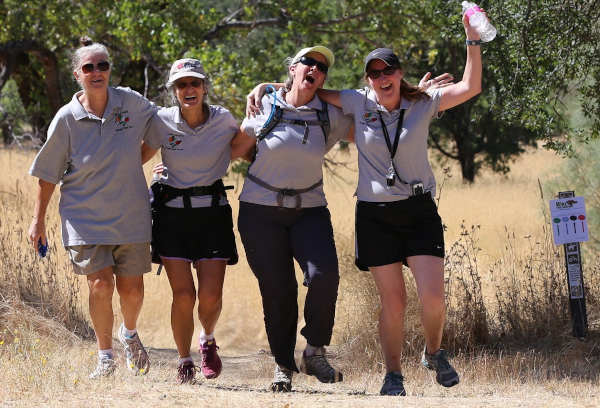
LAKEPORT, Calif. — Hospice Services of Lake County is presenting the sixth annual Hike for Hospice, a fundraising and friend-raising event, on Saturday, June 12, at Highlands Springs Park near Lakeport.
It’s time to lace up those shoes and enjoy a leisurely walk in a beautiful country setting; or for the more serious hiker, a rigorous trek and longer trail is an option.
Participating is free, easy and fun for the whole family or a group of friends while supporting a great cause.
Individuals who want to participate may preregister online at www.lakecountyhospice.org, pick up a registration form at one of the Hospice thrift stores located in Middletown, Clearlake or Lakeport, or contact Hospice to have a registration form mailed.
Hikers are encouraged to donate to Hospice as part of their hiking experience and many participants ask for sponsorships from friends and family to help raise funds. Participants with a minimum donation of $25 will receive an event T-shirt.
On the day of the hike, registration and check-in is from 8 to 9 a.m. at the picnic area near the reservoir.
Hikers taking the 4.5-mile route will start at 8:15 a.m., with 3-milers starting at 8:30 a.m., and the 1- and 2-mile hikers hit the trail at 9:15 a.m.
In the tradition of past Hike for Hospice events, hikers are encouraged to form or join teams. Creative apparel is highly encouraged. Solo hikers are welcome.
When hikers return, the fun continues with refreshments, music, and awards. Prizes will be presented for individual hikers and teams for most money raised and most creative attire.
Highland Springs Park is located at 3600 E. Highland Springs Road in Lakeport, off of Highway 29 past the Lampson Field Airport.
Donations from this event help provide care to residents of Lake County in their last months of life and the organization’s Wings of Hope grief counseling services for children and families who have experienced the death of a loved one.
For more information, to register to hike or to sponsor a hiker, go to www.lakecountyhospice.org, call 707-263-6270, Extension 112, or email
- Details
- Written by: Lake County News reports
The group will meet at 5 p.m. via Zoom.
The meeting ID is 946 2182 6581, pass code is 121115. The meeting also can be accessed via phone at 1-669-900-6833.
The group will host Deputy Water Resources Director Marina Deligiannis, who will give a presentation on Scott Valley’s groundwater, followed by a question-and-answer session.
Under old business, the group will discuss site visits with the US Department of Agriculture’s Natural Resources Conservation Service, the bridge approach over Scotts Creek at Scotts Valley Road and Hendricks and an cannabis early activation permit on Eickhoff Road, the Scotts Valley water basin and mapping of Scotts Creek via drone.
Under new business, they will discuss new use permits and the Scotts Valley Firewise Committee report.
There also will be an open forum for community members to share their concerns with District 4 Supervisor Tina Scott.
- Details
- Written by: Lake County News reports
Cal OES said most properties still need critical soil testing, erosion control and hazard tree removal to ensure the lots are safe for families to rebuild.
In 2020, more than 8,000 climate-induced wildfires burned 4.2 million acres of California, destroying more than 5,700 homes.
Property owners incur no direct costs for participation in the state-managed clean up and recovery program, administered by the California Department of Resources Recycling and Recovery, or CalRecycle, and the California Governor's Office of Emergency Services in collaboration with 25 participating counties.
Major clearing work: 83.4% complete
Wildfire survivors had the option to either use their own contractor or enroll in the state-managed program.
Of the 5,991 properties with damage from the 2020 fires, 3,764 signed up to have the remains of their homes and other structures cleared by the state.
As of May 12, state-managed crews cleared burned metal, concrete, ash and contaminated soil from 3,141 or 83.4% of the properties participating in the program.
That includes about half a dozen properties in southern Lake County impacted by last summer’s LNU Lightning Complex.
Steps left to complete
Before homeowners can begin rebuilding, cleared properties need additional work including:
— Separate contractors collect soil samples for verification at a state certified laboratory that they meet state environmental health and safety standards.
— Contractors next may install erosion control measures.
— Certified arborists or professional foresters assess wildfire-damaged trees in danger of falling on the public or public infrastructure for removal by separate contractors.
— Finally, state officials inspect the property to verify all completed work meets state standards. Debris officials submit a final inspection report to local officials to approve the property for reconstruction.
So far, 940 properties have gone through the entire post-debris removal steps of soil testing, erosion control, and removal of fire-damaged trees in danger of falling on public infrastructure before being returned to the county to begin reconstruction. 897 properties have cleared the entire process.
Property owners can track the above data on the Debris Operations Dashboard for the 2020 statewide wildfires.
The dashboard is updated every hour and provides users with the ability to search by county or address.