 How to resolve AdBlock issue?
News
- Details
- Written by: Karen Sullivan, Kim Riley and Terre Logsdon
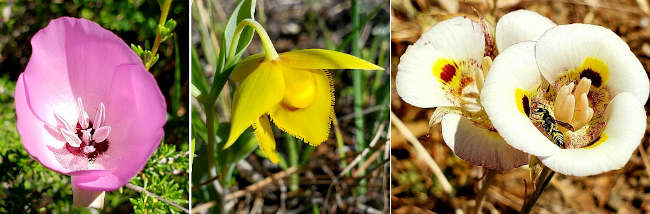
LAKE COUNTY, Calif. — Diminutive in size, but complex in structure and saturated in colors are the calochortus with a variety of common names such as fairy lanterns, star tulips, globe lilies and mariposas, and there are 10 different species to delight the eyes that can be found in Lake County in the forests, grasslands and chaparral areas.
“Calo,” derived from the Greek “kalos,” which means beautiful, and “chortus,” meaning grass, calochortus have a well-deserved reputation for their beauty and diversity.
According to the Pacific Bulb Society, calochortus have a reputation for being difficult to grow in your home garden. While these flowers are bulbs like nonnative daffodils, that reputation is well-deserved as it can take up to six years for seed-grown calochortus bulbs to flower — but if you love them, it can be worth the wait.
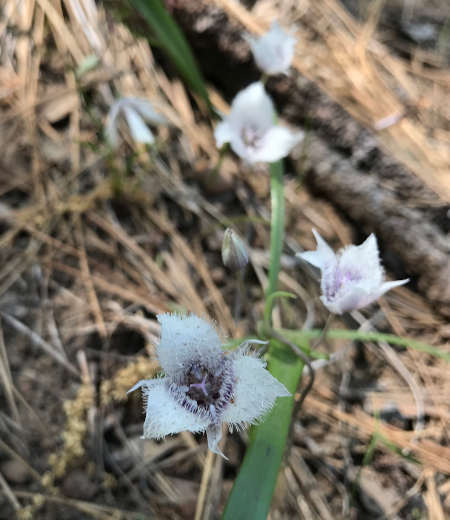
However, according to Mary E. Gerritsen and Ron Parsons in their book, “Calochortus: Mariposa Lilies and their Relatives” (2007), “With their graceful stance, brilliant colors, and intricate markings, members of the North American genus calochortus are among the most dazzling bulbous plants in the world. Yet their mostly undeserved reputation for being difficult to grow has kept them from being known and appreciated by the vast majority of gardeners,” and we agree!
Mariposa, which means “butterfly” in Spanish, have petals that resemble the wings of butterflies which dance and wave in the breeze, attracting all manner of insects to pollinate them.
Growing in grasslands and some open forest floors primarily in the central Coast Ranges and Sierra foothills, mariposas can be found with other varieties like fairy lanterns which are also found in our areas of chaparral.
To see and learn more about the species of calochortus in Lake County, visit CalFlora.

Nurseries where you can purchase calochortus:
Yellow mariposa lily: https://calscape.org/nurseries.php?id=668&showmap=1
Blue star tulip: https://calscape.org/nurseries.php?id=659&showmap=1
Large flowered star tulip: https://calscape.org/nurseries.php?id=687&showmap=1
Golden fairy lantern or globe lily: https://calscape.org/nurseries.php?id=649&showmap=1
Terre Logsdon is an environmentalist, certified master composter, and advocate for agroecology solutions to farming. An avid fan and protector of California wildflowers, plants, natural resources, and the environment, she seeks collaborative solutions to mitigate the effects of climate change. Kim Riley is retired, an avid hiker at Highland Springs, and has lived in Lake County since 1985. After 15 years of trail recovery and maintenance on the Highland Springs trails, she is now focused on native plants, including a native plant and pollinator garden on her property as well as promoting and preserving the beauty of the Highland Springs Recreation Area. Karen Sullivan has operated two nurseries to propagate and cultivate native plants and wildflowers, has lived in Kelseyville for the past 30 years, rides horses far and wide to see as many flowers as possible, and offers native plants and wildflowers for sale to the public. You can check her nursery stock here. They are collaborating on a book, Highland Springs Recreation Area: A Field Guide, which will be published in the future. In the meanwhile, please visit https://www.facebook.com/HighlandSpringsNaturalists and https://www.facebook.com/HighlandSpringsRecreationArea.

- Details
- Written by: David R. Buys, Mississippi State University


More than 2.4 million older adults are supported each year by Meals on Wheels, a program through which seniors and people with disabilities receive healthy and tasty meals for free from a network of volunteers. These efforts are usually organized through local senior centers and other community organizations across the U.S. that encourage the people who receive meals to make voluntary donations to cover at least part of the cost if that’s within their means.
Services like this nonprofit meal delivery program, for which eligibility begins at age 60, are becoming more important than ever before. About 5.3 million people 60 and up, 7.3% of all Americans in that age group, experienced food insecurity in 2018 – meaning that their households couldn’t acquire adequate food because they lacked enough money and other resources.
What’s more, the U.S. population is aging. The number of Americans who are 65 and up grew by one-third over the past decade, to 54 million people.
And, a growing share of the 1 in 6 Americans who are in that demographic group wish to age in place. That is, regardless of how ill or frail they are, they want to stay in their own homes, instead of going to a nursing home or assisted living facility.
No matter where folks live as they age, ailments and physical challenges will almost surely crop up. Those health problems will make getting out and about more difficult, and it will be increasingly hard for them to shop for food, cook meals and even feed themselves.
Daily Meals on Wheels deliveries also make a difference in ways unrelated to nutrition. According to gerontology and health services research Kali Thomas conducted and Meals on Wheels America commissioned, seniors who got hot meals delivered became less concerned about being able to continue living in their own homes. They also felt less isolated and lonely compared to those who received frozen meals, delivered once a week in bulk, or people who received none at all.
Despite those findings, as the COVID-19 pandemic set in, Meals on Wheels volunteers made needed adjustments. They began to drop off more meals at a time, sometimes in multi-week bundles. Rather than speaking with the people receiving food and companionship in person, some agency volunteers made phone calls to connect with them.
In some parts of the country, such as Rowan, North Carolina and Longmont, Colorado, Meals on Wheels saw demand for its deliveries rise. This probably occurred because even older adults who are able to do their own errands were newly homebound due to concerns about the coronavirus, which disproportionately kills elderly people.
Often, volunteer visits are the only in-person interaction a program participant will have that day.
With the majority of older adults in the U.S. now vaccinated against COVID-19, Meals on Wheels volunteers are resuming their traditional social contact. In my view, this is welcome news.
[You’re smart and curious about the world. So are The Conversation’s authors and editors. You can read us daily by subscribing to our newsletter.]
David R. Buys, Associate Professor of Food Science, Nutrition, and Health Promotion; State Health Specialist, MSU Extension, Mississippi State University
This article is republished from The Conversation under a Creative Commons license. Read the original article.
- Details
- Written by: Elizabeth Larson
Dogs available for adoption this week include mixes of chihuahua, corgi, dachshund, German shepherd, husky, pit bull and Rottweiler.
Dogs that are adopted from Lake County Animal Care and Control are either neutered or spayed, microchipped and, if old enough, given a rabies shot and county license before being released to their new owner. License fees do not apply to residents of the cities of Lakeport or Clearlake.
The following dogs at the Lake County Animal Care and Control shelter have been cleared for adoption (additional dogs on the animal control website not listed are still “on hold”).
Call Lake County Animal Care and Control at 707-263-0278 or visit the shelter online at http://www.co.lake.ca.us/Government/Directory/Animal_Care_And_Control.htm for information on visiting or adopting.

Female Rottweiler-shepherd
This female Rottweiler-shepherd mix has a medium-length black and red coat.
She is in kennel No. 12, ID No. 14575.

Male Chihuahua
This male Chihuahua has a short red coat.
He is in kennel No. 13, ID No. 14572.

Female German shepherd
This female German shepherd has a medium-length black and tan coat.
She is in kennel No. 17, ID No. 14566.

Female pit bull terrier
This female pit bull terrier has a short blue and white coat.
She is in kennel No. 22, ID No. 14486.

Female pit bull terrier
This female pit bull terrier has a short red and white coat.
She is in kennel No. 26, ID No. 14550.

Rottweiler-pit bull mix
This female Rottweiler-pit bull mix has a short black coat.
She has been spayed.
She is in kennel No. 27, ID No. 14551.

‘Brutus’
“Brutus” is a male pit bull terrier with a short gray and white coat.
He is in kennel No. 28, ID No. 14507.
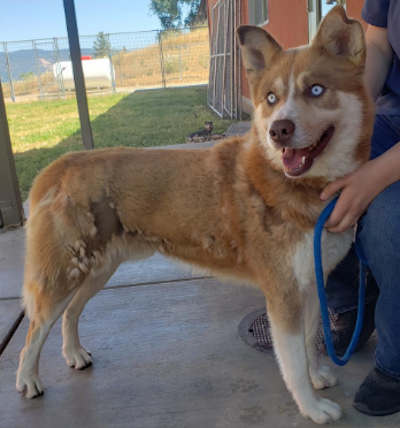
‘Apollo’
“Apollo” is a male husky mix with a medium-length red and white coat and blue eyes.
He is in kennel No. 31, ID No. 14569.

‘Ghost’
“Ghost” is as male husky mix with a white coat and blue eyes.
He has been neutered.
He’s in kennel No. 32, ID No. 14563.
Email Elizabeth Larson at
- Details
- Written by: Lonnie Shekhtman
A NASA team has found that organic salts are likely present on Mars.
Like shards of ancient pottery, these salts are the chemical remnants of organic compounds, such as those previously detected by NASA’s Curiosity rover.
Organic compounds and salts on Mars could have formed by geologic processes or be remnants of ancient microbial life.
Besides adding more evidence to the idea that there once was organic matter on Mars, directly detecting organic salts would also support modern-day Martian habitability, given that on Earth, some organisms can use organic salts, such as oxalates and acetates, for energy.
“If we determine that there are organic salts concentrated anywhere on Mars, we’ll want to investigate those regions further, and ideally drill deeper below the surface where organic matter could be better preserved,” said James M.T. Lewis, an organic geochemist who led the research, published on March 30 in the Journal of Geophysical Research: Planets. Lewis is based at NASA’s Goddard Space Flight Center in Greenbelt, Maryland.
Lewis’s lab experiments and analysis of data from the Sample Analysis at Mars, or SAM, a portable chemistry lab inside Curiosity’s belly, indirectly point to the presence of organic salts.
But directly identifying them on Mars is hard to do with instruments like SAM, which heats Martian soil and rocks to release gases that reveal the composition of these samples.
The challenge is that heating organic salts produces only simple gases that could be released by other ingredients in Martian soil.
However, Lewis and his team propose that another Curiosity instrument that uses a different technique to peer at Martian soil, the Chemistry and Mineralogy instrument, or CheMin for short, could detect certain organic salts if they are present in sufficient amounts. So far, CheMin has not detected organic salts.
Finding organic molecules, or their organic salt remnants, is essential in NASA’s search for life on other worlds. But this is a challenging task on the surface of Mars, where billions of years of radiation have erased or broken apart organic matter.
Like an archaeologist digging up pieces of pottery, Curiosity collects Martian soil and rocks, which may contain tiny chunks of organic compounds, and then SAM and other instruments identify their chemical structure.
Using data that Curiosity beams down to Earth, scientists like Lewis and his team try to piece together these broken organic pieces. Their goal is to infer what type of larger molecules they may once have belonged to and what those molecules could reveal about the ancient environment and potential biology on Mars.
“We’re trying to unravel billions of years of organic chemistry,” Lewis said, “and in that organic record there could be the ultimate prize: evidence that life once existed on the Red Planet.”
While some experts have predicted for decades that ancient organic compounds are preserved on Mars, it took experiments by Curiosity’s SAM to confirm this.
For example, in 2018, NASA Goddard astrobiologist Jennifer L. Eigenbrode led an international team of Curiosity mission scientists who reported the detection of myriad molecules containing an essential element of life as we know it: carbon. Scientists identify most carbon-containing molecules as “organic.”
“The fact that there’s organic matter preserved in 3-billion-year-old rocks, and we found it at the surface, is a very promising sign that we might be able to tap more information from better preserved samples below the surface,” Eigenbrode said. She worked with Lewis on this new study.
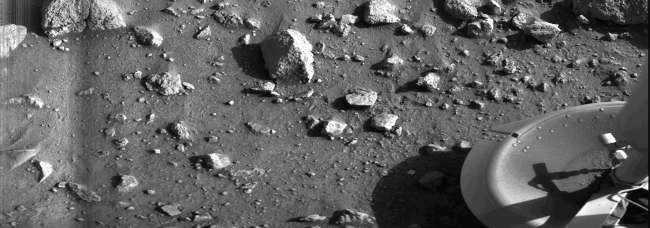
Analyzing organic salts in the lab
Decades ago, scientists predicted that organic compounds on Mars could be breaking down into salts. These salts, they argued, would be more likely to persist on the Martian surface than big, complex molecules, such as the ones that are associated with the functioning of living things.
If there were organic salts present in Martian samples, Lewis and his team wanted to find out how getting heated in the SAM oven could affect what types of gases they would release. SAM works by heating samples to upward of 1,800 degrees Fahrenheit (1,000 degrees Celsius). The heat breaks apart molecules, releasing some of them as gases. Different molecules release different gases at specific temperatures; thus, by looking at which temperatures release which gases, scientists can infer what the sample is made of.
“When heating Martian samples, there are many interactions that can happen between minerals and organic matter that could make it more difficult to draw conclusions from our experiments, so the work we’re doing is trying to pick apart those interactions so that scientists doing analyses on Mars can use this information,” Lewis said.
Lewis analyzed a range of organic salts mixed with an inert silica powder to replicate a Martian rock. He also investigated the impact of adding perchlorates to the silica mixtures. Perchlorates are salts containing chlorine and oxygen, and they are common on Mars. Scientists have long worried that they could interfere with experiments seeking signs of organic matter.
Indeed, researchers found that perchlorates did interfere with their experiments, and they pinpointed how. But they also found that the results they collected from perchlorate-containing samples better matched SAM data than when perchlorates were absent, bolstering the likelihood that organic salts are present on Mars.
Additionally, Lewis and his team reported that organic salts could be detected by Curiosity’s instrument CheMin. To determine the composition of a sample, CheMin shoots X-rays at it and measures the angle at which the X-rays are diffracted toward the detector.
Curiosity’s SAM and CheMin teams will continue to search for signals of organic salts as the rover moves into a new region on Mount Sharp in Gale Crater.
Soon, scientists will also have an opportunity to study better-preserved soil below the Martian surface. The European Space Agency’s forthcoming ExoMars rover, which is equipped to drill down to 6.5 feet, or 2 meters, will carry a Goddard instrument that will analyze the chemistry of these deeper Martian layers.
NASA’s Perseverance rover doesn’t have an instrument that can detect organic salts, but the rover is collecting samples for future return to Earth, where scientists can use sophisticated lab machines to look for organic compounds.
Lonnie Shekhtman works for NASA’s Goddard Space Flight Center in Greenbelt, Maryland.