 How to resolve AdBlock issue?
News
- Details
- Written by: Emily J. Blanchard, Dartmouth College

The Group of 7 is an informal group of seven powerful democracies: Canada, France, Germany, Italy, Japan, the United Kingdom and the United States. The presidents of the European Commission and European Council also attend G-7 meetings because several of Europe’s largest countries are also members.
Membership, which is decided internally, hasn’t changed much since the group’s founding in 1975. At the time, it included only six countries, all of which still belong. Canada joined a year later. Russia joined as an eighth member in 1998, temporarily changing the group’s moniker to the G-8, but Russia was ousted after it annexed Crimea in 2014.
Together, these seven wealthy nations form the foundation of the modern global economy and the cooperative rules-based system on which it is built.

Why the G-7 matters
The G-7 countries make up about 40% of the world economy, down from nearly 70% a few decades ago.
Despite the decline, the economic might of G-7 nations remains undeniable, not least due to their collective position as countries at the forefront of technological innovation and industrial know-how. Moreover, G-7 economies are inextricably interwoven with global supply chains, which means that a policy change or economic shock in one G-7 country will, for better or worse, have ripple effects across the globe.
Ultimately, the G-7 may be the best hope for quick, decisive and meaningful policy action on pressing global problems.
While the G-7 doesn’t have the institutional clout of the United Nations, the World Trade Organization or NATO, it also doesn’t have their institutional red tape or bureaucracy.
And although the G-7 is a subset of the ascendant G20 – which also includes rising economic powerhouses China, India and Brazil – the G-7 has another advantage: it’s much easier to achieve consensus in an intimate group of similar nations than it is to find common ground among diverse nations with very different economic and political priorities.

What the G-7 does
The world is facing profound challenges, from the devastation of the COVID-19 pandemic and climate change to authoritarianism and attacks on democracy.
None of these issues colors neatly within the lines of national borders. Countries need to cooperate to find solutions that do not simply kick the can to their neighbors.
An example of meaningful action by the G-7 is its June 5, 2021, announcement of an agreement on global minimum corporate tax rates, which marked a watershed moment in international taxation. If successful, the agreement could mean the end of tax havens and a dramatic shift in how companies record their profits around the world.
The Conversation U.S. publishes short, accessible explanations of newsworthy subjects by academics in their areas of expertise.
[You’re smart and curious about the world. So are The Conversation’s authors and editors. You can read us daily by subscribing to our newsletter.]
Emily J. Blanchard, Associate Professor of Economics, Dartmouth College
This article is republished from The Conversation under a Creative Commons license. Read the original article.
- Details
- Written by: Elizabeth Larson
Dogs available for adoption this week include mixes of Airedale terrier, German shepherd, Great Pyrenees, husky, Labrador retriever, McNab, pit bull, Rottweiler and shepherd.
Dogs that are adopted from Lake County Animal Care and Control are either neutered or spayed, microchipped and, if old enough, given a rabies shot and county license before being released to their new owner. License fees do not apply to residents of the cities of Lakeport or Clearlake.
The following dogs at the Lake County Animal Care and Control shelter have been cleared for adoption (additional dogs on the animal control website not listed are still “on hold”).
Call Lake County Animal Care and Control at 707-263-0278 or visit the shelter online at http://www.co.lake.ca.us/Government/Directory/Animal_Care_And_Control.htm for information on visiting or adopting.

Male Airedale terrier
“Peanut” is a male Airedale terrier with a curly tan and red coat.
He is estimated to be 10 years old.
He is in kennel No. 7, ID No. LCAC-A-889.

Female Rottweiler-shepherd
This 2-year-old female Rottweiler-shepherd mix has a medium-length black and red coat.
She is in kennel No. 12, ID No. LCAC-A-791.

‘Indie’
“Indie” is a female German shepherd mix with a short black and tan coat.
She weighs 51 pounds and is estimated to be less than 1-year-old.
She is in kennel No. 13, ID No. LCAC-A-768.

‘Ren’
“Ren” is a 2-year-old male McNab-sheepdog mix with a short brindle and white coat.
He has been neutered.
He is in kennel No. 15, ID No. LCAC-A-785.

Female Great Pyrenees
This female Great Pyrenees has a medium-length white coat.
She is estimated to be 2 years old and 84 pounds.
She is in kennel No. 19, ID No. LCAC-A-892.

Female pit bull terrier
This 1-year-old female pit bull terrier has a short blue and white coat.
She is in kennel No. 22, ID No. LCAC-A-611.

Rottweiler-pit bull mix
This 1-year-old female Rottweiler-pit bull mix has a short black coat.
She has been spayed.
She is in kennel No. 27, ID No. LCAC-A-731.

‘Brutus’
“Brutus” is a 5-year-old male pit bull terrier with a short gray and white coat.
He is in kennel No. 28, ID No. LCAC-A-670.

‘Apollo’
“Apollo” is a 2-year-old male husky mix with a medium-length red and white coat and blue eyes.
He is in kennel No. 31, ID No. LCAC-A-783.

Female pit bull terrier puppy
This female pit bull terrier puppy has a short black coat with white markings.
She is in kennel No. 33b, ID No. LCAC-A-853.

Male pit bull terrier puppy
This male pit bull terrier puppy has a short black coat with white markings.
He is in kennel No. 33d, ID No. LCAC-A-855.
Email Elizabeth Larson at
- Details
- Written by: NATIONAL AERONAUTICS AND SPACE ADMINISTRATION
On June 1, NASA’s Perseverance Mars rover kicked off the science phase of its mission by leaving the “Octavia E. Butler” landing site.
Until recently, the rover has been undergoing systems tests, or commissioning, and supporting the Ingenuity Mars Helicopter’s month of flight tests.
During the first few weeks of this first science campaign, the mission team will drive to a low-lying scenic overlook from which the rover can survey some of the oldest geologic features in Jezero Crater, and they’ll bring online the final capabilities of the rover’s auto-navigation and sampling systems.
By the time Perseverance completed its commissioning phase on June 1, the rover had already tested its oxygen-generating MOXIE instrument and conducted the technology demonstration flights of the Ingenuity helicopter. Its cameras had taken more than 75,000 images, and its microphones had recorded the first audio soundtracks of Mars.

“We are putting the rover’s commissioning phase as well as the landing site in our rearview mirror and hitting the road,” said Jennifer Trosper, Perseverance project manager at NASA’s Jet Propulsion Laboratory in Southern California. “Over the next several months, Perseverance will be exploring a 1.5-square-mile [4-square-kilometer] patch of crater floor. It is from this location that the first samples from another planet will be collected for return to Earth by a future mission.”
The science goals of the mission are to study the Jezero region in order to understand the geology and past habitability of the environment in the area, and to search for signs of ancient microscopic life.
The team will identify and collect the most compelling rock and sediment samples, which a future mission could retrieve and bring back to Earth for more detailed study. Perseverance will also take measurements and test technologies to support future human and robotic exploration of Mars.
Unique geology
Spanning hundreds of sols (or Martian days), this first science campaign will pursue all of the mission’s science goals as the rover explores two unique geologic units in which Jezero’s deepest (and most ancient) layers of exposed bedrock and other intriguing geologic features can be found.
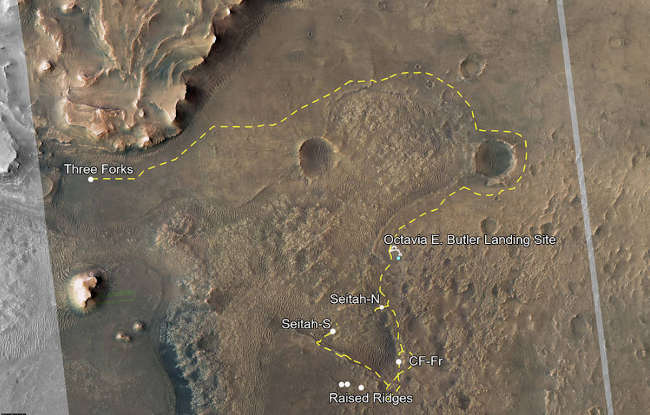
The first unit, called “the Crater Floor Fractured Rough,” is the crater-filled floor of Jezero. The adjacent unit, named “Séítah” (meaning “amidst the sand” in the Navajo language), has its fair share of Mars bedrock but is also home to ridges, layered rocks, and sand dunes.
“To do justice to both units in the time allotted, the team came up with the Martian version of an old auto club-style map,” said JPL’s Kevin Hand, an astrobiologist and co-lead, along with Vivian Sun, of this science campaign. “We have our route planned, complete with optional turnoffs and labeled areas of interest and potential obstructions in our path.”
Most of the challenges along the way are expected to come in the form of sand dunes located within the mitten-shaped Séítah unit.
To negotiate them, the rover team decided Perseverance will drive mostly either on the Crater Floor Fractured Rough or along the boundary line between it and Séítah. When the occasion calls for it, Perseverance will perform a “toe dip” into the Séítah unit, making a beeline for a specific area of interest.
The goal of the campaign is to establish what four locations in these units best tell the story of Jezero Crater’s early environment and geologic history. When the science team decides a location is just right, they will collect one or two samples.

“Starting with the Crater Floor Fractured Rough and Seitah geologic units allows us to start our exploration of Jezero at the very beginning,” said Hand. “This area was under at least 100 meters [328 feet] of water 3.8 billion years ago. We don’t know what stories the rocks and layered outcrops will tell us, but we’re excited to get started.”
The first science campaign will be complete when the rover returns to its landing site. At that point, Perseverance will have traveled between 1.6 and 3.1 miles and up to eight of Perseverance’s 43 sample tubes could be filled with Mars rock and regolith (broken rock and dust).
Next, Perseverance will travel north then west toward the location of its second science campaign: Jezero’s delta region. The delta is the fan-shaped remains of the confluence of an ancient river and a lake within Jezero Crater.
The location may be especially rich in carbonates – minerals that, on Earth, can preserve fossilized signs of ancient life and can be associated with biological processes.
The start of Perseverance’s first science campaign also marks a transition on the team: On June 7, Jennifer Trosper became the mission’s new project manager. She succeeds Matt Wallace, who is moving on to become JPL’s Deputy Director for Planetary Science.
“From Sojourner to Spirit and Opportunity to Curiosity to Perseverance, Matt has played key roles in the design, construction, and operations of every Mars rover NASA has ever built,” said Trosper. “And while the project is losing a great leader and trusted friend, we know Matt will continue making great things happen for the planetary science community.”
More About the mission
A key objective for Perseverance’s mission on Mars is astrobiology, including the search for signs of ancient microbial life.
The rover will characterize the planet’s geology and past climate, pave the way for human exploration of the Red Planet, and be the first mission to collect and cache Martian rock and regolith.
Subsequent NASA missions, in cooperation with ESA (European Space Agency), would send spacecraft to Mars to collect these sealed samples from the surface and return them to Earth for in-depth analysis.
The Mars 2020 Perseverance mission is part of NASA’s Moon to Mars exploration approach, which includes Artemis missions to the Moon that will help prepare for human exploration of the Red Planet.
JPL, which is managed for NASA by Caltech in Pasadena, California, built and manages operations of the Perseverance rover.
For more about Perseverance visit www.mars.nasa.gov/mars2020/ and www.nasa.gov/perseverance.
- Details
- Written by: Lake County News reports
As the court transitions its operations, it will continue to limit the number of cases on calendar, encourage physical distancing in court facilities as possible, monitor and apply state, local public health and Cal/OSHA guidance on face coverings as appropriate to court operations and will continue to handle matters via remote means when appropriate.
Under Gov. Gavin Newsom’s “Beyond The Blueprint” plan, effective June 15, the physical distancing requirements and capacity restrictions currently in place will be removed.
In association with the plan, on June 9, the California Department of Public Health, or CDPH, issued revised guidance on the requirement of face coverings for indoor events that requires an unvaccinated person to wear a face covering unless specifically exempted.
Also on June 9, the Cal/OSHA Board acted to maintain the COVID-19 Emergency Temporary Standards, pending further review, which require physical distancing and face covering by all employees in the workplace unless specifically excluded.
As a result of the governor’s plan, the court will make the changes outlined below to its operations.
Mandatory in-person court calendars
Beginning June 21, the calendars below will begin — or continue — to require in-person appearances.
Zoom appearances will be allowed for those parties or attorneys that were previously ordered to appear by remote appearance, or those authorized under statute or emergency rule.
Criminal and civil jury trials
Felony settlement conferences, Department 3, Tuesdays
Felony preliminary hearings, Mondays
Felony sentencing hearings, Mondays (remote appearance may be ordered by the judicial officer)
Family and civil court trials and hearings, both short and long cause settings (remote appearances may be ordered by the judicial officer)
Felony law and motion, Tuesdays at 2:30 p.m.
Unlawful detainer, Mondays, Clearlake (remote appearances may be ordered by the judicial officer)
Small claims, Mondays in Clearlake (remote appearances may be ordered by the judicial officer)
Civil and family law mandatory settlement conferences, beginning June 28
In-person or remote court calendars (Zoom)
Beginning June 21, 2021, the calendars below will allow either in-person or Zoom appearances, unless otherwise ordered by a judicial officer.
Felony law and motion, Tuesdays
Misdemeanor, disposition/setting, motions, Mondays
Misdemeanor, arraignment, settlements, Tuesdays
Conservatorship calendar, 1:30 p.m., Mondays
Family law, law & motion, case management conferences, Tuesdays
Domestic violence restraining order calendar, Tuesdays
Juvenile delinquency, Mondays
Juvenile dependency, Mondays
Civil harassment calendar, Tuesdays
Veteran’s Court, Wednesdays (first and third)
Juvenile drug court, Wednesdays
Traffic and infractions, Clearlake, Mondays
Department of Child Support Services Family Law, Clearlake, Tuesdays
In-person or remote court calendars (court call)
These calendars will allow in-person appearance and continue to allow appearances by court call. Compliance with all existing rules of courts for telephonic appearances will be required.
Civil law and motion, Mondays
Civil case management conferences, Mondays
Probate calendar, 2 p.m. Mondays
Calendars to continue by remote appearances (Zoom)
The following calendars will continue to be conducted only by remote appearance.
Trial assignment, Fridays
Daily in-custody arraignments
Jury trials
For a period of time after June 15, the court will continue to conduct jury selection at the
fairgrounds facility in all cases.
After selection, the jury trials will be conducted at the courthouse except for cases specifically set for jury trial at the fairgrounds facility.
Jurors who are unable to serve because they are high-risk for COVID-19 related complications, will be excused before coming to the courthouse.
Additional details about the process and precautions will be provided with the jury summons.
Face covering requirements
At present, and continuing effective June 15, the court will require that all individuals wear a proper face covering when coming into a court facility.
The provisions of the General Order on the Requirement of Wearing Face Coverings will continue in effect until further notice.
The court continues the requirement of face covering due to the uncertainty regarding the scope of the Cal/OSHA ETS directives, including application to jury service and the current requirement that all employees wear a proper face covering in the workplace.
The Cal/OSHA Standards are scheduled to be reviewed and may be subject to revision or further delineation on June 17.
The CDPH requires that unvaccinated persons wear a face covering in indoor settings which would include public buildings and the court facility.
It appears the application of the current guidance under the plan, CDPH and Cal/OSHA will result in classifications of people who are, and those who are not, required to wear a face covering while at court resulting in increased time and effort by the court to monitor compliance by the intermixing of the classifications during normal court operations.
Court officials said they are striving, under the present circumstances, to act to protect the health and safety of those coming to court.
The CDPH authorizes a business or other entity to continue a requirement that all participants wear a face covering.
The court is informed that courts in other counties are acting to retain face covering mandates in
courthouses across the state.
The Lake County Superior Court will monitor the CalOSHA Standards related to face covering requirements, and when they are modified, review and potentially modify the court’s general order on face coverings.
The court will continue to post updates on its website at www.lake.courts.ca.gov.