 How to resolve AdBlock issue?
News
- Details
- Written by: Elizabeth Larson
LAKE COUNTY, Calif. — U.S. Environmental Protection Agency staff held an online meeting with community members on Wednesday to report on the decades long effort to plan and carry out the cleanup of the Sulphur Bank Superfund site in Clearlake Oaks.
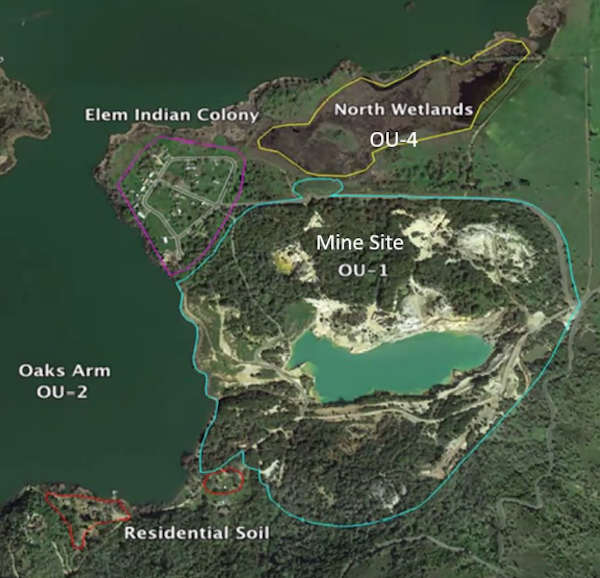
The 160-acre site, mined for sulfur and mercury between 1865 and 1957, has two million cubic yards of contaminated mine waste along with the Herman impoundment, a flooded open pit mine that’s filled with water contaminated by mine waste that’s impacting Clear Lake.
The mine site has been on the Superfund list since 1990.
While the process has been a slow one, officials estimated they are now within four years of beginning the main cleanup project, with the proposed plan for the cleanup expected to be released this fall.
Officials said the two-hour online meeting — which included descriptions of work and planning, and a chance to discuss the site in breakout rooms — was the result of a March planning group meeting. The goal was to update the community on the status of the project and its lengthy planning process.
Rusty Harris-Bishop, the EPA California Cleanup Sites Section manager, said they recognized how the site and its contamination have impacted livelihoods, the way of life and use of the lake, and prosperity of the community, and they wanted to hear input as they move the cleanup forward.
“Superfund is a very process heavy effort,” he said.
“It takes a long time and we recognize that,” he added.
Harris-Bishop said the agency has heard from people who want to see what EPA is doing as well as more action. “Things are going on as we’re doing this engagement.”
The situation at the site
Carter Jessop, the site project manager, said the material mined out of the Herman pit is significantly higher in mercury, arsenic and other metals.
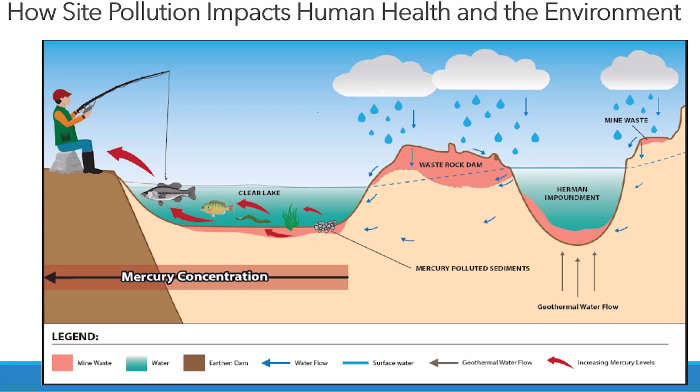
Those materials originally were contained in bedrock and not exposed to air and water. Once the materials were exposed, Jessop said they leach out acidity and metals that get into the environment and impact community health.
Next to the Herman pit is a waste rock dam, which Jessop said isn’t an engineered dam but a pile of waste rock that creates a barrier between the pit and Clear Lake. The dam causes the pit’s water level to be above that of Clear Lake.
He showed a conceptual site model that illustrated how the water from the Herman pit can flow as groundwater through waste rock and into Clear Lake.
The water from the pit itself isn’t the problem, said Jessop. Rather, it’s the waste rock the water flows through, causing it to pick up more contaminants. That’s an ongoing problem for Clear Lake.
He said the mercury carried from the mine site binds to the sediments on the bottom of the lake. It’s then transformed into another form of mercury and moves up the food chain, becoming more concentrated.
Predator fish can have high levels of mercury. Because of that high concentration of mercury in fish, the state of California has issued a fish advisory for Clear Lake that outlines how much of the fish people can safely eat, Jessop said.
Jessop said the consumption of fish from Clear Lake is the greatest source of risk from mercury.
Unauthorized entry on the mine site offers risk of arsenic contamination, said Jessop, adding that there also is substantial naturally occurring risk due to arsenic and mercury.
The proposed plan
The EPA’s work is expected to result this fall in the publication of its proposed plan for the mine site, which will have a separate public process. Jessop said the document is now going through the EPA’s internal review process.
Jessop said the plan is fairly brief; it’s about 25 pages and is meant to summarize EPA’s preferred cleanup approach.
The cleanup, as proposed, will be broken into two phases, consolidation and capping, Jessop said.
Consolidation will include moving smaller waste piles onto larger waste piles to shrink the footprint of the area that requires major remediation, he explained.
They will then place a cap — a barrier layer like heavy plastic — over the site then cover that with clean soil so vegetation can grow, Jessop said.
Jessop said the plan aims to block the mine waste’s interaction with air and water, and stormwater management will be important.
There will be additional signs and fences, work with the local community and a period of monitoring after the project is completed.
Once the plan is released in the fall, there will be a public meeting followed by a 60-day comment period, Jessop said.
He said formal decision making and final design will follow the proposed plan, which must be approved by the EPA headquarters and administrator in Washington, DC.
Jessop said the EPA has a really robust record of documents and a very strong understanding of the site, which are benefits of the lengthy process.
He said construction could begin as soon as 2025.
Because the mine doesn’t have a “responsible party,” the entire cleanup is being covered by taxpayer funds, EPA staff said.
The site also isn’t owned by the agency so it will not manage the mine site long-term. Harris-Bishop said once the cleanup is completed, the property will be the responsibility of someone else.
Staff did not specify who will be responsible, but a 2012 settlement the EPA reached with the U.S. Department of the Interior, the U.S. Forest Service, the Bradley Mining Co., the Worthen Bradley Family Trust and the Elem Indian Colony of Pomo Indians called for the Bradley Mining Co. and Bradley Trust to transfer nearly all of their land holdings at the Sulphur Bank Mercury Mine to a new trust created to retain the lands pending EPA cleanup.
EPA also is constrained to clean up the site to what it would have been under natural conditions, it was explained during the meeting.
Next steps
As far as what’s next, EPA staff, it's the proposed plan’s release in the fall.
For those who want to follow the process, sign up for the email list here or contact community involvement coordinator Gavin Pauley at
The administrative record, which includes the documents and studies completed so far, will be online at the EPA website, and a physical copy will be available at the Redbud Library in Clearlake.
A summary of the meeting is expected to be posted on the EPA website by the end of June.
Email Elizabeth Larson at
- Details
- Written by: Lake County News reports
The new holiday commemorates the arrival in Galveston, Texas, of Union troops led by General Gordon Granger, who on June 19, 1865, proclaimed there the end of the Civil War — nearly two months after the surrender of the Confederacy — and the end of slavery in Texas.
With the war came the end of slavery for Black Americans in the Condederate states, many of whom didn’t know they had been set free until that June day in 1865.
Most states recognize the date, with California having celebrated it since 2003.
“On June 19, our nation joins to mark Juneteenth, the end to slavery in the United States. It’s the day when the last enslaved people were freed after federal troops arrived in Texas, a full two years after President Abraham Lincoln issued the Emancipation Proclamation. Freedom was delayed for thousands because they had not heard the news and were kept where they were,” said Thompson.
“Designating Juneteenth as a federal holiday is an important recognition of that delayed freedom and a reminder of our responsibility to continue working to achieving full equality and justice for all. I was proud to vote to pass this legislation today and will continue my work to ensure Congress provides equal opportunity for everyone across our nation.”
You can click here to read more about this bill.
The bill is now on its way to President Joe Biden’s desk for his signature.
Thompson represents California’s Fifth Congressional District, which includes all or part of Contra Costa, Lake, Napa, Solano and Sonoma counties.
- Details
- Written by: Lake County News reports
When past Flex Alerts have been called, consumers have answered the call and cut back their electricity use. Those actions have helped California avoid or limit power outages that can, if conditions persist or worsen, become necessary when demand for electricity outstrips capacity.
“The public’s help is essential when extreme weather or other factors beyond our control put undue stress on the electric grid,” said Elliot Mainzer, president and chief executive officer of the ISO. “We have seen the huge impact that occurs when consumers pitch in and limit their energy use. Their cooperation can really make a difference.”
While Flex Alerts are normally 4 to 9 p.m., the hours of conservation for this event are 5 to 10 p.m. due to operational needs.
The statewide call for conservation is critical because when temperatures hit triple digits across a wide geographic area, no state has enough energy available to meet all the heightened demand, primarily due to air conditioning use.
For the next several days, much of California and the Southwest are expected to see triple-digit heat with above normal temperatures spread more broadly across much of the Western United States. And like California, other Western states — including Arizona and New Mexico — are experiencing similar stressful grid conditions due to the extreme heat.
Under such conditions, evening is the most difficult time of day for grid operations, especially in persistent hot weather when evening temperatures stay warm, because demand for electricity remains high as solar energy diminishes.
By collectively taking a few simple actions, electricity use can be reduced enough to keep power on for everyone.
Last August and September, for instance, Californians heeded multiple Flex Alerts and Gov. Gavin Newsom’s call for a concerted response to emergency conditions and reduced electricity use by 1,000 to 3,000 megawatts.
That is enough electricity to power up to three million homes, and the conservation likely prevented subsequent and more severe rotating outages last August and September. If demand still outstrips supply after Flex Alerts and other measures are taken, the ISO could again order utilities to begin rotating power outages.
That would extend available power supplies and guard against longer and more extensive disruptions while protecting high-voltage transmission lines from damage.
As California’s ability to store solar and wind energy with batteries or other technology continues to increase, the crucial evening hours will be less challenging. But for now, concerted action to conserve is the most effective way of keeping the grid working for everyone.
Conservation tips
Before a Flex Alert is in effect, consumers can take specific steps to manage their electricity usage to maintain comfort during days that conservation is needed.
Specifically, consumers can:
— Precool your home by lowering the thermostat;
— Use major appliances, like your dishwasher, and clothes washer and dryer;
— Close window coverings to keep your home or apartment cool;
— Charge electronic devices;
— Charge electric vehicles.
From 5 to 10 p.m. Thursday, when the statewide Flex Alert is in effect, consumers can help by:
— Setting your thermostat to 78 degrees or higher, if health permits.
— Avoiding the use of major appliances.
— Turning off all unnecessary lights.
— Using fans for cooling.
— Unplugging unused items.
- Details
- Written by: Lake County News reports

LAKEPORT, Calif. — The Lakeport Police Department announced that it has received a Gold Award for Excellence in Law Enforcement Policy Management.
Chief Brad Rasmussen said his department partners with Lexipol to provide up-to-date policies that govern law enforcement response and actions in the city of Lakeport.
“As the public is aware, recent national incidents have created calls for police reform and changes in policing policies across the country,” Rasmussen said. “Prior to these incidents, the Lakeport Police Department had updated its best practice policies, putting them in line with changes the public was seeking.”
An example of these policies can be found here.
Some of the department’s policies, which the new legal proposals were intended to mandate, including those governing use of force issues, were already in place as proposed, Rasmussen said.
“We thank our management, supervisory and instructor staff for their work in keeping our policies reviewed and updated,” he added. “We appreciate that all of our officers and other staff stay current with daily policy training throughout the year.”
Members of the public can find the current Lakeport Police Department policy manual here.