 How to resolve AdBlock issue?
News
Census Bureau data shows steady increase in funding of green programs by state and local governments
- Details
- Written by: Lynda Lee
Environmentalists have long been pushing the government, consumers and corporations to protect our planet, promoting everything from tougher environmental standards to paperless communications and environmentally friendly products like reusable shopping sacks.
Government is stepping up. The United States just hosted a global climate change summit coinciding with Earth Day and committed to reducing greenhouse gas emissions by 50%-52% below its 2005 emissions levels by 2030.
And state and local governments are spending more on preserving natural resources.
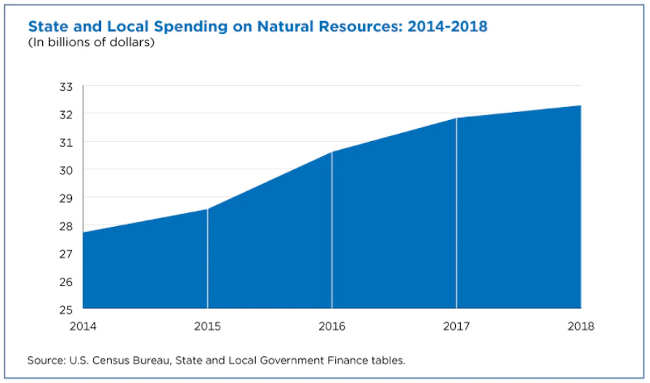
According to the U.S. Census Bureau’s Annual Survey of State and Local Government Finances, public spending to protect the nation’s natural resources jumped from $27.7 billion in 2014 to $32.3 billion in 2018.
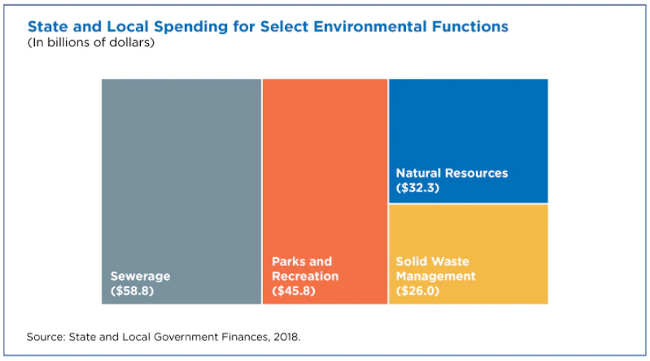
The survey includes a broad range of statistics on public expenditures on natural resources. It provides data on how much our governments spend on conservation and management of resources, such as fish and game, forestry, soil, water, and electric energy resources.
Some specific preservation programs include protection of soil and water resources, including controlling beach erosion, managing dams to prevent floods, educating the public about conservation and generating hydroelectric energy.
The survey also details government expenditures on caring for the environment, including maintaining parks and managing waste.
Employment in natural resources remain largely unchanged
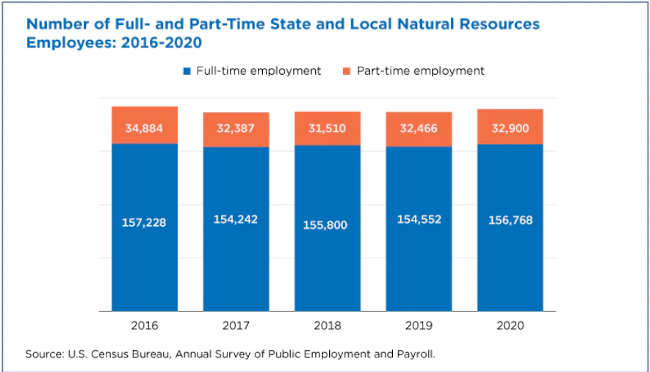
According to the Census Bureau’s Annual Survey of Public Employment & Payroll, in March 2020 there were 189,668 employees in the natural resources functions of state and local governments: 83% (156,768) were full-time and 17% (32,900) part-time.
While expenditures rose, a five-year comparison (from 2016 to 2020) showed a 5.7% decline in part-time employment and a 0.3% dip in full-time employment.
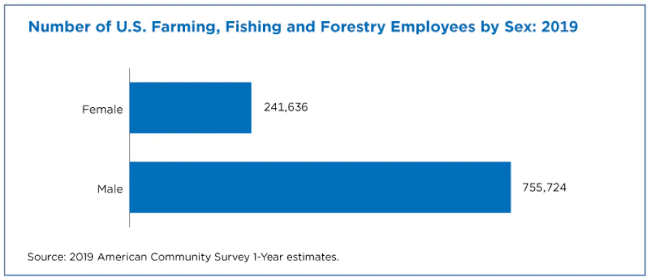
According to the American Community Survey, which shows employment data by sex, women held approximately 24% of the nation’s farming, fishing, and forestry sector jobs in 2019.
Alternative sources of energy
Part of preserving natural resources and the environment is increasing reliance on alternative power sources.
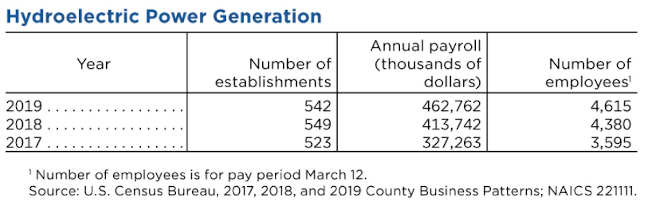
The private sector has seen increases in the number of businesses and employment in industries that generate power from non-fossil fuel sources, according to County Business Patterns data.
For example, there was about a 5% increase in the number of hydroelectric power generation establishments and a 22% rise in the number of people employed in the industry from 2017 to 2018. The 2019 data show fewer establishments with an increase in the number of employees in the sector.
It looks like reduce, reuse and recycle are here to stay and the Census Bureau is tracking all data relating to conservation.
The Census Bureau’s State and Local Governments Snapshot tool provides quick and easy access.
Lynda Lee is a supervisory statistician in the Census Bureau’s Economic Management Division.
- Details
- Written by: Lake County News reports
Lake County’s testing positivity and case rates continue to trend in the minimal-moderate range.
On Tuesday, June 15, the state of California will move Beyond the Blueprint for a Safer Economy), and most sector-specific business restrictions will be lifted as a result.
Some high-risk settings will still require all participants to take precautions. “Mega Events” (5,000 people indoors, or 10,000 outdoors) are one example.
“Please remember, while Lake County’s Case Rate is significantly lower than it was during our winter peak, COVID-19 is still present in our communities,” said Evan Bloom, MD, MPH, Lake County’s acting Public Health officer.
“Nearly half of eligible Lake County residents [46.8%] have not received even one dose of vaccine. We are well short of the 70% rate required for herd immunity. Some areas of the State have seen recent upticks in new cases, even as restrictions are about to loosen. Getting vaccinated and continuing to take common sense precautions are essential, as we enter this next phase,” Bloom said.
The county of Lake has no immediate intention to add restrictions beyond those required by the State Public Health officer’s order of June 11, 2021, which takes effect on Tuesday.
New guidance for the use of face coverings
Starting Tuesday, fully vaccinated Individuals will no longer be required to wear masks, except in settings where they are required for all people: public transit; indoors in K-12 schools, childcare and other youth settings; health care settings, including long-term care facilities; state and local correctional facilities and detention centers; and homeless shelters, emergency shelters and cooling centers.
Unvaccinated and partially vaccinated individuals will still be required to wear masks in most indoor public settings and businesses, including retail, restaurants, family entertainment centers, meetings, state and local government offices.
People are considered fully vaccinated for COVID-19 two weeks after they receive the second dose in a 2-dose series (Pfizer-BioNTech or Moderna), or two weeks after they have received a single-dose vaccine (Johnson and Johnson/Janssen).”
The California Department of Public Health’s complete guidance document can be found here.
Health services partnering with local school districts to vaccinate students and families
The Health Services Department, Lake County Office of Education and school districts are also partnering to make safe, effective COVID-19 vaccines available to students and their families on a rotating basis. Anyone under the age of 18 getting vaccinated will need parent/guardian consent for vaccination.
Appointments can be made at https://myturn.ca.gov/ and walk-ins will also be welcomed.
Two events are scheduled so far, follow the Lake County Office of Education Facebook page to make sure you don’t miss the event in your district.
— Tuesday, June 15, 2 to 7:30 p.m.: Upper Lake High School Cafeteria, 675 Clover Valley Road.
— Thursday, June 17, noon to 4 p.m.: Lakeport Elementary School Cafeteria, 150 Lange St.
Community members urged to get vaccinated
Appointments at a variety of locations throughout the county can be scheduled at https://myturn.ca.gov/ or by calling 833-422-4255. Lake County-focused information and resources are also available at http://health.co.lake.ca.us/Coronavirus/Vaccines.htm.
“To those who have already received their COVID-19 vaccinations: a heartfelt thank you,” said Dr. Bloom. “For the half of the county who are not yet vaccinated: please help us all breathe easier! Increasing our vaccination rate to 70% is still our goal, and further vaccination is key to a sustained return to normalcy.”
He added, “If you remain unsure, you are not alone. Please get your questions answered. Online resources, like https://yourvaccinationguide.org/, can be a great help.”
If you have reviewed online resources and still have questions, or are ready to be vaccinated, and need assistance overcoming barriers, call the Public Health’s MHOAC line, at 707-263-8174.
“Especially as things further open up, and people are mixing more, please take care of each other,” emphasizes Bloom. “If you are unvaccinated, and not feeling 100%, it is still best to stay home. Precautions that were mandates during the peak of the pandemic can help you stay healthier, and help protect your families and communities, even as we move Beyond the Blueprint. Stay safe and well.”
The following are state-produced resources on the reopening.
https://www.cdph.ca.gov/Programs/CID/DCDC/CDPH%20Document%20Library/COVID-19/What-Will-June-15-Look-Like.pdf
https://www.cdph.ca.gov/Programs/CID/DCDC/Pages/COVID-19/Beyond-Blueprint-Framework.aspx
https://www.cdph.ca.gov/Programs/CID/DCDC/Pages/COVID-19/Beyond-Blueprint-QA.aspx
Q&As and other resources are available at https://covid19.ca.gov/.
Actualización de COVID-19: Avanzando Más allá del Plan
Los distritos escolares locales ofrecerán vacunas de forma rotatoria en asociación con los Servicios de Salud https://www.facebook.com/LakeCountyOfficeofEducation/
Condado de Lake, CA (14 de junio de 2021)— Las tasas de casos y positividad de las pruebas del condado de Lake continúan con una tendencia en el rango mínimo-moderado. El martes 15 de junio, el estado de California se moverá "Más allá del plan (para una economía más segura)" y, como resultado, la mayoría de las restricciones comerciales específicas del sector se levantarán. Algunos entornos de alto riesgo aún requerirán que todos los participantes tomen precauciones. Los “mega-eventos” (5,000 personas en interiores o 10,000 al aire libre) son un ejemplo.
"Recuerde, mientras la tasa de casos del condado de Lake es significativamente más baja que durante nuestro pico de invierno, el COVID-19 todavía está presente en nuestras comunidades", urge Evan Bloom, MD, MPH, Funcionario Interino de Salud Pública del Condado de Lake. “Casi la mitad de los residentes elegibles del condado de Lake [46,8%] no han recibido ni una sola dosis de la vacuna. Estamos muy por debajo de la tasa del 70% requerida para la inmunidad colectiva. Algunas áreas del estado han visto repuntes recientes en nuevos casos, incluso cuando las restricciones están a punto de aflojarse. Vacunarse y seguir tomando precauciones de sentido común es esencial, ya que ingresamos a la siguiente fase”.
Nueva orden de salud estatal emitida el viernes 11 de junio a partir del 15 de junio: Reemplaza todos los pedidos anteriores
El Condado de Lake no tiene la intención inmediata de agregar restricciones más allá de las requeridas por la Orden del Oficial de Salud Pública del Estado del 11 de junio de 2021, que entrará en vigencia mañana, 15 de junio.
Puede encontrar esa Orden aquí: https://www.cdph.ca.gov/Programs/CID/DCDC/Pages/COVID-19/Order-of-the-State-Public-Health-Officer-Beyond-Blueprint.aspx
Preguntas y respuestas y otros recursos están disponibles en https://covid19.ca.gov/es/ .
Nueva orientación para el uso de cubiertas faciales
A partir de mañana, 15 de junio, ya no se requerirá que las personas totalmente vacunadas usen máscaras, excepto en los lugares donde se requieren para todas las personas: transporte público; en el interior de las escuelas K-12, cuidado de niños y otros entornos para jóvenes; entornos de atención médica, incluidas las instalaciones de atención a largo plazo; Instalaciones correccionales y centros de detención estatales y locales; y refugios para personas sin hogar, refugios de emergencia y centros de enfriamiento.
Se requerirá que las personas no vacunadas y parcialmente vacunadas usen máscaras en la mayoría de los entornos públicos y negocios interiores, que incluyen: venta minorista; restaurantes; centros de entretenimiento familiar; reuniones; oficinas gubernamentales estatales y locales.
Se considera que las personas están completamente vacunadas contra COVID-19 dos semanas después de recibir la segunda dosis de una serie de 2 dosis (Pfizer-BioNTech o Moderna), o dos semanas después de haber recibido una vacuna de dosis única (Johnson y Johnson / Janssen ). Fuente: https://covid19.ca.gov/vaccines/
El documento de orientación completo del Departamento de Salud Pública de California se puede encontrar aquí:
https://www.cdph.ca.gov/Programs/CID/DCDC/Pages/COVID-19/guidance-for-face-coverings.aspx#June15guidance
Servicios de Salud asociados con distritos escolares locales, LCOE para vacunar a estudiantes y familias locales
El Departamento de Servicios de Salud, la Oficina de Educación del Condado de Lake y los distritos escolares locales también se están asociando para hacer que las vacunas COVID-19 seguras y efectivas estén disponibles para los estudiantes y sus familias * de forma rotatoria. Las citas se pueden hacer en https://myturn.ca.gov/ , y también serán bienvenidas las personas sin cita previa.
Hasta ahora hay dos eventos programados, siga la página de Facebook de la Oficina de Educación del Condado de Lake para asegurarse de no perderse el evento en su distrito (https://www.facebook.com/LakeCountyOfficeofEducation/ ):
• Mañana (martes), 6/15, 2-7: 30pm - Cafetería de Upper Lake High School, 675 Clover Valley Rd, Upper Lake
• Jueves, 6/17, 12-4pm - Cafetería de la Escuela Primaria de Lakeport, 150 Lange St., Lakeport
* Tenga en cuenta: cualquier persona menor de 18 años que se vacune necesitará el consentimiento del padre / tutor
Vacúnese: sigue siendo clave para un retorno sostenido a la normalidad
Las citas en una variedad de ubicaciones en todo el condado se pueden programar en https://myturn.ca.gov/ o llamando al 833-422-4255. La información y los recursos centrados en el condado de Lake también están disponibles en http://health.co.lake.ca.us/Coronavirus/Vaccines.htm.
“Para aquellos que ya han recibido sus vacunas COVID-19: un sincero agradecimiento,” comparte el Dr. Bloom. “Para la mitad del condado que aún no está vacunada: ¡ayúdenos a respirar mejor! Aumentar nuestra tasa de vacunación al 70% sigue siendo nuestro objetivo, y una mayor vacunación es clave para un retorno sostenido a la normalidad.”
"Si no está seguro, no está solo,” continúa Bloom. “Por favor, obtenga respuestas a sus preguntas. Los recursos en línea, como ,https://yourvaccinationguide.org/ , pueden ser de gran ayuda.”
Si ha revisado los recursos en línea y aún tiene preguntas, o está listo para vacunarse y necesita ayuda para superar las barreras, llame a la línea MHOAC de Salud Pública al 707-263-8174.
“Especialmente a medida que las cosas se abren más y la gente se mezcla más, por favor cuídense unos a otros,” enfatiza Bloom. “Si no está vacunado y no se siente al 100%, es mejor quedarse en casa. Las precauciones que fueron obligatorias durante el pico de la pandemia pueden ayudarlo a mantenerse más saludable y ayudar a proteger a sus familias y comunidades, incluso mientras avanzamos Más allá del Plan. Mantente sano y salvo.”
Aquí hay algunos recursos producidos por el estado que muchos pueden encontrar útiles:
https://www.cdph.ca.gov/Programhttps://www.inyocounty.us/sites/default/files/2021-06/CA-Inyo_What-Will-June-15-Look-Like%28spanish%29.pdfs/CID/DCDC/CDPH%20Document%20Library/COVID-19/What-Will-June-15-Look-Like.pdf
https://www.cdph.ca.gov/Programs/CID/DCDC/Pages/COVID-19/Beyond-Blueprint-Framework.aspx
https://www.cdph.ca.gov/Programs/CID/DCDC/Pages/COVID-19/Beyond-Blueprint-QA.aspx
- Details
- Written by: Lake County News reports
When the commission begins drawing maps using census data, they will need to follow this set of criteria, in this order, as outlined in the California Constitution:
— Districts must be of nearly equal population to comply with the U.S. Constitution.
— Districts must comply with the Voting Rights Act to ensure that minorities have a fair opportunity to elect representatives of their choice.
— Districts must be drawn contiguously, so that all parts of the district are connected to each other.
— Districts must minimize the division of counties, cities, neighborhoods and communities of interest to the extent possible.
— Districts should be geographically compact such that nearby areas of population are not bypassed for more distant populations.
— Where practicable, each Senate District should consist of two complete and adjacent Assembly Districts, and Board of Equalization districts should consist of 10 complete and adjacent State Senate districts. This is known as “nesting.”
The commission can obtain city and county information from those jurisdictions, but it needs the neighborhood and communities of interest information from Californians directly.
“Although we have been accepting communities of interest submissions online since March, these virtual input sessions are yet another opportunity for communities to share with the commission about their communities of interest,” said Commission Chair Isra Ahmad.
During these input meetings, participants will be asked to describe their community and will be encouraged to consider highlighting the following:
— Begin with your county or city.
— Mention the street names and significant locations in your neighborhood to help the commission identify the parameters of your community.
— What are your shared interests?
— What brings you together?
— What is important to your community?
— Are there nearby areas you want to be in a district with?
— Nearby areas you don't want to be in a district with? Why or why not?
— Has your community come together to advocate for important services, better schools, roads or health centers in your neighborhood?
Registration is not required to participate in these public input meetings. The call-in number for public input on the day of each event will be 877-853-5247.
To view a full list of upcoming meetings, visit https://www.wedrawthelinesca.org/meetings.
Additionally, Californians can skip the line and provide their input online by visiting https://drawmycacommunity.org/.
The online COI tool is 14 in fourteen languages and includes tutorials.
Every 10 years, after the federal government publishes updated census information, California must redraw the boundaries of its electoral districts so that the state’s population is evenly allocated among the new districts.
In 2008, California voters passed the Voters First Act, authorizing the creation of the independent California Citizens Redistricting Commission to draw new State Senate, State Assembly and State Board of Equalization district lines.
In 2010, the Voters First Act for Congress gave the Commission the responsibility of drawing new Congressional districts following every census.
For more information, visit www.WeDrawTheLinesCA.org.
- Details
- Written by: Lake County News reports
The proposal, which will be put out for public comment, will be on the CPUC’s July 15 voting meeting agenda.
As a condition of approving PG&E’s plan for exiting bankruptcy in May 2020, the CPUC determined it necessary that an independent safety monitor succeed the federal monitor that was appointed as part of PG&E’s probation in criminal court.
The federal monitor’s work ends in 2022.
By creating an independent safety monitor, the CPUC is enhancing its oversight of PG&E to ensure the utility focuses on long-term outcomes that promote safety and reliability.
The independent safety monitor will be selected by and report to the CPUC.
In March, PG&E’s proposal with recommended oversight responsibilities for the independent safety monitor was issued for public comment.
The proposal issued by the CPUC incorporates feedback received and proposes a scope of work, budget and length of term.
Under the proposal, the term of the independent safety monitor will begin before the federal monitor completes its term and will continue for five years. The term can be extended based on PG&E’s performance.
The proposal sets the annual operating budget at $5 million and proposes these costs be paid by PG&E shareholders.
The CPUC’s oversight of PG&E includes exercising its broad investigation and enforcement authority, examining of rates and costs, pressing for progress on the utility’s efforts to reduce the risk of wildfire ignited by its equipment, ensuring safe execution of public safety power shut-offs, regulating the safety of the utility’s natural gas system and ensuring PG&E is progressing toward modernizing its electric grid.
Under the CPUC proposal, the independent safety monitor will support the CPUC in ensuring PG&E prioritizes and executes the highest level of risk reduction across all levels of the company, from senior officials to field personnel, and will assess PG&E’s risk management activities in the field.
The independent safety monitor will support the CPUC’s efforts to ensure PG&E has in place a risk assessment process that identifies where its operations and infrastructure create the greatest risk to public safety.
The independent safety monitor also will monitor PG&E’s safety-related record keeping and record management systems to ensure modernization efforts are informed by prior failures and support safe system construction, operation, and maintenance in PG&E’s electric and natural gas lines of business.
The proposal is available at www.cpuc.ca.gov/pgechapter11.
Public comment on the proposal may be sent to