 How to resolve AdBlock issue?
News
- Details
- Written by: Lake County News reports
LAKE COUNTY, Calif. — Lake County’s new Community Visioning Forum Planning Committee will hold its first meeting on Tuesday, June 15.
The meeting will take place from 6 to 7:30 p.m. via Zoom.
The Zoom link is here.
The meeting ID is 920 7500 9310, pass code is 896861.
One tap mobile: +16699006833,,92075009310#,,,,*896861#.
From any mobile or landline phone, you may also dial 1-669-900-6833, and enter the Meeting ID and Passcode above, when prompted. To contribute to this meeting from a phone, press *9 to raise your hand, and *6 to unmute, once you are recognized to speak.
The public is encouraged to attend and participate via Zoom.
The full meeting agenda for this meeting can be viewed here.
On Feb. 23, the Board of Supervisors unanimously proclaimed “Promoting Tolerance, Respect, Equity and Inclusion” among its utmost priorities.
That historic moment culminated significant community efforts, and was punctuated by each supervisor reading a portion of the proclamation, and affirming their commitment to host a community visioning forum to unearth priorities in the following categories:
· Meaningful actions and activities that will build bridges where there may be walls;
· Fostering tolerance, respect, understanding, equity and inclusion;
· Promotion non-violence and non-violent conflict resolution;
· Focusing resources on underlying causes and conditions that lead to inequitable resource and justice distribution; and
· Relevant solutions for any social injustices, as they may come to light.
Community members and governmental leaders that resonated with the board’s proclamation volunteered to be a part of this historic effort, by applying for a spot on the county’s new Community Visioning Forum Planning Committee.
Members include Supervisor Eddie Crandell, Beniakem Cromwell, Angela Cuellar-Marroquin, Delores Farrell, County Administrative Officer Carol Huchingson, Sally Peterson, JoAnn Saccato, Supervisor Tina Scott, Clearlake Mayor Dirk Slooten, Lakeport City Councilwoman Mireya Turner and Sue Williams. The law enforcement representative seat is vacant.
- Details
- Written by: LAKE COUNTY NEWS REPORTS
That includes terminating the stay-at-home order that was implemented early in the pandemic to protect Californians and retiring the Blueprint for a Safer Economy.
Effective June 15, restrictions such as physical distancing, capacity limits and the county tier system will end.
The governor is also continuing the wind down of executive actions put in place since March 2020 to help facilitate a coordinated response to the pandemic and ensure the state could quickly and efficiently respond to the impacts of the pandemic.
A subset of provisions that facilitate the ongoing recovery — such as the provision allowing pharmacy technicians to administer vaccinations as the state continues to vaccinate millions of eligible Californians every week — will remain in place.
“California is turning the page on this pandemic, thanks to swift action by the state and the work of Californians who followed public health guidelines and got vaccinated to protect themselves and their communities,” said Gov. Newsom. “With nearly 40 million vaccines administered and among the lowest case rates in the nation, we are lifting the orders that impact Californians on a day-to-day basis while remaining vigilant to protect public health and safety as the pandemic persists.”
The state’s decisive and early action through the stay-at-home order directing Californians to limit their interactions with people from other households and the blueprint criteria guiding the tightening and loosening of allowable activities based on the level of community transmission helped slow the spread of the virus, saving lives and protecting the state’s health care delivery system from being overwhelmed.
With nearly 40 million vaccines administered and among the lowest case rates in the country, California is entering a new phase, lifting these restrictions to fully reopen on June 15.
The Governor’s Office on Friday established a timeline and process to continue winding down the various provisions of the 58 COVID-related executive orders, which suspended statutes and regulations to help the state and businesses continue operations during the pandemic.
To ensure that impacted individuals and entities have time to prepare for the changes, the provisions will sunset in phases, beginning later this month, in July and in September.
For example, the suspension of certain licensing requirements for manufacturers to produce hand sanitizer will end on June 30, as shortages are no longer a concern.
By the end of September, nearly 90 percent of the executive actions taken since March 2020 will have been lifted.
On Friday the California Department of Public Health released a new state public health officer order that goes into effect on June 15.
The order replaces the previous pandemic public health orders with limited requirements related to face coverings and mega events, as well as settings with children and youth pending an expected update later this month to the K-12 school guidance issued by the Centers for Disease Control and Prevention.
The action supports the full and safe reopening of the state, while maintaining focused public health requirements that address the risk posed by variants as some regions across the nation and world continue to experience high levels of transmission.
The orders can be seen below.
6.11.21-EO-N-07-21-signed by LakeCoNews on Scribd
6.11.21-EO-N-08-21-signed by LakeCoNews on Scribd
- Details
- Written by: DENNIS FORDHAM
Lifetime gifting of property is an approach to estate planning that has its place under the right circumstances.
Lifetime gifting can either be outright or subject to a retained interest by the donor. An owner of real property, who owns their property free and clear, can deed (gift) their real property to another and still reserve (retain) a life estate for their lifetime. A deed with a life estate approach has its pluses and minuses.
A life tenant — i.e, the person with the life estate — has the use, rents and enjoyment of the real property until the life tenant either dies or relinquishes (gives up) their life estate. Thus, the life tenant can live there and/or collect any rent on the real property.
At the end of the life estate, ownership of the real property automatically passes to the holder(s) of the remainder interest named on the deed. No probate or trust administration is required. All that is required to transfer title is that an affidavit of death of life tenant or surrender of life estate, as relevant, be recorded with the county recorder’s office.
During the period of the life estate, the life tenant has all the obligations of ownership, including paying the real property taxes and insurance.
However, the life tenant alone can neither sell the property nor take out a reverse mortgage because the life tenant does not own a fee simple absolute (complete title).
To sell the property, the life tenant and the owner(s) of the remainder interest would all have to join together. The proceeds of the sale would be allocated (divided) based on the appraised value of the life estate at the time of sale factoring in the life expectancy of the life tenant.
Avoiding an administration at death may be viewed as particularly beneficial in some family circumstances. By transferring the property during the owner’s lifetime with a reserved life estate, no notice is required at the owner’s death to the owner’s heirs, as is required with either probate or trust administration.
This means that the heirs do not have an opportunity to contest the trust or will that might otherwise have been used as the owner’s estate planning tool.
Another use of the life estate applies when the owner wants to allow someone else the right to live in the property during their lifetime but wants the property to pass to a different person when the life tenant dies.
This is frequently seen in second marriages where the real property is owned by one spouse who wants to ensure that his or her children ultimately inherit the real property when the surviving spouse dies.
As life tenant, the surviving spouse can live at the residence but cannot prevent the deceased spouse’s own intended beneficiaries (usually the deceased spouse’s own children) from inheriting full ownership at the surviving spouse’s death.
However, in the foregoing situation it is more common for the owner to use a trust — and not a deed with a life estate — that allows their surviving spouse the right to live in the residence and gives the property to the owner’s children at the surviving spouse’s death.
The terms of the life estate are inside the trust. Using a trust to provide the life estate can allow the residence to be sold and a replacement residence to be purchased by the trust while the surviving spouse is alive. That way the surviving spouse can move or downsize their home.
The foregoing is a simplified discussion and not legal advice. Anyone considering or dealing with a life estate should consult an attorney.
Dennis A. Fordham, attorney, is a State Bar-Certified Specialist in estate planning, probate and trust law. His office is at 870 S. Main St., Lakeport, California. He can be reached at
- Details
- Written by: Emmanuel Fonseca, West Virginia University
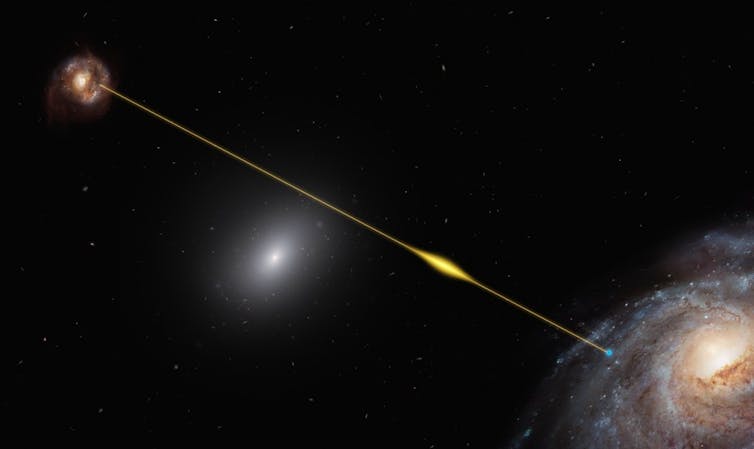 Mysterious blasts of radio waves from across the universe called fast radio bursts are getting more attention from astronomers. ESO/M. Kornmesser, CC BY-SA
On June 9, 2021, my colleagues and I announced the discovery of 535 fast radio bursts that we detected using the Canadian Hydrogen Intensity Mapping Experiment telescope (CHIME). Detected in 2018 and 2019, these bursts of radio waves last only milliseconds, come from far across the universe, and are enormously powerful – a typical event releases as much energy in a millisecond as the Sun does over many days.
Fast radio bursts are the subject of a young and emerging field in astrophysics, with only around 150 having been found before the release of our new catalog. A lot of work has been done to understand these events, but these cosmic radio bursts remain as mysterious as when they were first discovered in 2007. Simply put: No one knows what exactly produces them.
Every newly captured event is allowing astrophysicists like me to learn more about these weird cosmic phenomena. And, as this is happening, some astronomers have begun to use fast radio bursts as incredibly powerful tools to study the universe itself.
What is a fast radio burst?
The name “fast radio burst” is pretty on the nose. These signals are bursts of radiation in radio frequencies that last for mere milliseconds. A defining property of these bursts is their dispersion: The bursts produce a spectrum of radio waves, and as the waves travel through matter, they spread out – or disperse – with bursts at higher radio frequencies arriving at telescopes earlier than those at lower frequencies.
This dispersion allows researchers to learn about two important things. First, telescopes like CHIME can measure this dispersion to learn about the stuff that radio bursts pass through as they travel toward Earth. For example, some of my colleagues were able to solve a long-standing mystery of missing matter that was scattered across the universe.
Second, by measuring dispersion, astronomers can indirectly determine one of the most important pieces of information in all of astronomy: how far apart things are. The larger the dispersion measure, the more material the signal encountered. So, presumably, passing through more stuff means the burst traveled farther across the universe.
The dispersion measures for fast radio bursts are so large that astronomers know the signals must be coming from outside of the Milky Way galaxy, but these estimates can be inaccurate because of the uneven distribution of matter in the universe. We therefore needed another way of finding distances to the sources of fast radio bursts to avoid assumptions on how matter is distributed and thus unlock a large amount of information and opportunities.
A striking solution to this problem came in 2017, when colleagues of mine were able to pinpoint the exact location of the source of a repeating fast radio burst in the sky. By taking images of repeating bursts on the sky, they found the specific galaxy that the bursts were coming from. Then, using optical telescopes, they determined the distance to this galaxy – approximately 3 billion light-years away from Earth.
Repeating fast radio bursts make it much easier to pinpoint the host galaxies of their sources by giving researchers multiple chances to catch them. While astronomers work to answer important questions about fast radio bursts – What are they? Are repeating bursts different from single bursts? Are they all caused by the same things? – these lingering mysteries don’t stop us from putting them to good use in the meantime.

Using fast radio bursts to study the cosmos
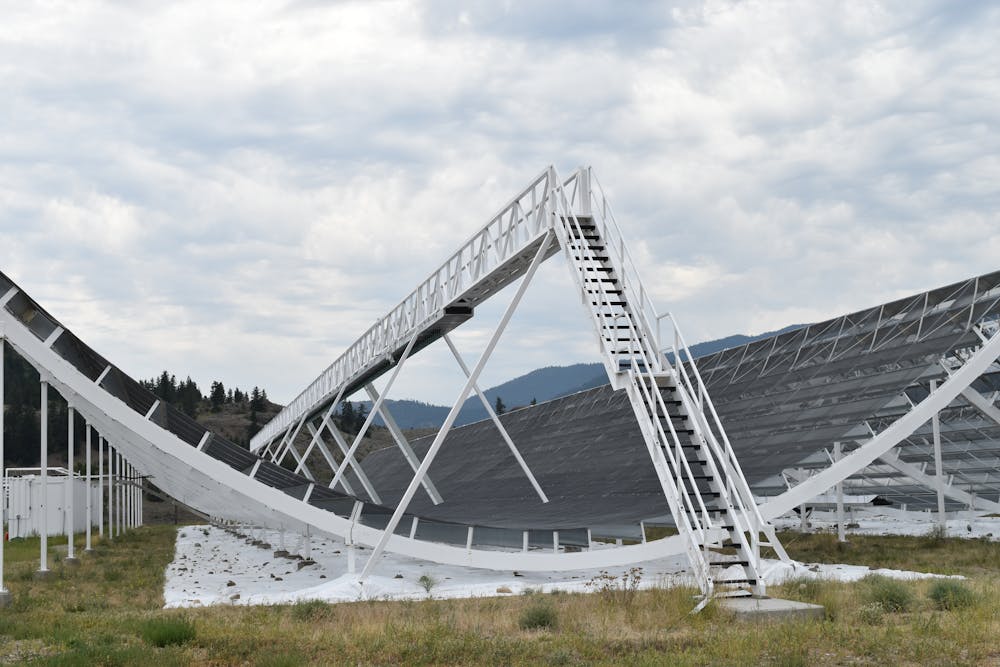
The unique properties of fast radio bursts and their host galaxies – combined with recent technological advancements like the CHIME telescope – have given researchers hope that these phenomena can be used to answer some long-standing questions about the universe.
For example, some theorists have proposed that fast radio bursts can be used to study the three–dimensional structure of matter in the universe. Others have shown that the most distant bursts could be used to learn about poorly understood early moments in the evolution of the universe. But to answer these and other questions, astronomers need a large number of fast radio bursts and their dispersion measures, strengths and locations in the sky.
And this is where our new catalog from CHIME comes in. By releasing information about 535 new fast radio bursts – including 61 bursts coming from 18 repeating sources – our team is more than quadrupling the total number of known events and pushing the field into an era of big data. With a large and growing number of measurements, all sorts of questions can finally start being addressed.
Recently, student members of the CHIME collaboration began releasing studies using this catalog. One study showed that the fast radio bursts detected by CHIME come equally from all directions – a fact that had previously been under debate. Another team studied the shapes and sizes of bursts in the catalog and confirmed that repeating events behave differently from single bursts, pointing to multiple causes of fast radio bursts. And a third team for the first time confirmed that fast radio bursts are strongly associated with known galaxies. This means astronomers can use events to map out the structure of the universe.
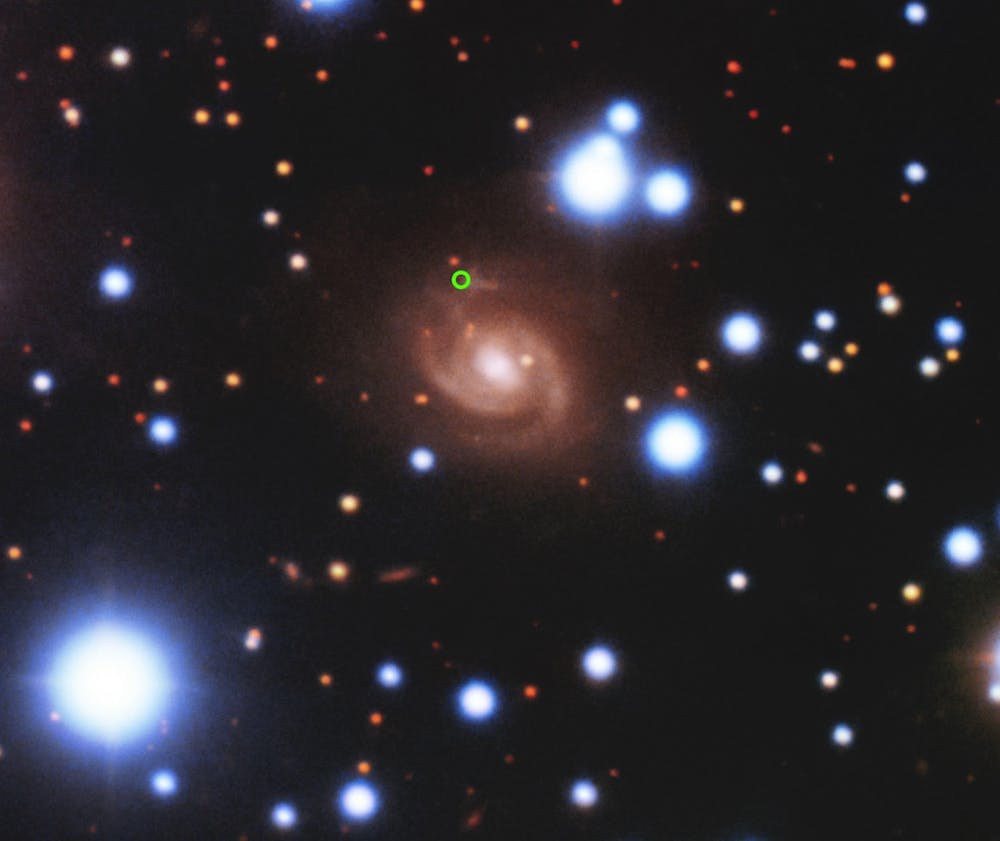
An adventurous future lies ahead
CHIME and other telescopes are detecting more fast radio bursts every day, but researchers are just scratching the surface of what can be learned about – and done with – these mysterious and powerful cosmic events.
Colleagues of mine recently argued that attributing thousands of events to their individual host galaxies is “the most urgent observational priority for [fast radio burst] science.” Finding host galaxies is very challenging, though – only 14 galaxies that host fast radio bursts have been found so far. But other telescopes, like the Australian Square Kilometre Array Pathfinder, have successfully detected and pinpointed a small number of nonrepeating bursts to their host galaxies. Next-generation telescopes are being designed to combine the high-detection capability of CHIME with the high-resolution imaging of the Australian telescope.
The field of fast radio burst astronomy is still in its infancy, and it is hard to predict what discoveries will be made next. But I expect the future of the field to be just like these profound cosmic events: bright and fast.
[Understand new developments in science, health and technology, each week. Subscribe to The Conversation’s science newsletter.]
Emmanuel Fonseca, Assistant Professor of Astronomy, West Virginia University
This article is republished from The Conversation under a Creative Commons license. Read the original article.