 How to resolve AdBlock issue?
News
- Details
- Written by: Elizabeth Larson
The City of Clearlake Animal Association also is seeking fosters for the animals waiting to be adopted.
Another way to help is through donations. A wish list has been posted on Amazon and on Chewy. For those who wish to shop local and drop off items, call 707-273-9440 to schedule a delivery or donate at the association’s Facebook page.
Here are this week’s adoptable dogs.

‘Bear’
“Bear” is a male American Staffordshire terrier mix with a short brown coat.
He has been neutered.
He is dog No. 3476.

‘Blue Eyed Jack’
“Blue Eyed Jack” is a male German shepherd mix.
He is dog No. 5046.

‘Mara’
“Mara” is a female Rottweiler mix.
She has a short black and tan coat.
He is house-trained.
She is dog No. 4628.

‘Mary J’
“Mary J” is a female pit bull terrier mix.
She has a white and tan coat.
She is house-trained.
She is dog No. 4927.

‘Mitzy’
“Mitzy” is a female shepherd mix with a medium-length black and white coat.
She is dog No. 4648.

‘Sassy’
“Sassy” is a female American bully mix with a short black coat.
She has been spayed.
She is dog No. 4602.

‘Sissy’
“Sissy” is a female American Staffordshire terrier mix with a black coat.
She is dog No. 4964.

‘Tanisha’
“Tanisha” is a female shepherd mix with a short orange and white coat.
She is dog No. 4647.

‘Terry’
“Terry” is a male Dutch shepherd mix with a smooth brindle coat.
He is dog No. 4880.

‘Yule’
“Yule” is a male husky with a medium-length black and white coat.
He is dog No. 4432.
Call the Clearlake Animal Control shelter at 707-273-9440, or email
Visit Clearlake Animal Control on Facebook or on the city’s website.
Email Elizabeth Larson at
- Details
- Written by: Elizabeth Larson
The fire weather watch is in effect from 5 p.m. Thursday until 5 a.m. Friday, the National Weather Service reported.
The agency said a fire weather watch means that critical fire weather conditions are forecast to occur.
In this case, that includes isolated dry thunderstorms that could occur and lead to fire starts, along with gusty and erratic winds of up to 40 miles per hour.
Forecasters expect showers and thunderstorms to develop across the interior mountains of northwest California Thursday evening and night.
A mix of dry and wet storm activity is expected, with dry storms posing a threat for fire starts, according to the forecast.
The specific Lake County forecast calls for a 20% chance of showers and thunderstorms after 11 p.m. Thursday, with conditions clearing by Friday morning.
Daytime temperatures will range into the high 90s in the south county on Thursday, with slightly cooler conditions elsewhere, reaching the high 80s and low 90s into early next week, with nighttime temperatures hovering in the mid 50s to low 60s, based on the forecast.
Light winds of up to about 10 miles per hour also are forecast through Friday, forecasters said.
Email Elizabeth Larson at
- Details
- Written by: Lake County News reports
Lexie Brooke Thompson, 21, was arrested by the Mendocino County Sheriff’s Office based on that agency’s investigation into the case, which came to light late in August.
A report from Det. Sgt. Luis Espinoza explained that on Aug. 25 Mendocino County Sheriff's Office deputies were dispatched on the report of a suspected sexual abuse of a 12-year-old female from Hidden Valley Lake.
Sheriff's office detectives were later dispatched to conduct further investigations, Espinoza said.
Through the investigation, Espinoza said authorities learned that near the end of July, Thompson engaged in multiple sexual acts with the girl — who she knew — over the course of a single day at a residence in Potter Valley.
On Aug. 27, investigators contacted and interviewed Thompson, who Espinoza said they subsequently arrested on charges of lewd sexual acts with a minor under 14 years old, oral copulation of a minor under 14 years old and sexual penetration with a foreign object of a minor under 14 years old.
Espinoza said Thompson was also identified as being on summary probation and arrested for violation of probation and she was booked into the Mendocino County Jail.
Investigators contacted a Mendocino Superior Court judge and requested a bail enhancement, which resulted in Thompson being held on a no bail status, Espinoza said.
On Wednesday, she remained in custody, according to jail records.
Espinoza said the investigation remains ongoing and anyone with information related to Lexie Thompson is asked to contact the Mendocino County Sheriff's Office Investigations Bureau Tip-Line at 707-234-2100 or contact Mendocino County Sheriff's Office Dispatch Center at 707-463-4086.
- Details
- Written by: Kara Manke
Though overall air quality in the U.S. has improved dramatically in recent decades, smoke from catastrophic wildfires is now creating spells of extremely hazardous air pollution in the Western U.S.
And, while many people have learned to reduce their exposure by staying inside, keeping windows closed and running air filtration systems on smoky days, data remains limited on how well these efforts are paying off.
In a new study, scientists from the University of California, Berkeley, used data from 1,400 indoor air sensors and even more outdoor air sensors included on the crowdsourced PurpleAir network to find out how well residents of the San Francisco and Los Angeles metropolitan areas were able to protect the air inside their homes on days when the air outside was hazardous.
They found that, by taking steps like closing up their houses and using filtration indoors, people were able to cut the infiltration of PM2.5 particulate matter to their homes by half on wildfire days.
“While the particulate matter indoors was still three times higher on wildfire days than on non-wildfire days, it was much lower than it would be if people hadn’t closed up their buildings and added filtration,” said study senior author Allen Goldstein, a professor of environmental engineering and of environmental science, policy and management at UC Berkeley. “This shows that when people have information about the smoke coming their way, they are acting to protect themselves, and they are doing it effectively.”
While individuals can take steps to reduce smoke infiltration to their homes, the ability for air pollution to get inside can also depend heavily on the nature of the building itself. To study these effects, the researchers also used the real estate website Zillow to estimate the characteristics of buildings in the sensor network, including the structure’s relative age, the type of building and the socio-economic status of the neighborhood.
Not surprisingly, they found that newly constructed homes and those that were built with central air conditioning were significantly better at keeping wildfire smoke out.
“One of the things that makes this study exciting is it shows what you can learn with crowdsourced data that the government was never collecting before,” said study co-author Joshua Apte, an assistant professor of civil and environmental engineering and of public health at UC Berkeley. “The Environmental Protection Agency (EPA) has a mandate to measure outdoor air quality and not indoor air quality — that’s just how our air quality regulations are set up. So, these kinds of crowdsourced data sets allow us to learn about how populations are affected indoors, where they spend most of their time.”
Protecting the air of the great indoors
Like many residents of the Western U.S., both Goldstein and Apte regularly use websites like AirNow and PurpleAir to check how wildfire smoke is affecting the air quality where they live. Both have even installed their own PurpleAir sensors to track the concentrations of PM2.5 particulate matter inside their homes.
So, when UC Berkeley graduate student Yutong Liang wrote a term paper using data from the PurpleAir network to study the impact of wildfire smoke on indoor air quality, Goldstein and Apte thought the work was worth expanding to a full research study.
“Our friends and neighbors and colleagues were all looking at this real-time data from PurpleAir to find out when smoke was affecting their area, and using that information to decide how to behave,” Goldstein said. “We wanted to use actual data from this network to find out how effective that behavior was at protecting them.”
The analysis compared indoor and outdoor sensor data collected during August and September of 2020, when both San Francisco and Los Angeles experienced a number of “fire days,” which the researchers defined as days when the average PM2.5 measured by the EPA exceeded 35ug/m3. This value corresponds to an Air Quality Index (AQI) of approximately 100, which represents the boundary between PM2.5 levels that the EPA considers “moderate” and those that are considered “unhealthy for sensitive groups.”
While scientists are still working to puzzle out just what types of chemical compounds are found in this particulate matter from wildfire smoke, a growing body of research now suggests that it may be even worse for human health than other types of PM2.5 air pollution.
“Wildfires create thousands of different organic chemicals as particulate matter and gases that can cause respiratory and cardiovascular problems in people,” said Liang, who is lead author of the study. “The Goldstein research group is trying to identify these unique compounds, as well as the ways that they react to transform the composition of wildfire smoke over time.”
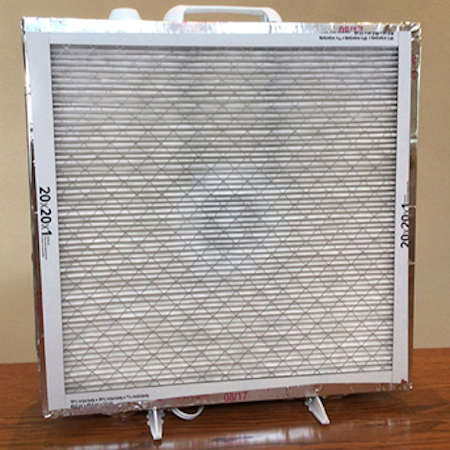
To protect indoor air during fire season, the research team suggests closing up your home before smoke arrives in your area and investing in an air filtration system. If you can’t afford a commercial air filter — or they are all sold out — you can also build your own for less than $50 using a box fan, a MERV-rated furnace filter and some tape.
“There are lots of very informative Twitter threads about how to build a good DIY system, and if you are willing to go a little crazy – spend $90 instead of $50 – you can build an even better design,” Apte said. “Every air quality researcher I know has played around with these because they are so satisfying and simple and fun, and they work.”
Where you put the filters also matters. If you only have one, Apte suggests putting it in your bedroom and leaving the door closed while you sleep, to keep the air in your bedroom as clean as possible.
Finally, the researchers suggest cooking as little as possible during smoky days. Cooking can generate surprising amounts of both particulate matter and gases, neither of which can be easily ventilated out of the house without inviting wildfire smoke in.
“Air filters can help remove particulate matter from cooking, but running a kitchen or bathroom exhaust fan during smoke events can actually pull PM2.5 -laden air from outdoors to indoors,” Goldstein said.
In the future, the researchers hope to find ways to sample the indoor air quality of a more diverse array of households. Because PurpleAir sensors cost at least $200 apiece, households that contribute data to the network tend to be affluent, and the Zillow estimates show that the average price of homes in the network is about 20% higher than median property values in their areas.
“One thing that we’re deeply interested in is understanding what happens to people in indoor environments, because that’s where people spend most of their time, and there’s still an awful lot we don’t know about indoor pollution exposure,” Apte said. “I think that these new methods of sensing the indoor environment are going to allow us to grapple a lot more with questions of environmental justice and find out more about who gets to breathe cleaner air indoors.”
Co-authors of the paper include Deep Sengupta, Mark J. Campmier and David M. Lunderberg of UC Berkeley.
This work was supported by the National Oceanic and Atmospheric Administration Climate Program Office’s AC4 program (Award NA16OAR4310107) and the California Air Resources Board (Award 19RD008). This publication was also developed as part of the Center for Air, Climate and Energy Solutions, which was supported under the Assistance Agreement R835873 awarded by the U.S. EPA. It has not been formally reviewed by the EPA.
Kara Manke writes for the UC Berkeley News Center.