 How to resolve AdBlock issue?
News
- Details
- Written by: Elizabeth Larson
The board will meet virtually online beginning at 9 a.m. Tuesday, Sept. 14.
The meeting is being conducted via Zoom this week because the board chambers will be used for voting activities on Election Day, which the board approved during a special virtual meeting on Thursday.
The meeting can be watched live on Channel 8, online at https://countyoflake.legistar.com/Calendar.aspx and on the county’s Facebook page. Accompanying board documents, the agenda and archived board meeting videos also are available at that link.
To participate in real-time, join the Zoom meeting by clicking this link.
The meeting ID is 958 6394 8038, pass code 845932. The meeting also can be accessed via one tap mobile at +16699006833,,95863948038#,,,,*845932# US.
All interested members of the public that do not have internet access or a Mediacom cable subscription are encouraged to call 669-900-6833, and enter the Zoom meeting ID and pass code information above.
To submit a written comment on any agenda item visit https://countyoflake.legistar.com/Calendar.aspx and click on the eComment feature linked to the meeting date. If a comment is submitted after the meeting begins, it may not be read during the meeting but will become a part of the record.
At 9:15 a.m., the board will hear a presentation on the Konocti Project and consider granting permission for excavating and exploring the Mount Konocti summit vents, and for the United States Geological Survey to do more research.
A report to the board from Supervisors Jessica Pyska explains that the Konocti Project’s specific purpose “is to promote and sponsor the scientific exploration and study of the geology, archeology and other natural and cultural aspects of Mt. Konocti and surrounding areas of Lake County, for the benefit of the public.”
She said the project would like to resume efforts in the summit vents “to either prove or disprove the existence of a large cavern and lake inside the mountain. If the science and research is right, and our local Indian legends are true, then Lake County will have uncovered one of the wonders of the world.”
Pyska said the project would like to gain permission to further excavate and explore the summit vents, and possibly put up a perimeter fence for public safety.
At 9:30 a.m., the board will hold a public hearing to consider the final recommended budget for fiscal year 2021/2022 for the county of Lake and Special Districts governed by the Board of Supervisors.
The final recommended budget totals $319,386,115, up from the initial budget accepted in June, which totaled $307,498,431.
Accounting for that increase is larger-than-anticipated property tax, sales tax and transient occupancy tax proceeds, as well as the first half of the $12.5 million the county is receiving through the American Rescue Plan Act.
At 10:40 a.m., the board will get an update on COVID-19 from Public Health officials.
In untimed items, the board will consider approving video content encouraging COVID-19 vaccination, and will discuss an amendment to the personnel policy for evaluation of the performance of the county administrative officer, appointed department heads and the Public Health officer.
The full agenda follows.
CONSENT AGENDA
5.1: Approve amendment to the county of Lake COVID-19 Public Health Emergency Worksite Protocol.
5.2: Adopt resolution approving Agreement No. 21-0277-023-SF with California Department of Food and Agriculture for compliance with the Sudden Oak Death Quarantine program for period July 1, 2021, through June 30, 2022, in the amount of $4,335.31.
5.3: Adopt resolution approving Agreement No. 21-0391-000-SG with California Department of Food and Agriculture for compliance with the High Risk Pest Exclusion Program for period July 1, 2021, through June 30, 2022, in the amount of $11,047.94.
5.4: Adopt resolution approving a MOU between county of Lake and Lake County Resource Conservation District for management of goat’s rue in Lake County for FY 2021-2023 in the amount of $21,041.12.
5.5: Sitting as the Lake County Air Quality Management District Board of Directors, authorize the district to sign and submit an application for Carl Moyer Program Year 23 funding and sign all other program documents.
5.6: Sitting as the Lake County Air Quality Management District Board of Directors, appoint Lowell Grant as the engineer/scientist member to the LCAQMD Hearing Board pursuant to Health and Safety Code.
5.7: Adopt resolution fixing tax rates for local agencies, general obligation bonds and other voter approved indebtedness for fiscal year 2021/2022.
5.8: Approve agreement between county of Lake and Behavioral Health Services as lead agency of the Lake County Continuum of Care and North Coast Opportunities for fiscal year 2021-25 in an amount not to exceed $207,585 and authorize the chair to sign.
5.9: Adopt proclamation designating the month of September 2021 as National Alcohol and Drug Recovery Month.
5.10: Adopt proclamation designating Sept. 5 through 11 as National Suicide Prevention Week.
5.11: Approve late travel claim for mental health case manager in the amount of $200.07 and authorize the auditor-controller to process payment.
5.12: Approve Board of Supervisors minutes for Aug. 10 and 31 meetings.
5.13: Approve the continuation of a local health emergency related to the 2019 Coronavirus (COVID-19) as proclaimed by the Lake County Public Health officer.
5.14: Approve the continuation of a local health emergency and order prohibiting the endangerment of the community through the unsafe removal, transport, and disposal of fire debris for the LNU Complex wildfire.
5.15: Approve the Continuation of a local emergency due to the Mendocino Complex fire incident (River and Ranch fires).
5.16: Approve the continuation of a local emergency due to COVID-19.
5.17: Approve the continuation of an emergency declaration for drought conditions.
5.18: Approve the continuation of a local emergency In Lake County in Response to the LNU Lightning Complex wildfire event.
5.19: Approve the continuation of a local emergency due to the Pawnee fire incident.
5.20: Approve Continuation of a local health emergency by the Lake County health officer for the Cache fire.
5.21: Approve continuation of a local emergency by the Lake County sheriff/OES director for the Cache fire.
5.22: Approve purchase of seven 2022 Ford Explorer police pursuit vehicles from Napa Ford Lincoln in the amount of $285,465 from the Sheriff/Pursuit Replacement Budget Unit 2217, Object Code 62.72 and (b) authorize the sheriff/coroner or his designee to sign the purchase order.
5.23: Approve leave of absence request for sheriff's department employee Kellie Beck from Oct. 15, 2021, through April 15, 2022, and authorize the chairman to sign.
5.24: Approve contract between county of Lake and Chabot-Las Positas Community College District for Title IV-E training in the amount of $1,000,000 per fiscal year from July 1, 2021, to June 30, 2024, and authorize the chair to sign.
TIMED ITEMS
6.2, 9:06 a.m.: Presentation of proclamation designating Sept. 5 through 11 as National Suicide Prevention Week.
6.3, 9:08 a.m.: Presentation of proclamation designating the month of September 2021 as National Alcohol and Drug Recovery Month.
6.4, 9:15 a.m.: (a) Presentation on the Konocti Project; and (b) consideration of permission to proceed with excavating and exploring the Mount Konocti summit vents.
6.5, 9:25 a.m.: Review of and recommendation for cannabis tax usage and expenditure policies and procedures.
6.6, 9:30 a.m.: Public hearing, consideration of the final recommended budget for fiscal year 2021/2022 for the county of Lake and Special Districts governed by the Board of Supervisors.
6.7, 10:30 a.m.: Hearing on account and proposed assessment for the property located at 6814 Hammond Ave., Nice, CA; APN #031-071-46; Property Owner: Steve M. DeFilippis.
6.8, 10:40 a.m.: Consideration of update on COVID-19.
6.9, 11:15 a.m.: Discussion and consideration of an ordinance amending Article VII of Chapter 13 of the Lake County Code relating to administrative fines and penalties.
UNTIMED ITEMS
7.2: Consideration of video content encouraging vaccination in Lake County, and approval for distribution via our county website and social media channels, and any other available media outlets.
7.3: (a) Consideration of Amendment to Personnel Amended Policy Rule 1100 “Performance Reports,” creating Rule 1102.3 For Evaluation of the Performance of the County Administrative Officer, Appointed Department Heads, and the Public Health officer; and (b) consideration of special meeting dates to added to the Board of Supervisors annual calendar for 2021, at 1 p.m. on Sept. 30, Oct. 7, Oct. 21 and Nov. 4, 2021.
7.4: Consideration of (a) waiving the formal bidding process, pursuant to Lake County Code Section 38.2, as it is not in the public interest due to the unique nature of goods or services; and (b) approval of the agreement between the county of Lake and Ford Street Project for adult substance use disorder residential treatment services including medication assisted treatment and detoxification services for fiscal year 2021-22 for a contract maximum of $199,250.00 and authorize the board chair to sign the agreement.
7.5: Consideration of agreement between county of Lake and Sutter Center for psychiatry for fiscal year 2021-22 for 2020-21 services in the amount of $39,160.00 for acute psychiatric inpatient psychiatric hospitalization services.
7.6: Consideration of agreement between county of Lake and North Valley Behavioral Health LLC for fiscal year 2021-22 for 2020-21 services in the amount of $329,360.00 for acute psychiatric inpatient psychiatric hospitalization services.
7.7: Consideration of presentation on Lake County Behavioral Health Services' Mental Health Services Act Program annual update and program recommendations for fiscal year 2021-22.
7.8: Consideration of the following advisory board appointments: Spring Valley CSA#2 Advisory Board and Glenbrook Cemetery District.
CLOSED SESSION
8.1: Sitting as the Board of Directors of the Lake County IHSS Public Authority: Conference with (a) Chief Negotiator M. Long and County Negotiator C. Markytan; and (b) employee organization: California United Homecare Workers Union Local 4034.
8.2: Conference with labor negotiator: (a) Chief Negotiator: M. Long; County Negotiators: C. Huchingson and P. Samac; and (b) Employee Organization: LCSMA.
8.3: Public employee evaluation: Scott De Leon, director of the Department of Public Works, Water Resources and Community Development (the latter until June 13).
8.4: Public employee evaluation: Behavioral Health Director Todd Metcalf.
8.5: Conference with legal counsel: Significant exposure to litigation pursuant to Gov. Code sec. 54956.9(d)(2),(e)(3) — Claim of Dano.
8.6: Conference with (a) temporary representatives designated to meet with county department heads regarding salary and benefits and (b) unrepresented management employees.
Email Elizabeth Larson at
- Details
- Written by: Elizabeth Larson
Cal Fire said the Hopkins fire began at 2:15 p.m. Sunday at East Hopkins and North State Street in Calpella.
The cause of the fire remains under investigation, Cal Fire said.
As of Sunday night, Cal Fire said it had burned 275 acres and was 10% contained, with 200 structures threatened but none so far destroyed or damaged.
The agency said 22 engines, six water tenders, two helicopters, six hand crews, seven dozers and 262 personnel are assigned to the incident.
Cal Fire said the fire is burning in a mix of grass, brush, oak and pine trees, with firefighters working in extreme conditions — including high heat, low humidity, steep terrain and the potential for erratic winds.
The fire appeared to be the source of smoke that poured into Lake County’s air basin on Sunday afternoon.
The Mendocino County Sheriff’s Office issued a mandatory evacuation order for residents in the area of Road 144 to 50000 block of eastside of Calpella.
An evacuation center has been set up at the Mendocino County Office of Education, 2240 Old River Road in Ukiah.
Two sites are available in Ukiah to shelter large animals: the Redwood Empire Fairgrounds, 1055 State St., and the Mendocino County Animal Shelter on Plant Road.
Road closures are in effect at the bridge at Lake Mendocino Drive, Eastside Calpella and East Road, Marina Drive exit off Highway 20 and the Calpella exit off Highway 101, officials reported.
Email Elizabeth Larson at
- Details
- Written by: Katelyn Jetelina, University of Texas Health Science Center at Houston
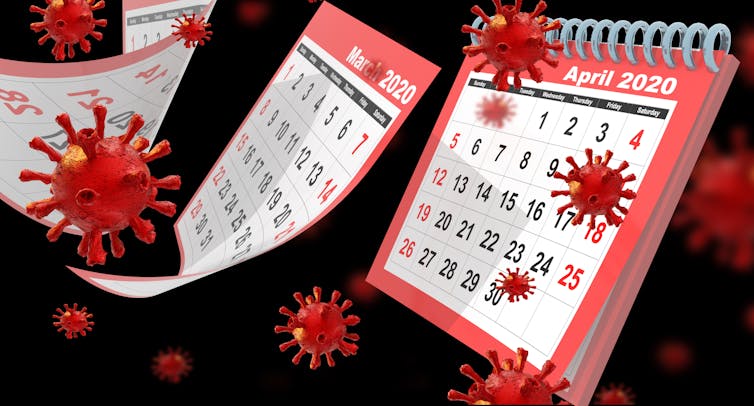
A year and a half into what the World Health Organization officially declared a pandemic on March 11, 2020, it’s an understatement to say that Americans are exhausted.
I’m an epidemiologist and an internationally recognized science communicator, and I’ve often found myself running between COVID-19 meetings asking “how did we get here?”
Figuring out the “how” is essential to preparing for the future. In trying to make sense of these past 18 months, I’ve found it helpful to broadly categorize the U.S. pandemic journey thus far into five phases: Scramble, Learn, Respond, Test and Hope.
Scramble: What’s going on?
In early 2020, SARS-CoV-2, the virus that causes COVID-19, hit the United States. The first documented case was a traveler who landed in Seattle from Wuhan, China on Jan. 15. Only later did public health officials find that SARS-CoV-2 was already spreading throughout the community.
It wasn’t until March that Americans were forced to take the pandemic seriously, as states began to implement stay-at-home orders. While civilians were struggling to figure out child care, working from home and Immunology 101, epidemiologists started to react.
But maybe a better word is “scramble.” The U.S. did not have the public health infrastructure in place to effectively respond. A chronically underfunded and politicized public health system hampered the nation’s real-time response.

Epidemiologists were scrambling, left to rely on volunteers to report national level public health data because there was no centralized public health data system in the U.S. Public health officials were scrambling to enact safety recommendations and contact trace because of limited resources. Data scientists, like those at Johns Hopkins University, were scrambling to share accessible data for decision-making. Scientists were scrambling to develop COVID-19 tests. And everyone was scrambling to figure out how to communicate the evolving threat of the virus to American lives. From the beginning, the seeds were sown for a reactive, rather than proactive, approach.
Learn: Are we doing anything right?
Once the Northeast started to get under control, June 2020 was fairly quiet across the nation. Is this done? Maybe the decrease is due to weather? People started relaxing.
Then July hit. In one month, cases in the South were as high as they had been in the Northeast months earlier. The West started creeping up, too. The game of whack-a-mole began as there still wasn’t a coordinated, national response.
Health departments were expanding capacity for testing, tracing and surveillance. A multitude of multidisciplinary, academic teams were forming to understand COVID-19 from microscopic-level virology all the way to population-level social implications.
This is when published, peer-reviewed data on COVID-19 started coming through. In fewer than five months, scientific literature database Scopus indexed more than 12,000 publications. Researchers started discovering long COVID-19 symptoms and figuring out effective protective measures like social distancing and wearing a mask. Researchers also learned more about superspreader events and how COVID-19 is transmitted through the air – although this wasn’t officially recognized by the WHO or the Centers for Disease Control and Prevention until about a year later.
While the flood of evidence provided scientists and clinicians with critical information, a wave of retractions pulling papers with erroneous or unreliable data began to appear. This, coupled with lack of accurate scientific communication from unbiased sources, fueled a concurrent infodemic – an epidemic of misinformation and public health threats that researchers, social media companies and public health officials are still learning how to identify, mitigate and treat.
Respond: Bring it on, virus!
Then came winter, which proved to be a perfect storm of pandemic fatigue and holiday travel. This resulted in our biggest pandemic wave yet. More than 3,000 people were dying per day in the U.S.
Thankfully, help was on its way: vaccines. And not just pretty good vaccines – vaccines that blew efficacy out of the water. The Pfizer-BioNTech vaccine proved to have an efficacy of 95%, significantly above the threshold target of 50%. Thanks to over 500,000 clinical trial volunteers, decades of mRNA research, an estimated US$39.5 billion and fast-moving scientists, the vaccines got to the public in record time. And, while the vaccine rollout was rough, more than 260 million doses were administered by May 2021 in the U.S.
With vaccines, though, came new challenges: a new fight against disinformation (no, mRNA does not change your DNA) and a struggle to understand breakthrough infections.
In the meanwhile, new COVID-19 variants arrived on the scene. Suboptimal genomic surveillance made it difficult to identify where and what variants were spreading. The race between vaccination and variant spread was upon us. The fight was far from over.
Test: We’re tired
Early summer 2021 for Americans was blissful. The U.S. reached an all-time pandemic low in terms of COVID-19 cases. People who were vaccinated were told they could take off their masks, while some unvaccinated people took this carte blanche. More Americans started traveling again and getting back to working in person.
But then the delta variant knocked on the door. Significantly more transmissible and severe than the original strain of the coronavirus, it first created a tsunami of cases in the South that then spread to every corner of the United States.
Unfortunately, pandemic fatigue has settled in. And the pandemic is pushing the U.S. response to its limits. It’s testing the amount of pressure vaccines can withstand. It’s testing health care system capacity. It’s testing the resilience of public health and health care workers. It’s testing the ability of scientists to effectively communicate ever-evolving research findings. And it’s testing the public’s patience as pediatric vaccines undergo clinical trials.
Hope: This will end
Every epidemic curve comes down. And this one will too. But even after it comes down, the pandemic will still be far from over.
There’s still trauma to be addressed. Families were robbed of proper funerals and goodbyes. Friendships were ripped apart by politically charged misinformation and disinformation. Millions of people lost their jobs. And frontline workers are still not OK. A survey of public health workers across the U.S. found that more than half reported symptoms of at least one mental health condition from March to April 2021.
The U.S. will also need to self-reflect as a nation. In order to deal effectively with the next infectious disease crisis, the U.S. will need to create centralized public health systems and expand genomic surveillance, hospital networks and testing capabilities. Scientists need to revamp how they accessibly communicate science and research so the CDC can build public trust again. And by removing politics from public health, science might be able to infiltrate echo chambers instead of feeding them.
Americans need to prepare so when the next pandemic hits, everyone will be ready to mount a proactive, effective fight against a common enemy: the virus.
[Get The Conversation’s most important coronavirus headlines, weekly in a science newsletter]
Katelyn Jetelina, Assistant Professor of Epidemiology, University of Texas Health Science Center at Houston
This article is republished from The Conversation under a Creative Commons license. Read the original article.
- Details
- Written by: Elizabeth Larson
The following cats at the shelter have been cleared for adoption.
Call Lake County Animal Care and Control at 707-263-0278 or visit the shelter online at http://www.co.lake.ca.us/Government/Directory/Animal_Care_And_Control.htm for information on visiting or adopting.
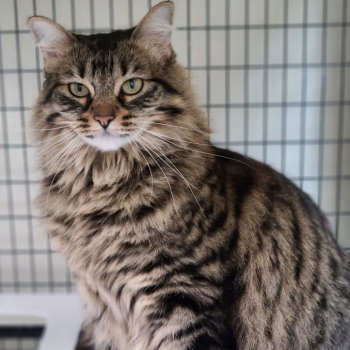
Female domestic longhair
This 6-year-old female domestic longhair has a brown tabby coat.
She is in cat room kennel No. 54, ID No. LCAC-A-1477.

Domestic medium hair cat
This 3-year-old female domestic medium hair cat has a brown tabby coat.
She is in cat room kennel No. 58, ID No. LCAC-A-1029.
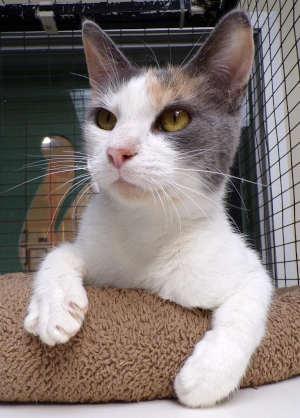
‘Marmalade’
“Marmalade” is a 5-year-old female domestic short hair cat with a calico and white coat.
She is in cat room kennel No. 68, ID No. LCAC-A-1444.
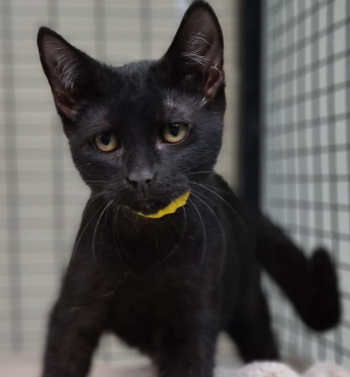
Female domestic short hair kitten
This female domestic short hair kitten has a black coat.
She is in cat room kennel No. 101, ID No. LCAC-A-1504.

Domestic short hair kitten
This male domestic short hair kitten has all-black coat.
He is in cat room kennel No. 101, ID No. LCAC-A-1502.

Domestic short hair kitten
This male domestic short hair kitten has an all-black coat.
He is in cat room kennel No. 125B, ID No. LCAC-A-1139.

Female domestic short hair
This 1-year-old female domestic short hair cat has a black coat.
She is in cat room kennel No. 135, ID No. LCAC-A-1133.
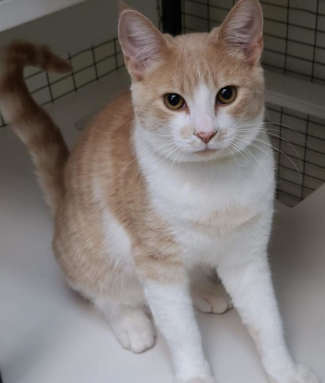
‘Goldie’
“Goldie” is a male domestic short hair kitten with a yellow tabby and white coat.
He is in cat room kennel No. 142, ID No. LCAC-A-1442.

‘Ophir’
“Ophir” is a male domestic short hair kitten with a red and white coat.
He is in cat room kennel No. 142, ID No. LCAC-A-1443.
Email Elizabeth Larson at