 How to resolve AdBlock issue?
News
- Details
- Written by: Lake County News reports
Planning commissioners hear and act upon land use matters and are advisory to the City Council on zoning regulations, the general plan and other land use issues.
Commissioners serve at the will of the City Council and are designated filers under the Fair Political Practices Commission and must file periodic statements of economic interest disclosing financial interests within the jurisdiction of the city.
The Marketing Committee takes an active role in recommending projects and programs for City
Council adoption.
Previous recommendations by the committee that were approved by the City Council include a new city seal, city motto, police department graphics and patches, banners, newspaper advertisements and a city photo contest.
Applications are available at Clearlake City Hall, 14050 Olympic Drive, on the city’s website or by emailing Administrative Services Director/City Clerk Melissa Swanson at
The City Council will consider applications and appointments during its Oct. 7 meeting.
The deadline for applications to be included in the City Council meeting packet is Sept. 30 at 5 p.m.
- Details
- Written by: Lake County News reports
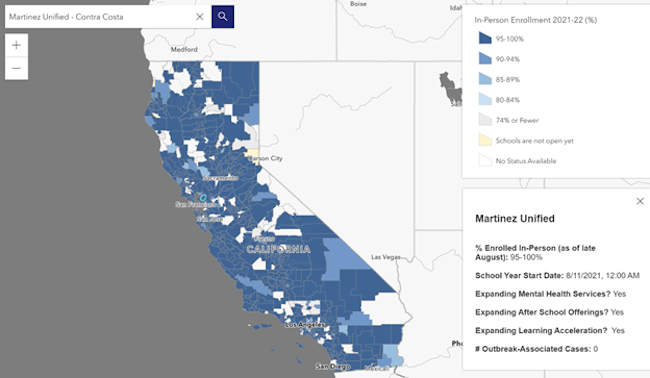
New data show that the vast majority of California’s school districts are reporting that 95 to 100% of students are in-person.
This is in addition to California leading national trends when it comes to keeping schools open and keeping kids out of the hospital.
On Wednesday, Gov. Gavin Newsom visited a TK-8 school in Oakland as part of the effort to highlight the state’s efforts to safely open schools for full in-person instruction.
“We implemented the most robust school reopening and safety strategy in the entire country, and now California’s students are back in the classroom and schools are remaining open at nation-leading rates,” said Gov. Newsom. “It’s no coincidence that California is the first state to advance out of the CDC’s ‘high’ transmission category and has the lowest case rates in the entire country. The state’s efforts and resources have made schools among the safest places in our communities.”
The state’s new Student Supports & In-Person Dashboard provides data collected from school districts regarding how many students are back in classrooms.
Regarding the expanded educational opportunities and wellness services available for students, the data shows that the vast majority of districts have 95 to 100% percent of students in-person, and nearly 98% of schools are expanding mental health, after-school and tutoring programs.
Additionally, the new District 2021-22 Instruction Status Map provides a regional breakdown of student in-person rates, expanded educational opportunities and in-school outbreak-associated cases.
In Lake County, the map shows that Lakeport Unified, Lucerne Elementary Middletown Unified and Upper Lake Unified fall into the 95 to 100% category, while Kelseyville Unified is at 85 to 89% and Konocit Unified is at 90 to 94%.
Centers for Disease Control and Prevention data has shown that California is leading national trends for keeping kids out of the hospital.
As of Sept. 12, the national rate of COVID-19 hospitalizations for those aged 0 to 17 was three times the rate of California’s, while Florida’s rate was six times that of California.
Nationally, California is leading national trends in keeping schools open. According to the independent site Burbio that tracks nationwide school closures, roughly 1,900 to 2,000 school closures have occurred this year, with only nine in California — amounting to roughly 0.5% of total closures nationwide.
Through the winter, the governor championed urgent action to provide school funding to both accelerate school reopenings in the 2020-21 school year and expand student supports for the summer and 2021-22 school year.
AB 86 was enacted on March 5, 2021, with $4.6 billion (of $6.6 billion in total funding) dedicated to expanding student supports. Schools used those early funds to expand educational opportunities for the summer and the upcoming school year.
According to the summer data, 89% of school districts reporting offered new learning opportunities over the summer, including learning acceleration (e.g., high-dose tutoring), enrichment and mental health services.
Building on this funding, the Governor signed into law a historic $123.9 billion K-12 education package that represents a transformation of the state’s public schools over the next several years.
- Details
- Written by: Elizabeth Larson
Statewide, as of 2:55 a.m. Wednesday, the Secretary of State’s Office said 100% of precincts statewide — 18,185 in all — were “partially reporting” since vote-by-mail, provisional and other ballots will continue to be processed for several weeks to come.
The preliminary statewide count showed the recall failing by a wide margin, with a 63.9% “no” vote and a 36.1% “yes” vote.
Ballots cast against the recall totaled 5,840,283 in the initial count, compared to 3,297,145 ballots in favor of removing Newsom from office.
In Lake County, the Registrar of Voters Office posted preliminary results for vote-by-mail and in-person voting for all 70 precincts shortly before 12:30 a.m. Wednesday.
A total of 9,372 ballots were cast, of which 37 were undervotes and two were overvotes, the elections office said.
Of those ballots, 8,816 were vote-by-mail, or absentee, and 517 were cast in the 22 polling places open across the county for the Tuesday special election.
Based on those preliminary results, Lake County voters rejected recalling Newsom with a 62.48% “no” vote, or 5,605 ballots cast, compared to a 37.52% “yes” vote, which accounted for 3,728 ballots.
Of the 46 alternate candidates on the ballot, Larry Elder received the most votes in Lake County’s preliminary results, with 1,907. The rest of the top 10 included John Cox, 495; Kevin Kiley, 317; Kevin Paffrath, 277; Patrick Kilpatrick, 269; Brandon M. Ross, 232; Kevin L. Faulconer, 196; Joel Ventresca, 145; Jacqueline McGowan, 142; and Caitlyn Jenner, 85.
Those counts are expected to change as more ballots come in.
The Secretary of State’s Office said mailed ballots had to be postmarked on or before Sept. 14, and must be received by the county elections office no later than Sept. 21 in order to be counted.
The Registrar of Voters Office reported that the official canvass will commence on Thursday, Sept. 16, at 9 a.m.
The Secretary of State’s Office said the results will be certified by Oct. 22.
The recall attempt of Newsom was the 55th filed against a governor of California since the actions were first taken in 1913, according to state records.
Only one governor — Democrat Gray Davis — has been successfully recalled since that time.
Email Elizabeth Larson at
- Details
- Written by: Elizabeth Larson
The final recommended budget for the county and its special districts for fiscal year 2021-22 totals $319,386,115, down slightly from the adopted 2020-21 fiscal year budget of $322,362,410.
The board’s public hearing on the budget Tuesday morning was a matter of fine tuning, touching on some of the major adjustments made since the supervisors held June budget hearings and approved an initial budget of $307,498,431.
One of the large new sources of money coming into the county this year is through the American Rescue Plan Act.
Lake County is receiving $12.5 million from the act. The county has already received half of that amount already, with the final installment to come next spring, said County Administrative Officer Carol Huchingson.
Just how those funds will be spent by the county of Lake was not revealed on Tuesday; Huchingson said an ad committee is actively working on plans to spend those funds and those recommendations will be presented to the board in October.
“It’s a tremendous opportunity for Lake County,” said Huchingson, noting she hasn’t seen anything like this before during her tenure.
Huchingson said the funds can be used in a variety of ways, from pandemic response to infrastructure. One possible use might be broadband, although she said there is other money now coming forward for the long-awaited broadband expansion.
Deputy Administrative Officer Stephen Carter told the board that staff had made 365 changes made to the budget, mostly minor adjustments in numbers and funds.
He said the county had a high general fund balance carry-over — in part due to salary savings from the county’s high vacancy rate. Staff recommended placing $3.5 million of that carry-over into the reserves, putting the reserves at $12.5 million, or 25%.
Carter said several revenue streams came in during the 2020-21 fiscal year that were at the highest levels in the county’s history.
Those high-performing revenue sources included property tax, which came in just over $1.1 million higher than the previous year, for a 4.74% increase, he said.
Bradley-Burns sales tax, which comes from a law which provides for 1 ¼% of proceeds for cities and counties, brought in $4,414,350.19 for the 2021 fiscal year, which was an increase of $1,132,343.86 over fiscal year 2019-20, Carter reported.
Carter said Proposition 172 sales tax revenues, which come from a one-half percent sales tax that can be used for public safety, equaled $3,417,484.37 last fiscal year, an increase of $182,079.29 over the previous year.
Transient occupancy, or bed tax, came in at $1.9 million, an increase of more than $247,909.76 over 2019-20. When removing proceeds related to the county’s tourism improvement district, Carter said that revenue totaled $977,000, the highest it’s been since 2002, when Konocti Harbor Resort remained in operation.
One of the main changes discussed on Tuesday was a $100,000 increase to the Board of Supervisors’ budget unit to cover facilitation services for the community visioning forum process.
Another budget adjustment was for $306,275 the county received from the state to pay for the gubernatorial recall election on Tuesday.
Since the recommended budget was approved in June, Carter said nine requested positions were added: temporary property tax coordinator, Public Works service technician, business software analyst, deputy sheriff, sheriff’s public information officer, deputy sheriff sergeant, code enforcement officer, staff services analyst and Water Resources field maintenance technician.
The staff report to the board also noted that in anticipation of the supervisors completing implementation of the human resources classification and compensation study of October 2019, payroll cost adjustments will be budgeted at midyear.
“We have more money than the county has ever seen before,” said Board Chair Bruno Sabatier, noting that some of it is from the state and federal government due to COVID-19, along with the increased tax proceeds and cannabis tax funds.
Sabatier said the county is taking steps to look at big future projects, noting that they need to get to a five-year strategic plan. “I think we are on that path.”
“We haven’t had an opportunity like this before,” said Supervisor Moke Simon.
Simon said they want to strengthen the workforce and this budget is a step in that direction.
The board unanimously approved three separate motions — adoption of the final recommended budget resolution, adoption of a resolution establishing new classifications and amending the position allocation chart for fiscal year 2021-22, and the continuation of the informal hiring freeze for general fund departments, delegating authority to the county administrative officer to waive that hiring freeze as appropriate.
Email Elizabeth Larson at