 How to resolve AdBlock issue?
News
- Details
- Written by: Lake County News reports
LAKE COUNTY, Calif. — Due to an offshore weather system that could bring high winds on Monday, Pacific Gas and Electric Co. said it may need to shut off power to 14,000 customers in 13 counties across Northern California, including Lake County.
The company said its meteorologists continue to monitor a potential weather system that could bring dry offshore winds to parts of the company’s service area beginning Monday morning.
Due to the wind event, combined with extreme to exceptional drought and extremely dry vegetation, PG&E began sending advance notifications to the customers where it may implement a public safety power shutoff Monday morning in portions of the North Coast and North Bay.
Shutoffs in the Northern Sierra foothills and Kern County could begin Monday afternoon, depending on the timing of the wind event, PG&E said.
PG&E said it activated its Emergency Operations Center on Friday to support this weather event.
PG&E said it notified 756 customers, including 65 Medical Baseline customers, in Lake County of the potential shutoff.
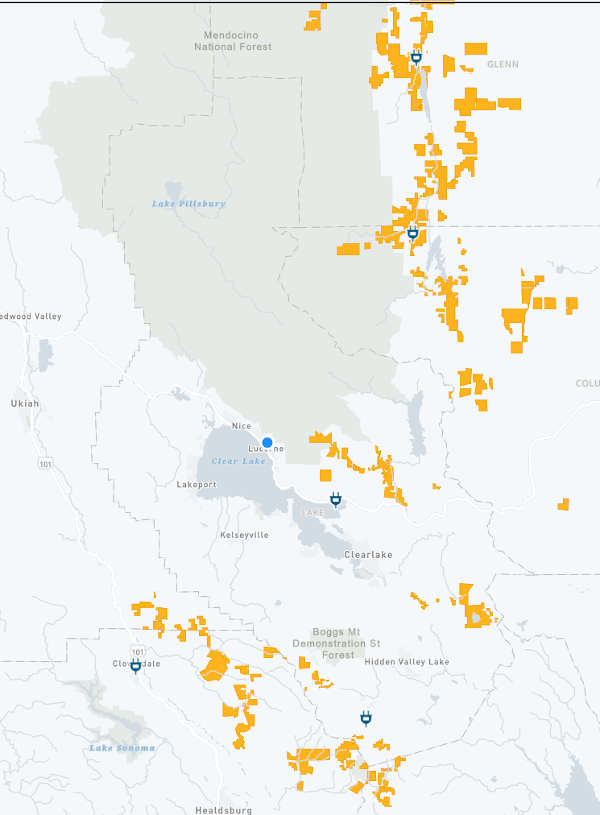
The Lake County customers expected to be impacted are in areas north and east of Clearlake Oaks, east of Lower Lake, and south of Cobb and Middletown, as shown in the map above.
PG&E estimated that power in those areas will be shut off between 4 and 6 a.m., and be restored by 10 p.m. Monday.
Potentially affected customers in other counties are as follows:
Butte County: 2,735 customers, 248 Medical Baseline customers;
Colusa County: 567 customers, 36 Medical Baseline customers;
Glenn County: 376 customers, 21 Medical Baseline customers;
Kern County: 674 customers, 35 Medical Baseline customers;
Mendocino County: 13 customers, 4 Medical Baseline customers;
Napa County: 1,584 customers, 70 Medical Baseline customers;
Santa Barbara County: 19 customers, 1 Medical Baseline customer;
Shasta County: 3,166 customers, 294 Medical Baseline customers;
Solano County: 802 customers, 56 Medical Baseline customers;
Sonoma County: 1,241 customers, 47 Medical Baseline customer;
Tehama County: 2,270 customers, 177 Medical Baseline customers;
Yolo County: 20 customers, 0 Medical Baseline customers.
The impacted customers and the numbers could change as the company adjusts its plans in response to conditions.
Customers can also look up their address online to find out if their location is being monitored for the potential safety shutoff at www.pge.com/pspsupdates.
During a PSPS, PG&E offers support to customers by opening Community Resource Centers with snacks, water and other essential items; partnering with community-based organizations to assist customers with medical and independent living needs; and continuing to update our customers on power restoration status.
Two Community Resource Centers are planned in Lake County, one at the Live Oaks Senior Center, 12502 Foothill Blvd, Clearlake Oaks, and the other at Twin Pine Casino and Hotel, 22223 Highway 29, Middletown.
The two centers will be open from 8 a.m. to 10 p.m. Monday and Tuesday.
They will offer blankets, snacks and water, device charging, ADA-accessible restrooms and washing station, seating, small medical device charging and wifi.
Details about customer support programs are available at www.pge.com/pspsupdates.
- Details
- Written by: Lake County News reports
According to the National Highway Traffic Safety Administration, or NHTSA, car crashes are the leading cause of death for children ages 1 to 13.
In 2020, 90 children aged 13 and under died as a result of car crashes in California.
The NHTSA reports that while most parents and caregivers are confident they have correctly installed their child’s safety seat, when checked almost half (46%) are found to be installed incorrectly.
California law requires all children under the age of 2, or weighing under 40 pounds and under 40 inches tall, ride in a rear-facing car seat. All children under the age of 8 must ride in the back seat in an age-appropriate safety seat. Safety experts recommend children ride in the back seat until the age of 13.
For more information about child passenger safety, visit https://www.chp.ca.gov/Programs-Services/Programs/Child-Safety-Seats.
“Proper use of child safety seats can mean the difference between life and death,” CHP Commissioner Amanda Ray said. “Our child passenger safety technicians can assist you in ensuring your most precious cargo arrives safely.”
At all CHP child safety seat events throughout the week, child passenger safety technicians will provide free safety seat inspections, education, and hands-on training for parents and caregivers.
These free safety seat inspections are also available year-round, by appointment, at any CHP Area office.
To locate the nearest CHP Area office, please visit https://www.chp.ca.gov/find-an-office.
Funding for this program is provided by a grant from the California Office of Traffic Safety through the NHTSA.
- Details
- Written by: Elizabeth Larson
Dogs available for adoption this week include mixes of American bulldog, Australian shepherd, border collie, cattle dog, Chihuahua, German shepherd, husky, Labrador retriever, pit bull, Rhodesian ridgeback, Rottweiler, shepherd and terrier.
Dogs that are adopted from Lake County Animal Care and Control are either neutered or spayed, microchipped and, if old enough, given a rabies shot and county license before being released to their new owner. License fees do not apply to residents of the cities of Lakeport or Clearlake.
The following dogs at the Lake County Animal Care and Control shelter have been cleared for adoption (additional dogs on the animal control website not listed are still “on hold”).
Call Lake County Animal Care and Control at 707-263-0278 or visit the shelter online at http://www.co.lake.ca.us/Government/Directory/Animal_Care_And_Control.htm for information on visiting or adopting.
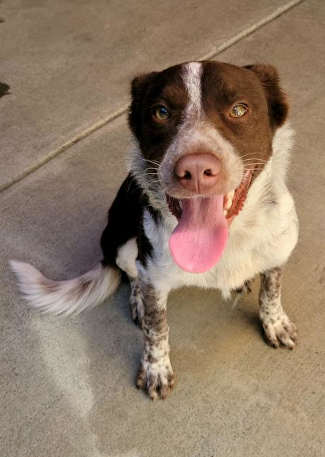
Border collie mix
This 4-year-old male border collie mix has a short liver and white coat.
He is in kennel No. 5, ID No. LCAC-A-1611.

‘George’
“George” is a 1-year-old male American bulldog mix with a short gray coat.
He’s in kennel No. 6, ID No. LCAC-A-1430.

Male pit bull terrier mix
This 1-year-old male pit bull terrier mix has a short gray coat.
He’s in kennel No. 8, ID No. LCAC-A-1617.

‘Milo’
“Milo” is a 3-year-old male American bulldog-pit bull mix with a short white coat.
He is in kennel No. 9, ID No. LCAC-A-1657.

‘Cookie’
“Cookie” is a 1-year-old female husky mix with a long red and white coat.
She is in kennel No. 10, ID No. LCAC-A-1682.
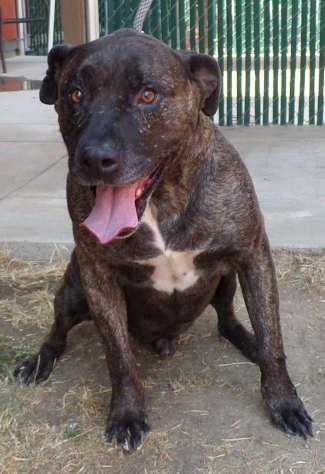
‘Dozer’
‘Dozer’ is a 5-year-old American pit bull terrier mix with a short brindle coat.
He is in kennel No. 12, ID No. LCAC-A-1483.

Male pit bull mix
This 3-year-old male pit bull mix has a short brindle coat.
He is in kennel No. 13, ID No. LCAC-A-1604.
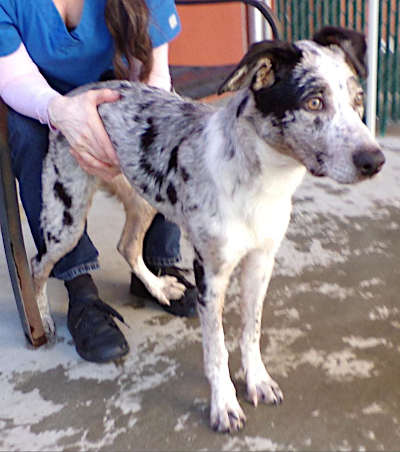
Female Australian shepherd
This young female Australian shepherd mix has a blue merle coat.
She is in kennel No. 14, ID No. LCAC-A-1672.

‘Groover’
“Groover” is a 1-year-old male German shepherd-cattle dog mix with a short black and tan coat.
He’s in kennel No. 15, ID No. LCAC-A-1659.

‘Topolina’
“Topolina” is a 10-year-old male Chihuahua mix with a short black coat with white markings.
He is in kennel No. 16, ID No. LCAC-A-1663.

Female German shepherd
This 1-year-old female German shepherd has a short black and tan coat.
She is in kennel No. 18, ID No. LCAC-A-1673.

Male Labrador retriever
This 2-year-old male Labrador retriever has a short black coat with white markings.
He is in kennel No. 19, ID No. LCAC-A-1349.

Male pit bull terrier mix
This 2-year-old male pit bull terrier mix has a short black coat with white markings.
He is in kennel No. 24, ID No. LCAC-A-1625.

‘Rosco’
“Rosco” is 3-year-old a male Rhodesian Ridgeback-Shepherd mix with a short tan coat.
He is in kennel No. 25, ID No. LCAC-A-1205.

‘LuLu’
“LuLu” is a 1-year-old female Rottweiler with a short black and tan coat.
She is in kennel No. 27, ID No. LCAC-A-1658.

‘Raina’
“Raina” is a 5-year-old female Rottweiler with a short black and tan coat.
She is in kennel No. 28, ID No. LCAC-A-1480.

Male pit bull
This young male pit bull has a short brindle coat.
He is in kennel No. 30, ID No. LCAC-A-1591.

Male husky
This 2-year-old male husky has a red and cream coat.
He is in kennel No. 32, ID No. LCAC-A-1024.

Male pit bull mix
This 2-year-old male pit bull terrier mix has a short brindle coat.
He is in kennel No. 33, ID No. LCAC-A-1528.
Email Elizabeth Larson at
- Details
- Written by: Supriya Chakrabarti, University of Massachusetts Lowell
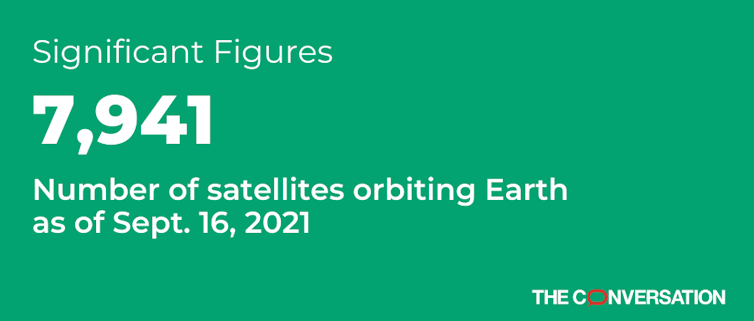
It seems like every week, another rocket is launched into space carrying rovers to Mars, tourists or, most commonly, satellites. The idea that “space is getting crowded” has been around for a few years now, but just how crowded is it? And how crowded is it going to get?
I am a professor of physics and director of the Center for Space Science and Technology at the University of Massachusetts, Lowell. Many satellites that were put into orbit have gone dead and burned up in the atmosphere, but thousands remain. Groups that track satellite launches don’t always report the same exact numbers, but the overall trend is clear – and astounding.
Since the Soviet Union launched Sputnik – the first human-made satellite – in 1957, humanity has steadily been putting more and more objects into orbit every year. Over the the second half of the 20th century, there was a slow but steady growth, with roughly 60 to 100 satellites launched yearly until the early 2010s.
But since then, the pace has been increasing dramatically.
By 2020, 114 launches carried around 1,300 satellites to space, surpassing the 1,000 new satellites per year mark for the first time. But no year in the past compares to 2021. As of Sept. 16, roughly 1,400 new satellites have already begun circling the Earth, and that will only increase as the year goes on. Just this week, SpaceX deployed another 51 Starlink satellites into orbit.

Small satellites, easy access to orbit
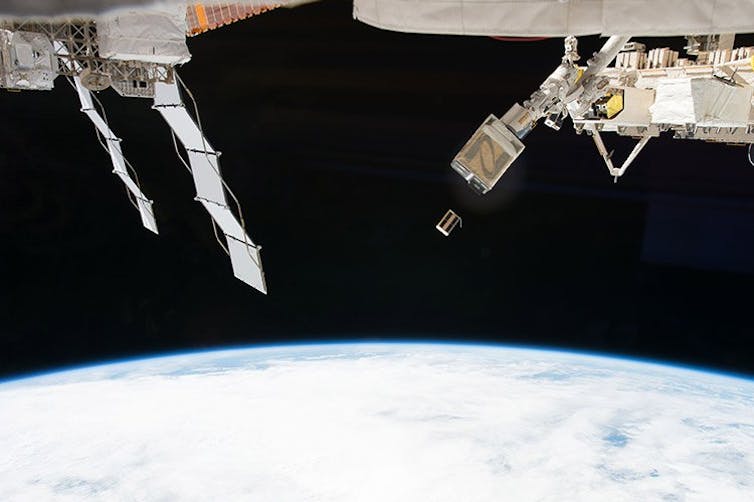
There are two main reasons for this exponential growth. First, it has never been easier to get a satellite into space. For example, on Aug. 29, 2021, a SpaceX rocket carried several satellites – including one built by my students – to the International Space Station. On Oct. 11, 2021, these satellites will deploy into orbit, and the number of satellites will increase again.
The second reason is that rockets can carry more satellites more easily – and cheaply – than ever before. This increase isn’t due to rockets getting more powerful. Rather, satellites have gotten smaller thanks to the electronics revolution. The vast majority – 94% – of all spacecraft launched in 2020 were smallsats – satellites that weigh less than around 1,320 pounds (600 kilograms).
The majority of these satellites are used for observing Earth or for communications and internet. With a goal of bringing the internet to underserved areas of the globe, two private companies, Starlink by SpaceX and OneWeb together launched almost 1,000 smallsats in 2020 alone. They are each planning to launch more than 40,000 satellites in the coming years to create what are called “mega-constellations” in low-Earth orbit.
Several other companies are eyeing this US$1 trillion market, most notably Amazon with its Project Kuiper .
A crowded sky
With the huge growth in satellites, fears of a crowded sky are starting to come true. A day after SpaceX launched its first 60 Starlink satellites, astronomers began to see them blocking out the stars. While the impact on visible astronomy is easy to understand, radio astronomers fear they may lose 70% sensitivity in certain frequencies due to interference from satellite megaconstellations like Starlink.
Experts have been studying and discussing the potential problems posed by these constellations and ways the satellite companies could address them . These include reducing the number and brightness of satellites, sharing their location and supporting better image-processing software.
As low-Earth orbit gets crowded, concern about space debris increases, as does a real possibility of collisions.
Future trends
Less than 10 years ago, the democratization of space was a goal yet to be realized. Now, with student projects on the Space Station and more than 105 countries having at least one satellite in space, one could argue that that goal is within reach.
Every disruptive technological advancement requires updates to the rules – or the creation of new ones. SpaceX has tested ways to lower the impact of Starlink constellations, and Amazon has disclosed plans to de-orbit their satellites within 355 days after mission completion. These and other actions by different stakeholders make me hopeful that commerce, science and human endeavors will find sustainable solutions to this potential crisis.
[The Conversation’s science, health and technology editors pick their favorite stories. Weekly on Wednesdays.]
Supriya Chakrabarti, Professor of Physics, University of Massachusetts Lowell
This article is republished from The Conversation under a Creative Commons license. Read the original article.