 How to resolve AdBlock issue?
News
- Details
- Written by: Elizabeth Larson
The council will meet at 6 p.m. Thursday, Feb. 3, in the council chambers at Clearlake City Hall, 14050 Olympic Drive.
The meeting will be broadcast live on the city's YouTube channel or the Lake County PEGTV YouTube Channel. Community members also can participate via Zoom or can attend in person.
The agenda can be found here.
Comments and questions can be submitted in writing for City Council consideration by sending them to City Clerk Melissa Swanson at
To give the council adequate time to review your questions and comments, please submit your written comments before 4 p.m. Thursday, Feb. 3.
Each public comment emailed to the city clerk will be read aloud by the mayor or a member of
staff for up to three minutes or will be displayed on a screen. Public comment emails and town hall public comment submissions that are received after the beginning of the meeting will not be included in the record.
At the start of the meeting, Police Chief Andrew White will swear in a new officer and present the annual police department report.
Under business, the council will consider offering a letter of support for the Lake Area Planning Council’s pursuit of a rural regional energy network, or RuralREN, program in Lake County.
City Manager Alan Flora’s report to the council explained that RuralRENs “are a solution for delivering energy efficiency programs envisioned in the early 2010s by the California Public Utilities Commission.”
He said the networks were created “as an innovative framework for local governments to design and administer energy efficiency programs and report directly to the commission. The goal was for the regional energy networks to create energy efficiency programs that would serve customers not otherwise served by the investor-owned utility programs.”
He said Lake APC, which will have staff at the meeting to give an update, is partnering with the seven other members of the Rural Hard to Reach Working group to submit a business plan to the CPUC for a new RuralREN. The business plan will be submitted by Feb. 15 and will seek funding from Jan. 1, 2023, to Dec. 31, 2031.
“The RuralREN is a direct response to the unique issues and urgent needs of rural California energy customers and will address energy equity in our communities by providing programs for residents, businesses, and public agencies,” Flora wrote in his report. “Opportunities for community investment will include hands-on career training and placement, incentives for energy efficiency projects, and localized lending. The RuralREN will provide the resources our communities need to play an equitable role in California’s transition to a clean energy economy.”
In other business, council members will consider confirming assessments totaling for city-funded abatements on six properties.
On the meeting's consent agenda — items that are not considered controversial and are usually adopted on a single vote — are warrants; the second reading of Ordinance No. 258-2022, approving a development agreement for Ogulin Canyon Holdings LLC to allow a cannabis operation located at 2185 Ogulin Canyon Road, Clearlake; waive the requirement for multiple proposals, and authorize the city manager to sign the contract/proposal provided by Weeks Drilling & Pump Co. to rehabilitate the agricultural well near the northeast corner of the Burns Valley Development property for future irrigation demand; minutes of the Dec. 8 Lake County Vector Control District Board meeting; approval of a letter of support for the Berryessa Snow Mountain Expansion Act; authorize city manager to enter into a contract with Argonaut
Constructors for the Burns Valley Development Project and authorize the city manager to approve up to 10% for additional unforeseen contract amendments; move to approve the amendment of contract with Resource Environmental for the waterpark demolition and authorize the city manager to approve up to 10% for additional unforeseen contract amendments.
Email Elizabeth Larson at
- Details
- Written by: LAKE COUNTY NEWS REPORTS
The meeting will begin at 4 p.m. at the Moose Lodge, located at 15900 Moose Lodge Lane in Clearlake Oaks.
The meeting can be attended in person or via Zoom; the meeting ID is 935 8339 6020, the pass code is 448228.
On the agenda is a presentation from the Lake County Community Development Department, with Code Enforcement Manager Marcus Beltramo and interim Chief Building Official Jack Smalley to speak to the group.
There also will be updates on Spring Valley, Sonoma Clean Power geothermal, a consolidated lighting district in Clearlake Oaks, commercial cannabis cultivation permit applications for District 3, the Roadmap Task Force update, a report from Supervisor EJ Crandell and new business.
ERTH will next meet on Wednesday, March 2.
ERTH’s members include Denise Loustalot, Jim Burton, Tony Morris and Pamela Kicenski.
- Details
- Written by: Suzanne McLeod, Binghamton University, State University of New York and Dr. Larry Dake, Binghamton University, State University of New York
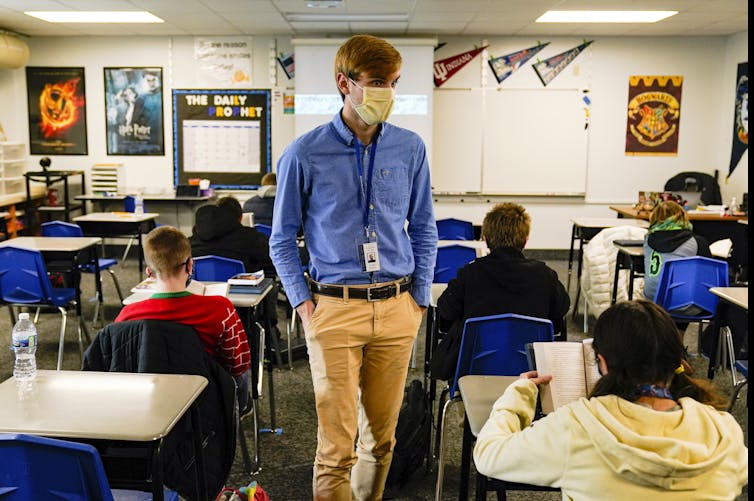
As a result of the omicron variant of the coronavirus, many school districts across the country are finding themselves short of teachers, who are quitting, getting sick or even dying.
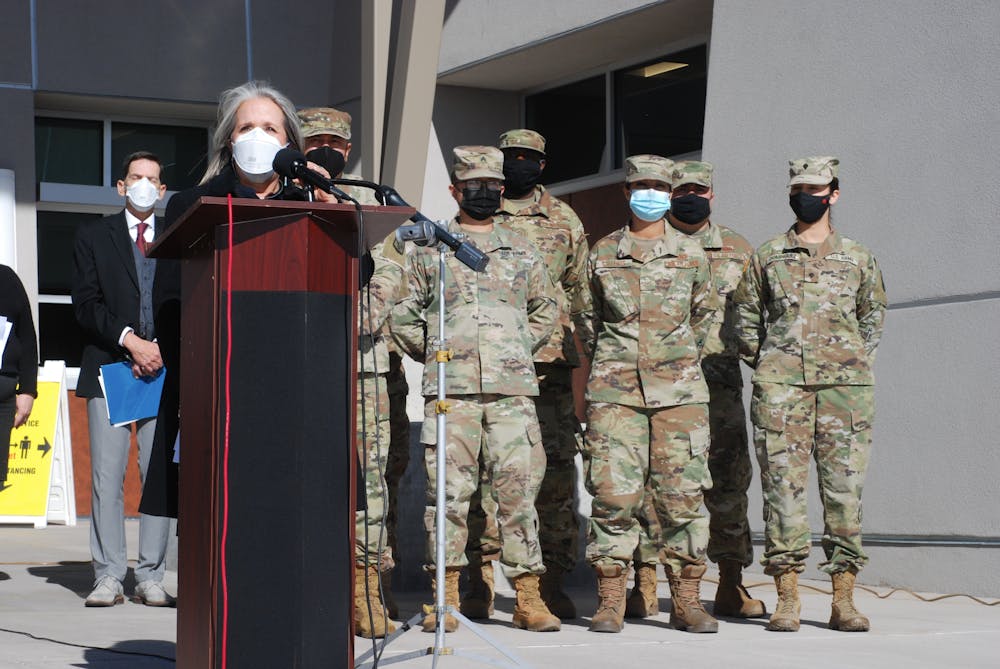
Some schools have even called on parents to step in to provide adult supervision in classrooms. In New Mexico, the governor has asked National Guard members to serve as substitute teachers.
Normally schools hire substitutes to cover teacher absences. But there are so many teachers out with COVID-19 that the demand is much higher than usual.
Pay for substitute teachers averaged $17 an hour in May 2020, according to federal figures. Assuming a substitute worked as much as possible – seven hours a day for 180 school days – that’s $21,420 a year, which is about one-third of the national average pay for full-time teachers. It is also below the poverty line for households with three people. Because school breaks are short, people who are regular subs may not be able to pursue longer-term work.
And that’s on the high end. Substitute teaching work is not always steady and doesn’t usually earn benefits, so it’s less attractive in a job market where workers have many options.
As education administrators and scholars of school leadership, we see school districts across the U.S. adjusting their requirements, and their compensation, for substitute teachers – all in an effort to keep schools open despite large numbers of staff out sick.
Why are there substitute teachers?
With the rise of compulsory education in the U.S. in the early 20th century, and the subsequent emergence of collective bargaining agreements for public school teachers, schools began needing to hire substitute teachers. Contracts often gave teachers a specific number of sick or personal days off. School districts had to provide coverage when a regular teacher was out, either for a short period of illness or a longer time, such as a maternity leave.
In general, states set minimum requirements for substitutes. In Alabama, Colorado, Georgia, Indiana, Iowa, Montana, Virginia and Wyoming, anyone with a high school diploma can be a sub, unless a specific school district has implemented a higher level of requirements. But most states require at least some college credits, and local school boards often set additional requirements, such as licensure in the subject where the person will work as a substitute teacher.
Subs are employed in a variety of ways, sometimes through collective bargaining agreements with school districts, including formal approval as employees with negotiated compensation and working conditions, or as independent contractors, or through external temporary staffing agencies. Their pay is typically determined by school districts. In general, short-term subs, who fill in for a teacher for a day or so at a time, are paid the least. Subs tend to get paid more if they work some number of days in a row, or if they are engaged to fill a longer-term absence. Pay also can increase depending on a sub’s educational level, license status or prior teaching experience.
Though the national average in 2020 – the most recent year for which data is available – was $17 an hour, actual pay varies widely by location. Districts in and around southeastern Maryland paid an average of $42.13 an hour in 2020. But school districts on Alabama’s Gulf Coast paid $8.35 an hour on average that same year.
What can be done to address the shortage?
The standard approach to a worker shortage is to raise pay and other compensation. One school district outside San Antonio, Texas, has temporarily raised its substitute teacher pay by as much as 20%, to between $98 and $150 per day, depending on a person’s qualifications.
In education, however, we have more often seen a reduction in required qualifications for a particular job, demanding a lower-level license or less prior experience. That’s happening, too, such as in Kansas, which temporarily eliminated the statewide requirement that subs have at least some college-level education.
However, our experience as school district leaders has shown us that attracting and keeping substitute teachers requires more than fair compensation.
Often, substitute teachers are viewed on the school system’s periphery rather than as an integral core. For instance, subs often are not included in district events such as professional learning opportunities or districtwide communications. Research has demonstrated that even though substitutes are necessary for the continuing function of schools, substitutes do not see the organization as valuing their contribution.
Some substitutes, such as retired teachers, may prefer to be more detached from general school operations. But other subs could interpret that distancing as a message that they are not really a part of the school culture. Principals and fellow teachers could welcome subs more directly, greeting them, visiting their classrooms, and making sure they know where to find a coat rack or a fridge for their lunch. Offering subs access to a break room and professional development also helps connect substitutes to the broader school community.
Opportunities for change
We also think it might be time for schools to consider alternatives to the current substitute teaching model.
Some districts pay regular teachers to cover for absent colleagues during planning or preparation periods. If this model is set up correctly, teachers substituting in other classrooms will have existing relationships with students and expertise in the subject matter needing to be taught.
Binghamton University, where we work, has developed a program called “Substitutes with a Purpose” in collaboration with regional educational leaders. This program sets up graduate students in education as substitute teachers, using that time to fulfill state requirements for in-classroom teaching.
We have found that this effort helps regional school districts address substitute shortages and helps university students earn money and fulfill academic requirements. It also provides an opportunity for these future teachers to become known in local schools, furthering their efforts to secure future full-time employment.
Suzanne McLeod, Assistant Professor of Educational Leadership, Binghamton University, State University of New York and Dr. Larry Dake, Adjunct Professor of Educational Leadership, Binghamton University, State University of New York
This article is republished from The Conversation under a Creative Commons license. Read the original article.
- Details
- Written by: LAKE COUNTY NEWS REPORTS
The CHP did not release the 23-year-old crash victim’s name on Monday pending the notification of family.
The agency’s reports said that at 7:50 a.m. Sunday, the CHP’s Ukiah Communication Center received a call of a vehicle crash on Highway 20, east of Walker Ridge Road, involving a possible fatality.
Northshore Fire personnel responded to the scene and confirmed the driver had died of her injuries, the CHP said.
When CHP officers arrived on scene, they determined it was a solo-vehicle crash that occurred during the hours of darkness, several hours before it was reported.
The CHP said the driver was traveling westbound on Highway 20 in a 2009 Subaru Forester when, for unknown reasons, the Subaru veered to the right of the roadway.
The Subaru hit an embankment, crossed the roadway to the south and went down another embankment, into the creek bed and overturned several times, the CHP said.
The CHP said the driver was wearing her seat belt and remained in the driver’s seat where she succumbed to the injuries she sustained during the wreck.
The Subaru was equipped with front and side air bags which deployed as a result of the crash, the CHP said.
So far, the CHP said it is unknown if drugs or alcohol were factors in the crash.