 How to resolve AdBlock issue?
News
- Details
- Written by: Elizabeth Larson
The board will meet beginning at 9 a.m. Tuesday, Feb. 1, in the board chambers on the first floor of the Lake County Courthouse, 255 N. Forbes St., Lakeport.
The meeting can be watched live on Channel 8, online at https://countyoflake.legistar.com/Calendar.aspx and on the county’s Facebook page. Accompanying board documents, the agenda and archived board meeting videos also are available at that link.
To participate in real-time, join the Zoom meeting by clicking this link.
The meeting ID is 992 8044 5927, pass code 645363. The meeting also can be accessed via one tap mobile at +16699006833,,99280445927#,,,,*645363#.
All interested members of the public that do not have internet access or a Mediacom cable subscription are encouraged to call 669-900-6833, and enter the Zoom meeting ID and pass code information above.
To submit a written comment on any agenda item visit https://countyoflake.legistar.com/Calendar.aspx and click on the eComment feature linked to the meeting date. If a comment is submitted after the meeting begins, it may not be read during the meeting but will become a part of the record.
On the consent agenda, the board will consider a resolution — which is in response to requests from the cannabis industry at the board’s meeting last week — to postpone cannabis tax payments from Jan. 31 to May 15, suspend late payment penalties during the period of postponement and suspend tax rate increases based on the consumer price index until 2024.
Cannabis business owners said they need the help because they are struggling to stay afloat.
At 9:15 a.m., the board will get a presentation from Patrick Blacklock, president and chief executive officer of the Rural County Representatives of California, or RCRC.
In untimed items, the board will consider appointments to the Lake County Vector Control, Lower Lake Cemetery Board and Law Library Board.
The full agenda follows.
CONSENT AGENDA
5.1: a) Approve memorandum of understanding by and between county of Mendocino and the Lake County Air Quality Management District for air pollution control officer duties, effective Feb. 1, 2022; and b) authorize the chair to sign a report of appointment increasing Air Pollution Control Officer Douglas Gearhart’s salary by 20% during this limited agreement.
5.2: Adopt resolution postponing cannabis tax payments to May 15, 2022, suspending late payment penalties during the period of postponement, and suspending tax rate increases pursuant to the consumer price index until 2024.
5.3: a) Waive the formal bidding process, pursuant to Lake County Code Section 38.2, as it is not in the public interest due to the unique nature of goods or services; and b) approve agreement between county of Lake and Adventist Health St. Helena and Vallejo for acute inpatient psychiatric hospital services and professional services associated with acute inpatient psychiatric hospitalizations for fiscal years 2021-22 and 2022-23 for a maximum compensation of $300,000 and authorize the chair to sign.
5.4: Approve Board of Supervisors meeting minutes Jan. 4, 2022.
5.5: a) Approve purchase order for the purchase of a Ford Escape for the Community Development Department, and authorize the Community Development director/assistant purchasing agent to sign the purchase order; and b) approve budget transfer to increase capital asset in the amount of $500 to facilitate the purchase of the Ford Escape and authorize the chair to sign.
5.6: Approve continuation of resolution authorizing teleconferenced meetings during a state of emergency.
5.7: Approve addendum to lease for commercial property located at 858 Lakeport Blvd., Lakeport from Feb. 1, 2022, through Feb. 28, 2023, at $2,100 per month and authorize the chair to initial all pages of the addendum.
5.8: Approve continuation of a local health emergency by the Lake County health officer for the Cache fire.
5.9: Approve the continuation of a local health emergency related to the 2019 Coronavirus (COVID-19) as proclaimed by the Lake County Public Health officer.
5.10: Approve the continuation of a local health emergency and order prohibiting the endangerment of the community through the unsafe removal, transport, and disposal of fire debris for the LNU Complex wildfire.
5.11: Approve the continuation of a local emergency in Lake County in response to the LNU Lightning Complex wildfire event.
5.12: Approve the continuation of a local emergency due to the Mendocino Complex fire incident (River and Ranch fires).
5.13: Approve the continuation of a local emergency due to COVID-19.
5.14: Approve the continuation of an emergency declaration for drought conditions.
5.15: Approve the continuation of a local emergency due to the Pawnee fire incident.
5.16: Approve continuation of a local emergency by the Lake County Sheriff/OES director for the Cache fire.
5.17: Approve plans and specifications for the Cooper Creek at Witter Springs Road Bridge Replacement Project Bid No. 22-03, Federal Aid Project No. BRLO-5914(078).
5.18: Approve a purchase order for engineering services to complete a local road safety plan and authorize the Public Works director/assistant purchasing agent to sign the purchase order.
5.19: Authorize the closure of the Special Districts administration office from 8 a.m. to 5 p.m. Friday, Feb. 4, for all staff training.
TIMED ITEMS
6.2, 9:15 a.m.: Presentation by RCRC President and CEO Patrick Blacklock.
UNTIMED ITEMS
7.2: Consideration of the following advisory board appointments: Lake County Vector Control, Lower Lake Cemetery Board, Law Library Trustee.
CLOSED SESSION
8.1: Conference with legal counsel: Existing litigation pursuant to Gov code sec 54956.9(d)(1) — City of Clearlake v. County of Lake.
8.2: Conference with legal counsel: Decision whether to initiate litigation pursuant to Government Code section 54956.9(d)(4) — One potential case.
Email Elizabeth Larson at
- Details
- Written by: Elizabeth Larson
The council will meet at 6 p.m. Tuesday, Feb. 1, in the council chambers at Lakeport City Hall, 225 Park St.
The agenda can be found here.
The council chambers will be open to the public for the meeting. In accordance with updated guidelines from the state of California and revised Cal OSHA Emergency Temporary Standards, persons who are not fully vaccinated for COVID-19 are required to wear a face covering at this meeting.
If you cannot attend in person, and would like to speak on an agenda item, you can access the Zoom meeting remotely at this link or join by phone by calling toll-free 669-900-9128 or 346-248-7799.
The webinar ID is 973 6820 1787, access code is 477973; the audio pin will be shown after joining the webinar. Those phoning in without using the web link will be in “listen mode” only and will not be able to participate or comment.
Comments can be submitted by email to
On Tuesday, the council will give a presentation on the Lake Area Planning Council’s efforts regarding the formation of a rural regional energy network, which will take advantage of available energy efficiency programs.
City Manager Kevin Ingram also will ask for the council to approve the mayor signing a letter supporting formation of the network.
Assistant City Manager Nick Walker will seek direction to formalize a spending plan for the council to review regarding Coronavirus State and Local Fiscal Recovery Funds.
Walker also will present the annual comprehensive financial report for fiscal year 2020-21.
On the consent agenda — items usually accepted as a slate on one vote — are ordinances; minutes of the council’s regular meeting on Jan. 18; adopt a resolution authorizing continued remote teleconference meetings of the Lakeport City Council and its legislative bodies pursuant to Government Code section 54953(e); adopt the proposed resolution to reaffirm the necessity of AB 1600 development impact fees; adopt the proposed ordinance adding Chapter 17.53 of the Lakeport Municipal Code regarding the water efficient landscape requirements; authorize the out of state travel as requested by the city manager for Council Member Turner to attend the National League of Cities’ Congressional City Conference to be held in Washington DC, March 14 to 16; receive and file the draft minutes of the Jan. 19 Measure Z Advisory Committee meeting; approve event application 2022-002, with staff recommendations, for the 2022 Memorial Day Parade; approve event application 2022-003, with staff recommendations, for the 2022 July Fourth Street Fair; approve event application 2022-004, with staff recommendations, for the 2022 Taste of Lake County event; approve event application 2022-005, with staff recommendations, for the 2022 Pumpkin and Dia de los Muertos Festival; approve event application 2022-006 fee waiver request, with staff recommendations, for the 2022 Trick or Treat Main Street event; and approve event application 2022-007, with staff recommendations, for the 2022 Dickens’ Festival.
Email Elizabeth Larson at
- Details
- Written by: Alexander Kurov, West Virginia University and Marketa Wolfe, Skidmore College
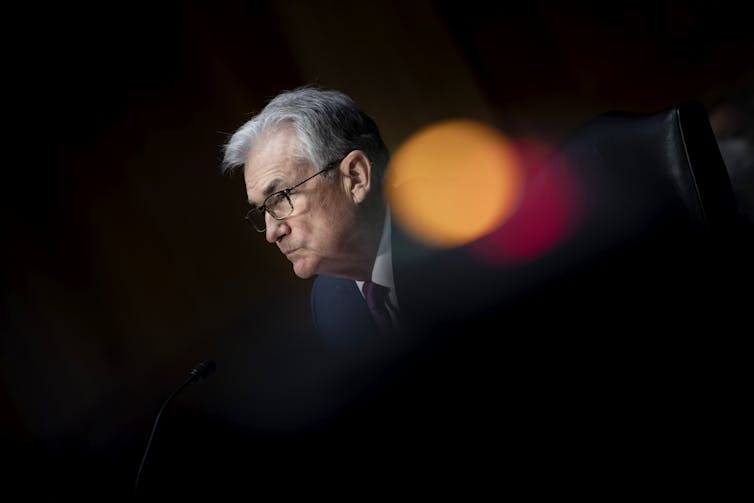
The Federal Reserve on Jan. 26, 2022, signaled plans to begin raising interest rates “soon” – possibly in March – in a bid to tamp down inflation before it poses a serious risk to the U.S. economy. A separate report released the next day showed the economy grew 6.9% in the fourth quarter of 2021. An interest rate hike would be the first time the central bank has increased its benchmark lending rate in over three years.
Lifting the borrowing costs consumers and businesses pay for loans has the effect of slowing economic activity, which in turn could curb inflation. But there are also concerns that it could put on the brakes too quickly. We asked Alexander Kurov, a finance professor at West Virginia University, and Marketa Wolfe, an economist at Skidmore College, to explain what the Fed is doing and what it means for you.
1. Why is the Fed raising interest rates?
Short-term interest rates in the U.S. are now essentially zero.
The Fed quickly cut rates to zero at the beginning of the COVID-19 crisis in March 2020 in an attempt to soften the blow of the sharp recession that began that month as the U.S. went into lockdown. As a reminder of how bad things were back then, over 40 million workers – a quarter of the American workforce – filed for unemployment in the first few months of the pandemic, a staggering number with no precedent in the job market.
Although the recession was short-lived – lasting only two months – and the economy has mostly recovered, the Fed has kept rates at rock bottom because many workers and businesses still need support as the pandemic continues to rage.
The big problem for the Fed now is that U.S. consumer prices have surged. For 10 months in a row, inflation has been above the Fed’s 2% target and reached an annual pace of about 7% in December. This is the highest rate of inflation recorded in the U.S. in the last 40 years. High inflation means the prices people pay for goods and services are continually going up – especially for basic items like meat and gasoline, as well as for manufactured goods like cars.
The Fed can ill afford to allow this to continue because if higher inflation becomes entrenched, it would damage the economy. And the longer it lasts, the harder – and more painful for consumers and businesses – it is going to be to bring it back to a more sustainable 2%.
So the Fed has to act quickly before it’s too late.
2. How does the Fed raise rates?
The Fed sets a target range for what is called the “federal funds rate.” This rate acts like a benchmark for all interest rates in the economy.
While the Fed’s statement didn’t specify a time when it plans to raise rates, Chair Jerome Powell said “the committee is of a mind to raise the federal funds rate at the March meeting, assuming that the conditions are appropriate for doing so. Analysts expect it to be a 0.25 percentage point increase. This would affect banks’ cost of borrowing, which in turn slowly filters throughout the economy as lenders charge more for loans on homes, cars, businesses, college tuition and anything else you might want to buy with debt. Banks would also gradually increase the interest they offer on deposits and savings accounts.
The Fed does not directly control all these other rates, and the exact path they will take is not completely predictable, but the overall trend will be up if the Fed keeps raising its target rate.
Markets expect the Fed to raise interest rates at least two more times in 2022.
3. What does that mean for consumers and businesses?
Put simply, higher interest rates mean borrowers would need to pay more for the loans they get.
If the Fed lifts interest rates this year by 0.75 percentage point, as expected, this would translate into about US$45,000 in additional interest payments on a 30-year, $300,000 mortgage.
[Get the best of The Conversation, every weekend. Sign up for our weekly newsletter.]
So if you want to borrow to start a business, pay for college, buy a car or do anything else, you should expect your borrowing costs to be higher later this year.
On the other hand, higher rates is good news for savers and investors, as their returns from activities like making deposits and buying bonds will go up.
4. And how will it affect the broader economy?
Higher interest rates would likely slow down business activity. While this can help reduce inflation, it also means lower economic growth.
The Fed always makes decisions based on what is happening in the economy and on how economic conditions are expected to change. And changes in the economy are often hard to predict.
The biggest unknown at this point is what will happen to inflation later this year. This is uncertain because inflation is driven by multiple factors, such as supply chain shortages and strong demand.
In addition, the labor force participation rate has still not recovered to pre-pandemic levels, and the economy is experiencing labor shortages, which could push wages and prices higher. If these COVID-19-related pressures don’t ease up soon, inflation could continue to stay high or continue to accelerate, which may force the Fed to increase interest rates faster than currently expected.
On the other hand, if economic or employment growth stalls, this will make it much harder for the Fed to raise rates without making things worse. The Fed will need to find the right balance between taming inflation and avoiding slowing down the economy too much.
Article updated to add GDP report and Powell comment.
Alexander Kurov, Professor of Finance and Fred T. Tattersall Research Chair in Finance, West Virginia University and Marketa Wolfe, Associate Professor of Economics, Skidmore College
This article is republished from The Conversation under a Creative Commons license. Read the original article.
- Details
- Written by: Elizabeth Larson
Call Lake County Animal Care and Control at 707-263-0278 or visit the shelter online for information on visiting or adopting.
The following cats at the shelter have been cleared for adoption.

Domestic shorthair kitten
This domestic shorthair kitten has a black coat.
He is in cat room kennel No. 6b, ID No. LCAC-A-2480.
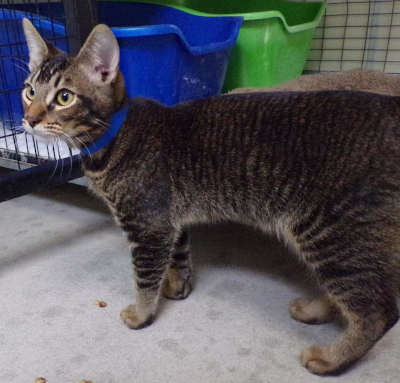
Male domestic shorthair
This young male domestic shorthair has a unique striped gray tabby coat.
He is in cat room kennel No. 53d, ID No. LCAC-A-2383.
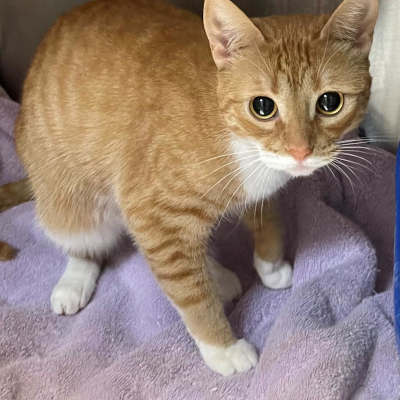
‘Artista’
“Artista” is a female orange tabby kitten with a short coat.
She is in cat room kennel No. 146, ID No. LCAC-A-2475.
Email Elizabeth Larson at