 How to resolve AdBlock issue?
News
- Details
- Written by: Elizabeth Larson
Lily Ann Richey, 23, of Redding died in the crash, said Lauren Berlinn, spokesperson for the Lake County Sheriff’s Office.
The California Highway Patrol’s Clear Lake Area office Richey’s 2009 Subaru Forester was found in a creek bed off Highway 20 east of Walker Ridge Road early Sunday.
The CHP said the crash happened several hours before Richey’s vehicle was found.
Based on what is known so far, investigators said Richey’s Forester veered to the right of the roadway, hit an embankment, crossed the highway to the south and went down another embankment and into the creek bed, overturning several times.
Richey was wearing her seat belt and the Subaru’s front and side air bags deployed, the CHP said.
The CHP office said Tuesday that no new information on the cause of the crash was available.
Email Elizabeth Larson at
- Details
- Written by: Lake County Sheriff's Office
The test will take place beginning at 11 a.m. Monday, Feb. 7.
The test will involve the warning sirens in Middletown, Anderson Springs, Cobb, Loch Lomond, and Kelseyville Riviera, formerly known as the Clear Lake Riviera.
The test will last three minutes. In the event of an actual emergency, the warning siren is one way the community may be alerted to danger from wildfire, earthquake, or other hazards.
Ongoing monthly testing for the sirens will occur on the first Monday of each month at 11 a.m. The testing from March through January will be 30-second tests.
The February test each year is the full three-minute activation. Just before each test, messaging will be sent out through LakeCoAlerts and Nixle notifying residents in the area of the sirens of the test.
When the sirens are heard outside of a scheduled test, community members should take shelter, be vigilant, and look for further information and instructions from LakeCoAlerts and Nixle. The sirens may not be heard depending on topography, natural and human-made noise, if residents are indoors, or potentially too far aware from the sirens.
The Middletown, Anderson Springs, Cobb, and Loch Lomond sirens have been in place since 2018. These sirens are owned and maintained by the South Lake Fire Protection District.
Since these sirens have been installed, they have only undergone monthly 30 second tests to ensure their functionality.
Over the past year, many residents expressed a desire to have a full three-minute test conducted to ensure residents know what the siren will sound like in the event of an emergency.
In the summer of 2021, the Kelseyville Riviera Home Owners Association installed three warning sirens to provide another form of warning to their residents in the case of an emergency.
As these are new sirens, their functionality has not been tested. This will be the first test of the warning sirens in the Kelseyville Riviera. Should there be any issues, please contact the Kelseyville Riviera Home Owners Association at
The Lake County Sheriff’s Office encourages all residents of Lake County to sign up for LakeCoAlerts at http://www.lakesheriff.com/About/OES/LakeCoAlerts and follow both the Office of Emergency Services and the Lake County Sheriff on Facebook at www.facebook.com/lakecountyOES and www.facebook.com/lakesheriff.
Alerts, notifications, and updates will be posted on Twitter as well; follow the Lake County Sheriff at https://twitter.com/lake_sheriff.
- Details
- Written by: Jeanne Homer, Oklahoma State University
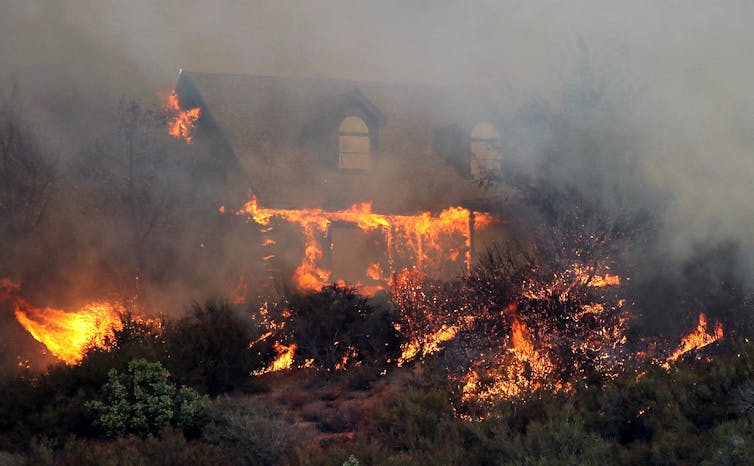
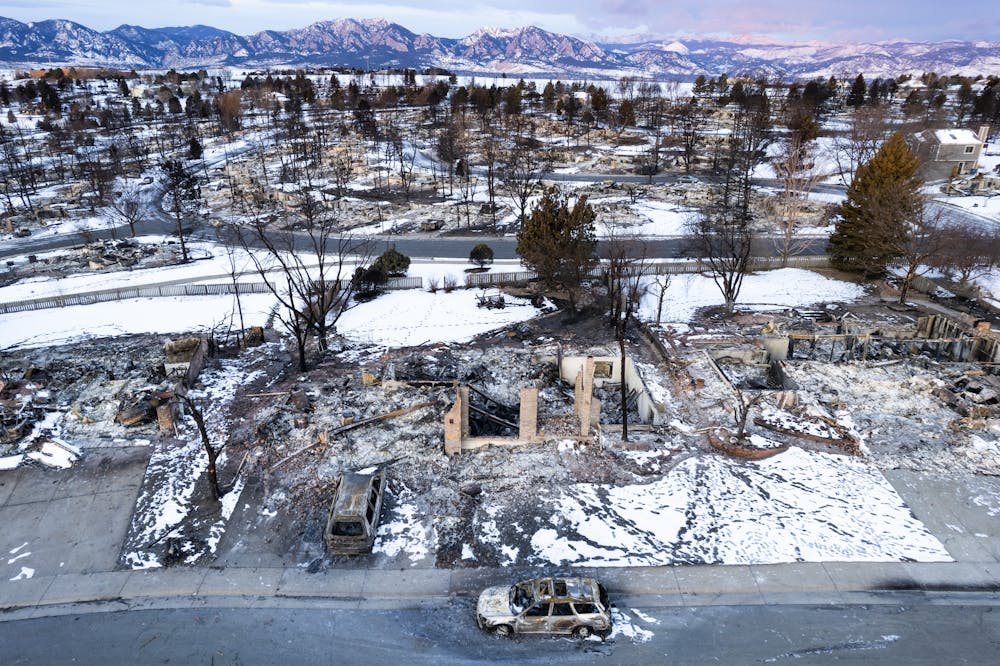
Across the West, thousands of people are deciding what to do about homes that have been destroyed by wildfires in recent months. Those planning to rebuild will be looking for ways to make their new homes and neighborhoods as fire-resistant as possible.
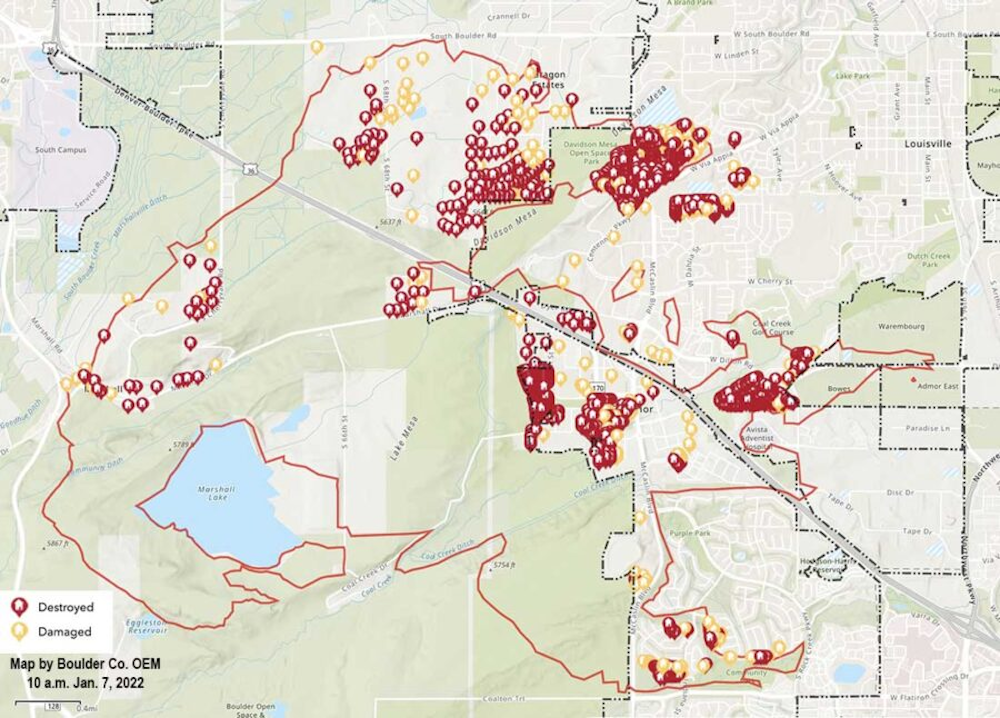
As an architect, I can tell you that rebuilding the same number of structures and replacing belongings after December’s Boulder County, Colorado, fire alone will likely cost more than the estimated US$513 million in residential losses.
To protect these investments as fire risk grows, here are some key strategies that communities and anyone building in the wildland-urban interface need to consider. Research shows that every $1 spent on prevention can save at least $6 in emergency rescue and recovery later.
Know the risk and plan for it
Designing for resiliency starts with risk assessments, particularly for communities in the wildland-urban interface – areas at the edge of forests and grasslands that are typically at higher risk of wildfires. Nearly half of Colorado residents lived in these areas in 2017, according to the Colorado State Forest Service.
From these risk assessments, communities can strategically plan and design safer developments.
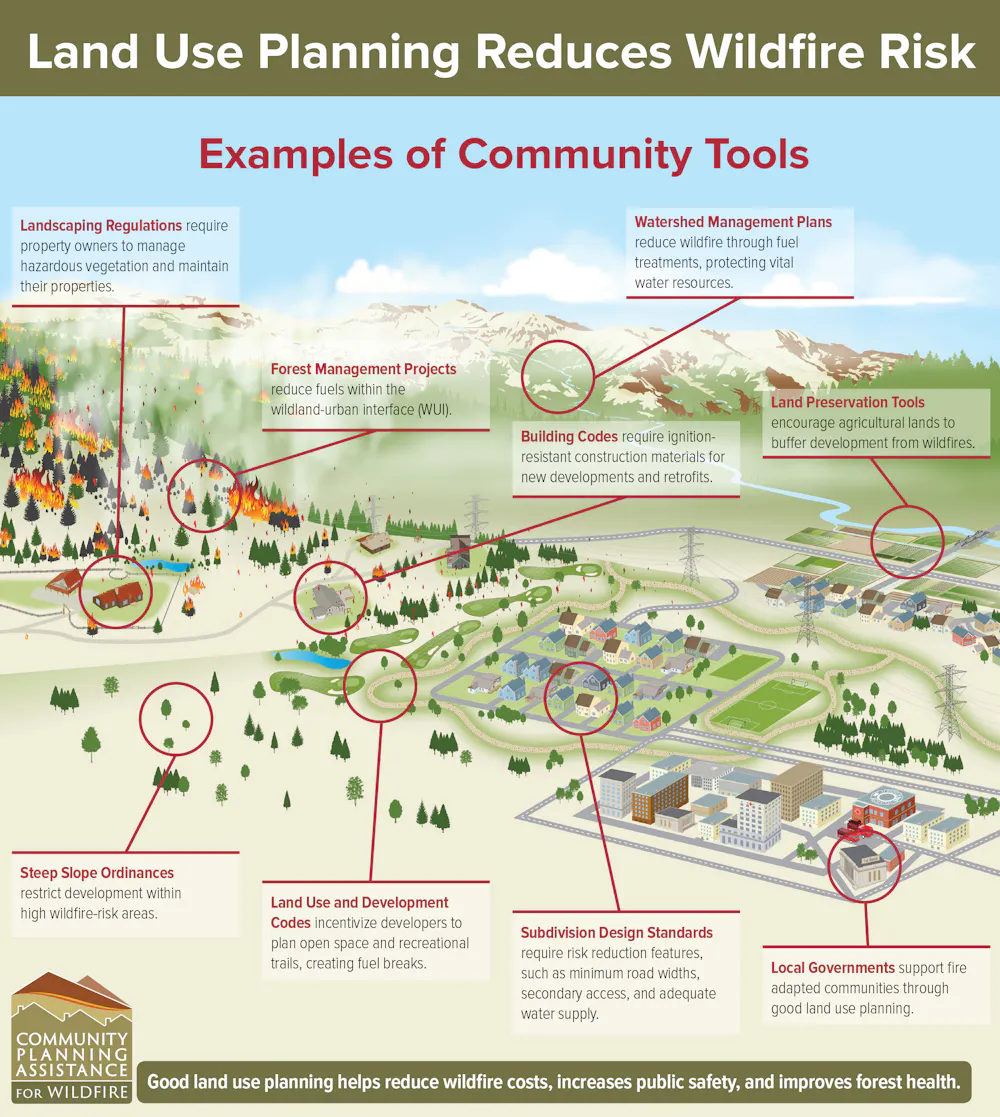
California has a statewide code for its wildland-urban interface areas that includes details such as how far trees and shrubs should be kept away from homes, and construction materials to use that can help protect homes within a fire hazard zone. Typically, builders must follow these codes to get permits for the construction of certain buildings and neighborhoods in the risk areas.
Not all states provide that guidance, though. Colorado lawmakers rejected recommendations for a statewide code in 2014, leaving wildland-urban interface decisions to each county. Some Colorado communities and counties, including Boulder County, do require fire mitigation measures in wildland-urban interface areas. The International Code Council and National Fire Protection Association publish wildland-urban interface fire codes that can be adjusted to local conditions.
In a fire spread by extreme winds like the Boulder County fire, even following code may not be enough to save homes, but following that guidance in many circumstances will better protect a community.
Creating defensible space
Creating resilience in the wildland-urban interface involves several layers of defense.
At the community level, forest management, including thinning forests around communities and clearing away brush that could fuel a fire, is an important aspect of fire risk reduction and has become a priority for the federal government.
Carefully planning how land is used in communities can lower the risk to homes and property. A site’s vegetation types, weather and wind patterns, and slope of the ground can all affect how a fire spreads. Planning also ensures firefighters have road access to reach homes in all weather and identifies water sources for firefighting.
At the neighborhood scale, fire experts recommend maintaining an open area around housing developments in wildland fire-risk areas that is clear of tall grass and dense trees. These buffer zones could include mowed recreation fields, shopping area parking lots or other features that can slow a fire’s spread.
Depending on the fire risk, each house should have a perimeter of defensible space extending out at least 30 feet and as much as 100 feet from the home. Within this area, landscapes should be maintained in a way that reduces the chances of a wildfire spreading to the house and adjacent structures. That means keeping trees and shrubs separated from structures like the house, barn or garage, as well as from other landscaping. It’s best to avoid more combustible landscaping like conifer trees, and grass should be mowed and kept free of debris, such as dead leaves and branches that could catch fire.
The closest 5 feet around a house should be totally free of trees and debris, bushes, wood mulch, furniture, barbecue pits and grills – basically anything that can be ignited by flames, embers or radiant heat. Decks, fences and other projections can be built with non-combustible material or wood treated with fire retardant.
How to make construction fire-resistant
The last line of defense to reduce flammability and fire spread is the design of the house and its construction.
A simple shape with few projections and indented corners has been shown to be more resilient because there are fewer areas that can catch debris.
Most codes and the insurance industry suggest the roof be made of fire-resistive Class A materials, such as asphalt shingles or concrete tiles. The walls should be a continuous fire-rated construction from the foundation to the roof, and its assembly of materials, like wood studs, insulation, gypsum board and siding, should have undergone regulated testing. These assemblies of materials are rated based on the duration of time they can withstand fire.
Vulnerable openings like windows and doors should also have rated assemblies. And vents, if required for a particular climate, should be protected with fine mesh screens made of metal that can block most blowing embers.
Gutters and downspouts should be made of non-combustible materials – metal rather than vinyl – and be regularly cleaned or covered with a metal leaf guard. If possible, gutters can be eliminated with the addition of an underground drainage system to direct water away from the foundation and wall, but those systems also need maintenance.
[Understand new developments in science, health and technology, each week. Subscribe to The Conversation’s science newsletter.]
Ideas for the future
These are all passive measures – they don’t need to be activated in an emergency, but they should be in place well before a fire event.
Researchers are also testing the performance of active systems for use in imminent threats, such as exterior sprinklers that don’t require electricity, large fire blankets that can cover a house, and fire-retardant foam that can be sprayed on structures.
With thorough risk assessment and several lines of defense, neighborhoods can be safer. But these strategies will have to be balanced with initial and long-term costs, realistic maintenance expectations and efforts to mitigate future anticipated threats. As storms become more intense and wildfires more frequent, we should be designing to reduce risk and our impact on the environment.
Jeanne Homer, Professor of Architecture, Oklahoma State University
This article is republished from The Conversation under a Creative Commons license. Read the original article.
- Details
- Written by: Elizabeth Larson
LAKE COUNTY, Calif. — A judge on Monday threw out a plea agreement that would have placed a former Lakeport business owner on probation for child pornography possession, instead saying she intended to sentence him to state prison.
Judge Shanda Harry rejected the plea agreement during an afternoon sentencing hearing for Jeffery Scott Cramer, 60.
Cramer was arrested in May 2020 as the result of a Lake County Sheriff’s Office investigation.
Detectives served search warrants at his home and at the business he owned at the time, Main Street Bicycles, seizing digital devices and determining that social media accounts associated with Cramer had been used to upload child pornography on at least five occasions between August 2019 and February 2020.
The District Attorney’s Office filed the case in September of 2020, charging him with felony possession of child pornography and bringing obscene materials that depict a minor in a sex act into the state.
In March of 2021, Cramer entered a no contest plea to felony possession of child pornography. As part of a plea agreement that he reached with the District Attorney’s Office, the second charge was dropped, said District Attorney Susan Krones.
Krones, who took over the case after Deputy District Attorney Lisa O’Brien left her office, said that second charge was dismissed with a Harvey waiver, which allows the judge to consider the factual circumstances of that charge.
The agreement required Cramer to register for life as a sex offender. While on conviction the charge has sentencing guidelines of 16 months, two or three years in state prison, Krones said Cramer was going to get no prison time but was to serve up to three years’ probation with strict terms that, if they hadn’t been fulfilled, would have sent him to prison.
Since that plea agreement was reached, the state Legislature has reduced maximum probation time to two years, except in unusual cases, Krones said.
Asked why Cramer was offered that deal, Krones said, “He had a lot of support in the community and he also has no prior record whatsoever.” If he’d had any prior record, the offer wouldn’t have been made.
She said Cramer also immediately went into sex offender treatment counseling.
Judge explains her concerns, rejects plea agreement
Cramer’s sentencing has been continued numerous times since May 2021 but on Monday afternoon it appeared that the prosecution, defense and Judge Shanda Harry were ready to proceed.
Harry didn’t indicate immediately that she intended to reject the plea agreement. Instead, she offered a thorough explanation of her conclusions on the case, which she said involved reading a probation report that she thought was incomplete.
She said that wasn’t necessarily the fault of the Probation Department, because in such cases victims are difficult to contact. “You don’t always know who the victims are.”
Harry said she asked to see the materials that had been in Cramer’s possession, explaining that with only one or two exceptions, all were clearly children under age 12, with the judge estimating the children ranged in age from 9 to 11 years.
She said many of the images showed prepubescent girls in various stages of undress and all of them depicted girls in suggestive poses. Some more graphic pictures showed the girls’ genitalia.
With the images were a number of videos. “I wanted to be clear what these videos were of, because I think that’s significant,” Harry said.
Harry called those items “tribute videos,” in which Cramer filmed himself masturbating and then ejaculating on the images. He then uploaded those videos to porn sites, where they were distributed.
“This was not a passive exploration of pictures,” Harry said.
She said there have been claims made about the case that she hasn’t found credible, including that Cramer “went down a rabbit hole” and was led from one image to another. However, Harry pointed out that rather than just viewing them, he made his own tribute videos. “I find that claim to be somewhat disingenuous at best.”
Harry said a number of letters from friends and neighbors of Cramer’s had been submitted to the court, claiming he has good character.
“Many people who wrote the letters didn't seem to know what it was he was accused of exactly,” she said.
When these types of cases occur, a lot of people will come out and defend the accused, noting that that person is great otherwise, Harry said, adding that goes to the court’s analysis.
She agreed that Cramer has taken responsibility. “It’s easy to do once you’re caught.”
Harry said someone once told her that dangerous individuals in cases such as this one are friendly looking, and the type no one would expect. Cramer, she said, looks just like that.
The argument had been made that jail would be bad for Cramer’s physical and mental health, which Harry accepted. However, she said she accepted that argument for almost everyone.
The crime for which Cramer is charged has victims, said Harry, explaining the damage to the lives of the children shown in the images and videos. “Saying there are no victims is a misnomer.”
She added, “These items would not be created if there was not a consumer.”
Harry then announced she didn’t accept the plea deal as negotiated, explaining that she didn't find Cramer eligible for probation.
Instead, she intended to sentence him to two years in state prison, with other terms of the deal remaining in effect. “That is my sentence.”
Cramer’s attorney, Jane Gaskell of Santa Rosa, said the plea had been entered with the understanding that probation would be granted. As such, she asked for more time to talk to Cramer about next steps.
Gaskill also asked to withdraw the letters of support that had been submitted in order to remove them from the public record.
Harry granted both the request for more time and the removal of the letters, and set Cramer’s return to court for 3 p.m. Tuesday, Feb. 15.
Following the court appearance, Krones told Lake County News that about 20 letters had been submitted in support of Cramer.
Neither she nor anyone in court on Monday identified any of the letter writers.
As for what could happen next, Krones said Cramer could withdraw his plea, at which point all of the original charges would be available, and go to a jury trial, risking the potential for a greater prison sentence.
Krones said he also can stay with the plea with the understanding that the judge is not going to grant probation and is likely going to sentence him to two years in prison.
“Basically, those are the options,” she said.
Email Elizabeth Larson at