How to resolve AdBlock issue?
News
- Details
- Written by: Elizabeth Larson
Dogs available for adoption this week include mixes of American Staffordshire terrier, Anatolian shepherd, Australian cattle dog, Great Pyrenees, husky, Labrador retriever, mastiff, Rhodesian ridgeback, Shar-Pei, shepherd and pit bull.
Dogs that are adopted from Lake County Animal Care and Control are either neutered or spayed, microchipped and, if old enough, given a rabies shot and county license before being released to their new owner. License fees do not apply to residents of the cities of Lakeport or Clearlake.
The following dogs at the Lake County Animal Care and Control shelter have been cleared for adoption (additional dogs on the animal control website not listed are still “on hold”).
Call Lake County Animal Care and Control at 707-263-0278 or visit the shelter online for information on visiting or adopting.

Labrador-pit bull mix puppy
This male Labrador retriever-pit bull mix puppy has a short tan coat.
He is in kennel No. 2a, ID No. LCAC-A-2523.

Labrador-pit bull mix puppy
This male Labrador retriever-pit bull mix puppy has a short brindle coat.
He is in kennel No. 2b, ID No. LCAC-A-2521.

‘Colt’
“Colt’ is a 3-year-old male pit bull with a short tan and white coat.
He is in kennel No. 5, ID No. LCAC-A-2429.

Female Shar-Pei-Rhodesian ridgeback mix
This 2-year-old female Shar-Pei-Rhodesian ridgeback mix has a short tan coat.
She is in kennel No. 13, ID No. LCAC-A-2560.

Male pit bull
This 2-year-old male pit bull has a short black and white coat.
He is in kennel No. 14, ID No. LCAC-A-2473.

Male pit bull
This 2-year-old male pit bull has a short brindle coat.
He is in kennel No. 16, ID No. LCAC-A-2462.

Male husky mix
This 2-year-old male husky mix has a short black and tan coat.
He is in kennel No. 17, ID No. LCAC-A-2512.

‘Nova’
“Nova” is an 8-year-old female yellow Labrador retriever with a short coat.
She is in kennel No. 18, ID No. LCAC-A-2509.

‘Akeyla’
“Akeyla” is a 1-year-old Labrador retriever mix with a short black coat and white markings.
She is in kennel No. 20, ID No. LCAC-A-2614.

‘Nioki’
“Nioki” is a 1-year-old female shepherd with a black coat.
She is in kennel No. 21, ID No. LCAC-A-2442.
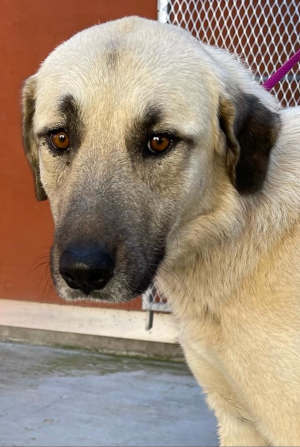
Anatolian shepherd mix
This 2-year-old female Anatolian shepherd mix has a short tan coat with black markings.
She is in kennel No. 23, ID No. LCAC-A-2535.

Labrador retriever mix puppy
This female Labrador Retriever mix puppy has an all black coat.
She is in kennel No. 28, ID No. LCAC-A-2533.

Female Australian cattle dog
This female Australian cattle dog puppy has a short black and white coat.
She is in kennel No. 29, ID No. LCAC-A-2506.

Male pit bull-chocolate Labrador
This 5-year-old male pit bull terrier-chocolate Labrador retriever mix has a short coat.
He is in kennel No. 31, ID No. LCAC-A-2537.

‘Iris’
“Iris” is a 3-year-old American Staffordshire terrier with a short black coat with white markings.
She is in kennel No. 32, ID No. LCAC-A-1727.

Anatolian shepherd-Great Pyrenees mix
This 2-year-old male Anatolian shepherd-Great Pyrenees mix has a short white coat.
He is in kennel No. 34, ID No. LCAC-A-2536.
Email Elizabeth Larson at
- Details
- Written by: Maggie Villiger, The Conversation

More than two years after the first cases of COVID-19 were diagnosed, people are exhausted by the coronavirus pandemic, ready for all this to end. When – if ever – is it realistic to expect SARS-CoV-2 will recede from the headlines and daily life?
That’s the unspoken question beneath the surface of many of The Conversation’s articles about COVID-19. None of our authors can see the future, but many do have expertise that offers insights about what’s reasonable to expect. Here are four such stories from our archive. Written by historians and scientists, they each suggest a way to think about what’s at the end of the pandemic tunnel – and paths to get there.
1. Past pandemics are not a perfect prediction
Almost as soon as it hit, people were trying to figure out how the COVID-19 pandemic would proceed. It was tempting to look for clues in the course of the 1918 flu pandemic that killed as many as 50 million people worldwide. Could the waves of disease seen in the 1900s provide a road map for what could be expected a century later?
Daily deaths from COVID-19 were declining in the U.S. when historian Mari Webel and virologist Megan Culler Freeman from University of Pittsburgh Health Sciences cautioned against reading too much into how things had gone for people generations ago.
It was so tempting to superimpose a timeline of flu surges on the modern calendar to get even a blurry forecast of what the coronavirus might have in store for us. “Scanning the historical record is one way to draw our own lives into focus and perspective,” wrote Webel and Culler Freeman. “Unfortunately, the end of influenza in summer 1919 does not portend the end of COVID-19 in the summer of 2020.”
And for reasons ranging from biology to demographics to politics, that is one prediction that most certainly came true.
2. Calling it over before it’s really over
While the 1918 flu pandemic wasn’t an exact template for how the coronavirus would sweep the world, the earlier pandemic provided plenty of parallels when it came to human behavior.
University of Michigan historian J. Alexander Navarro described how in the early 20th century Americans essentially quit on effective social distancing precautions when they got fed up with living constrained lives. Sound familiar?

As case numbers declined, “People clamored to return to their normal lives. Businesses pressed officials to be allowed to reopen,” Navarro wrote. “Believing the pandemic was over, state and local authorities began rescinding public health edicts.”
With the burden of public health resting on individual choices, additional waves of flu crashed over the population. Some amount of wishful thinking, along with a premature return to “normal,” was likely to blame. People’s choices can affect whether an infectious disease outbreak ends or drags on.
3. Once a virus comes, it never really leaves
Infectious diseases are as old as humanity. Pointing to examples such as malaria, tuberculosis, leprosy and measles, Rutgers University – Newark historian Nükhet Varlik wrote, “Once added to the repertoire of pathogens that affect human societies, most infectious diseases are here to stay.” Only smallpox has been completely eradicated, thanks to an intense global vaccination campaign.
Varlik’s own research has focused on plague, a bacterial disease that’s caused at least three pandemics in the past 5,000 years – including the 14th century’s Black Death – along with many more localized outbreaks over the years. Outbreaks wound down based on factors like “changes in temperature, humidity and the availability of hosts, vectors and a sufficient number of susceptible individuals,” Varlik wrote. “Some societies recovered relatively quickly from their losses caused by the Black Death. Others never did.”
The responsible bacterium, Yersinia pestis, is still with us today.

4. The endemic endgame
A post-pandemic world may still have COVID-19 in it. Many researchers suspect that the SARS-CoV-2 coronavirus will become endemic, meaning it’s always around, with some level of constant ongoing transmission. The viruses that cause the flu and the common cold, for instance, are endemic.
Sara Sawyer, Arturo Barbachano-Guerrero and Cody Warren, a team of virologists and immunologists from the University of Colorado Boulder, wrote that SARS-CoV-2 might hit the sweet spot for a virus to become endemic by being just the right degree of transmissible: “Generally speaking, viruses that are highly contagious, meaning that they spread really well from one person to the next, may never die out on their own because they are so good at finding new people to infect.”
[More than 140,000 readers get one of The Conversation’s informative newsletters. Join the list today.]
SARS-CoV-2 spreads easily through the air. Even people who aren’t experiencing any symptoms can pass the coronavirus to others. These factors, along with today’s heavily interconnected global society, make it unlikely COVID-19 is going away completely anytime soon.
For now, these scholars write, the best we can likely hope for is stabilized rates of SARS-CoV-2 that settle down into predictable patterns, like flu season. If you want to help hurry things along toward this end stage, do what you can to make yourself an inhospitable host for the coronavirus – most notably, keep up to date with recommended COVID-19 vaccinations.
Editor’s note: This story is a roundup of articles from The Conversation’s archives.
Maggie Villiger, Senior Science + Technology Editor, The Conversation
This article is republished from The Conversation under a Creative Commons license. Read the original article.
- Details
- Written by: NATIONAL AERONAUTICS AND SPACE ADMINISTRATION

The NASA-funded Asteroid Terrestrial-impact Last Alert System, or ATLAS — a state-of-the-art asteroid detection system operated by the University of Hawaiʻi Institute for Astronomy for the agency’s Planetary Defense Coordination Office — has reached a new milestone by becoming the first survey capable of searching the entire dark sky every 24 hours for near-Earth objects, r NEOs, that could pose a future impact hazard to Earth.
Now comprised of four telescopes, ATLAS has expanded its reach to the southern hemisphere from the two existing northern-hemisphere telescopes on Haleakalā and Maunaloa in Hawai’i to include two additional observatories in South Africa and Chile.
“An important part of planetary defense is finding asteroids before they find us, so if necessary, we can get them before they get us” said Kelly Fast, Near-Earth Object Observations Program Manager for NASA’s Planetary Defense Coordination Office. “With the addition of these two telescopes, ATLAS is now capable of searching the entire dark sky every 24 hours, making it an important asset for NASA’s continuous effort to find, track, and monitor NEOs.”
University of Hawaiʻi Institute for Astronomy, or UH IfA, developed the first two ATLAS telescopes in Hawaiʻi under a 2013 grant from NASA’s Near-Earth Objects Observations Program, now part of NASA’s Planetary Defense Coordination Office, or PDCO, and the two facilities on Haleakalā and Maunaloa, respectively, became fully operational in 2017.
After several years of successful operation in Hawaiʻi, IfA competed for additional NASA funds to build two more telescopes in the southern hemisphere.
IfA sought partners to host these telescopes, and selected the South African Astronomical Observatory, or SAAO, in South Africa and a multi-institutional collaboration in Chile. The ATLAS presence augments already substantial astronomical capability in both countries.
Each of the four ATLAS telescopes can image a swath of sky 100 times larger than the full moon in a single exposure. The completion of the two final telescopes, which are located at Sutherland Observing Station in South Africa and El Sauce Observatory in Chile, enable ATLAS to observe the night sky when it is daytime in Hawai‘i.
To date, the ATLAS system has discovered more than 700 near-Earth asteroids and 66 comets, along with detection of 2019 MO and 2018 LA, two very small asteroids that actually impacted Earth.
The system is specially designed to detect objects that approach very close to Earth — closer than the distance to the Moon, about 240,000 miles or 384,000 kilometers away.
On Jan. 22, ATLAS-Sutherland in South Africa discovered its first NEO, 2022 BK, a 100-meter asteroid that poses no threat to Earth.
The addition of the new observatories to the ATLAS system comes at a time when the agency’s Planetary Defense efforts are on the rise.
NASA’s Double Asteroid Redirection Test, or DART —the world’s first full-scale mission to test a technology for defending Earth against potential asteroid impacts — launched Nov. 24, 2021, on a SpaceX Falcon 9 rocket from Space Launch Complex 4 East at Vandenberg Space Force Base in California.
DART will deflect a known asteroid, which is not a threat to Earth, to slightly change the asteroid’s motion in a way that can be accurately measured using ground-based telescopes.
Additionally, work on the agency’s Near-Earth Object Surveyor space telescope, or NEO Surveyor, is underway after receiving authorization to move forward into Preliminary Design, known as Key Decision Point-B.
Once complete, the infrared space telescope will expedite the agency’s ability to discover and characterize most of the potentially hazardous NEOs, including those that may approach Earth from the daytime sky.
“We have not yet found any significant asteroid impact threat to Earth, but we continue to search for that sizable population we know is still to be found. Our goal is to find any possible impact years to decades in advance so it can be deflected with a capability using technology we already have, like DART,” said Lindley Johnson, planetary defense officer at NASA Headquarters. “DART, NEO Surveyor, and ATLAS are all important components of NASA’s work to prepare Earth should we ever be faced with an asteroid impact threat.”
The University of Hawai’i ATLAS is funded through a grant from the Near-Earth Object Observations Program administered by NASA’s PDCO. The Johns Hopkins Applied Physics Lab manages the DART mission for NASA's PDCO as a project of the agency’s Planetary Missions Program Office, or PMPO.
NEO Surveyor is being developed by NASA’s Jet Propulsion Laboratory in Southern California and the University of Arizona and managed by NASA’s PMPO with program oversight by the PDCO. NASA established the PDCO in 2016 to manage the agency‘s ongoing efforts in Planetary Defense.
For more information, visit https://www.nasa.gov/planetarydefense. Follow NASA Asteroid Watch on Twitter at @AsteroidWatch.
- Details
- Written by: LAKE COUNTY NEWS REPORTS
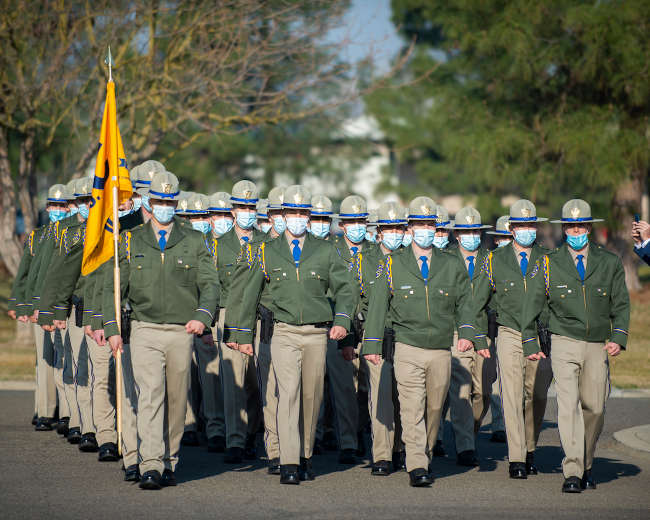
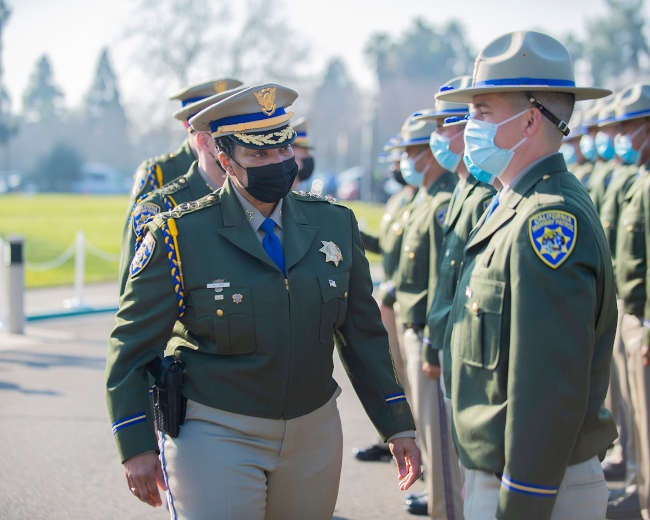
NORTHERN CALIFORNIA — The California Highway Patrol’s 142 newest officers graduated from the CHP Academy on Friday and, after the swearing-in ceremony, received their badges following 27 weeks of training.
Two of the cadets have been assigned to the Clear Lake Area office, Officer Zachary Cornell and Officer Jared Wade, said CHP spokesperson Jaime Coffee.
Coffee said the two new officers will report for duty in Lake County on Monday, Feb. 14.
With family and friends looking on, each cadet was promoted to the rank of officer and took their first steps as California’s newest defenders of the law.
“I have pride knowing that these women and men will be deploying throughout our great state to serve the people of California,” CHP Commissioner Amanda Ray said. “These new officers answered the call and are embarking on a time-honored tradition of service.”

At the CHP Academy, cadet training starts with nobility in policing, leadership, professionalism and ethics, and cultural diversity. Cadets also receive instruction on mental illness response and crisis intervention techniques.
The training also covers vehicle patrol, accident investigation, first aid, and the apprehension of suspected violators, including those who drive under the influence of alcohol or drugs.
The cadets also receive training in traffic control, report writing, recovery of stolen vehicles, assisting the motoring public, issuing citations, emergency scene management, and knowledge of various codes including the California Vehicle Code, Penal Code, and Health and Safety Code.
Upon graduation, this class of officers will be reporting for duty to one of the 103 CHP Area offices throughout the state.
For more information about becoming a CHP officer, or to apply, visit the CHP’s website.