 How to resolve AdBlock issue?
News
- Details
- Written by: LAKE COUNTY NEWS REPORTS
Cal OES reported that state contractors have cleared the remains — burned metal, concrete, ash and contaminated soil — from all 78 homes and property in Lake County whose owners enrolled in the state's Consolidated Debris Removal Program.
At the same time, they also completed the cleanup work on all 19 properties in Mendocino County impacted by last year’s Hopkins fires.
In total, state-managed crews removed 5,024 tons of debris from Mendocino County and 9,308 tons of debris from Lake County, Cal OES reported.
Metal and concrete is diverted for recycling, while ash, debris, and contaminated soil is disposed of at lined landfills approved by the Regional Water Quality Control Board.
Under the program, administered by Cal OES and the California Department of Resources Recycling and Recovery, or CalRecycle, in collaboration with county officials, participating property owners incur no direct costs.
Property owners opted into the program by submitting a right-of-entry form to their county, which allows the state to begin work on their property and incur no direct costs for the removal of burned metal, concrete, ash and contaminated soil from their properties.
Statewide, crews have removed debris from 1,138, or 66.4%, of the 1,715 parcels enrolled in the full program. An additional 377 properties are participating in the hazardous trees-only element of the program.
State and federal officials are reviewing additional commercial parcels that may be subsequently approved for debris removal.
Steps left to complete
Before homeowners can begin rebuilding, cleared properties need additional work including:
• Separate contractors collect soil samples for verification at a laboratory that they meet state environmental health and safety standards.
• Contractors next may install erosion control measures.
• Certified arborists or professional foresters assess wildfire-damaged trees in danger of falling on the public or public infrastructure for removal by separate contractors.
• Finally, state officials inspect the property to verify all completed work meets state standards. Debris officials submit a final inspection report to local officials to approve the property for reconstruction.
To date, 15 properties in Lake County have completed the entire debris removal process and been returned to county officials to begin the permitting process.
Property owners can track progress on the Debris Operations Dashboard for the 2021 statewide wildfires.
The dashboard is updated every hour and provides users with the ability to search by county or address.
- Details
- Written by: LAKE COUNTY NEWS REPORTS
Last week, the agency released its year-end numbers for the 2021 calendar year, looking at its operations statewide.
CDFW said its 68 dedicated cannabis enforcement officers work with county, state and federal partners to investigate illegal cannabis cultivation operations. Their goal is to uncover and curtail operations that result in significant environmental damage.
Statewide in 2021, CDFW eradicated 2.6 million illegal cannabis plants, destroyed 487,270 pounds of illegal cannabis flower, served 1,125 search warrants, seized 794 firearms, and removed 32,230 pounds of trash and 404 illegal water diversions from public lands.
In Lake County, CDFW last year eradicated 83,735 cannabis plants, seized 4,756 pounds of processed cannabis, served 31 search warrants and seized 32 firearms, said Janice Mackey, a spokesperson for CDFW’s Cannabis Program.
“The numbers represent all operations where CDFW was either the lead agency or in a support role,” said Mackey.
She added that there could have been other enforcement operations during the year in which CDFW was not involved.
CDFW said that illegal cannabis cultivation continues to move away from public land operations to private property.
The public is encouraged to report environmental crimes to the CalTIP hotline by calling 888-334-2258 or by texting information to “TIP411” (847411).
- Details
- Written by: Krishna Rao, Stanford University; Alexandra Konings, Stanford University; Marta Yebra, Australian National University; Noah Diffenbaugh, Stanford University, and Park Williams, University of California, Los Angeles
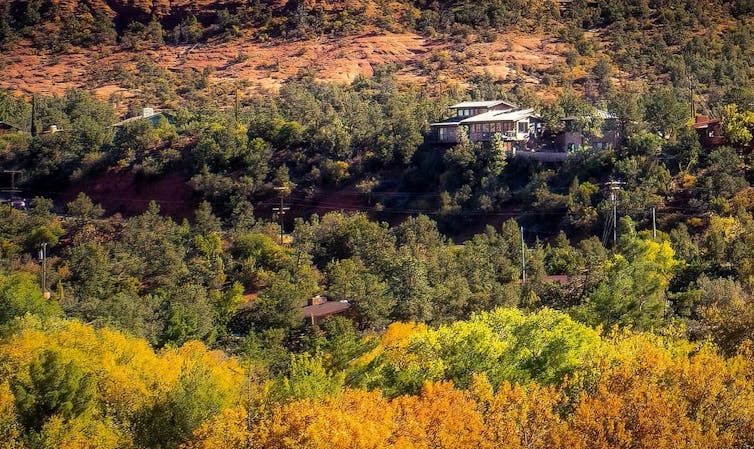
The view from the foothills of the Sierra Nevada in California can be beautiful – pine forests and chaparral spill across an often rugged landscape. But as more people build homes in this area, where development gets into wild land, they’re facing some of the highest risks for wildfires in the country.
The type of trees, plants and grasses at any location will influence how likely the area is to burn. However, our new research shows that some areas of the wildland-urban interface – the land where development ends and wilderness begins – are at much higher risk of burning than others. A key reason is how vulnerable the local vegetation is to drying out in a warming climate.
In a study published Feb. 7, 2022, our team of climate scientists, fire scientists and eco-hydrologists mapped out where vegetation is creating the highest fire risks across the western U.S. We then compared that map to where in the region people have been moving into the wildland-urban interface.
We were surprised to discover that the fastest rate of population growth by far has been in the areas with the highest fire risk. This includes several areas in California, Oregon, Washington and Texas.
Plant sensitivity has a large effect on fires
When a fire does break out, the amount of area that burns increases significantly if a region’s vegetation is drought sensitive, meaning it dries up easily after periods of little rainfall and hot temperatures.

Just as a succulent is better at surviving a water shortage than, say, a citrus tree, some vegetation loses moisture more quickly in dry conditions. Such diverse sensitivity can have a strong effect on wildfires. In fact, we found that under the same increase in droughtlike conditions, burned area increases twice as much in the most sensitive regions as the least sensitive regions. As a result, fire hazard in regions like California, eastern Oregon, and central Arizona has far outstripped the average. But what about human exposure to wildfires?
The wildland-urban interface population boom
We found that while the number of people living in the wildland-urban interface overall roughly doubled from 1990 to 2010, the population in its highest-hazard regions grew by 160%. As more people move into these areas, the opportunity for fires to ignite rises, as does the number of people at risk.
In all, the population of those high-hazard areas grew from 1 million in 1990 to 2.6 million in 2010, the latest year with detailed population data. That’s an increase equivalent to the current populations of San Francisco and Seattle combined.
More people still live in the low-hazard regions of the wildland-urban interface, where the population grew 107%, from 5 million in 1990 to 10.4 million in 2010, but the high-hazard regions have seen much faster growth.
We don’t know what is causing the population boom in these highly sensitive areas of the western U.S. Building codes, timber-dependent communities and people seeking homes surrounded by forests may have contributed to the expansion of the wildland-urban interface, but those factors alone don’t explain why population would rise the most in the most vulnerable regions.
However, a map of vegetation’s sensitivity to water shortages can provide some insight. By linking satellite-based estimates of vegetation dryness to climate observations, we created continental-scale maps of vegetation moisture. For the first time, we now know the precise locations of the most drought-vulnerable and hence fire-prone vegetation.
The map shows that the foothills of the Sierra Nevada in Central California, the outskirts of the San Francisco Bay Area, San Diego and San Antonio all have drought-sensitive vegetation and saw populations expand in the wildland-urban interface.
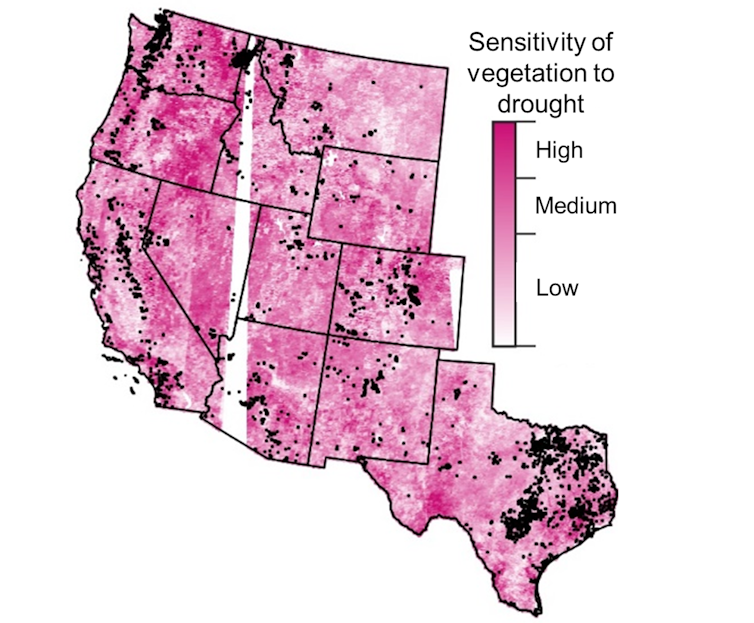
Further studies examining the demographics and local land use and development regulations in such regions can shed light on the drivers of growth in these high-risk areas. In the Bay Area, for example, a lack of affordable housing has pushed people farther from cities and may be encouraging more development in the wildland-urban interface, including high-risk areas that hadn’t previously been developed.
What can people living in high-risk areas do?
The disproportionate population growth in high-hazard areas is a warning that the likelihood of humans sparking a fire in an area with high-risk vegetation is rising – and that it may be higher than was previously understood.
Community leaders can use this knowledge to identify where human activity overlaps with drought-sensitive regions to improve local land-use planning, prepare firefighting resources and develop safer evacuation routes.
Property owners can keep a safe defensible space of at least a 100 feet of nonvegetated land on all sides of a home to help protect their structures when wildfires occur. Retrofitting homes using fire-retarding materials or double-paned windows can help too.
[Over 140,000 readers rely on The Conversation’s newsletters to understand the world. Sign up today.]
Preventive measures like these can limit the ballooning losses from wildfires, including devastating air quality due to wildfire smoke, while also allowing humans to more safely coexist with natural fires.
Preparing homes for wildfires can take months, so it’s important to use the winter, when many of these areas have their wet seasons, to be ready by the time the land dries out and wildfires ramp up in spring.
Krishna Rao, Ph.D. candidate in Earth System Science, Stanford University; Alexandra Konings, Assistant Professor of Earth System Sciences, Stanford University; Marta Yebra, Associate professor, Australian National University; Noah Diffenbaugh, Professor of Earth System Science, Stanford University, and Park Williams, Associate Professor of Hydroclimatology, University of California, Los Angeles
This article is republished from The Conversation under a Creative Commons license. Read the original article.
- Details
- Written by: Anderson Marsh Interpretive Association
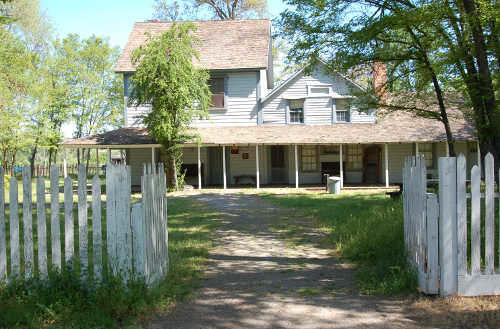
LOWER LAKE, Calif. — One of Lake County’s historic buildings is about to get some much-needed repairs thanks to state funding.
The Anderson Marsh Interpretive Association, or AMIA, has announced that an $800,000 fund has been created by the California Department of Parks & Recreation to be used to perform critical repairs to the historic Anderson Ranch House at Anderson Marsh State Historic Park.
The Anderson Ranch House is one of the oldest remaining buildings in Lake County, with construction beginning in the mid-19th century.
It has been furnished by State Parks to provide an opportunity for the public to experience what life was like on a working cattle ranch in Lake County between 1850 and 1920.
State Parks said the funding will be used to stabilize the ranch house by performing structural foundation repairs, along with repairs to other critical parts of the ranch house structure.
The project is in the beginning planning phase, with preliminary reports and inspections being conducted.
Out of these inspections, a final scope and project schedule will be created. After a project plan is developed, a construction start date will be determined.
“AMIA is grateful to State Parks for creating this significant project to protect the structural integrity of the Anderson Ranch House,” said AMIA President Roberta Lyons. “We are looking forward to the time when the COVID-19 pandemic allows us to resume public tours of the ranch house.”
AMIA is a nonprofit association cooperating with the Department of Parks and Recreation to promote educational and interpretive activities at Anderson Marsh State Historic Park.
For information about Anderson Marsh State Historic Park and AMIA, go to www.andersonmarsh.org or contact AMIA at either