 How to resolve AdBlock issue?
News
- Details
- Written by: OFFICE OF CONGRESSMAN MIKE THOMPSON
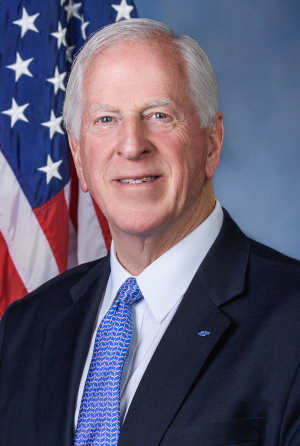
LAKE COUNTY, Calif. — U.S. Rep. Mike Thompson announced that he has filed to run for reelection in the newly numbered Fourth Congressional District.
The district includes all of Lake and Napa counties and portions of Solano, Sonoma and Yolo counties.
“I’m excited to run for reelection in the newly drawn Fourth Congressional District,” said Rep. Mike Thompson. “I was born, grew up and have lived my entire life in our district and I consider it the honor of my life to represent our beautiful region in Congress.
“Families here want a fair shake: well-paying jobs, affordable health care, a clean environment, quality education, and dignity in retirement. They want to know that if they work hard and play by the rules, they can leave more for their children than they themselves had — that the American Dream is alive and well. Folks here want to put food on the table and gas in the car, cover their mortgage payment, and provide an education for their kids without going broke.
“From my first day in Congress, I’ve made these shared priorities the focus of my work. I will continue pushing for sensible, responsible policy solutions that bolster the middle class, create jobs, lower the cost of housing and health care, and strengthen Medicare and Social Security for future generations. I will continue working to empower young people by advancing bold policies that protect our environment and invest in education. And, as Chair of the House Gun Violence Prevention Task Force, I will not stop until H.R. 8, my Bipartisan Background Check Act, is enacted into law to help prevent senseless gun violence and save lives.
“In the current Congress, I also authored the most sweeping climate policy ever to pass the House of Representatives. It is the flagship climate policy of President Biden’s agenda. As chairman of the Select Revenues Subcommittee, which has jurisdiction over tax policy, I advanced the Child Tax Credit, a tax cut for working families with children that has already significantly reduced child poverty in the months since it was first enacted.
“The past two years have been challenging for all of us. The COVID-19 pandemic is an unprecedented test, one that has taken hundreds of thousands of lives, has repeatedly pushed our health care system to the brink, and has disrupted our economy in every conceivable way. Know that as we continue to battle the virus, I will always place our community at the forefront.
“For all of these reasons, I have earned the endorsement of mayors, supervisors, sheriffs and district attorneys from every county in our district as well as hundreds of business owners, farmers, educators, community leaders and countless other hardworking men and women in our district.
“We have a shared commitment to our great country: because we share the responsibility of building and maintaining a great nation, we share in its challenges and we share in its successes. We are in this together and I will continue to fight for our district in Congress,” he said.
A list of those signing Rep. Thompson’s nomination papers includes:
Kelly Cox, retired Lake County administrative officer
Lake County Supervisor Eddie Crandell,
Madelene Lyon, former trustee, Lake County Board of Education
Lake County Sheriff Brian Martin,
Stacy Mattina, Lakeport mayor and Realtor
Lakeport Police Chief Brad Rasmussen
Denise Rushing, retired Lake County supervisor and entrepreneur
Lake County Supervisor Bruno Sabatier
Dirk Slooten, mayor of Clearlake
Karen Slooten, retired
David Weiss, vineyard management firm owner, Kelseyville
Peter Windrem, retired attorney at Law, Kelseyville
Elizabeth Alessio, Napa councilwoman
Christopher Canning, mayor of Calistoga
Amelia Ceja, winery owner and business woman
Leon Garcia, mayor of American Canyon
Rolando Herrera, business owner
Ricardo “Ricky” Hurtado, community advocate and leader
Hope Lugo, community leader
John Robertson, retired Napa County sheriff
Scott Sedgley, mayor of Napa
Janet Thompson, nurse
Jon Thompson, lieutenant, Napa County Sheriff’s Department
Robert “Bob” Torres, owner, Trinchero Family Estates
Steven C. Bird, mayor of Dixon
Thomas Ferrara, Solano County sheriff/coroner
Caitlin O’Halloran, Dixon School Board member
Marjorie Olson, community advocate and leader
Annette L. Porini, retired public servant
Ron Rowlett, mayor of Vacaville
John Vasquez, Solano County supervisor
Jeanie White, community advocate and leader
Jeanette Wylie, Vacaville City councilmember
CC Yin, Solano County business owner
Madolyn Agrimonti, Sonoma City Council member
Connie Codding, business owner
Karen Collins, former Alcaldessa
Cheryl Ann Diehm, retired
Jackie Elward, mayor of Rohnert Park
Margaret Fishman, Santa Rosa Junior College Board trustee
Gerard Giudice, business owner and Rohnert Park Council member
Susan Harvey, vice mayor of Cotati
Herman G. Hernandez, Sonoma County Board of Education trustee
Maddy Hirschfield, community leader and labor advocate
Mark Landman, Cotati mayor
Frankie Lemus, business owner
Willy Linares, vice mayor, Rohnert Park
John C. Moore, Cotati City Council member
Steve Page, retired business leader
Chris Rogers, Santa Rosa Mayor
Steve Sangiacomo, Sonoma grape grower
John Sawyer, Santa Rosa Councilmember
Tim Smith, former Sonoma County Supervisor
Cecilia Aguiar-Curry, California Assembly member
Angel Barajas, Yolo County supervisor
Jody Bogle, business owner
Linda Deos, community advocate and leader
Mike Hall, Yolo County farmer
Stephen F. Heringer, Clarksburg farmer, business owner
Garth Lewis, Yolo County Superintendent of Schools
Gloria Partida, mayor of Davis
Bruce J. Rominger, Yolo County farmer
Chris Turkovich, Winters farmer, business owner
Mayra Vega, mayor of Woodland
Lois Wolk, former State senator
For information about the newly drawn and numbered Fourth Congressional District visit here.
For more information about Congressman Mike Thompson’s campaign, visit https://www.mikethompsonforcongress.com/.
- Details
- Written by: Elizabeth Larson
Forecasters said clouds are expected to begin gathering during the day on Monday, Presidents Day, leading to slight chances of rain in the evening. Winds of nearly 25 miles per hour in parts of Lake County also are forecast.
Beginning at 10 p.m. Monday, the forecast calls for a six-hour period during which there are chances of rain and snow showers, then a chance of snow showers after 4 a.m. Tuesday.
Chances of rain and snow showers also are in the Tuesday forecast, with conditions expected to clear later in the day and the evening.
The National Weather Service reported that, based on its latest weather models, an inch or so of snow “now seems possible” above the 2,000 foot elevation mark in Mendocino and Lake counties, “though impacts to populated areas will be minimal.”
The weather is supposed to be mostly clear and sunny for the rest of the week, with chances of showers against forecast for Saturday and Sunday.
Daytime temperatures this week will range from the high 40s on Monday to the low 60s on Saturday. Nighttime temperatures will be in the 30s for much of the week, dropping into the high 20s on Tuesday, reaching the low 40s by Saturday.
Email Elizabeth Larson at
- Details
- Written by: OFFICE OF SENATOR BILL DODD
“Eating disorders are serious conditions that are potentially life-threatening and have a great impact on our physical and emotional health,” Sen. Dodd said. “We must improve the public’s understanding of the causes, encourage early intervention and lay to rest the stigma of this pervasive affliction. As someone who’s had a loved one suffer from an eating disorder, I know how difficult it can be, but with support recovery is possible.”
Sen. Dodd’s resolution raises awareness of a range of disorders affecting men and women across all backgrounds. Conditions include anorexia, bulimia and binge-eating disorders.
This year’s theme, “Come as You Are: Hindsight is 20/20,” will focus on alerting the public to environmental and biological causes as well as empowering people to reduce personal risk factors for developing eating disorders.
California Treasurer Fiona Ma is a co-sponsor. Supporters include the National Eating Disorders Association, American Nurses Association-California, Cielo House and the Eating Disorders Resource Center.
“For too long the media has focused on women needing to be thin to be beautiful,” said Treasurer Fiona Ma. “I remember struggling in college and being forced to look inward to correct unhealthy eating habits. Eating disorders are the third most common chronic illness among adolescent women in the U.S., and 10 million men in the U.S. will suffer from one in their lifetime. De-stigmatizing this conversation and talking openly is the best way to take our power back, and I’m proud to work once again along with my longtime friend and colleague, Sen. Dodd, to make sure we do not let these disorders define us.”
Dodd, who formerly represented Lake County in the California Assembly, now represents the Third Senate District, which includes all or portions of Napa, Yolo, Sonoma, Solano, Sacramento and Contra Costa counties.
- Details
- Written by: CHRISTOPHER GOETZ AND MARTHA STINSON
The evolution of job growth and employment in the U.S. economy over the past four decades has been characterized by two important but seemingly contradictory facts: Young startup businesses have been a key driver of economic growth, yet more and more of the American workforce has become concentrated at older, more mature firms.
This window into the nation’s economic trends comes from the U.S. Census Bureau’s Business Dynamics Statistics, or BDS, which provide annual measures of establishment openings and closings, firm startups and shutdowns, and job creation and loss.
The BDS paints a portrait of the constantly evolving and dynamic U.S. economy over time and provides information on the contributions to employment changes across and within industries.
These measures are available for the entire economy and by industry (sector and 3-digit and 4-digit North American Industry Classification System or NAICS) and geography (state, county and metropolitan and micropolitan statistical areas).
They’re also published by firm and establishment size and age. Statistics are available from 1978 to 2019.
In this story, we summarize recent findings using the publicly available statistics to describe the dynamics of the U.S. economy over the past 40 years. We specifically focus on the role firms of different ages and sizes played in the creation of jobs across various industries.
Age and size of firms
As prior research has shown, the age and size of a business are important characteristics that may reflect its potential to create jobs and economic growth.
The BDS allows us to distinguish between the age and size of an establishment (a physical place of work) and the age and size of the firm (the larger enterprise that owns and operates the establishment).
Firm age is defined as the age of the oldest establishment in the first year in which a firm has employees. We define a startup as any firm that employed its first worker in the current year.
New establishments created by new firms will have job creation patterns that resemble other startups. But new establishments created by long-existing firms will grow in ways that reflect the trends of mature firms.
In addition, an establishment that belongs to a larger parent company may act differently than an independent establishment.
For the purposes of this article, we focus on two age categories: young and old. Young firms are those with positive employment for five years or less, and old firms are those with positive employment for more than five years.
A firm’s size is based on the first quarter employment of a given year and includes all establishments associated with the firm at that time. We consider firms with 100 or more employees “large,” and those with fewer than 100 employees “small.”
Increasing share of employment in older firms
One of the major trends over the past three decades is that employment has become increasingly concentrated at older firms.
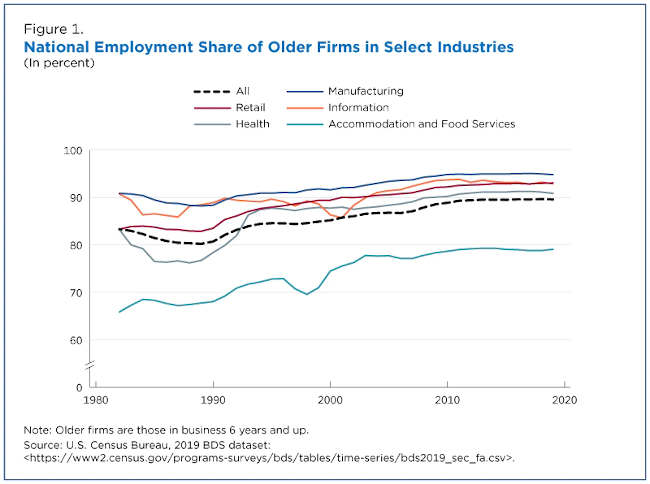
After falling in the 1980s, the share of employment at more mature firms rose steadily, representing approximately 90% of all employees by 2019 (Figure 1).
The patterns in a few notable industries mirror this national trend. By the mid-2000s, for example, the Manufacturing, Retail, and Health Care sectors all had over 90% of their employment at mature firms.
There were exceptions: Accommodation and Food Services and Information sectors.
Restaurants and hotels had a lower share of employment in older firms relative to other industries over the entire time series. This share dipped even lower in the late 1990s, then rose until the early 2010’s, and has been flat or slightly declining since.
The Information sector trended somewhat away from older firms through the tech crash in the early 2000’s but has risen since and is now nearly 95% concentrated in mature firms.
The large and increasing presence of employment at old firms appears to contradict the notion that young startups are the engine of economic growth. However, it is true that young firms are more dynamic and have much greater rates of net job creation.
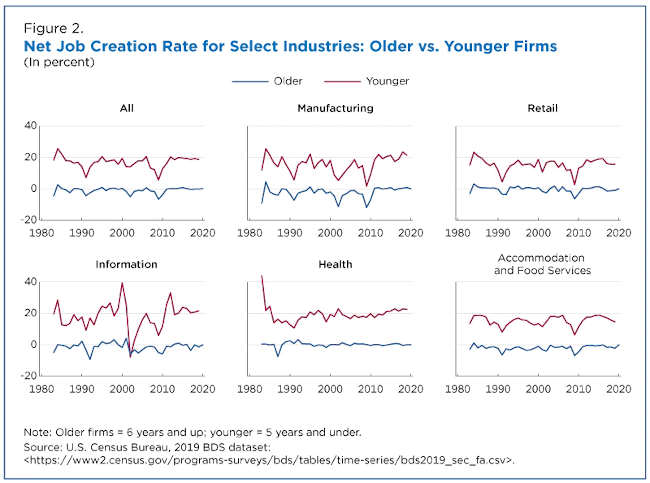
The Net Job Creation Rate, or NJCR, indicates how many more jobs were created than were destroyed relative to overall employment in an industry.
The job creation rate is notably higher for young firms than for old ones — the NJCR has hovered around 15% to 20% for younger firms throughout the time series but was roughly 0% and often negative for more established firms.
The NJCR time series is more volatile for young firms than old ones, showing larger drops during business contractions and larger gains in expansions (Retail and Manufacturing during and after the Great Recession, for example). Despite these fluctuations, the rate is almost always higher for young firms.
The single exception is the Information sector in 2001, when the job creation rate for young firms fell to the same level as for old firms.
Therefore, it is simultaneously true that startups grow at faster rates but old firms account for an increasing share of employment.
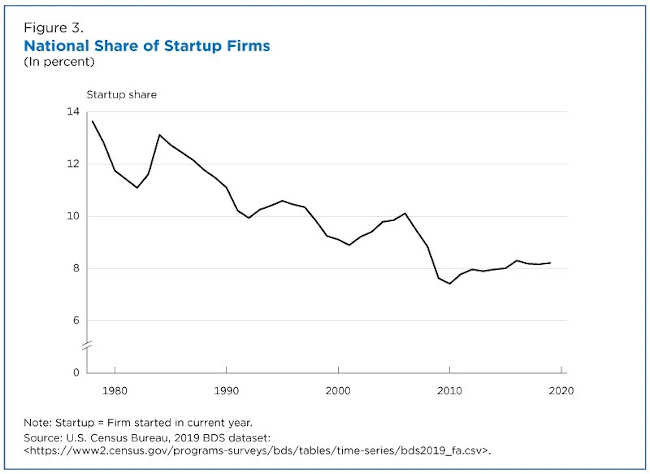
Reconciling these facts requires noting that there are fewer startups over time and in turn fewer young firms over time (Figure 3). That is, the net growth rate differential between young and old has not changed much but there are fewer and fewer young firms over time.
Employment concentrated in larger firms
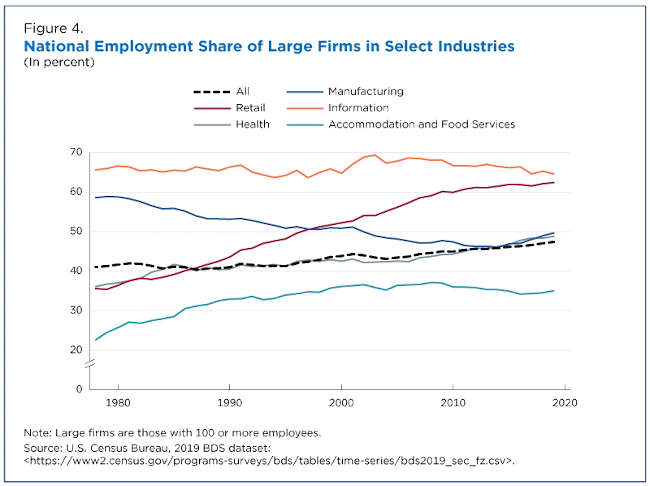
Mirroring the growing share of employment at older firms, the share of employment located at large firms with at least 100 employees also increased.
The national share of employment at these large firms has grown from 41% at the beginning of the time series in 1978 to 48% at the end of the series in 2019.
However, this steady rise in the national share masks considerable industry variation.
Manufacturing has notably defied this trend, becoming more concentrated in smaller firms, despite a slight reversal of this pattern in the last few years.
The Information and Accommodation and Food Services sectors have also moved away from larger firms since the mid-2000’s, despite moving towards them during other time periods.
Retail ‘Megafirms’
The increasing concentration of employment at large firms is most obvious in the Retail sector, which grew steadily from a 36% share in 1978 to 62% in 2019.
Retail’s status as an industry dominated by large players is well-known, with the familiar rise of so-called “megafirms” that have crowded out smaller firms during the last two decades.
Recent research using Census data suggests that the increasing presence of such firms helps explain the decline in the share of national income going to labor, as these firms tend to be capital intensive and highly efficient.
Does age or size influence job creation more?
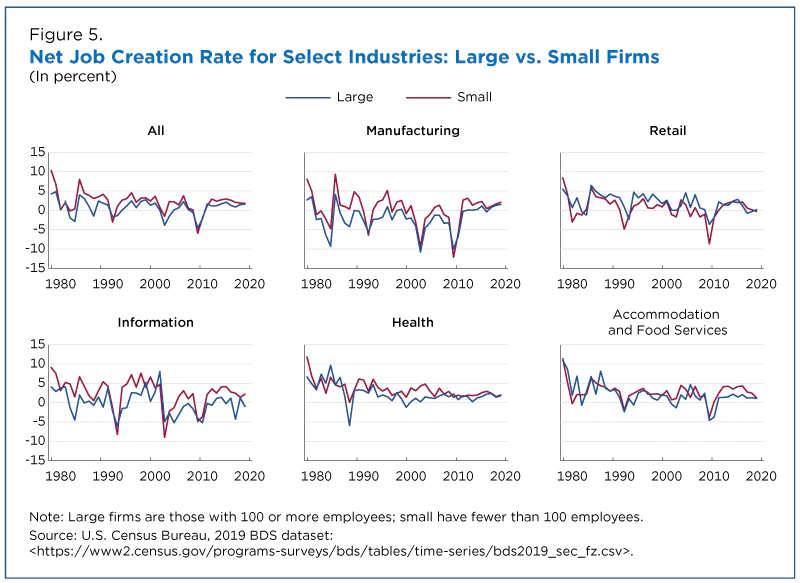
The increased concentration of large firms in the economy appears to have a smaller impact on job creation than does the increase in older firms. This is because small firms have higher rates of job growth than large ones but not by nearly the same margin as between young and old firms.
During economic expansions, the net job creation rate of small firms exceeds that of large firms by a few percentage points. However, during contractions, the rates fall to nearly the same negative level as large firms.
This is especially apparent in the Information sector during the 2001 recession, where small firms destroyed jobs at a higher rate than large ones.
The NJCR in this sector remains lower today than in the 1990s but aside from the Great Recession, small firms have created more jobs on net than large ones since the mid-2000’s. The exception to this trend of stagnant job growth at large firms is Retail, where large firms have mostly out-performed small firms in net jobs created.
BDS data tables are available for further analysis. BDS data can also be accessed via the BDS Explorer application and guidance on how to use it is available in this webinar.
Christopher Goetz is an economist in the Center for Economic Studies, or CES, at the U.S. Census Bureau. Martha Stinson is a senior economist in CES.