 How to resolve AdBlock issue?
News
- Details
- Written by: GOVERNOR’S OFFICE
Building on lessons learned over the past two years and the state’s ongoing commitment to equity, the SMARTER Plan will guide California’s strategic approach to managing COVID-19 while moving the state’s recovery forward.
Emphasizing continued readiness, awareness and flexibility, the Plan will ensure California can maintain its focus on communities that continue to be disproportionately impacted, and stay prepared to swiftly and effectively respond to emerging COVID-19 variants and changing conditions.
Read the California SMARTER Plan: The Next Phase of California’s COVID-19 Response here.
“As we enter the next phase of the pandemic, the state is better equipped than ever to protect Californians from COVID-19 with smart strategies that save lives and advance our ongoing recovery,” said Newsom. “Building on proven tools — rooted in science and data — that have been honed over the past two years, we’re keeping our guard up with a focus on continued readiness, awareness and flexibility to adapt to the evolving pandemic. As we have throughout the pandemic, the state will continue applying the lessons we’ve learned about the virus to keep California moving forward.”
The SMARTER Plan’s core pillars and preparedness metrics focus on lifesaving public health measures and strategies the state has successfully used to slow the spread and protect Californians.
Recognizing that each variant brings with it unique characteristics relative to the specific conditions in our neighborhoods and communities, the plan preserves needed flexibility and ensures the state has the resources and capabilities in place to tackle the COVID-19 challenges that lie ahead:
• Shots: Vaccines are the most powerful weapon against hospitalization and serious illness. Under the plan, California will maintain capacity to administer at least 200,000 vaccines per day on top of existing pharmacy and provider infrastructure.
• Masks: Properly worn masks with good filtration help slow the spread of COVID-19 or other respiratory viruses. The state will maintain a stockpile of 75 million high quality masks and the capability to distribute them as needed.
• Awareness: We will continue to stay aware of how COVID-19 is spreading and evolving variants, communicate clearly how people should protect themselves, and coordinate our state and local government response. California will maintain capability to promote vaccination, masking and other mitigation measures in all 58 counties and support engagement with at least 150 community-based organizations.
• Readiness: COVID-19 isn’t going away and we need to be ready with the tools, resources and supplies that will allow us to quickly respond to protect public health and to keep the health care system well prepared. The state will maintain wastewater surveillance in all regions and enhance respiratory surveillance in the health care system while continuing to sequence at least 10% of positive COVID-19 test specimens. The state will also maintain the ability to add 3,000 clinical staff within 2-3 weeks of need and across various health care facility types.
• Testing: Getting the right type of tests — PCR or antigen — to where they are needed most. Testing will help California minimize the spread of COVID-19. California will maintain commercial and local public health capacity statewide to perform at least 500,000 tests per day — a combination of PCR and antigen.
• Education: California will continue to work to keep schools open and children safely in classrooms for in-person instruction. The state will expand by 25 percent school-based vaccination sites supported by the state to increase vaccination rates as eligibility expands.
• Rx: Evolving and improving treatments will become increasingly available and critical as a tool to save lives. The state will maximize orders for the most clinically effective therapeutic available through federal partnerships, ensuring allocations of effective therapeutics are ordered within 48-hours.
The SMARTER Plan maintains the state’s focus on targeted investments and outreach to tackle COVID-19 health disparities in disproportionately impacted communities.
The plan features a new COVID-19 Assessment and Action Unit to monitor data and front line conditions in real-time.
It also includes building upon a robust, regionally-based wastewater surveillance and genome sequencing network to have early and rapid insights into the changing nature of the virus and early identification of variants.
In collaboration with external partners and the federal government, California will launch the first-in-the-nation impacts of COVID-19 longitudinal cohort study to examine the direct and indirect impacts of COVID-19 on individuals and communities over time.
Under the plan, the state is pursuing a public-private partnership with a test manufacturer to drive down the costs of at-home tests while securing a reliable and timely supply chain for California.
The state will also continue taking steps to ensure our health care facilities can continue to ramp up with additional staff and resources to respond to potential surges while minimizing strain on our health care systems.
"California is prepared to lean in on the principles that have made us successful in our COVID-19 response. Under the SMARTER Plan, we will use the significant knowledge we have gained and the tools and resources we have developed over the last two years to adapt and respond to whatever is next," said California Health and Human Services Agency Secretary Dr. Mark Ghaly. "Californians should rest assured we are ready and prepared to meet any public health challenges that may lie ahead."
Since the onset of the pandemic, California has led the nation’s fight against COVID-19 with early, robust public health measures that officials said have saved tens of thousands of lives, contributing to California’s maintaining one of the lowest death rates among large states.
California’s pandemic response to date has administered more than 70 million COVID-19 vaccines; distributed more than 870 million N-95 and surgical masks; deployed more than 28,000 state supported staff to support health care facilities; and administered more than 140 million COVID-19 tests, distributed 33 million at-home COVID-19 antigen tests and established more than 7,500 testing sites statewide.
The state has also significantly closed disparities in infection and death rates in disproportionately impacted communities through equity-focused vaccination and testing outreach and culturally-competent engagement and information.
National and state leaders in the public health and health care communities are offering their support to the SMARTER Plan.
“SMARTER is just that. It’s a plan to take all that we’ve learned from the first two years of the COVID-19 pandemic and use that knowledge to go forward. COVID-19 will be with us for several years to come, and having a nimble plan that can respond strategically to the twists and turns the pandemic will undoubtedly take will be invaluable for Californians,” said George W. Rutherford, MD, AM, professor of epidemiology, preventive medicine, pediatrics and history, and head of the Division of Infectious Disease and Global Epidemiology in the Department of Epidemiology and Biostatistics School of Medicine at the University of California, San Francisco.
“California leads the USA in the most important statistic: fewest deaths per capita from COVID-19 among large states. It is no accident. It takes determined leadership. The last two years have not been easy and the next stage won’t be easy either, but Governor Newsom’s new SMARTER Plan is a very big step forward,” said Larry Brilliant MD, MPH, an epidemiologist, technologist, philanthropist and author who worked with the World Health Organization from 1973 to 1976, helping to successfully eradicate smallpox.
- Details
- Written by: Elizabeth Larson
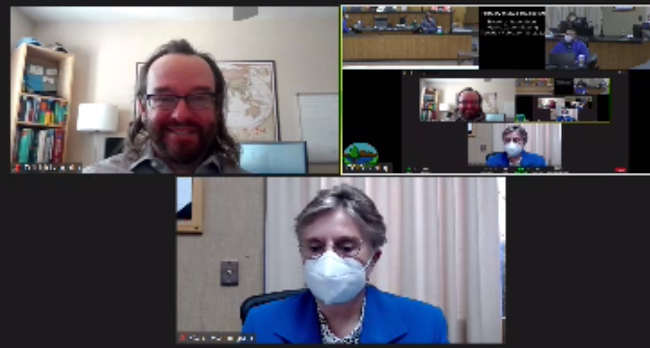
LAKE COUNTY, Calif. — Following a recruitment process that has lasted close to a year, the Board of Supervisors this week voted unanimously to hire a new Public Health officer.
The Board of Supervisors emerged from a Tuesday morning closed session to vote unanimously to appoint Dr. Erik McLaughlin to the post.
McLaughlin, who now lives in Las Vegas, said he is very excited to join Lake County’s team and take care of the county’s citizens.
He will serve at 80% time and will be on the third salary step, officials said.
A specific date for when he will begin the job was not given Tuesday.
Officials indicated it’s dependent on him receiving state Medical Board licensure.
The Medical Board of California so far does not show a license for McLaughlin in its online records system.
The Nevada State Board of Medical Examiners’ online record for a Dr. Erik McLaughlin of Las Vegas shows that he has a specialty in family medicine.
He received his medical degree in November 2005 from Saint Christopher’s College of Medicine in Dakar, Senegal, a school that is not included in a list of approved institutions by the Medical Board of California.
His postgraduate training, a residency in family medicine, took place from June 2006 to June 2009 at Advocate Christ Medical Center in Oak Lawn, Illinois.
The county has been seeking a new Public Health officer since Dr. Gary Pace announced he was stepping down exactly one year ago.
Pace has since returned to private practice in Sonoma County, although he has continued to offer part-time public health officer duties under contract with Lake County.
Another Sonoma County physician, Dr. Charlie Evans, has provided public health officer-related support to the county over the past year as well.
Email Elizabeth Larson at
- Details
- Written by: CALIFORNIA HIGHWAY PATROL
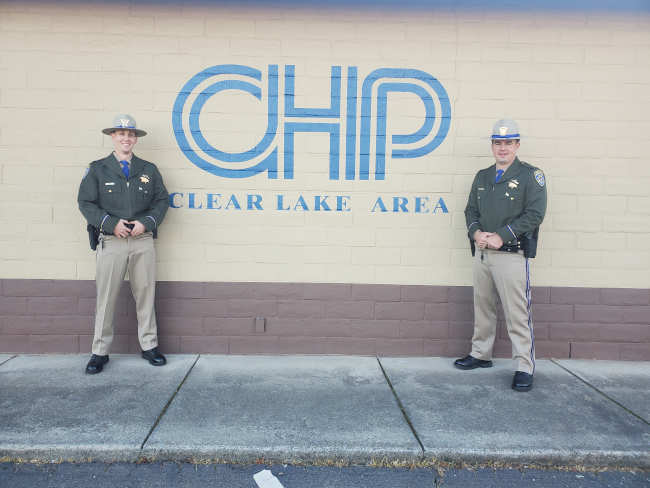
LAKE COUNTY, Calif. — The California Highway Patrol’s Clear Lake Area office is welcoming two new officers.
Jared Wade and Zach Cornel were among 142 new officers who graduated from the CHP Academy in West Sacramento, on Feb. 4.
After 27 weeks of intense training, the group was officially sworn in.
Officers Wade and Cornell will receive on-field training with experienced officers for approximately four months and later be on their own.
Lake County is a unique area and different from large metropolitan areas, and will challenge these new officers’ skills, the CHP’s Clear Lake Area office reported.
The office’s goal is to get these new CHP Officers ready to face the challenges they will encounter on a day-to-day basis so they can provide the highest level of safety, service and security to the people of California.
Officer Jared Wade is a Lake County local. He attended Upper Lake High School graduating in 2013. He chose the CHP because he knew local officers and was advised this was a great agency to work for. He got the chance to come back to his hometown and serve the community in which he grew up.
“The CHP academy was a great experience, tough, but great,” Wade said.
Wade wants to make our roads safer, change the overall negative views of law enforcement and serve his community.
Officer Zach Cornell is from Chico. He attended Chico High School, graduating in 2010.
Officer Cornell has friends and family in law enforcement including an uncle with the CHP. He chose CHP because of the diversity of the state and places to work.
He described his stay at the CHP Academy as “Challenging, but well worth it.
Cornell wants to give back to the community, build public trust, and make roads safe for family, friends and the motoring public.
Both officers encourage anyone thinking about joining the CHP’s ranks to go online and check it out.
Visit www.chpcareers.com or contact your local CHP Office for more information.
- Details
- Written by: California Department of Insurance
State Senators Henry Stern (D-Los Angeles) and Bob Hertzberg (D-Los Angeles) are principal co-authors of this legislation.
California has experienced record-breaking heat waves in recent years that are projected to increase in frequency and severity.
In 2020, emergency room visits increased by 10 times the normal number during record-breaking heat as high as 121 degrees in Los Angeles County.
California’s 2021 heat wave broke records across the state, with Sacramento topping out at 109 degrees and the Coachella Valley having its hottest year ever with temperatures reaching 123 degrees. Temperatures climbed to near 90 degrees in Los Angeles during Super Bowl LVI, when many people are unprepared to experience high heat in mid-February.
The idea of ranking heat waves was first proposed by Commissioner Lara and the California Climate Insurance Working Group, which issued a new report in 2021 aimed at protecting Californians who are more vulnerable to the impacts of climate change.
According to the newly introduced bill, “[h]eat waves and extreme heat are responsible for more deaths than all other extreme weather events, and disproportionately impact communities of color, persons with disabilities, seniors, and low-income communities.”
“Extreme heat waves are the deadliest climate threat that California is facing today. With more heat waves forecast in the years ahead, it is essential to public health and safety that we help Californians prepare, especially our most vulnerable,” said Commissioner Lara, who was a member of the Climate Insurance Working Group. “Giving advance warning and ranking these heat waves help us confront the growing threat of extreme heat with actions that people and communities can take to stay safe and healthy.”
“California’s climate has become increasingly erratic — we must take bold action to protect our residents from climate crises like extreme heat, which has intensified in both severity and occurrence,” said Assemblywoman Luz Rivas (D-Los Angeles), chair of the Assembly Natural Resources Committee. “For years, I have elevated extreme heat policy issues because we cannot keep leaving our most vulnerable residents exposed to dangerous heat waves without proper warning or preparation. I’m excited to work with Commissioner Ricardo Lara and my colleague Eduardo Garcia, both of whom are environmental leaders and champions for Californians disproportionately suffering from the effects of rising temperatures.”
“Extreme heat is a matter of life and death in my district and throughout California. We can no longer ignore this escalating climate consequence as it jeopardizes health and safety conditions for residents,” said Assemblymember Eduardo Garcia (D-Coachella), chair of the Assembly Utilities and Energy Committee. “Assemblymember Luz Rivas, Insurance Commissioner Lara, and I are taking legislative action and enlisting support to better prepare and protect our most vulnerable communities with this first-in-the-nation, lifesaving heat ranking system.”
"When it’s 110 and above in the San Fernando Valley, it's the people with medical issues who are homebound without shade, sufficient insulation, AC, or stable power supplies that I worry most about. This legislation is needed to notify everyone of what is coming and mobilize resources to those who need it," said Senator Henry Stern (D-Los Angeles), Chair of the Senate Natural Resources and Water Committee and Joint Legislative Committee on Emergency Management.
“We are no longer in the business of climate change as a distant problem to deal with in the future, we are seeing the devastating impacts of a changed climate today, especially here in California,” said Senate Majority Leader Emeritus Bob Hertzberg (D-Van Nuys). “Extreme heat is killing Californians, disproportionately impacting communities of color and our most vulnerable. This heat ranking system is vital to protecting our state and will save countless lives.”
AB 2238 directs the California Environmental Protection Agency, or Cal EPA, to work in coordination with the California Department of Insurance and the Governor’s Office of Planning and Research, or OPR, to create and implement a statewide extreme heat ranking system.
Heat-wave ranking would include the projected health impact and meteorological data, such as maximum and minimum temperatures, as well as how long a heat wave is anticipated to persist.
The Integrated Climate Adaptation and Resiliency at OPR would undertake a communications strategy and planning guidance for local communities in consultation with a variety of local stakeholders.
This bill also directs the Department of Insurance to study the insured and uninsured costs related to past extreme heat waves in order to identify “insurance gaps” of uncovered costs and promote more effective risk communication and planning.
An early warning ranking system for heat waves would further empower local governments and communities to plan in advance and implement specific policies to reduce the impacts from the harshest heat waves, especially on vulnerable communities and those more susceptible to extreme heat.
Commissioner Lara and the authors of AB 2238 first proposed the bill last November at the international climate conference, COP 26 — the 26th United Nations Climate Change Conference of Parties — in Glasgow, Scotland.