 How to resolve AdBlock issue?
News
- Details
- Written by: Heather Bednarek, Saint Louis University and Ellen Barnidge, Saint Louis University


As of July 2021, a total of 83.6 million Americans were insured through either Medicaid or the Children’s Health Insurance Program.
That’s almost 1 in 4 Americans, with 76.7 million insured through Medicaid and 6.9 million through CHIP. Both public health insurance programs are funded jointly by the federal and state governments. Medicaid provides health insurance for low-income people, most of whom are 64 or younger.
CHIP provides health coverage to kids and pregnant women whose families have low incomes but make too much to qualify for Medicaid.
Affordable Care Act’s impact
Before states began to expand Medicaid in 2014 as part of the Affordable Care Act, the program was much smaller, covering around 55 million people in 2013.
So far, 38 states and the District of Columbia have expanded Medicaid access, with financial support from the federal government.
Prior to the ACA, most states were more restrictive about who could enroll in Medicaid, a program launched following the enactment of landmark legislation President Lyndon B. Johnson signed into law in 1965. After the ACA, the federal government began to shoulder more of the program’s costs, footing at least 90% of the bill for new enrollees covered through the program’s expansion.
Today, all adults in Medicaid expansion states who are under 65 with annual incomes less than 138% of the federal poverty line are eligible for Medicaid. In 2022, that means someone who is single without dependents and has an income of $18,754 or less qualifies, as does a family of four earning up to $38,295.
Eligibility rules in nonexpansion states vary widely and exclude more low-income people.
CHIP was signed into law in 1997. Like the Medicaid expansion it was optional, yet it was adopted in all states within three years, by 2000.
Unfortunately, 4.3 million children remain uninsured, many of whom are in poverty, live in a nonexpansion state or a state with stricter income eligibility standards for CHIP.
Even when children are eligible for Medicaid or CHIP, they may not be enrolled in the program due to their parents’ lack of awareness or their state’s lack of outreach.
The pace of Medicaid expansion since 2014 has been far slower than the CHIP rollout. Twelve states have yet to opt in, as of February 2022, though the expansion debate continues.
And yet Medicaid’s sharp enrollment growth has reduced the share of uninsured people.
Fewer uninsured Americans
About 91.4% of Americans had public or private health coverage for at least part of 2020, leaving an estimated 28 million Americans without any health insurance, according to the Census Bureau. In 2013, only 86.7% of the country was insured.
Our state, Missouri, expanded Medicaid on Oct. 1, 2021. The state estimates that as many as 275,000 people are newly eligible, though only about 64,000 enrolled in the first five months. Oklahoma expanded Medicaid in July 2021, enrolling more than 200,000 in its first few months. South Dakota may be next: its voters will decide whether to expand Medicaid in November 2022.
Of the 28.6 million Americans who have enrolled in Medicaid or CHIP since the ACA was rolled out, about 60% obtained coverage prior to the COVID-19 pandemic.
Response to the COVID-19 pandemic
In March 2020, the federal government responded to what it correctly anticipated as the sharp growth of Medicaid and CHIP coverage.
At the time, an unemployment surge was stripping millions of workers of their economic stability, including health insurance coverage. Medicaid enrollments tend to rise during bad economic times, as people become eligible due to lower incomes. The pandemic was no different, particularly in 2020.
What’s different this time is that states, which administer Medicaid and CHIP, haven’t been allowed to kick anyone out of the program during this period – even if they would have lost eligibility due to higher earnings.
This restriction will continue as long as the federal government public health emergency declaration remains in effect. To help states with that increased financial burden, the federal government increased its share of Medicaid payments to states.
In January 2022, the Biden administration renewed the public health emergency for another three months. The emergency declaration is scheduled to expire on April 16.
Soon after this measure expires, millions who have been covered by Medicaid but now make too much money to qualify could lose their eligibility, particularly if they live in states that have not yet expanded Medicaid.
But it’s not clear whether the number of Americans enrolled in these programs will decline sharply. In part, that’s because more people are getting access to Medicaid for the first time due to their states’ participation in its expansion.
[You’re smart and curious about the world. So are The Conversation’s authors and editors. You can read us daily by subscribing to our newsletter.]
Heather Bednarek, Associate Professor of Economics, Saint Louis University and Ellen Barnidge, Associate Professor of Behavioral Science and Health Education; Interim Dean of the College for Public Health and Social Justice, Saint Louis University
This article is republished from The Conversation under a Creative Commons license. Read the original article.
- Details
- Written by: Elizabeth Larson
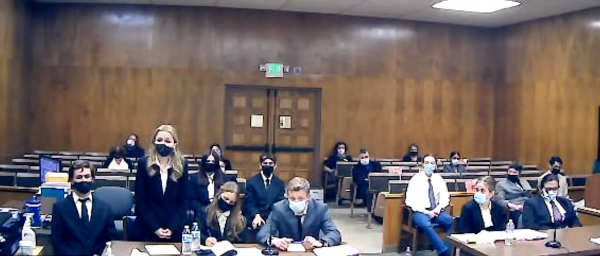
LAKE COUNTY, Calif. — Two teams of talented high school students took to the courtroom this month to argue a hypothetical murder case as part of the annual Mock Trial competition.
The event took place on Friday, Feb. 11, on the fourth floor of the Lake County Courthouse in Lakeport.
Now in its 10th year, the competition is run in partnership with the Constitutional Rights Foundation, the Lake County Superior Court and Lake County Office of Education.
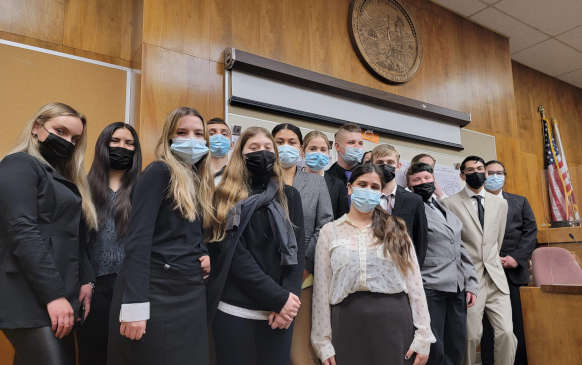
Competing again this year were teams from Middletown and Upper Lake high schools, with Middletown coming away with the win.
Last year, due to COVID-19, the event was virtual and hosted by the Napa County courthouse.
This year, however, it was back to the courtroom in the Lake County Superior Court.
However, Dana Adams, the Mock Trial coordinator for the Lake County Office of Education, said COVID resulted in this year’s scrimmage being canceled, meaning the teams had a limited amount of practice, “but the teams did a stellar job,” Adams said.
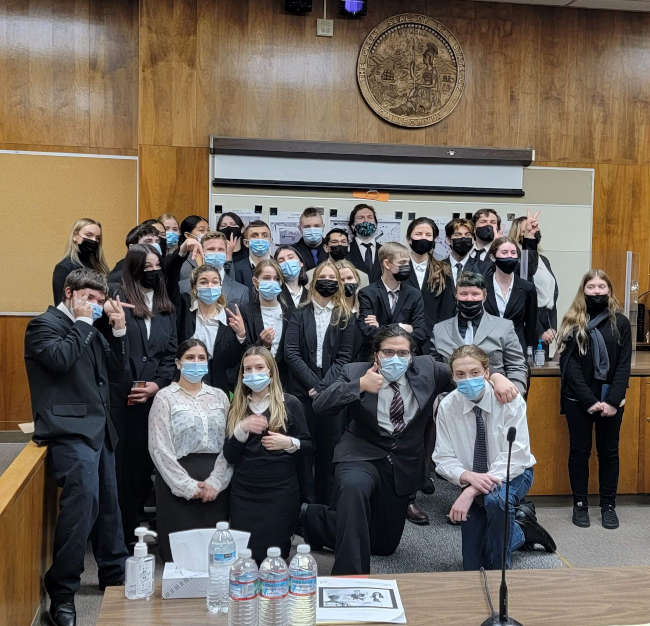
Adams said the students — with the help of volunteer attorney coaches and teachers — prepared arguments, evidence and more for the county competition through Mock Trial classes at their schools.
The Middletown team was assisted by teacher coach Dawnmarie Schneider, and attorney coaches Jon Hopkins and Janina Hoskins.
For Upper Lake, teacher coaches Alex Stabiner and Anna Sabalone, along with attorney coach Judy Conard, worked with the students.
Over the years, all of the court’s judges have taken turns volunteering their time to judge the competition.
This time around, judges J. David Markham and Shanda Harry presided over the competition in the morning and afternoon sessions, respectively.
Middletown and Upper Lake argued the fictional case of People v. Cobey.
The case revolves around Jamie Cobey, a horticulturist living in the community of Burnsley, California, a semi rural town in the high desert.
Cobey is charged with killing landlord and next-door neighbor, Erik Smith, in the most unusual of ways — by placing a rattlesnake in Smith’s mailbox.
Based on the arguments and evidence presented, both Markham and Harry ruled that Cobey was not guilty on all counts.
“Reasonable doubt is a difficult standard to make,” Harry said.
Harry, who wrapped up the day with the students, congratulated them for their passion. “I was very impressed by everyone.”
One of the team members, in turn, thanked Harry and the other adults who helped make the competition possible.
“I had a great time,” Harry said. “This is a great experience for everyone.”
Individual recognition for outstanding students was given to the following students:
• Outstanding prosecuting attorney: Zoey Petrie, Upper Lake High School.
• Outstanding defense attorney: Ellary Isherwood, Middletown High School.
• Outstanding pretrial attorney: Olivia Gallagher, Middletown High School.
• Outstanding defense witness: Brandon Blecman, Middletown High School.
• Outstanding defense witness: Isabella Neylon, Middletown High School.
• Outstanding prosecution witness: Gabriela Neylon, Middletown High School.
• Outstanding prosecution witness: Kenneth Carter, Middletown High School.
• Outstanding clerk/bailiff: Jacob Colecleaser, Upper Lake High School.
Middletown High School will now advance to the 41st annual state competition, which will be held virtually in March.
Two community groups are generously supporting the teams in the state competition, the Lake County Bar Association and Lake County Friends of Mendocino College, Adams said.
Adams said this year’s competition would not have been possible without the support of volunteer court organizers Melissa Perry and Luanne Hayes, Markham and Harry, and volunteer attorney scorers Nicholas Rotow, Megan Lankford, Mary Amodio and Edward Savin.
Email Elizabeth Larson at
- Details
- Written by: LAKE COUNTY NEWS REPORTS
The event will take place from 6 to 7 p.m.
All constituents of California’s Fifth Congressional District and California’s Fourth Assembly District are invited to attend.
To RSVP, email
Aguiar-Curry represents the 4th Assembly District, which includes all of Lake and Napa Counties, parts of Colusa, Solano and Sonoma Counties, and all of Yolo County except West Sacramento.
- Details
- Written by: Elizabeth Larson
Dogs available for adoption this week include mixes of Anatolian shepherd, Australian cattle dog, border collie, Chihuahua, fox terrier, German shepherd, Great Pyrenees, husky, Labrador retriever, Rhodesian ridgeback, Shar-Pei, shepherd, pit bull, wirehaired terrier and Weimaraner.
Dogs that are adopted from Lake County Animal Care and Control are either neutered or spayed, microchipped and, if old enough, given a rabies shot and county license before being released to their new owner. License fees do not apply to residents of the cities of Lakeport or Clearlake.
The following dogs at the Lake County Animal Care and Control shelter have been cleared for adoption (additional dogs on the animal control website not listed are still “on hold”).
Call Lake County Animal Care and Control at 707-263-0278 or visit the shelter online for information on visiting or adopting.

Male Weimaraner
This 2-year-old male Weimaraner has a short gray coat.
He is in kennel No. 3, ID No. LCAC-A-2701.

Female German shepherd
This female German shepherd has a short black and tan coat.
She is in kennel No. 4, ID No. LCAC-A-2598.

Female fox terrier
This 2-year-old female fox terrier has a short brown and white coat.
She is in kennel No. 6, ID No. LCAC-A-2628.

Male fox terrier
This 5-year-old male fox terrier has a short black and white coat.
He is in kennel No. 7, ID No. LCAC-A-2637.

Female husky-shepherd puppy
This female husky-shepherd puppy has a white coat.
She is in kennel No. 8, ID No. LCAC-A-2763.

‘Panda’
“Panda” is a 3-year-old male pit bull mix with a short black and white coat.
He is in kennel No. 11, ID No. LCAC-A-361.

‘Ruby’
“Ruby” is a 2-year-old female Shar-Pei-Rhodesian ridgeback mix with a short tan coat.
She is in kennel No. 13, ID No. LCAC-A-2560.

Male pit bull
This 2-year-old male pit bull has a short black and white coat.
He is in kennel No. 14, ID No. LCAC-A-2473.
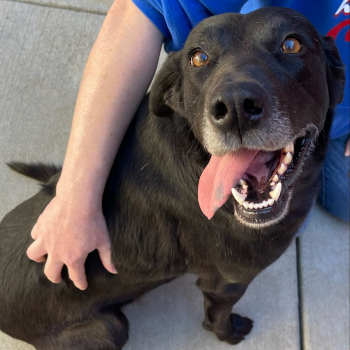
Female Labrador retriever
This 4-year-old female Labrador retriever has a short black coat.
She is in kennel No. 18, ID No. LCAC-A-2694.

Male Labrador retriever
This 3-year-old male Labrador retriever has a short black coat.
He is in kennel No. 21, ID No. LCAC-A-2745.
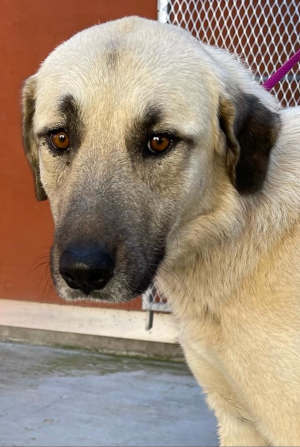
Anatolian shepherd mix
This 2-year-old female Anatolian shepherd mix has a short tan coat with black markings.
She is in kennel No. 23, ID No. LCAC-A-2535.
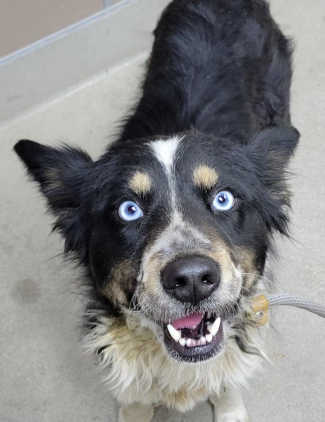
Female border collie mix
This 3-year-old female border collie mix has a tricolor coat and blue eyes.
She is in kennel No. 27, ID No. LCAC-A-2641.

‘Turbo’
“Turbo” is a 2-year-old male wirehaired terrier with a cream-colored coat.
He is in kennel No. 31, ID No. LCAC-A-2587.

‘Ginger’
“Ginger” is a 1-year-old female shepherd-Australian cattle dog mix with a cream and white coat.
She is in kennel No. 33, ID No. LCAC-A-2534.
Email Elizabeth Larson at