How to resolve AdBlock issue?
Refresh this page
How to resolve AdBlock issue?
Refresh this page
Lake County News,California
  • Home
    • Registration Form
  • News
    • Education
    • Veterans
    • Community
      • Obituaries
      • Letters
      • Commentary
    • Police Logs
    • Business
    • Recreation
    • Health
    • Religion
    • Legals
    • Arts & Life
    • Regional
  • Calendar
  • Contact us
    • FAQs
    • Phones, E-Mail
    • Subscribe
  • Advertise Here
  • Login
How to resolve AdBlock issue?
Refresh this page

News

Kelseyville set for 31st annual Pear Festival on Saturday

Details
Written by: Elizabeth Larson
Published: 24 September 2025
Downtown Kelseyville, California, will be filled with people, equipment and activities during the upcoming Pear Festival. Pictured here is the 2023 event. Photo by Elizabeth Larson/Lake County News.

KELSEYVILLE, Calif. — Downtown Kelseyville will be filled with the sights and sounds of local agriculture as well as food and fun when the annual Pear Festival returns this weekend.

The 31st annual festival will take place from 7:30 a.m. to 4 p.m. Saturday, Sept. 27.

The day will begin with a pancake breakfast from 7:30 to 10:30 a.m. at the Kelseyville Fire house on Main street.

Vendor booths throughout town will open at 9 a.m. 

One of the day’s main events, the parade down Main Street, will start at 9:30 a.m., with My Divas singing the national anthem.

There will be a variety of activities throughout the day, including a pear art contest for fourth and fifth graders, adult and high school poetry, pear tasting, awards for the pear dessert winners and the pie eating contest, as well as “Kids’ Town” with jump houses, coloring, pear decorating, face painting, giveaways and pictures with Barty the Pear.

Highlights of this year’s event will include a special performance by the Lake County Pomo Traditional Dancers from 11:30 a.m. to noon in the Pear Square.

Other performers set to entertain throughout the day include the Austin & Owens, Clear Lake Clikkers, Lake County Line Dancers, Mark Weston Band, Roadhouse and The Shufflenuts.

Throughout town, there will be many vendors offering food and beverages.

At Kelseyville Presbyterian Church, located at the corner of Third and Church streets, the Presbyterian Women will once again be selling their popular pear shakes for $5 each.

The church also will hold a parking fundraiser, with parking spaces $10 each.

For event updates, follow the Kelseyville Pear Festival Facebook page. 

Email Elizabeth Larson at This email address is being protected from spambots. You need JavaScript enabled to view it.. Follow her on Twitter, @ERLarson, and on Bluesky, @erlarson.bsky.social. Find Lake County News on the following platforms: Facebook, @LakeCoNews; X, @LakeCoNews; Threads, @lakeconews, and on Bluesky, @lakeconews.bsky.social. 

Elijah Watkins of Kelseyville High School shows his winning pear pie eating technique in his quest to win the pie eating contest and claim the prize for the high school Booster Club in the September 2024 Pear Festival. Photo by Lingzi Chen/Lake County News.


California Issues statement on credible medical information regarding acetaminophen and pregnancy

Details
Written by: LAKE COUNTY NEWS REPORTS
Published: 24 September 2025

Officials from the California Department of Public Health, the Office of the Surgeon General and the Department of Developmental Services are responding to recent claims by federal officials regarding acetaminophen and pregnancy.

The group put out a joint statement on Tuesday in response to those claims.

“Americans deserve clear medical guidance that is the result of a rigorous scientific process. We urge everyone to seek out credible medical guidance to inform their health care choices and to have conversations with their licensed health care providers.

“We are currently seeing the federal government provide a proliferation of simple answers to complex issues and false claims that can cause harm. The Society for Developmental and Behavioral Pediatrics has concluded that decades of research shows that autism has complex causes involving both genetics and environmental influences working together and that there is no strong evidence showing a causal relationship between the appropriate use of acetaminophen (Tylenol) during pregnancy and harmful effects on fetal development. In a separate news release, the American College of Obstetricians and Gynecologists called the current federal Administration’s opinions ‘irresponsible.'

“The California Department of Public Health will continue to work with partners in health care and science to share guidance that people can trust. California is committed to providing up-to-date, evidence-based information and resources to support healthy pregnancies and the workforce and families supporting individuals with autism.”

Thompson, Steube, Panetta, LaMalfa introduce bipartisan bill extending federal disaster tax relief

Details
Written by: LAKE COUNTY NEWS REPORTS
Published: 24 September 2025

On Tuesday, Rep. Mike Thompson (D-CA) and Reps. Greg Steube (R-FL), Jimmy Panetta (D-CA), and Doug LaMalfa (R-CA) announced the introduction of the Federal Disaster Tax Relief Act of 2025. 

This bill extends Thompson and Steube’s landmark 2024 law providing tax relief for individuals impacted by federally declared disasters. 

The bill will permit victims to claim disaster-related personal casualty losses without having to itemize deductions through 2026.

"After disaster strikes, survivors face not only the loss of their loved ones, homes, and livelihoods, but they also face the uncertainty of how to begin again," said Rep. Thompson. "In those moments, the last thing a survivor should fear is whether they qualify for tax relief. I am proud to work with my colleagues to expand on our disaster tax relief work and ensure survivors have the certainty and support they deserve."

“Allowing taxpayers to write off damages from natural disasters is a no-brainer. Millions of Floridians have already benefited from my Federal Disaster Tax Relief Act as they rebuild from the last several hurricane seasons. This law provides a much-needed lifeline to families as they navigate the most difficult of times," said Rep. Steube. "I am grateful to partner with Senator Rick Scott to extend this critical part of the federal government's emergency response."

“Families and communities recovering from natural disasters shouldn’t face the added burden of arbitrary deadlines that cut off their access to critical tax relief,” said Rep. Panetta. “Our bipartisan bill extends those deadlines and ensures that wildfire relief payments and hurricane losses continue to qualify for fair tax treatment.  By providing this certainty, we can give disaster-impacted Americans the time and tools they need to rebuild and move forward.”

“Families who lose their homes and livelihoods in a wildfire shouldn’t be hit with the possibility of a tax bill on their equity affecting the very payments meant to help them recover," said Rep. LaMalfa. "This bill ensures disaster relief is treated fairly and victims aren’t left fighting with the IRS on top of other challenges they may face. I'm pleased to join Congressman Steube in leading it.”

Rep. Thompson, who represents Lake County, serves as the Ranking Member of the Subcommittee on Tax for the Ways and Means Committee. 

He introduced the original legislation with Rep. Doug LaMalfa in the House of Representatives to provide tax relief to PG&E fire victims in the 117th Congress and worked with Sen. Padilla and Rep. LaMalfa to advance the legislation.

Last year, Rep. Thompson and Rep. Steube led a bipartisan group of 218 Members of Congress to successfully advance a discharge petition which forced House Speaker Mike Johnson to bring the Federal Disaster Tax Relief Act of 2023 to the House floor for a vote. 

The historic advancement of Rep. Thompson and Rep. Steube’s petition marked only the third time a House discharge petition had succeeded in the 21st Century. 

H.R. 5863 passed the Senate by unanimous consent and was signed into law by President Joe Biden in December of 2024.

Tuesday’s legislation would build upon this landmark law. Read the full bill here.

Facing a shutdown, budget negotiations are much harder because Congress has given Trump power to cut spending through ‘rescission’

Details
Written by: Charlie Hunt, Boise State University
Published: 24 September 2025

Will Congress keep the government running? Phil Roeder/Getty Images

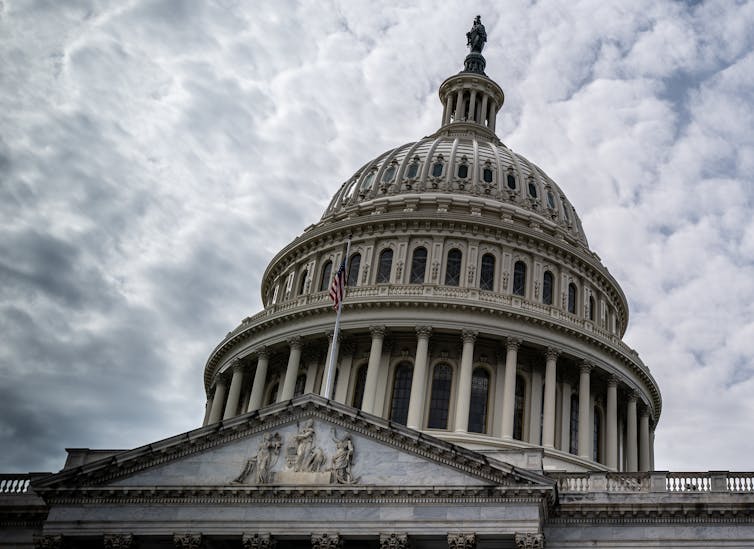
Congress faces a deadline of Oct. 1 to adopt a spending measure to keep the federal government open. Various reporters will be interviewing serious people saying serious things in the basement corridors of the U.S. Capitol. There will also be political posturing, misrepresentation and either braggadocio or evasion. Politics editor Naomi Schalit interviewed congressional expert Charlie Hunt, a political scientist at Boise State University, about the now-perennial drama over spending in Congress and what’s very different about this year’s conflict.

In the past, how did Congress pass budgets so that government could keep operating?

Typically, you would get an actual passage of a full budget for a year. But in the last 20 or 30 years or so, since we’ve become a more polarized country with a polarized Congress, we have a lot of what are called continuing resolutions, or CRs.They’re stopgap measures – not the full budget – and don’t tend to make a lot of changes on a lot of the spending priorities that Congress has.

Continuing resolutions usually just extend current levels of spending for a short time so that the two parties can continue negotiating. But as negotiations over long-term budgets have tended to fail more and more, these CR’s are becoming more common, and Congress almost never passes a full budget on a yearly basis at this point.

A bunch of people in office clothes, crowded around something in a hallway.
You’ll be seeing a lot of this sort of scrum – reporters interviewing members of Congress – as spending gets wrangled over. Matt McClain/The Washington Post via Getty Images

What’s the role of the president here?

The president has the power to veto any piece of legislation, and that includes the federal budget. Essentially, what majorities in Congress need when they are going into a budget fight is either the president’s implicit sign-off on whatever they pass, or they need enough votes to override the president’s veto.

Congress and the presidency right now are both held by Republicans, they’re in pretty deep alignment, so that’s not as much of a concern this time. It’s really just what Trump wants that needs to be a part of this legislation, and if there’s something in it that he really doesn’t like, then Congress needs to go back to the drawing board and the Republicans need to find out a way to get that into the bill.

What is driving each party in these negotiations?

Two different things are at work here. One is that Congress, as I mentioned, is really polarized. The two parties are farther apart from each other than they used to be. So the average Democrat and the average Republican aren’t going to agree as much on policy priorities and funding priorities than they did, say, in the 1980s or 1970s or before that.

The other thing is that Congress in recent decades has been more closely divided than they have been in the recent past, say, the last century. In both chambers, House and Senate, it’s very rare for one party or the other to have some massive majority. You need a majority of 60 in the Senate to have a chance at passing most legislation, for example, and this big a majority hasn’t happened since 2009. That’s something President Obama enjoyed with the Democrats for just a short period of time.

Since then, there have been very closely divided chambers in Congress, and that means that you need, at least in the Senate, some bipartisanship in order to pass that 60-vote threshold to break a filibuster. That’s what’s really gumming up the works right now. Democrats don’t feel like they’re being included in negotiations, and so they’re not likely to agree to a Republican-only budget in the Senate.

A man in a suit and wearing glasses, surrounded by reporters with mobile phones used to record him.
Speaker of the House Mike Johnson, a Republican from Louisiana, has been key to rallying House Republicans behind a stopgap funding bill to avert a shutdown. Kent Nishimura/Getty Images

What is different about the 2025 budget fight than previous ones?

A lot of the dynamics are still the same. You still have partisan fighting. And you still have some divides within the two parties that I think are worth mentioning. One example: There was a Senate vote just the other day on one of these budget resolutions, and a couple of Republicans voted with the Democrats. So for some of these more deficit-hawk Republicans, that concern is still playing a role.

What’s new this time around is this element of rescissions. This is a tool that’s been available since the 1970s in which presidents ask Congress to rescind spending that they had allocated. This is what happened earlier this year with the rescissions on public broadcasting – NPR and PBS – that got a lot of attention, as well as on USAID. Trump said he wanted to cut funding for public broadcasting – the GOP in the Senate and House voted to let him. They didn’t need 60 votes in the Senate for a rescission, either. Just a majority for this move.

So in this case, Democrats are looking at this and thinking, “Why should we negotiate, if you’re just going to rescind that later on without our consent?” That’s a major element that’s changed. While it’s a power that has been in place for a while, Trump and the Republicans have been really willing to wield that.

Do you see this rescission power being exercised with every budget or continuing resolution that Congress passes?

This is a pretty serious breach of what we call Congress’ “power of the purse.” That spending power is set out in Article 1 of the Constitution. It is a key power, maybe their most important power and point of leverage they have in going back and forth with the president and making sure the executive branch doesn’t accrue too much power.

But if this rescission authority is going to be used in this way going forward, where basically any spending priority that the president doesn’t want or doesn’t want to fund is going to be subject to rescission, then Congress doesn’t really have the power of the purse, right? They have a president who is going to veto anything that doesn’t live up to their expectations, or they can just sign it and then ask for these rescissions later.

The key thing here is that President Trump currently has in Congress a set of Republicans in both the House and the Senate who are willing to do virtually anything he wants and are subject to a lot of the political pressures in their districts that put him in office in the first place. So if they don’t go along with rescissions, they’re going to face the wrath of their Republican voters in their district.

That’s one thing that’s really changed in the last 30 years that I think gives the president a lot more authority in these matters, and makes rescission such a powerful tool that did not exist before.The Conversation

Charlie Hunt, Associate Professor of Political Science, Boise State University

This article is republished from The Conversation under a Creative Commons license. Read the original article.

  1. Sheriff’s office identifies homicide victim; investigation continuing
  2. Lake County officials challenge PG&E’s claims about Potter Valley Project’s seismic safety
  3. Shooting reported in Clearlake Monday night
  • 150
  • 151
  • 152
  • 153
  • 154
  • 155
  • 156
  • 157
  • 158
  • 159
How to resolve AdBlock issue?
Refresh this page