How to resolve AdBlock issue?
Refresh this page
How to resolve AdBlock issue?
Refresh this page
Lake County News,California
  • Home
    • Registration Form
  • News
    • Education
    • Veterans
    • Community
      • Obituaries
      • Letters
      • Commentary
    • Police Logs
    • Business
    • Recreation
    • Health
    • Religion
    • Legals
    • Arts & Life
    • Regional
  • Calendar
  • Contact us
    • FAQs
    • Phones, E-Mail
    • Subscribe
  • Advertise Here
  • Login
How to resolve AdBlock issue?
Refresh this page

News

Hepatitis B shot for newborns has nearly eliminated childhood infections with this virus in the US

Details
Written by: David Higgins, University of Colorado Anschutz Medical Campus
Published: 21 September 2025

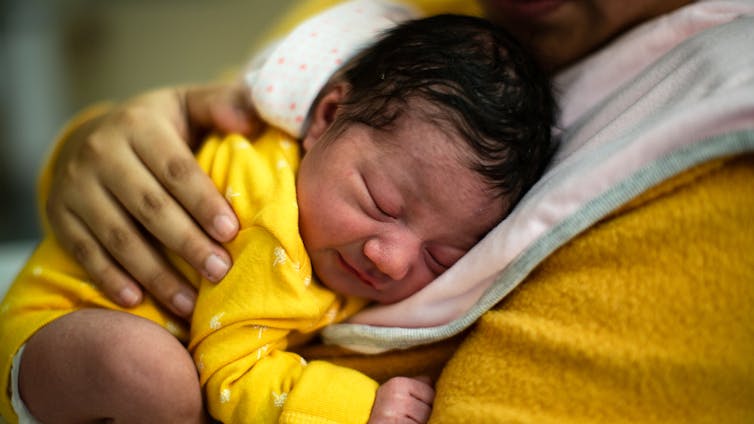
About 80% of parents currently choose to follow CDC guidelines to vaccinate their babies for hepatitis B at birth. timnewman/iStock via Getty Images Plus

Graphic saying '95% Drop in U.S. childhood hepatitis B infections since 1991, when routine infant vaccination began'
The Conversation, CC BY-ND

Before the United States began vaccinating all infants at birth with the hepatitis B vaccine in 1991, around 18,000 children every year contracted the virus before their 10th birthday – about half of them at birth. About 90% of that subset developed a chronic infection.

In the U.S., 1 in 4 children chronically infected with hepatitis B will die prematurely from cirrhosis or liver cancer.

Today, fewer than 1,000 U.S. children or adolescents contract the virus every year – a 95% drop. Fewer than 20 babies are reported infected at birth.

I am a pediatrician and preventive medicine specialist who studies vaccine delivery and policy. Vaccinating babies for hepatitis B at birth remains one of the clearest, most evidence-based ways to keep American children free of this lifelong, deadly infection.

On Sept. 18, 2025, the Advisory Committee on Immunization Practices, an independent panel of experts that advises the Centers for Disease Control and Prevention, debated changing the recommendation. According to the proposed language of the vote, infants whose mothers test positive for hepatitis B would still receive the vaccine at birth. Infants whose mothers do not test positive for hepatitis B would get the vaccine at 1 month of age, though parents would have the choice for them to receive it earlier. On Sept. 19, however, the committee tabled the vote, delaying it to the next committee meeting, scheduled for Oct. 22-23.

Although such a proposed change sounds small, it is not based on any new evidence. It would undo more than three decades of a prevention strategy that has nearly eliminated early childhood hepatitis B in the U.S.

While the committee regularly reviews vaccine guidance, nothing is business as usual about this meeting. In June 2025, Secretary of Health and Human Services Robert F. Kennedy Jr. disbanded the entire committee and handpicked new members. The committee has long-standing procedures to evaluate the evidence supporting the risks and benefits of a given vaccine, as well as other parameters of its use. But in this case, these procedures are not being followed.

Why the CDC adopted universal hepatitis B shots

Hepatitis B is a virus that infects liver cells, causing inflammation and damage. In adults, it is spread through blood and bodily fluids, which can happen through unprotected sex, contaminated needles or contact with open cuts or sores of someone who is carrying it.

The hepatitis B vaccine has been available since the early 1980s. Before 1991, public health guidance recommended giving newborns and young children the hepatitis B vaccine only if they were at high risk of being infected – for example, if they were born to a mother infected with hepatitis B or living in a household with someone known to have hepatitis B.

That targeted plan failed. Tens of thousands of children were still infected each year.

Newborn lying on exam table touching doctor's stethoscope
Children are most likely to get infected by hepatitis B at birth, when contact with their mother’s blood can transmit the virus. Ekkasit Jokthong/iStock via Getty Images Plus

Some newborns were exposed when their mothers weren’t properly screened or if their mothers got infected late in pregnancy. Children also became infected through household contacts or in child care settings by exposures as ordinary as shared toothbrushes or a bite that breaks the skin. Because hepatitis B can survive for a week on household surfaces, and many carriers are unaware they are infected, even babies and toddlers of uninfected mothers remained at risk.

Recognizing these gaps, in 1991 the CDC recommended hepatitis B vaccination for every child starting at birth, regardless of maternal risk.

Vaccinating at birth

The greatest danger for infants contracting hepatitis B is at birth, when contact with a mother’s blood can transmit the virus. Without preventive treatment or vaccination, 70% to 90% of infants born to infected mothers will become infected themselves, and 90% of those infections will become chronic. The infection in these children silently damages their liver, potentially leading to liver cancer and death.

About 80% of parents choose to follow the CDC’s guidance and vaccinate their babies at birth. If the CDC’s recommendations change to delaying the first dose to 1 month old, it would leave babies unprotected during this most vulnerable window, when infection is most likely to lead to chronic infection and silently damage the liver.

The hepatitis B vaccines used in the U.S. have an outstanding safety record. The only confirmed risk is an allergic reaction called anaphylaxis that occurs in roughly 1 in 600,000 doses, and no child has died from such a reaction. Extensive studies show no link to other serious conditions.

The current recommendations are designed to protect every child, including those who slip through gaps in maternal screening or encounter the virus in everyday life. A reversion to the ineffective risk-based approach threatens to erode this critical safety net.The Conversation

David Higgins, Assistant Professor of Pediatrics, University of Colorado Anschutz Medical Campus

This article is republished from The Conversation under a Creative Commons license. Read the original article.
Space News: 50 years ago, NASA sent 2 spacecraft to search for life on Mars – the Viking missions’ findings are still discussed today

Details
Written by: Joel S. Levine, William & Mary
Published: 21 September 2025

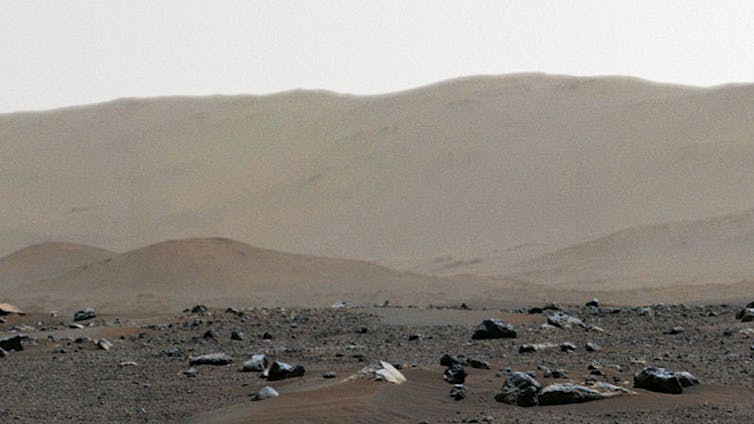
NASA’s Viking landers were the first spacecraft to successfully touch down on the surface of Mars. NASA/JPL-Caltech via AP

Finding life beyond the Earth would be a major scientific discovery with significant implications for all areas of science and human thought. Yet, only one direct search for extraterrestrial life has ever been conducted.

A poster showing the Viking craft parachuting to the Martian surface.
The Viking missions landed on the Martian surface using parachutes. This diagram shows each stage the spacecraft went through as they landed. NASA

The NASA Viking spacecraft, which landed on Mars, conducted this search in the summer of 1976. Viking consisted of two twin orbiters and landers, with experimental chambers in the landers to conduct three biology experiments.

Over the past half-century, the measurements made during the Viking biology experiments have been the subject of many discussions, analyses and speculation. Today, scientists are still discussing the results of these experiments in an attempt to answer the age-old question of whether there is life beyond the Earth.

The year 2025 marks 50 years since the two spacecraft launched, three weeks apart. These landers achieved humankind’s first two successful soft landings of operational and functioning spacecraft on the surface of another planet.

I’m an atmospheric scientist who worked on the Viking missions in the 1970s at the NASA Langley Research Center, the laboratory that developed and managed the highly successful Viking missions. The Viking missions’ scientific discoveries painted a new picture of Mars’ atmosphere, surface and planetary history.

The Viking 1 lander reached the surface of Mars after being ejected from a spacecraft and deploying a parachute.

Launching and landing the Viking spacecraft

The two Viking spacecraft both consisted of an orbiter and a lander. Viking 1 entered Mars’ orbit on June 19, 1976, and successfully landed on the surface on July 20, 1976, which was also the seventh anniversary of the first human Moon landing. Viking 2 followed, landing on Sept. 3, 1976, at a site farther to the northwest.

Viking wasn’t just looking for life.

These crafts contained equipment to take pictures; map heat energy, wind and weather; study the chemical composition of the surface, dust and atmosphere; and collect and analyze soil samples.

Measurements that Viking took of the atmosphere suggested that Mars used to have a much denser atmosphere but over time lost it. It also observed that the wind picks up tiny dust particles, blowing them into the atmosphere. This process colors the planet’s sky permanently pink.

A diagram of the Viking landers, with each instrument labeled.
All the instruments found on the Viking landers. NASA

The Viking landers also discovered that at any location on Mars, the atmosphere’s surface pressure varies seasonally. The planet has frozen north and south poles, like on Earth. At the Martian poles in summer, the frozen carbon dioxide sublimates – transforming from a frozen solid to a gas – and then at the winter pole condenses back into a frozen solid.

That process, unique to Mars, affects the atmospheric pressure by changing how much carbon dioxide is in gas form instead of solid form over the planet’s surface.

Biology experiments

Each of the three Viking biology experiments brought a soil sample from the Martian surface into a sterilized test chamber and exposed the sample to a different nutrient under different atmospheric conditions.

Researchers wanted to find out whether the soil contained microorganisms, so they monitored how the atmosphere in the chamber changed. Metabolic processes – like breathing – from organisms consuming the nutrient would change the chemical composition of the chamber’s atmosphere.

Depending on the experiment, the nutrient contained either carbon, carbon dioxide or carbon monoxide – all of which were radioactive. With radioactive samples, researchers could track the level of radioactivity in the chamber to see if metabolic reactions in the soil samples were raising or lowering it.

For all three experiments, the researchers could use radio commands to heat up the test chamber, which was still inside the Viking spacecraft on Mars. This would destroy any potential microorganisms in the soil and stop the production of any gases they were creating metabolically.

In the first experiment, called the carbon assimilation experiment or the pyrolytic release experiment, the researchers simulated the Martian atmosphere in one of Viking’s test chambers. They filled the chamber with gases such as carbon dioxide and carbon monoxide and made these gases radioactive to see how the atmosphere changed from interactions with the soil sample.

In the second experiment, The labeled release experiment, researchers directly injected the soil sample with a nutrient containing radioactive carbon. They monitored the experimental chamber for radioactive carbon dioxide and measured the level of radioactive carbon dioxide after injecting the soil samples. In this experiment, the investigators saw results that could have come from a biological source.

A diagram showing the three experiments in sealed chambers.
The three biology experiments involved putting soil samples in sealed chambers with nutrients and seeing what happened to the atmosphere in each chamber. NASA

The third experiment, the gas exchange experiment, filled the chamber with helium, which doesn’t react with anything. They exposed the soil to different types of nutrients. Some had been incubating in wet conditions, others in humid conditions and others still in dry conditions.

Again they monitored the chamber for potential metabolically produced gases. When the soil samples touched the wet nutrient, the humidity immediately caused some changes in the chamber’s chemical environment. Most of these changes were just caused by the water evaporating.

In one case, superoxides in the soil, which are O₂ molecules that have taken on an extra electron, reacted with water. Other changes had to do with oxygen molecules in the soil breaking down. All of these changed the atmosphere in the chamber but likely wouldn’t have been caused by microorganisms.

The researchers repeated this experiment by resetting the chamber’s atmosphere and adding in fresh nutrients, but they didn’t change the soil sample. This time, the soil released only carbon dioxide into the chamber, which likely came from the organic materials in the nutrient they added breaking down.

The results from this third experiment led the researchers to conclude that there likely weren’t microorganisms in the soil. But together, the results from the three experiments weren’t exactly straightforward.

Only the labeled release experiment results suggested a biological source for the observed results. The carbon assimilation experiment and the gas exchange experiment suggested that nonbiological or inorganic chemical reactions caused the observed results.

Lead researchers on the project concluded that there was no unambiguous discovery of life by the Viking landers, but it cannot be completely ruled out.

The front page of the New York Times, with a headline reading 'viking robot sets down safely on Mars and sends back pictures of rocky plain' with a picture of a rocky plain.
The Viking mission was a major scientific and engineering success. On July 21, 1976, the day after the successful Viking 1 landing on the surface of Mars, The New York Times published the first photograph of Mars taken by the Viking Lander on its front page, covering all eight columns of the newspaper. The New York Times

The molecular analysis experiment

Unlike the biology experiments, which experimented on soil samples, another Viking experiment, the molecular analysis experiment, directly searched the Martian surface for organic matter. Organic materials are carbon compounds bonded with hydrogen, oxygen or nitrogen that come either directly or indirectly from living organisms.

To everyone’s surprise, this experiment did not detect any organic compounds on the surface of Mars. Researchers had known for years that meteorites containing organic materials had hit Mars repeatedly throughout its history, so to find none at all seemed strange.

Some scientists theorized that Martian soil might contain a compound that quickly converts any organic material on the surface to carbon dioxide. A compound like this would have evaporated any evidence before scientific instruments had the chance to find it.

In 2008, decades after this finding, NASA found a compound that may be doing just that. Their Phoenix lander detected high concentrations of a compound called perchlorate in the soil.

When perchlorate is heated – as it was in the Viking molecular analysis experiment – it can chemically destroy organic compounds, and scientists figured it’s the likely culprit behind the strange result from the molecular analysis experiment.

A small, low to the ground spacecraft with an antenna disk pointing upwards, resting on a rocky surface.
The Viking 1 lander, pictured in a Mars simulation laboratory. AP Photo

A new model for life on Mars

Scientists are still using the findings from these experiments today. Recently, Steven A. Benner, the director of the Foundation for Applied Molecular Evolution, developed a new model for present-day life on Mars based on the three Viking biology experiments’ measurements.

His model predicts that microorganisms could have used the radioactive carbon nutrient in the experiment chamber to create their own food, releasing radioactive carbon dioxide in the process. It also suggests that at night, microorganisms could be absorbing oxygen and expelling carbon dioxide. That could explain the oxygen released from the Mars soil sample when moistened.

The Benner model suggests that there could be living microorganisms on the surface of Mars, but future research and measurements will need to confirm this very intriguing possibility.The Conversation

Joel S. Levine, Research Professor of Applied Science, William & Mary

This article is republished from The Conversation under a Creative Commons license. Read the original article.

Lake County Continuum of Care to host community conversation on local unhoused crisis Sept. 24

Details
Written by: LAKE COUNTY NEWS REPORTS
Published: 20 September 2025

LAKE COUNTY, Calif. — The Lake County Continuum of Care will host a public town hall meeting on the ongoing unhoused crisis in Lake County next week.

The town hall will take place from 5:30 to 7:30 p.m. Wednesday, Sept. 24, at the Soper Reese Theater, 275 S. Main St. in Lakeport.

It also can be viewed here.

The event will offer residents an opportunity to hear updates, ask questions and engage in meaningful solutions-based dialogue.

“The unhoused crisis touches every part of our small community. It will take all of us working together to respond with compassion, creativity, and resolve,” said District 2 Supervisor Bruno Sabatier. “This community conversation provides us all a chance to share updates, listen to concerns, and foster community-driven action for the good of us all.”

Topics for this conversation will include:

• Funding and ongoing organizational efforts.
• Updates on shelter and housing initiatives.
• Services provided for the unhoused.
• Current challenges facing unhoused residents.
• Lived experience.
• Up-to-date data.
• Opportunities for public engagement, volunteerism, and advocacy.

All community members are invited to attend this free public event. 

Snacks and refreshments will be served from 5:30 to 6 p.m. followed by feature presentations from local leaders, service providers and members of the Continuum of Care committees. 

Presentations will include intentional space and time for open discussion and Q&A. 

For more information, contact Melissa Kopf via e-mail at This email address is being protected from spambots. You need JavaScript enabled to view it.. 

Clearlake Animal Control: ‘Tinker Bell’ and the dogs

Details
Written by: Elizabeth Larson
Published: 20 September 2025
“Tinker Bell.” Photo courtesy of Clearlake Animal Control.

CLEARLAKE, Calif. — Clearlake Animal Control has dogs of many breeds waiting for someone who wants to give them a new home.

The shelter has 49 adoptable dogs listed on its website.

This week’s dogs include “Tinker Bell,” an 8-month-old large female mixed breed dog with a black and brown coat. 

The shelter is located at 6820 Old Highway 53. It’s open from 9 a.m. to 6 p.m. Tuesday through Saturday. 

For more information, call the shelter at 707-762-6227, email This email address is being protected from spambots. You need JavaScript enabled to view it., visit Clearlake Animal Control on Facebook or on the city’s website.

This week’s adoptable dogs are featured below.

Email Elizabeth Larson at This email address is being protected from spambots. You need JavaScript enabled to view it.. Follow her on Twitter, @ERLarson, and on Bluesky, @erlarson.bsky.social. Find Lake County News on the following platforms: Facebook, @LakeCoNews; X, @LakeCoNews; Threads, @lakeconews, and on Bluesky, @lakeconews.bsky.social. 

  1. Pneumonia vaccines for adults are now recommended starting at age 50 – a geriatrician explains the change
  2. Estate Planning: Considerations for real properties
  3. Space News: Mars rovers serve as scientists’ eyes and ears from millions of miles away – here are the tools Perseverance used to spot a potential sign of ancient life
  • 154
  • 155
  • 156
  • 157
  • 158
  • 159
  • 160
  • 161
  • 162
  • 163
How to resolve AdBlock issue?
Refresh this page