How to resolve AdBlock issue?
Refresh this page
How to resolve AdBlock issue?
Refresh this page
Lake County News,California
  • Home
    • Registration Form
  • News
    • Education
    • Veterans
    • Community
      • Obituaries
      • Letters
      • Commentary
    • Police Logs
    • Business
    • Recreation
    • Health
    • Religion
    • Legals
    • Arts & Life
    • Regional
  • Calendar
  • Contact us
    • FAQs
    • Phones, E-Mail
    • Subscribe
  • Advertise Here
  • Login
How to resolve AdBlock issue?
Refresh this page

News

Pneumonia vaccines for adults are now recommended starting at age 50 – a geriatrician explains the change

Details
Written by: Laurie Archbald-Pannone, University of Virginia
Published: 20 September 2025

A new version of the pneumonia vaccine that specifically targets strains that affect adults helped spur the updated recommendations. zoranm/E+ via Getty Images

Autumn brings a chill in the air – and the start of another season of respiratory illnesses, which can be especially hard for older adults.

Although vaccine recommendations have been in flux, the Centers for Disease Control and Prevention’s recommendations on respiratory vaccines for older adults remain robust.

As a geriatrician treating primarily patients age 65 and older, I’ve found that my patients are often unsure which of the various types of pneumonia vaccines is the best option for them.

Until recently, the CDC recommended that everyone age 65 and older get a pneumonia vaccine. A year ago, in October 2024, the CDC lowered the recommended age from 65 to 50 due to a growing recognition that pneumonia can cause serious illness in people ages 50-65 – especially people who have other conditions that make them particularly vulnerable.

Pneumonia basics

Pneumonia most commonly occurs when a bacterium called Streptococcus pneumoniae infects the lungs. The infection can spur an outsize immune response and damage cells.

The first vaccine for pneumonia was developed more than 100 years ago, at the request of the South African mining industry, which was losing a startling 5% to 10% of workers to the disease each year.

For decades the most widely used pneumonia vaccine for adults was the so-called 23-valent vaccine, or PPSV23, which was approved in 1983 and protected against 23 strains of pneumococcal bacteria. In 2014, the PCV13 vaccine, which protected against 13 types of these bacteria, became the first pneumonia vaccine to be routinely recommended for adults age 65 and older. This vaccine was made using a newer technology that is thought to be more effective.

Patient gets a vaccine from a doctor.
The pneumonia vaccine has been recommended for older adults since 2014. fstop123/E+ via Getty Images

Since then, three other pneumonia vaccines for adults, also made using the newer technology, have been licensed and added to the list of those recommended for older adults. The most recent of these is PCV21, which was approved in 2024 and specifically targets strains that usually affect adults rather than children.

Which specific pneumonia vaccine you get will depend on your medical conditions and other health factors. Your health care provider will determine the most appropriate option, but you can learn more about pneumonia vaccines on the CDC’s website and bring specific questions to your next health care visit.

Why did the guidelines change?

As the population of older adults rises, research suggests that without intervention, the number of people hospitalized with pneumococcal pneumonia could nearly double by 2040. About 150,000 Americans are hospitalized with pneumococcal pneumonia each year.

Although the Advisory Committee on Immunization Practices, the independent body that advises the CDC on vaccines, had previously considered lowering the recommended age to receive the vaccine from 65 to 50, the approval of PCV21 provided a push. Because the rate of pneumococcal pneumonia was so high in this age group, they moved to adopt the recommendation.

The pneumonia vaccine boosts the immune system’s ability to fight off this bacterium and lowers the likelihood of getting pneumonia – and of getting seriously ill, getting hospitalized, being put on a breathing machine or dying from a pneumonia infection.

According to the CDC, the old vaccine, PPSV23, is 60% to 70% effective in preventing invasive pneumonia, the more serious version of the disease in which pneumococcal bacteria infect the major organs and the blood. Althoughtis new, its mechanism and the strains it covers suggest it is even more effective, especially for people living in nursing homes or other long-term care facilities.

Who should get the vaccine?

Older age is the clearest risk factor for getting sick from pneumonia. So, if you’re like me and you are planning for an upcoming 50th birthday – and have never gotten the pneumonia vaccine before – make sure to put “get the pneumonia vaccine” on your birthday list.

If you’re an adult under 50 years old with a high risk condition, such as chronic liver disease or diabetes, the CDC also recommends you get vaccinated for pneumonia.

And make sure to talk with your health care provider to see that you’re also up to date on all recommended vaccines, which could include shingles, flu, RSV and COVID-19.The Conversation

Laurie Archbald-Pannone, Associate Professor of Medicine and Geriatrics, University of Virginia

This article is republished from The Conversation under a Creative Commons license. Read the original article.


Estate Planning: Considerations for real properties

Details
Written by: Dennis Fordham
Published: 20 September 2025
Dennis Fordham. Courtesy photo.
California offers various estate planning approaches for real property, including primary residences, vacation homes, rental properties and vacant lots.

That is, the transfer on death (“TOD”) deed, a joint tenancy or community property with right of survivorship deed, a life estate deed, a will or a trust.

Which applies and is best suited depends on the situation. For reasons discussed below, the Living Trust is often the best choice.

The TOD deed is limited, has significant drawbacks, but offers a simple, cost effective option effective upon the transferor’s death.

It is limited: The TOD applies to land with one to four residential units, but excludes real property exceeding 40 acres, and to condominiums; and a TOD deed allows you to name one or more equal beneficiaries (only) and does not allow alternative beneficiaries; if any of the beneficiaries predecease the transferor then any remaining named beneficiaries inherit all.

Second, a TOD deed has serious drawbacks: All beneficiaries inherit equally; All beneficiaries inherit subject to any unpaid / unsecured debts owed by the transferor at death (often an unknown quantity); a TOD deed may be invalidated due to a preexisting joint tenancy deed or due to a competing deed filed within 60 days of when the TOD was recorded; and, very importantly, a title insurance company may decline to provide title insurance for up to three years from the transferor’s death.

A beneficiary is personally answerable for the decedent’s unsecured debts up to the net worth of the residence at the transferor’s death (i.e., gross value minus liens).

Joint tenancy and community property with right of survivorship deeds mean that the surviving joint tenant(s) or surviving co-owning spouse, as relevant, inherit(s) the deceased co-owner’s entire interest outright by recording an affidavit and death certificate.

Joint tenancy involves two or more equal co-owners during their lifetimes. Joint tenancy is not advisable except between spouses or domestic partners.

Each co-owner, or their judgment creditor, can petition to force the sale of the co-owned property. It is not advisable to make one’s heirs (e.g., children) joint tenants due to possible adverse consequences to the transferor and the transferee.

Community property with right of survivorship is superior to joint tenancy due to income tax advantages for the surviving spouse.

A life estate deed is a transfer where the transferor gifts an interest in real property to one or more persons (i.e., remaindermen”) subject to retaining a reserved life estate for the transferor to live in and to rent the property while alive.

This has its limitations and drawbacks. The life tenant cannot sell the property without the cooperation of the remaindermen who receive a percentage of the net sale proceeds equal to the present value of their interest.

It may lead to a probate at the death of the life tenant if a remainderman predecease the life tenant without transferring their interest into a living trust.

A will means a court petition at the owner’s death (unless another non probate approach is used). That is, either California’s new simplified petition to determine succession to a decedent’s primary residence interest (without probate) or a petition for probate administration.

The new simplified petition is limited to primary residences only (worth less than $750,000) where the decedent’s remaining probate assets collectively are worth less than the threshold for probate (e.g., under $208,850 for deaths after 4/1/2025).

It is inapplicable to rental properties, vacation homes and vacant lots. A will, unlike the other foregoing options, can name alternative death beneficiaries.

A living trust unlike a will avoids any court petition, whatsoever, and can provide more protections both for the transferor while alive (but not against the settlor’s own creditors) and for the trust beneficiaries (including against many creditors of the beneficiaries).

Anyone who owns more than one piece of real property and wants to avoid probate will probably want to use a living trust to avoid probate.

The foregoing is not legal advice. If needing legal guidance regarding health care decision planning consult an estate planning attorney.

Dennis A. Fordham, attorney, is a State Bar-Certified Specialist in estate planning, probate and trust law. His office is at 870 S. Main St., Lakeport, Calif. He can be reached at This email address is being protected from spambots. You need JavaScript enabled to view it. and 707-263-3235.

Space News: Mars rovers serve as scientists’ eyes and ears from millions of miles away – here are the tools Perseverance used to spot a potential sign of ancient life

Details
Written by: Ari Koeppel, Dartmouth College
Published: 20 September 2025

Scientists absorb data on monitors in mission control for NASA’s Perseverance Mars rover. NASA/Bill Ingalls, CC BY-NC-ND

NASA’s search for evidence of past life on Mars just produced an exciting update. On Sept. 10, 2025, a team of scientists published a paper detailing the Perseverance rover’s investigation of a distinctive rock outcrop called Bright Angel on the edge of Mars’ Jezero Crater. This outcrop is notable for its light-toned rocks with striking mineral nodules and multicolored, leopard print-like splotches.

By combining data from five scientific instruments, the team determined that these nodules formed through processes that could have involved microorganisms. While this finding is not direct evidence of life, it’s a compelling discovery that planetary scientists hope to look into more closely.

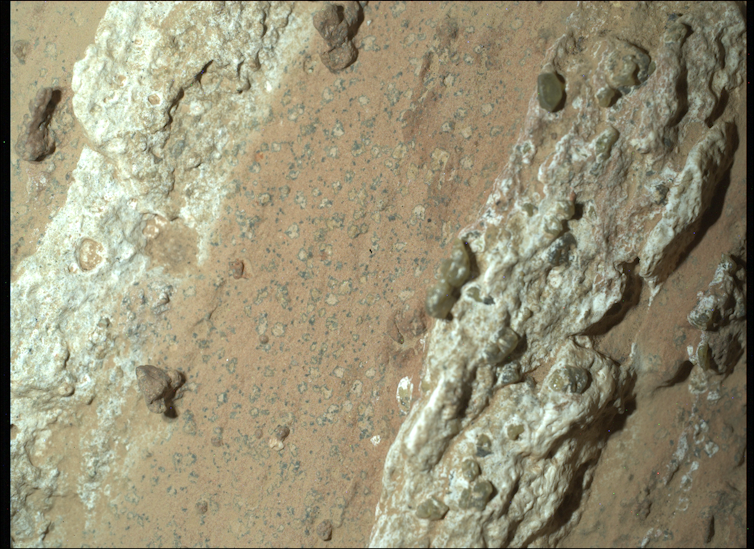
A streaked and spotted rock surface
Bright Angel rock surface at the Beaver Falls site on Mars shows nodules on the right and a leopard-like pattern at the center. NASA/JPL-Caltech/MSSS

To appreciate how discoveries like this one come about, it’s helpful to understand how scientists engage with rover data — that is, how planetary scientists like me use robots like Perseverance on Mars as extensions of our own senses.

Experiencing Mars through data

When you strap on a virtual reality headset, you suddenly lose your orientation to the immediate surroundings, and your awareness is transported by light and sound to a fabricated environment. For Mars scientists working on rover mission teams, something very similar occurs when rovers send back their daily downlinks of data.

Several developers, including MarsVR, Planetary Visor and Access Mars, have actually worked to build virtual Mars environments for viewing with a virtual reality headset. However, much of Mars scientists’ daily work instead involves analyzing numerical data visualized in graphs and plots. These datasets, produced by state-of-the-art sensors on Mars rovers, extend far beyond human vision and hearing.

A virtual Mars environment developed by Planetary Visor incorporates both 3D landscape data and rover instrument data as pop-up plots. Scientists typically access data without entering a virtual reality space. However, tools like this give the public a sense for how mission scientists experience their work.

Developing an intuition for interpreting these complex datasets takes years, if not entire careers. It is through this “mind-data connection” that scientists build mental models of Martian landscapes – models they then communicate to the world through scientific publications.

The robots’ tool kit: Sensors and instruments

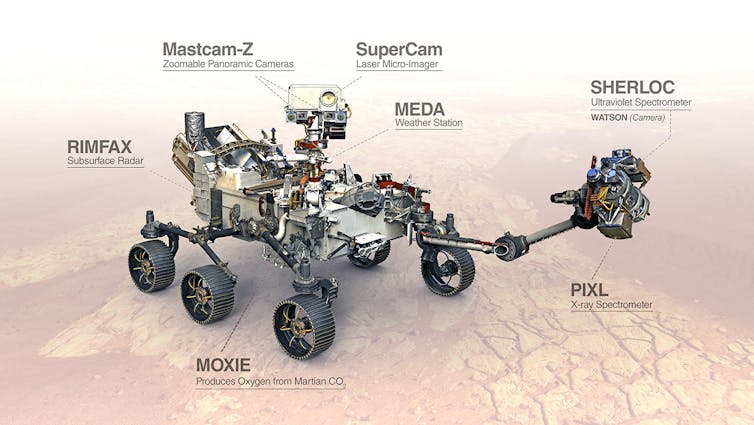
Five primary instruments on Perseverance, aided by machine learning algorithms, helped describe the unusual rock formations at a site called Beaver Falls and the past they record.

Robotic hands: Mounted on the rover’s robotic arm are tools for blowing dust aside and abrading rock surfaces. These ensure the rover analyzes clean samples.

Cameras: Perseverance hosts 19 cameras for navigation, self-inspection and science. Five science-focused cameras played a key role in this study. These cameras captured details unseeable by human eyes, including magnified mineral textures and light in infrared wavelengths. Their images revealed that Bright Angel is a mudstone, a type of sedimentary rock formed from fine sediments deposited in water.

Spectrometers: Instruments such as SuperCam and SHERLOC – scanning habitable environments with Raman and luminescence for organics and chemicals – analyze how rocks reflect or emit light across a range of wavelengths. Think of this as taking hundreds of flash photographs of the same tiny spot, all in different “colors.” These datasets, called spectra, revealed signs of water integrated into mineral structures in the rock and traces of organic molecules: the basic building blocks of life.

Subsurface radar: RIMFAX, the radar imager for Mars subsurface experiment, uses radio waves to peer beneath Mars’ surface and map rock layers. At Beaver Falls, this showed the rocks were layered over other ancient terrains, likely due to the activity of a flowing river. Areas with persistently present water are better habitats for microbes than dry or intermittently wet locations.

X-ray chemistry: PIXL, the planetary instrument for X-ray lithochemistry, bombards rock surfaces with X-rays and observes how the rock glows or reflects them. This technique can tell researchers which elements and minerals the rock contains at a fine scale. PIXL revealed that the leopard-like spots found at Beaver Falls differed chemically from the surrounding rock. The spots resembled patterns on Earth formed by chemical reactions that are mediated by microbes underwater.

A diagram of the Perseverance rover with lines pointing to its instruments
Key Perseverance Mars Rover instruments used in this analysis. NASA

Together, these instruments produce a multifaceted picture of the Martian environment. Some datasets require significant processing, and refined machine learning algorithms help the mission teams turn that information into a more intuitive description of the Jezero Crater’s setting, past and present.

The challenge of uncertainty

Despite Perseverance’s remarkable tools and processing software, uncertainty remains in the results. Science, especially when conducted remotely on another planet, is rarely black and white. In this case, the chemical signatures and mineral formations at Beaver Falls are suggestive – but not conclusive – of past life on Mars.

There actually are tools, such as mass spectrometers, that can show definitively whether a rock sample contains evidence of biological activity. However, these instruments are currently too fragile, heavy and power-intensive for Mars missions.

Fortunately, Perseverance has collected and sealed rock core samples from Beaver Falls and other promising sites in Jezero Crater with the goal of sending them back to Earth. If the current Mars sample return plan can retrieve these samples, laboratories on Earth can scrutinize them far more thoroughly than the rover was able to.

The Perseverance rover on the dusty, rocky Martian surface
Perseverance selfie at Cheyava Falls sampling site in the Beaver Falls location. NASA/JPL-Caltech/MSSS

Investing in our robotic senses

This discovery is a testament to decades of NASA’s sustained investment in Mars exploration and the work of engineering teams that developed these instruments. Yet these investments face an uncertain future.

The White House’s budget office recently proposed cutting 47% of NASA’s science funding. Such reductions could curtail ongoing missions, including Perseverance’s continued operations, which are targeted for a 23% cut, and jeopardize future plans such as the Mars sample return campaign, among many other missions.

Perseverance represents more than a machine. It is a proxy extending humanity’s senses across millions of miles to an alien world. These robotic explorers and the NASA science programs behind them are a key part of the United States’ collective quest to answer profound questions about the universe and life beyond Earth.The Conversation

Ari Koeppel, Earth Sciences Postdoctoral Scientist and Adjunct Associate, Dartmouth College

This article is republished from The Conversation under a Creative Commons license. Read the original article.
Sheriff’s office investigating death of man at site of reported home invasion

Details
Written by: Lake County News reports
Published: 19 September 2025

LAKE COUNTY, Calif. — The Lake County Sheriff’s Office said it is investigating the death of a man whose body deputies discovered Friday morning while responding to a reported home invasion.

The identity of the man has not yet been released pending the notification of his next of kin, said sheriff’s spokesperson Lauren Berlinn.

Berlin said that at 7 a.m. Friday deputies responded to the 12000 block of South State Highway 29 in Lower Lake following a report of a possible home invasion.
 
Deputies entered the residence and located an adult male who was determined to be deceased, Berlinn said.

The cause and manner of death are still under investigation, according to Berlinn’s report.

Berlinn said detectives from the Lake County Sheriff’s Office Major Crimes Unit responded and are actively investigating the circumstances surrounding this incident.
 
“This remains an open and active investigation, and law enforcement personnel will remain at the scene for an extended period as they gather evidence,” Berlinn said in a Friday afternoon report.
 
Anyone with information related to this incident is encouraged to contact Lake County Sheriff’s Office Dispatch at 707-263-2690.

  1. Fish dieoff reported in Clear Lake
  2. California prepares state resources ahead of heavy rain, dry lightning and increased fire threats
  3. Giusti reappointed to state water board
  • 155
  • 156
  • 157
  • 158
  • 159
  • 160
  • 161
  • 162
  • 163
  • 164
How to resolve AdBlock issue?
Refresh this page