How to resolve AdBlock issue?
Refresh this page
How to resolve AdBlock issue?
Refresh this page
Lake County News,California
  • Home
    • Registration Form
  • News
    • Education
    • Veterans
    • Community
      • Obituaries
      • Letters
      • Commentary
    • Police Logs
    • Business
    • Recreation
    • Health
    • Religion
    • Legals
    • Arts & Life
    • Regional
  • Calendar
  • Contact us
    • FAQs
    • Phones, E-Mail
    • Subscribe
  • Advertise Here
  • Login
How to resolve AdBlock issue?
Refresh this page

News

Fish dieoff reported in Clear Lake

Details
Written by: Elizabeth Larson
Published: 19 September 2025
Hundreds of dead fish have washed up on the beach at Lucerne Harbor Park in Lucerne, California, as the result of a fish dieoff in Clear Lake. Photo by John Jensen/Lake County News.

LAKE COUNTY, Calif. — A fish dieoff that’s impacting several species of fish is taking place in Clear Lake.

The dieoff may have started as early as Sept. 3, according to the Clear Lake Water Quality Facebook page, run by the Big Valley Band of Pomo Indians.

“It appears to be mostly a shad die off but hitch, catfish, blue gill, crappie and bass have been noted as well,” a post on the page explained.

At one site, at Lucerne Harbor Park, several species of fish — from threadfin shad to bass and carp — have been found washing up on the beach in large numbers. 

The discovery on Monday of a dead 7-foot-long white sturgeon in Buckingham — a fish whose natural range does not include Clear Lake — coincides with the dieoff, which wildlife officials are attributing to oxygen levels.

“Fish die-offs in Clear Lake are pretty common, especially this time of year,” California Department of Fish and Wildlife spokesman Peter Tira told Lake County News.

“This particular situation is caused by a lack of dissolved oxygen in the water, a scenario resulting from the recent heat, a lack of wind, no seasonal turnover yet in the water column mixing surface water with bottom water, which replenishes the entire water column with oxygen, and the lack of photosynthesis taking place due to recent cloud cover (so aquatic plants not producing oxygen like they otherwise would),” Tira explained in an email.

Tira said the threadfin shad die-off “then compounds the situation with the resulting bacteria and decomposition process consuming even more dissolved oxygen from the water.”

He said threadfin shad “are a bit more delicate and less hardy of a species than other fish in Clear Lake,” and thus the shad are particularly susceptible to die-offs as a result of low dissolved oxygen levels.

While CDFW attributed the die-off to lack of dissolved oxygen, the Clear Lake Water Quality Facebook page noted that measurements the tribe took of dissolved oxygen concentrations have been below 5 mg/L, “which is the standard for the lake, and protective of fish.”

“Dissolved oxygen is often low in the summertime because warm water does not hold onto oxygen as easily as cold water, and when weeds, cyanobacteria or algae die off, dissolved oxygen also drops. The blooms haven't been as extensive this summer as in previous summers,” the post explained.

Those who wish to help document the dieoff are invited to report it to iNaturalist. It will then become part of the Clear Lake Fish Kill Monitoring Project that Big Valley Rancheria established in 2021.

Email Elizabeth Larson at This email address is being protected from spambots. You need JavaScript enabled to view it.. Follow her on Twitter, @ERLarson, and on Bluesky, @erlarson.bsky.social. Find Lake County News on the following platforms: Facebook, @LakeCoNews; X, @LakeCoNews; Threads, @lakeconews, and on Bluesky, @lakeconews.bsky.social. 

California prepares state resources ahead of heavy rain, dry lightning and increased fire threats

Details
Written by: LAKE COUNTY NEWS REPORTS
Published: 19 September 2025

The state is preparing for the possibility of early fall storms expected to arrive next week.

On Thursday, Gov. Gavin Newsom announced that California has predeployed resources throughout the state and is closely monitoring weather conditions that bring the potential for localized heavy rain, dry lightning, and gusty winds that could spark new wildfires.
 
According to the National Weather Service, warm and dry conditions combined with incoming tropical moisture are expected to bring thunderstorm activity and gusty winds across much of the state through next week. 

While some storms may bring beneficial rainfall, the potential for localized heavy rain as well as dry lightning remains high.
 
Gov. Newsom has directed the California Governor’s Office of Emergency Services, or Cal OES, along with Cal Fire, the California Highway Patrol and Caltrans to coordinate with local emergency managers and first responders across the state to prepare for potential impacts.
 
Cal Fire predeploys state resources

State resources are being prepositioned to respond to new incidents and support local jurisdictions should they request assistance.

“Lightning can strike with little or no warning, sparking dangerous wildfires,” said Cal Fire Chief/Director Joe Tyler. “We urge all Californians to stay alert, follow evacuation orders if issued, and take lightning safety seriously.”

In anticipation of the incoming weather, Cal Fire has staffed the following resources in addition to normal staffing:
 
Southern Region:

• Additional staffing in local and regional emergency command centers.
• Staff additional region intel as needed.
• Staff all (Cal Fire firefighter, California Department of Corrections and Rehabilitation, California Conservation Corp, California Military Department hand crews 24 hours a day.
• Staff all Cal Fire reserve engines (one per operational unit).

Northern Region:

• Staff one additional reserve engine per unit (one per operational unit).
• Staff two additional firefighter hand crews per unit.
• Staff all (Cal Fire firefighter, California Department of Corrections and Rehabilitation, California
Conservation Corp, California Military Department) hand crews 24 hours a day.
• Staff one strike team leader per camp/fire center.

Contract counties

• Ventura County to staff five additional type 3 wildland engines and one additional hand crew.
• Santa Barbara County to staff five additional type 3 wildland engines and one additional hand crew.
• Kern County to staff five additional type 3 wildland engines.
• LA County to staff two additional hand crews.
• Marin County to staff one hand crew 24 hours a day.

Cal OES coordinates with local emergency managers

Local officials remain the first line of response in an emergency. Cal OES is coordinating closely with local officials across all lines of effort and stands ready to support through the California Fire and Rescue Mutual Aid System, California Law Enforcement Mutual Aid System and more.
 
“California continues to face the dual threat of localized heavy rain and wildfire activity,” said Cal OES Director Nancy Ward. “We are working hand in hand with our local partners to make sure communities have the resources and support they need. This is a multi-agency effort focused on protecting lives, property, and the environment.”
 
California reminds the public to remain vigilant. If you hear thunder, you are close enough to be struck by lightning, so stay indoors if possible. 

If you are outdoors when a storm approaches, seek shelter immediately in a large building or a hard-topped vehicle, avoid open areas and tall objects, and never shelter under trees.
 
Now is the time to prepare — make sure your go bag is packed with essentials like medications, important documents, clothing, and supplies for every member of your household. Visit ReadyforWildfire.org for evacuation planning tips.
 
Having it ready means you can move fast if evacuation orders are issued. Just as important, visit Ready.CA.gov to sign up for emergency alerts in your county so you receive real-time information directly from local officials.

Giusti reappointed to state water board

Details
Written by: LAKE COUNTY NEWS REPORTS
Published: 19 September 2025

LAKE COUNTY, Calif. — A respected local biologist has been reappointed to a state water board.

The Governor’s Office said Gregory Giusti of Kelseyville has been reappointed to the North Coast Regional Water Quality Control Board, where he has served since 2013. 

Giusti has been director and advisor of forests and wildlands ecology at the University of California Cooperative Extension since 1985. 

He was an agricultural biologist for the San Mateo County Department of Agriculture from 1981 to 1985. 

Giusti was chief biologist at the Marine Ecological Institute from 1978 to 1981. 

He is a member of the California Forest Pest Council and of the Western Section of Wildlife Society. 

Giusti earned a Master of Arts degree in ecology and population biology and a Bachelor of Arts degree in systemic biology from California State University, San Francisco. 

This position requires Senate confirmation, and the compensation is $250 per diem. 

Giusti is registered without party preference. 

Fed rate cut is attempt to prevent recession without sending prices soaring

Details
Written by: Ryan Herzog, Gonzaga University
Published: 19 September 2025

The Fed’s job can seem like a balancing act. Dimitri Otis/DigitalVision via Getty Images

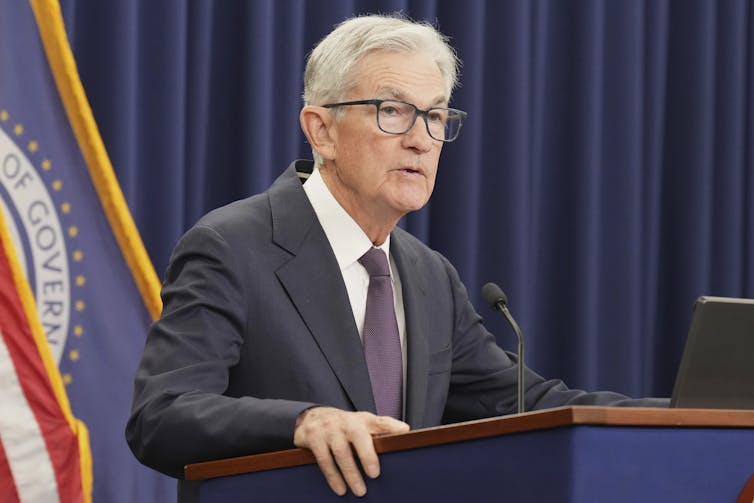
The Federal Reserve on Sept. 17, 2025, cut its target interest rate as it shifts focus from fighting inflation to supporting the choppy labor market.

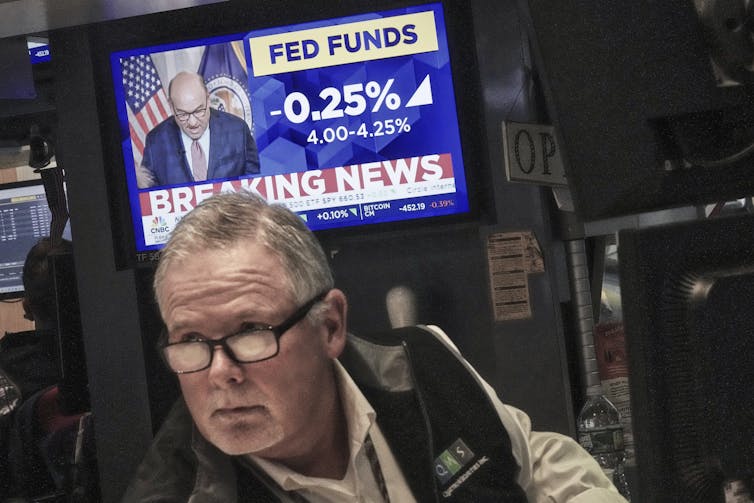
As financial markets expected, the Fed lowered rates a quarter point to a range of 4% to 4.25%, its first cut since December 2024.

The Fed’s decision to begin cutting rates comes as evidence mounts that the U.S. labor market is losing momentum. The headline unemployment rate has stayed steady at near record lows, but the underlying trends are more concerning.

At the same time, the fight against inflation is not over yet. While a cooling jobs market could lead to a recession, cutting rates too much could drive inflation higher.

So if you’re the Fed, what do you do?

I’m an economist who tracks labor market data and monetary policy, examining how changes in hiring, wages and unemployment influence the Federal Reserve’s efforts to steer the economy. There’s an incredibly large amount of data the Fed, investors, economists like me and many others use to understand the state of the economy – and much of it often tells conflicting stories.

Here are some the data points I’ve been following most closely to better understand where the U.S. economy might go from here – and the tough choices the Fed has to make.
a bespectacled white man in a suit stands before a podium with a micrphone
Fed Chairman Jerome Powell speaks during a news conference after the rate-cut decision. AP Photo/Jacquelyn Martin

Underlying trouble in the labor market

The labor market looks stable on the surface, but more granular data tells a different story.

The unemployment rate has remained close to historic lows at 4.3% as of August 2025, according to the U.S. Bureau of Labor Statistics.

But the number of long-term unemployed – people out of work for 27 weeks or longer – rose to 1.9 million in August, up 385,000 from a year earlier. These workers now make up 25.7% of all unemployed people, the highest share since February 2022. Persistent long-term joblessness often signals deeper cracks forming in the labor market.

At the same time, new claims for unemployment benefits are spiking. Initial claims for unemployment insurance – a leading indicator of labor market stress – jumped by 27,000 to 263,000 for the week ending Sept. 6, according to the U.S. Department of Labor. That’s the sharpest increase in months and well above economists’ forecasts. It suggests layoffs are becoming more common.

We also got news that past payroll growth was overstated. In a process the Bureau of Labor Statistics undertakes annually to double-check its data, the bureau recently revised its jobs data downward from April 2024 through March 2025 by 911,000. In other words, the economy created roughly 75,000 fewer jobs per month than previously reported. This implies the labor market was weaker than it appeared all along.

Finally, workers are losing confidence. The Federal Reserve Bank of New York reported in August that the confidence of people who lost their jobs in finding another fell to its lowest level – 44.9% – since it started surveying consumers in June 2013. That’s another sign workers are feeling less secure about their prospects.

Taken together, these data points paint a clear picture: The labor market is not collapsing, but it is softening. That helps explain why the Fed is beginning to cut rates now – hoping to stimulate spending – before the job market breaks more sharply.

packages of bacon and other meat are on display in a grocery store
Prices of meat and other groceries have been on the rise recently. Scott Olson/Getty Images

Tariffs are complicating the inflation data

Even as the labor market softens, tariffs are pushing certain prices higher than they otherwise would be, complicating the Federal Reserve’s effort to bring inflation down.

Government data shows that businesses have begun passing the costs of President Donald Trump’s new import tariffs to consumers. In August, clothing prices rose 0.5% and grocery prices rose 0.6%, with especially strong gains for tariff-sensitive items such as coffee.

Lower-income households are getting hit hardest because they spend more of their budget on imported goods, which tend to be the lower-cost items most affected by tariffs. A report from the Yale Budget Lab found that core goods prices are about 1.9% above pre-2025 trends as tariffs raise costs for basic items such as appliances and electronics.

Phillip Swagel, director of the Congressional Budget Office, said recently that Trump’s tariffs have pushed inflation higher than CBO analysts had expected, even as overall economic activity has weakened since January.

Typically, a slowdown in the labor market is met with slower inflation. But while the CBO now projects that the tariffs will reduce the federal budget deficit by about US$4 trillion over the next decade – roughly $3.3 trillion in new revenue and $700 billion in lower debt service costs – but it will come at the cost of near-term upward pressure on prices.

This creates a difficult balancing act for the Fed: Cut rates too quickly, and tariff-driven price pressures could reignite inflation; move too slowly, and the softening labor market could tip into recession.
a bespectacled white man in a vest look on as a tv screen shows news of fed rate cut behind him
Traders react to the Fed news. AP Photo/Richard Drew

A narrow path to a soft landing

As it resumes cutting rates, the Federal Reserve is trying to thread a narrow needle – easing policy enough to keep the labor market from cracking while not reigniting inflation, which is proving stickier in part because of tariffs.

Markets are betting the Fed will keep cutting. The futures market is betting the Fed will cut rates by another half point by the end of the year. And the one-year Treasury yield has dropped about 150 basis points (1.5%) since June, signaling that investors expect a series of rate cuts through 2025 and into 2026.

At its latest meeting, the Fed signaled two more rate cuts in 2025 and at least one rate cut in 2026.

Such cuts would ultimately bring the federal funds rate closer to 3% and hopefully reduce 30-year mortgage rates to around 5% – from an average of 6.35% as of Sept. 11. If the labor market continues to weaken – with jobless claims climbing, payrolls revised down and more workers stuck in long-term unemployment – that expectation will likely harden into consensus.

But the path is far from certain. Cutting rates too quickly could cause inflation to spike, while going too slow could lead to further deterioration in the labor market. Either outcome would jeopardize the Fed’s credibility – whether by appearing unable to control prices or by allowing unemployment to rise unnecessarily. That would undermine its ability to influence markets and enforce its dual mandate of maximum employment and stable prices.

Another tricky issue is Trump’s public campaign to push the Fed to cut rates – appearing to do his bidding could also undercut Fed credibility. For what it’s worth, the Sept. 17 rate cut appears driven less by politics than by economic data. The Fed itself was projecting a year ago that rates would be much lower today than they actually are, suggesting it’s been following the data.

The economy appears to be slowing but remains resilient, which is why the Fed is likely to move gradually. The risk is that the window for a soft landing is closing. The coming months will determine whether the Fed can ease early enough to avoid recession, or whether it has already waited too long.The Conversation

Ryan Herzog, Associate Professor of Economics, Gonzaga University

This article is republished from The Conversation under a Creative Commons license. Read the original article.

  1. Man sentenced to prison for teen’s fentanyl death
  2. Clearlake Police seeking missing juvenile
  3. Congressman Thompson to host Sept. 18 virtual town hall 
  • 156
  • 157
  • 158
  • 159
  • 160
  • 161
  • 162
  • 163
  • 164
  • 165
How to resolve AdBlock issue?
Refresh this page