 How to resolve AdBlock issue?
News
- Details
- Written by: LAKE COUNTY NEWS REPORTS
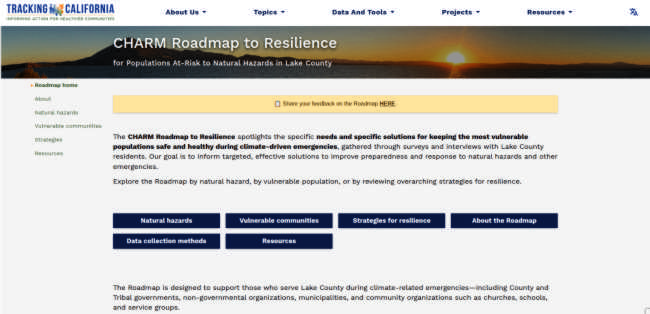
LAKEPORT, Calif. — After two years of community-driven research and collaboration, the Community Health Adaptation and Resilience Mobilization, or CHARM, project has released the Roadmap to Resilience for Populations At-Risk to Natural Hazards in Lake County.
This innovative online tool equips emergency planners and those serving the most impacted communities with insights and recommendations to better protect them against extreme heat, harmful cyanobacterial blooms, wildfires and other natural hazards.
The roadmap, now live on the Tracking California website, summarizes findings from over 230 community surveys and 65 interviews with county residents and includes practical strategies to reduce health risk from natural hazards like extreme heat and cyanobacterial blooms on Clear Lake.
Co-developed with Big Valley Band of Pomo Indians and four other Lake County tribes, community-based organizations and public agencies, the roadmap centers on the experience of elders, tribal members, outdoor workers, unhoused people, mobile home residents, people with mobility or transportation issues, and others often overlooked in traditional emergency response planning.
“By listening to community members directly, we’ve created a tool that not only documents the challenges Lake County faces, but also lifts up local knowledge and trusted solutions,” said Susan Paulukonis, principal Investigator of the CHARM project and epidemiologist with the Public Health Institute’s Tracking California program.
The CHARM project is a collaboration between Big Valley Band of Pomo Indians Environmental Protection Department and Tracking California, supported by the National Institutes of Health’s Community Engagement Alliance Initiative.
Building on the momentum of this roadmap, the CHARM team has been awarded a Phase II grant to implement a multi-year community-based intervention.
This next phase will pilot strategies to protect those most at risk during extreme heat, implemented directly through local sites such as peer support centers, senior centers and tribal social services offices across the county.
“We’re proud to build on this foundational work by turning plans into action,” said Sarah Ryan, environmental director for Big Valley and co-investigator of the project. “This project helps the most vulnerable members of our communities by reducing impacts of extreme heat and identifying lake water safety mechanisms. We now have a framework to guide targeted, community-led solutions.”
To ensure local input continues to guide next steps, the roadmap is being shared with the broader Lake County community throughout summer 2025, including presentations to the Board of Supervisors, the Risk Reduction Authority and at public events such as the Tule Boat Festival in July.
The roadmap remains open for feedback, and a brief evaluation form is available on the roadmap website for community members to share their input.
For more information, visit www.trackingcalifornia.org/projects/charm or contact Susan Paulukonis at
- Details
- Written by: Elizabeth Larson
CLEARLAKE, Calif. — Clearlake Animal Control has dozens of great dogs needing new homes.
The shelter has 47 adoptable dogs listed on its website.
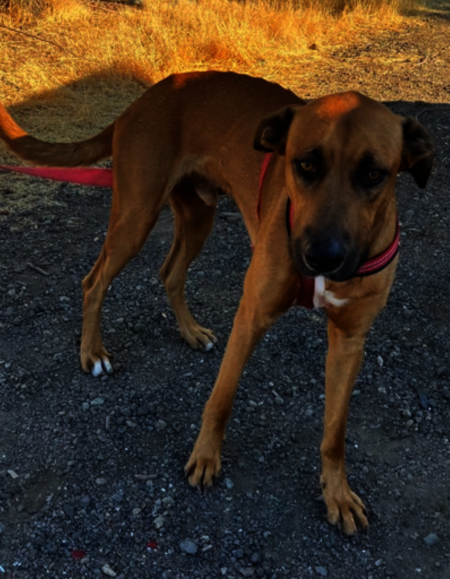
This week’s dogs include “Biggie,” a large mixed breed dog with a tan and white coat.
Shelter staff said has a personality as big as his body. “This lovable guy is full of affection — he adores cuddles, loves his toys, and is always ready to play. With his goofy charm and gentle heart, he'll keep you smiling every day.”
They said he may do well with other dogs with proper introductions, but they are not sure about cats yet.
“What we do know is that he's eager to find a family to love and be loved by. Come by and see if he's the right fit for your family,” shelter staff said.
The shelter is located at 6820 Old Highway 53. It’s open from 9 a.m. to 6 p.m. Tuesday through Saturday.
For more information, call the shelter at 707-762-6227, email
This week’s adoptable dogs are featured below.
Email Elizabeth Larson at
- Details
- Written by: LAKE COUNTY NEWS REPORTS
LAKE COUNTY, Calif. — The East Region Town Hall, or ERTH, will meet on Wednesday, Oct. 1.
The meeting will begin at 4 p.m. at the Moose Lodge, located at 15900 Moose Lodge Lane in Clearlake Oaks.
The meeting will be available via Zoom. The meeting ID is 813 6295 6146, pass code is 917658.
Please note, at times Zoom has issues with sound or video. The meeting will also be live streamed on the Lake County Peg TV YouTube channel.
Guest speakers will include Shannon Walker-Smith of Lake County Community Development Department, who will give a presentation on the public draft of the climate adaptation plan and take community input.
The group also will hear from Robin Borre, administrator Lake County Special Districts, regarding a discussion on the status of the Special Lighting District in Clearlake Oaks and Spring Valley CSA No. 2 projects and issues.
Also on the agenda are updates and consideration of ERTH activities/projects, ERTH Council opening, District 3 MAC Update, discussion and consideration of a letter to submit to the Board of Supervisors regarding the Sonoma Clean Power proposal and another on the environmental process for a cell phone tower.
Standing agenda items include the commercial cannabis report and cannabis ordinance update, updates on code enforcement updates, Spring Valley, the Superfund cleanup and Klaus Park, a report from District 3 Supervisor EJ Crandell, and new business and announcements.
ERTH’s next meeting will take place on Nov. 5.
Members are Angela Amaral, Holly Harris, Maria Kann and Denise Loustalot.
For more information visit the group’s Facebook page.
- Details
- Written by: LAKE COUNTY NEWS REPORTS
This week, Gov. Gavin Newsom announced that there are now 201,180 fully public and shared electric vehicle, or EV, charging ports available for use throughout the state.
This is 68% more EV charger ports than the number of gasoline nozzles statewide, according to the California Energy Commission, or CEC.
Earlier this week, the governor announced clean truck sales continued to rise in California in 2024, with zero-emission models representing nearly 1 in 4 of all new truck sales.
“In the state of California, 94% of people now live within just 10 minutes of an EV charger. We’re proving that electric vehicles are here to stay — even as Trump sells out American innovation and jobs to China,” said Newsom.
California’s growing number of publicly available EV chargers can be found at highly accessible locations like grocery stores, parking lots, and even gas stations. Shared chargers can be found at apartment complexes, workplaces, sports facilities, and other parking areas. This statewide network of public and shared chargers is in addition to the estimated 800,000 EV chargers installed in single family homes.
“With this expanding public network, EV chargers are becoming ubiquitous in California,” said CEC Commissioner Nancy Skinner. “Our goal is to make driving an EV a no-brainer choice for Californians. They are fun to drive, never need an oil change, don’t cause smog, and it’s getting easier to charge your vehicle with public EV infrastructure.”
Federal ZEV incentives end Sept. 30
Thanks to the Trump administration and Republicans in Congress, federal incentives are ending on September 30.
Tax credits up to $7,500 are available until then for purchase or lease of eligible new ZEVs, which include EVs and hydrogen-fueled vehicles, and up to $4,000 for eligible used ones.
Federal incentives for at-home charging and associated battery storage are also available, up to $1,000.
California is charging ahead
State agencies recently published a report in response to Governor Gavin Newsom’s executive order reaffirming the state’s commitment to ZEV adoption.
While the federal government wants to keep us hooked on gas, California is charging ahead in the fight for clean air for all.
California is tearing down barriers to ZEV adoption and providing financial and other assistance to speed up EV charger deployment including in low-income areas and rural communities.
California state agencies continue efforts to speed up EV charger installation and plan for increasing grid demand. This includes:
• Providing grant funds that support publicly accessible, workplace and at-home charging installations, including in multi-family complexes, throughout the state.
• Prioritizing shovel-ready fast-charging installations for the funding incentives available through the CEC’s grant solicitation programs.
• Developing the ZEV Infrastructure Plan, a comprehensive plan that lays out the overall infrastructure strategy to meet California’s zero-emission transportation goals.
• Establishing charger reliability standards.
In June, the state successfully blocked the Trump Administration from unlawfully withholding billions of dollars in funding approved by bipartisan majorities in Congress for electric vehicle charging infrastructure.
California also announced that there are 20,093 charging and hydrogen fueling points for medium- and heavy-duty zero-emission vehicle vehicles across the state. This is an increase of 3,766 (23%) since the last update in February.
While trucks total just six percent of vehicles on California’s roads, they account for over 35 percent of the state’s transportation emissions and a quarter of the state’s on-road greenhouse gases.
California’s climate leadership
Pollution is down and the economy is up. Greenhouse gas emissions in California are down 20% since 2000 — even as the state’s GDP increased 78% in that same time period all while becoming the world's fourth largest economy.
The state also continues to set clean energy records. California was powered by two-thirds clean energy in 2023, the latest year for which data is available — the largest economy in the world to achieve this level of clean energy. The state has run on 100% clean electricity for some part of the day almost every day this year.
Since the beginning of the Newsom Administration, battery storage is up to over 15,000 megawatts — a 1,900%+ increase, and over 25,000 megawatts of new resources have been added to the electric grid.