 How to resolve AdBlock issue?
News
Swelling grocery bills are pummeling the poorest – who spend over a quarter of their incomes on food
- Details
- Written by: David Soll, University of Wisconsin, Eau Claire
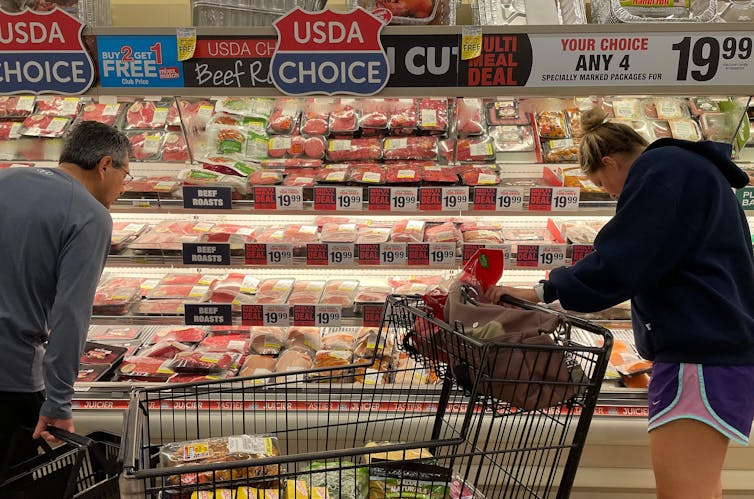
The cost of eggs and bread is soaring – a trend that’s particularly punishing for the poorest Americans.
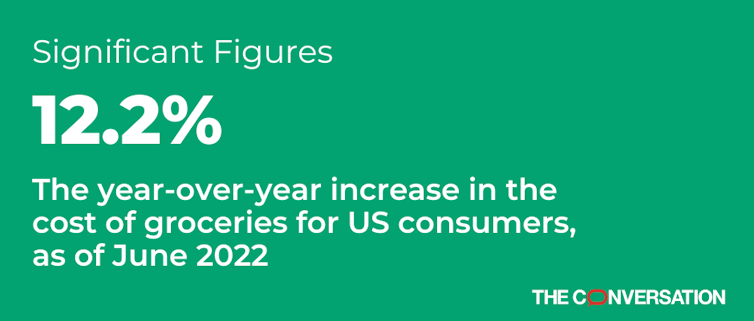
Average food prices climbed an annualized rate of 10.4% in June, the Bureau of Labor Statistics reported on July 13, 2022. The gains were driven primarily by the cost of groceries, which jumped the most since the 1970s, by 12.2%. Overall inflation was up 9.1% from a year earlier.
These sharp increases have startled consumers, in large part because food costs had been rising moderately for decades.
While all Americans have seen their grocery bills swell, many may not fully appreciate the enormous burden that rising food costs pose for low-income households. The reason is simple: Poor families spend a much larger share of their income on food than the median household.
In 2020, the average middle-income American family spent roughly 12% of its earnings on food. In sharp contrast, poor households spent 27% on food that year.
What explains this enormous discrepancy? The answer begins with a dramatic change in spending patterns among American households during the 20th century, which I learned while researching shifts in commuting practices.
In the 1900s, the bare necessities of life, including food, were enormously expensive compared with today, leaving little room for spending on other goods or services for most Americans, according to a 2006 study by the Department of Labor. On average, American families spent over 40% of their income on food in 1901, 23% on housing and 14% on clothing.
But the relative cost of food and clothing decreased steadily over the next 100 years. By 2002, the two categories represented only 17.3% of a middle-class family’s expenditures and by 2020, the figure had fallen to 14.2%.
The sharp drop in the cost of food and clothing led to a massive reshuffling of family budgets over roughly the past century. As people reduced their spending on these items, they spent more on housing, transportation and insurance. As the country became wealthier, discretionary spending increased, too. Most Americans had more room in their budgets for eating out, televisions and entertainment.
This revolution in household spending largely excluded poor Americans, who continue to devote most of their income to feeding their families and other necessities like shelter. As a result, they are particularly vulnerable to spikes in food costs.
Low-income households devote more than twice as large a share of their budgets to food as middle-income households. As a result, food inflation is around twice as burdensome for families of limited means. But this actually understates the burden of high food costs on the poor because, unlike middle-class families, they have little discretionary spending they can pare back to free up funds for food.
American households are responding to soaring food inflation by eating out less frequently, buying generic brands and consuming less meat. For many, it may be the first time they’ve ever had to be so careful about what they spent on food.
Poor families, however, have long been forced to deploy these tactics to keep food expenditures in check.
An estimated 38 million Americans are food insecure, meaning that they have insufficient means to obtain sufficient food. The concern is, with food inflation rising at the rate it is, more families will face the prospect of being unsure where their next meal is coming from.
David Soll, Associate Professor of History and Environmental Studies, University of Wisconsin, Eau Claire
This article is republished from The Conversation under a Creative Commons license. Read the original article.
- Details
- Written by: Elizabeth Larson
The council will meet at 6 p.m. Tuesday, July 19, in the council chambers at Lakeport City Hall, 225 Park St.
The agenda can be found here.
The council chambers will be open to the public for the meeting. Masks are highly encouraged where 6-foot distancing cannot be maintained.
If you cannot attend in person, and would like to speak on an agenda item, you can access the Zoom meeting remotely at this link or join by phone by calling toll-free 669-900-9128 or 346-248-7799.
The webinar ID is 973 6820 1787, access code is 477973; the audio pin will be shown after joining the webinar. Those phoning in without using the web link will be in “listen mode” only and will not be able to participate or comment.
Comments can be submitted by email to
On Tuesday, Public Works Superintendent Ron Ladd will present to the council a construction services agreement with Builder Solutions Inc.
The new park consists of approximately 6.9 acres at 800 and 801 N. Main St.
Ladd’s report said the city received two bids for the project, which were opened on July 12.
Builder Solutions Inc. was the lowest of two bids submitted at $4,399,381. The engineer’s estimate for the project was $4,237,401, Ladd said.
He said construction is estimated to start in early September and be complete mid-January 2023.
In February 2020 the city received a $5.9 million grant to purchase the land and build the park from the California Department of Parks and Recreation in January 2020 through Proposition 68, the California Drought, Water, Parks, Climate, Coastal Protection and Outdoor Access For All Act of 2018, as Lake County News has reported.
“After two years of design, the project is ready for construction,” Ladd wrote.
Ladd said the project includes construction of a basketball court, splash pad, skate park, concession building with restrooms, shade structures, picnic areas, fitness equipment, a pavilion, lighting, irrigation and landscaping.
The bids were opened July 12, 2022. Two bids were received for the project.
Also on Tuesday, the council will consider adopting a resolution setting the storm drainage special tax at twenty cents per square foot of area covered by the new structure and related impermeable surface.
On the consent agenda — items usually accepted as a slate on one vote — are ordinances; minutes of the regular council meeting on June 21; adoption of a resolution authorizing continued remote teleconference meetings of the Lakeport City Council and its legislative bodies pursuant to Government Code section 54953(e); warrants; approve event application 2022-020, with staff recommendations, for the 2022 Konocti Challenge.
After the open portion of the meeting, the council will meet in closed session to discuss labor negotiations with the Lakeport Police Officers Association.
Email Elizabeth Larson at
- Details
- Written by: Elizabeth Larson
The board will meet beginning at 9 a.m. Tuesday, July 19, in the board chambers on the first floor of the Lake County Courthouse, 255 N. Forbes St., Lakeport.
The meeting can be watched live on Channel 8, online at https://countyoflake.legistar.com/Calendar.aspx and on the county’s Facebook page. Accompanying board documents, the agenda and archived board meeting videos also are available at that link.
To participate in real-time, join the Zoom meeting by clicking this link.
The meeting ID is 948 7125 3037, pass code 045716. The meeting also can be accessed via one tap mobile at +16699006833,,94871253037#,,,,*045716#.
All interested members of the public that do not have internet access or a Mediacom cable subscription are encouraged to call 669-900-6833, and enter the Zoom meeting ID and pass code information above.
To submit a written comment on any agenda item visit https://countyoflake.legistar.com/Calendar.aspx and click on the eComment feature linked to
the meeting date. If a comment is submitted after the meeting begins, it may not be read during the meeting but will become a part of the record.
On Tuesday, the board will consider an update on the Human Resources Department’s recruitment process for the Community Development director position. The item is untimed.
Last week, Community Development Director Mary Darby tendered her resignation to the board after less than a year, following another closed session performance evaluation, as Lake County News has reported. Her resignation is effective Nov. 4.
A report to the board from County Administrative Officer Susan Parker said Human Resources staff will review with the board the steps that will be taken for the recruitment.
On Thursday, Human Resources staff opened “a continuous and promotional recruitment” which will have a first review of applications on Aug. 9, Parker reported. Human Resources is also planning advertisements with professional organizations, recruitment sites and social media.
If, after the first review of applications, no qualified applicants are produced, Parker said Human Resources will request a bid from the several executive search firms.
She said that Human Resources recently completed a request for qualifications for recruitment firm services for the Public Health officer, her own job and for county counsel attorney positions.
Out of the 10 recruitment firms contacted for the request for qualifications, Human Resources only received two qualified responses for the county administrative officer’s recruitment and one for the Public Health officer recruitment.
It should be noted that the board hired Parker before ever engaging a recruitment firm.
In an untimed item, the board will consider a resolution clarifying the eligibility requirements for early activation permits in Lake County.
In an item on the consent agenda, the board will consider approving the purchase of a customized Mercedes Sprinter 3500 vehicle to serve as Lake County’s new Bookmobile, and authorize County Librarian Christopher Veach to issue and sign a purchase order not to exceed $250,000 to Farber Specialty Vehicles, Ohio. That new vehicle is grant-funded.
The full agenda follows.
CONSENT AGENDA
5.1: Approve agreement between county of Lake and Hilltop Recovery Services for substance use disorder treatment ASAM Levels 1.0, 2.1, 3.1, intensive outpatient and outpatient drug free treatment services in the amount of $336,150 for fiscal year 2022-23 and authorize the board chair to sign.
5.2: Approve Amendment No. 1 to the agreement between the county of Lake — Lake County Behavioral Health Services as lead agency for the Lake County Continuum of Care and World Wide Healing Hands for fiscal years 2021-22 and 2022-23 and authorize the board chair to sign.
5.3: Approve Board of Supervisors minutes June 28, 2022.
5.4: Approve purchase of a customized Mercedes Sprinter 3500 vehicle to serve as a Bookmobile; and authorize the county librarian/assistant purchasing agent to issue and sign a purchase order not to exceed $250,000 to Farber Specialty Vehicles, Ohio.
5.5: Approve agreement between the county of Lake and the Yuba-Yuba, Sutter-Colusa Tri-County Regional Juvenile Rehabilitation Facility for youth housing for the term of July 19, 2022, through June 30, 2025, for an amount not to exceed $25,000 in any single fiscal year and authorize the chair to sign.
5.6: Adopt proclamation designating the week of July 17 to 23 as Probation Officers Week in Lake County.
5.7: Acceptance of a donation from the Habematolel Pomo of Upper Lake in the amount of $25,000.
5.8: Acceptance of an IRobot 510 PackBot from the Hayward Police Department through the 1033 program.
TIMED ITEMS
6.2, 9:06 a.m.: Presentation of proclamation designating the week of July 17 to 23 as Probation Officers Week in Lake County.
6.3, 9:10 a.m.: Consideration of ARPA/SLFRF allocation recommendations, pursuant to the recovery and revitalization plan for Lake County Not available Not available
6.4, 9:35 a.m.: Consideration of ordinance to adopt Lake County Sheriff’s Office “Military Equipment” Policy #708.
6.5, 10 a.m.: a) Consideration of an update from the county of Lake’s Energy Services Co. (ESCo), Trane US Inc., regarding recent progress on the N. Lakeport FLASHES Energy, disaster and climate change resiliency projects; and b) consideration of next steps and potential direction to staff to develop a letter of commitment to further the North Lakeport projects.
UNTIMED ITEMS
7.2: Continued from July 12, consideration of a resolution adopting a display of flags policy.
7.3: Consideration of resolution clarifying eligibility requirements for early activation permits in Lake County.
7.4: Consideration of second amendment to the abandoned vehicle towing and disposal services agreement with Kelseyville Auto Salvage Towing to Increase the FY 21/22 limit by $5,500 and FY 22/23 by $10,000 and approve the chair to sign.
7.5: Consideration of update on HR’s recruitment process for the Community Development director position.
CONSENT AGENDA
8.1: Conference with legal counsel: Significant exposure to litigation pursuant to Government Code sec. 54956.9(d)2),(e)(1) — One potential case.
8.2: Conference with legal counsel: Existing litigation pursuant to Gov. Code sec. 549.56.9(d)(1) — Citizens for Environmental Protection and Responsible Planning, et al. v. County of Lake, et al.
8.3: Conference with legal counsel: Existing litigation pursuant to Gov. Code sec. 54956.9(d)(1) — Center for Biological Diversity, et al. v. County of Lake.
Email Elizabeth Larson at
- Details
- Written by: Emily Smith-Greenaway, USC Dornsife College of Letters, Arts and Sciences; Ashton Verdery, Penn State; Haowei Wang, Penn State, and Shawn Bauldry, Purdue University

COVID-19 was the third-most-common cause of death between March 2020 and October 2021 in the U.S., behind only heart disease and cancer, according to a recent study.
Older adults face the greatest risk of dying from COVID-19, but infection with the coronavirus remains a serious risk for younger people, too. In 2021, COVID-19 was the leading cause of death in adults aged 45 to 54, the second leading cause for adults aged 35 to 44 and the fourth leading cause for those aged 15 to 34.
As sociologists who study population health, we have been assessing how losing a loved one to COVID-19 has affected people’s well-being. Our research shows that more than 9 million people have lost a close relative to COVID-19 in the U.S. This dramatic rise in bereavement is troubling because our research finds that COVID-19 bereavement not only increases people’s risk of depression, but can make them uniquely vulnerable to mental distress.
The distinctness of grieving COVID-19 deaths
Researchers have a sense of what constitutes “good” and “bad” deaths. Bad deaths are those that involve pain or discomfort and happen in isolation. Their unexpectedness also makes these deaths more distressing. People whose loved ones die “bad deaths” tend to report greater mental distress than those whose loved ones died in more favorable circumstances.
COVID-19 deaths often bear many hallmarks of “bad” deaths. They are preceded by physical pain and distress, often occur in isolated hospital settings and happen suddenly – leaving family members unprepared. The ongoing nature of the pandemic has inflicted an added layer of agony, as individuals are grieving during a time of protracted social isolation, economic precarity and general uncertainty.
In another recent study, our team used national survey data from 27 countries to test whether the mental health impacts of COVID-19 deaths are more severe than death from other causes. We focused on the case of spousal death and compared two groups of people: those whose spouses died of COVID-19 in the pandemic’s first wave and those whose spouses died of other causes just before the pandemic began. We found that COVID-19 widows and widowers face higher rates of depression and loneliness than expected based on widow and widower mental health outcomes pre-pandemic.
The secondary population health consequences of COVID-19 deaths
The outsized effects of COVID-19 deaths on grieving spouses’ mental health is troubling because we estimate that nearly 500,000 people have already lost a spouse to COVID-19 in the U.S. alone. The mental health problems that people face after losing a loved one can also lead to declines in physical health and even increase a person’s risk of death.
Our research suggests that COVID-19 not only increased rates of family bereavement, but that people who lost loved ones to the coronavirus were particularly distressed afterward. But we studied only widowhood; future research needs to identify the potentially unique health, social and economic consequences of COVID-19 losses for other bereaved relatives.
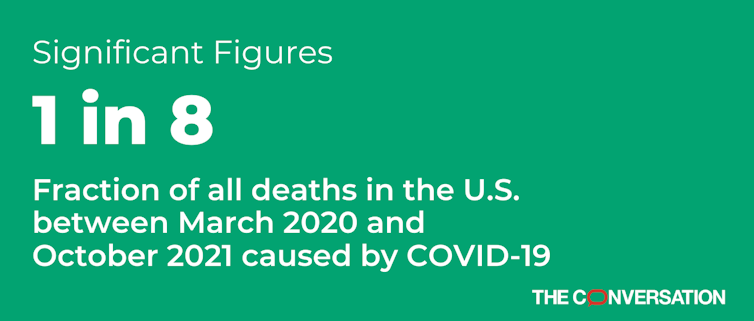
With COVID-19 representing 1 in every 8 deaths between March 2020 and October 2021, there are millions of people who could benefit greatly from financial, social and mental health support. It is also critical to continue taking steps to prevent future COVID-19 deaths. Each death averted not only saves a life but also saves numerous loved ones from the harm that follows these tragedies.
Emily Smith-Greenaway, Associate Professor of Sociology, USC Dornsife College of Letters, Arts and Sciences; Ashton Verdery, Professor of Sociology, Demography and Social Data Analytics, Penn State; Haowei Wang, Postdoctoral Research Associate in Sociology, Penn State, and Shawn Bauldry, Associate Professor of Sociology, Purdue University
This article is republished from The Conversation under a Creative Commons license. Read the original article.