How to resolve AdBlock issue?
News
- Details
- Written by: LAKE COUNTY NEWS REPORTS
The bills voted on were the Women’s Health Protection Act (H.R. 8296) and the Ensuring Women’s Right to Reproductive Freedom Act (H.R. 8297).
The bills passed mostly along party lines and are expected not to be able to overcome the 60-vote threshold needed to overcome the Senate’s filibuster.
Rep. Mike Thompson (CA-05), who represents a portion of Lake County in Congress, said he voted to pass both bills.
“When the Supreme Court released their decision in Dobbs v. Jackson Women’s Health Organization, they laid the groundwork for states to criminalize abortion and strip health care away from millions of women,” said Thompson. “The Supreme Court’s dangerous decision turns back the clock and strips rights away from Americans. My granddaughters will now have fewer rights than their grandmother. Access to reproductive care protects the health, well-being, and autonomy of women — that is why action to reverse the Supreme Court’s misguided ruling is imperative.
“Today, I was proud to vote for two bills that will protect the right to reproductive health care and ensure Americans are not penalized for crossing state lines to access health care. I urge my colleagues in the Senate to act on this legislation and deliver protections for women across the country,” he said Friday.
Thompson said access to comprehensive health care must include access to abortion — and the ability to access care should not depend on where you live.
He said the Women’s Health Protection Act restores the right to abortion nationwide ensuring all Americans – regardless of where they live – can make their own decisions about their lives and their futures.
Since the Supreme Court overturned the constitutional right to abortion and reversed nearly 50 years of precedent established in Roe v. Wade, abortion has been banned in at least 10states, with more bans expected soon. These bans force people to travel to other states where abortion care remains legal.
Thompson said the Ensuring Women’s Right to Reproductive Freedom Act “protects Americans from extremist policies and groups by ensuring no person acting under state law can prevent, restrict, impede, or otherwise retaliate against a person traveling across state lines to obtain a lawful abortion.”
- Details
- Written by: GOVERNOR’S OFFICE
Enough trash to fill trash bags lining the entire California coastline twice over. That’s how much trash has been removed in the first year of Gov. Gavin Newsom’s Clean California initiative.
In just the first 12 months since the $1.1 billion multiyear cleanup effort began last July, Clean California has removed 12,700 tons of trash — which would fill enough trash bags to line the California coastline two times — from California’s roadways, funded 231 projects to revitalize underserved communities, and created nearly 1,500 jobs, with thousands more expected in the coming years.
“It’s simple: all Californians deserve clean streets. That’s why we’re cleaning up California like never before in our state’s history,” said Gov. Newsom. “I’m proud of the work we’ve done in just one year to make the Golden State a cleaner, safer place to call home – and we’re just getting started.”
California roadsides have less trash, underserved communities statewide are receiving beautification and safety upgrades, and hundreds more Californians have stable jobs in just the first year of Clean California.
“Clean California is helping communities throughout the state break the destructive cycle of litter and create public spaces we can all take pride in,” said Caltrans Director Tony Tavares. “Thanks to Governor Newsom’s vision, California is cleaner, communities are addressing blight, and hundreds more of our fellow Californians have dependable work. I cannot wait to see what we can accomplish together in Year 2.”
First-year highlights of Clean California include:
Litter cleanup: Caltrans collected more than 756,000 cubic yards (12,700 tons) of litter from the state highway system – which would fill enough trash bags to line the entire California coastline two times. This is a 183 percent increase in litter removal compared to 2020, when Caltrans collected 267,000 cubic yards of trash.
Job creation: Caltrans hired more than 700 new team members as part of Clean California, including 470 maintenance positions to collect litter and remove graffiti. Forty-five of these maintenance workers have already earned promotions within the department. Caltrans also expanded its partnership with the Butte County Office of Education Back 2 Work program, adding 82 crews in counties throughout California. The $127 million contract has already created 760 jobs and will fund more than 4,000 positions that provide income and job training to Californians who have experienced barriers to employment, such as homelessness, addiction and incarceration. Clean California grant-funded projects (see below) are estimated to create another 7,200 jobs.
State beautification projects: 126 beautification projects with a total budget of $312 million are underway to transform and connect communities along the state highway system. Nearly all the projects – 98 percent – will benefit underserved communities. Humboldt County residents and visitors are already enjoying the first completed project, a new parklet along the Humboldt Bay National Wildlife Refuge near State Route 255.
Local grant projects: Nearly $300 million in Clean California grants is funding 105 local projects statewide to remove litter and transform public spaces with community markers and public art in underserved communities.
Adopt-A-Highway Program: Clean California created a $250 monthly volunteer incentive stipend through the Adopt-A-Highway Program, increasing highway adoptions by more than 800 in a matter of months.
Dump day events: Nearly 150 free events throughout the state allowed the public to safely dispose of more than 50,000 cubic yards of litter, including more than 15,400 tires and 4,100 mattresses.
In the coming year, Caltrans looks to continue the momentum by removing 1.2 million cubic yards of trash from the state highway system – 60% more than the first year. For more information, visit www.CleanCA.com.
- Details
- Written by: Silas Laycock, UMass Lowell

The James Webb Space Telescope team has released the first science-quality images from the new telescope. In them are the oldest galaxies ever seen by human eyes, evidence of water on a planet 1,000 light-years away and incredible details showing the birth and death of stars. Webb’s purpose is to explore origins – of the universe, of galaxies, of stars and of life – and the five images released on July 12, 2022, make good on that promise.
Once the suite of instruments onboard all cooled down and were running smoothly, astronomers wasted no time in putting Webb to work. Each of the first images contains enough data to produce major scientific results on their own.
Webb was designed to collect light across the entire red to mid-infrared spectrum – wavelengths of light that are blocked by Earth’s atmosphere. And with its giant mirror and sun-shade blocking infrared emitted by the Sun, Earth and Moon, Webb can produce images of a sharpness never before achieved by any other telescope.
The buzz among professional astronomers like me has been electric since members of the Webb team shared tantalizing test images. And the real images are even better than anyone could have hoped for. During the presentation where the first images were released, Webb project scientist Jane Rigby remarked “for Webb there is no blank sky, everywhere it looks it sees distant galaxies.” Most of those galaxies were invisible until now.

Ancient galaxies and the early universe
The first Webb image the world saw is of a galaxy cluster known to astronomers as SMACS 0723. It lies in the southern hemisphere sky and is 5.12 billion light-years from Earth.
The detail of the thousands of individual galaxies in the image is stunning. It is like the universe in high definition, and I encourage you to look at the full resolution image and zoom in to truly appreciate the details.

The large white galaxies in the middle of the image belong to the cluster and are similar in age to the Sun and Earth. Surrounding and interspersed among the cluster galaxies are more distant galaxies, but stretched into spectacular arcs as if seen through a magnifying glass. And that is exactly what is happening. The background galaxies are much farther from Earth but appear magnified, as their light is bent toward Earth by the gravity of the much closer cluster.
In the background you can see faint red galaxies scattered like rubies across the sky. Those galaxies are even farther away. By measuring precise attributes of their light, astronomers can tell that they formed over 13 billion years ago and even determine the abundance of different elements in these early galaxies.
Webb is not only producing incredibly sharp images, but it is doing so easily when compared to its predecessor, the Hubble Space Telescope, which was launched in 1990. As Rigby quipped, “… the Hubble Extremely Deep Field took two weeks of exposure, Webb went deeper before breakfast.” Once Webb carries out longer observations that allow it to collect more light from faint stars or galaxies, astronomers will be able to see some of the first stars and galaxies that formed right after the Big Bang.

Understanding planets around other stars
The second reveal was not of an image but a spectrum – a breakdown of the strength of light at different wavelengths.
Webb pointed its mirror at the exoplanet WASP 96-B – a giant hot gas planet orbiting a star about 1,000 light-years from Earth – as the planet passed in front of its parent star. During this transit, a portion of the star’s light was filtered through the planet’s atmosphere and left a “chemical fingerprint” in the light’s unique spectrum. The specifics of this fingerprint strongly suggest that there is water vapor, clouds and haze in the atmosphere of WASP 96-B.
As Webb moves on to observe smaller planets that could potentially harbor life, astronomers expect to detect the fingerprints of oxygen, nitrogen, ammonia and carbon in the form of methane and other hydrocarbons. The goal is to find biosignatures of life – that is, chemistry that would point toward the atmosphere being modified by living organisms.
The technical challenge of doing this type of observation, called transit spectroscopy, is enormous, and this initial result barely scratches the surface of the scientific content of the spectrum.

Galactic dances and the lives of stars
The last three images showed the incredible resolution of Webb’s optics as the telescope explored the birth and death of stars.
Webb’s ability to capture light in the mid-infrared range allows its cameras to cut through dense clouds of dust and gas. This ability helped Webb to capture spectacular details of the Carina Nebula where stars are born.

Webb is also excellently suited to study the end of a star’s life. As stars get old, they can puff off their outer layers and form nebulas like the stunning Southern Ring Nebula, which was imaged by Webb. The image revealed never-before-seen details of successive waves of matter expelled by the dying central star. While Hubble was unable to see through the expanding cloud of dust and debris, Webb provided the first look at the binary star system that formed the nebula.
The last photo from Webb’s coming out party showed Stephan’s Quintet, a group of five galaxies 300 million light-years from Earth, interacting in a cosmic dance. Thanks to the suite of complementary instruments aboard Webb, the telescope can simultaneously pick up details of individual stars in these galaxies, see the cold dust and gas fueling star formation within these galaxies and – most remarkably – block out the stars, gas and dust to see the material swirling around the supermassive black hole at the center of one of the galaxies.
Webb also captured data on the spectra of hundreds of individual star-forming regions in the Quintet, which will take months to analyze and study.
Webb is the result of 25 years of work by thousands of scientists, engineers and administrators belonging to an international collaboration of space agencies, companies, research centers and universities worldwide. John Mather, a project leader for Webb, emotionally described the journey: “This was hard to do. It is difficult to express just how hard this was. There were so many thousands of ways it could have gone wrong.”
But it didn’t go wrong. It all came together, and now humanity’s greatest space telescope is open for business.
This story was updated to correct the description of the photo of the Southern Ring Nebula.
Silas Laycock, Professor of Astronomy, UMass Lowell
This article is republished from The Conversation under a Creative Commons license. Read the original article.
- Details
- Written by: LAKEPORT POLICE DEPARTMENT
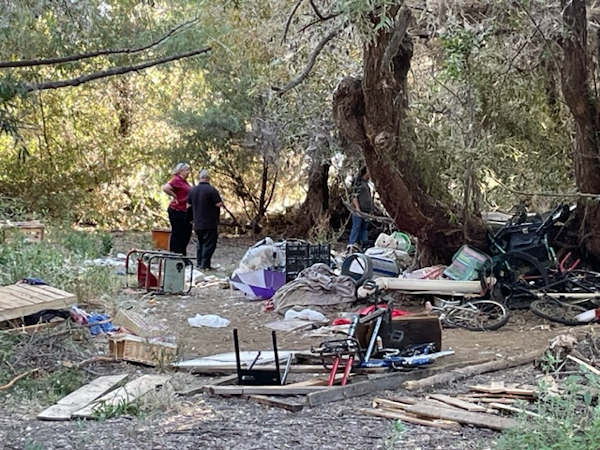
LAKEPORT, Calif. — Lakeport Police officers and Lakeport Public Works staff on Wednesday removed a significant homeless encampment from public property.
The camp was located along the shoreline of Clear Lake, off the east side of the private properties of 1 First St. and 2 C St., said Police Chief Brad Rasmussen.
The persons using the encampment were trespassing across the private properties to gain access.
For approximately the past two years this location has been a regular site of camps and a source of concern for surrounding residential and commercial property owners for numerous reasons including safety, sanitary conditions and fire danger, Rasmussen said.
He said that in recent months several wildland fires have started in the area and caused threats for surrounding neighborhoods.
Officers surveyed the property and contacted the occupants numerous times over the past few months in efforts to mitigate the situation.
Police officers and their embedded crisis responder from Lake Family Resource Center worked with occupants to offer resources from the many agencies working on homelessness in Lake County.
On July 6, by Rasmussen’s direction, the property was ordered vacated, with written notices posted as well as personally served on occupants giving them sufficient time to remove their belongings.
On both July 6 and July 13, officers took crisis and outreach staff from Lake County Behavioral Health with them to offer additional resources for any persons remaining in the encampment. The written notices and removal times are required by federal court case law decisions.
Upon arrival at 7 a.m. Wednesday, three occupants were located in the camp. Rasmussen said the occupants were again offered and one did accept resources and transportation to a local homeless shelter. The person’s valuables which could not be transported to the shelter were secured and safeguarded.
The other two individuals declined resources and were ordered to vacate immediately or face arrest. They left the area without further incident, Rasmussen said.
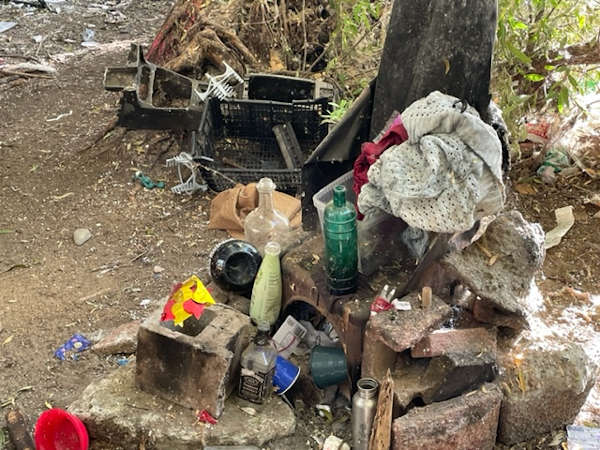
A crew of 10 public works and police staff with necessary equipment proceeded to clean the camp and rehabilitate the area over the next nine hours. Rasmussen said this work included hauling off 75 yards of garbage totaling 22,360 pounds.
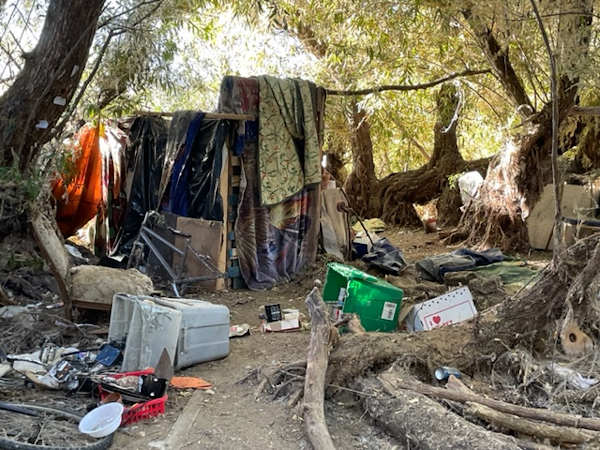
Rasmussen said that had this trash not been removed, when the Clear Lake water levels returned to full or higher, it would have entered the lake.
On Thursday, another 10-person crew rehabilitated the area to ensure it is safe and clean and to reduce fire danger.
In the future, Rasmussen said officers will conduct extra patrol of the area to ensure the encampment does not reestablish.
The cleanup process alone, not including all of the previous outreach, is estimated to have cost the public $15,000, he said.
Rasmussen said the removal of homeless camps from public property is complex. “When we take this action we want to be sure that the problem will not just move down the street to the next neighborhood or business district. For this reason we are very persistent with offering resources and assistance with connecting people to programs including those for housing, medical care, behavioral health and drug and alcohol addiction.”
He added, “The most significant reasons we see people being in a homeless situation are behavioral health and substance abuse problems. Many of the people causing issues for neighborhoods and businesses are people who refuse our assistance because they do not want to recognize or change their conditions.”
Additionally, Rasmussen said many of the tools his agency had used previously to deal with misdemeanor criminal behavior have been removed by voter or legislative initiatives.
“Much of this type of criminal behavior affects the lives of the residents and business owners and generally makes people feel unsafe or hesitant to use their public spaces or even being able to run their business,” he said.
“It is sometimes difficult for us to address this bad behavior but we want the community to know we continue to work hard every day to keep Lakeport safe,” Rasmussen said. “Please continue to contact us with your concerns.”