 How to resolve AdBlock issue?
News
- Details
- Written by: Elizabeth Larson
Call Lake County Animal Care and Control at 707-263-0278 or visit the shelter online at http://www.co.lake.ca.us/Government/Directory/Animal_Care_And_Control.htm for information on visiting or adopting.
The following cats at the shelter have been cleared for adoption.

Female domestic short hair kitten
This female domestic short hair kitten has an all-gray coat.
She is in kennel No. 7, ID No. LCAC-A-3624.

‘Mom’
“Mom” is a female domestic shorthair cat with a white coat and blue eyes.
She is in cat room kennel No. 21, LCAC-A-3635.
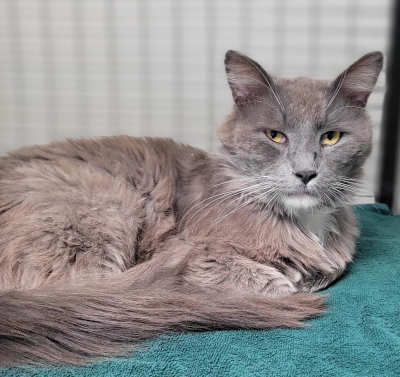
Male domestic medium hair cat
This 3-year-old male domestic medium hair cat has a gray coat with white markings.
He is in cat room kennel No. 63, ID No. LCAC-A-3633.

Domestic shorthair kitten
This female domestic shorthair kitten has an all-black coat.
She is in cat room kennel No. 84a, ID No. LCAC-A-3614.

Domestic shorthair kitten
This female domestic shorthair kitten has an all-black coat.
She is in cat room kennel No. 84b, ID No. LCAC-A-3615.

Domestic shorthair kitten
This male domestic shorthair kitten has an all-black coat.
He is in cat room kennel No. 84c, ID No. LCAC-A-3616.

‘Fudge’
“Fudge” is a young female domestic shorthair cat with a gray tabby coat.
She is in cat room kennel No. A#139, ID No. LCAC-A-3700.
Email Elizabeth Larson at
- Details
- Written by: Elizabeth Larson
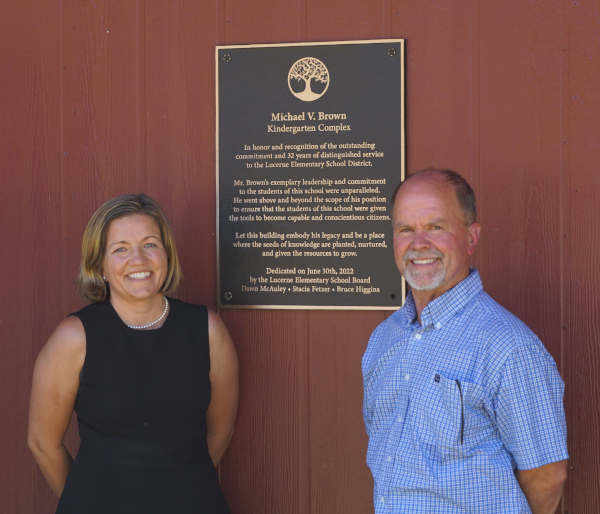
LUCERNE, Calif. — Standing together outside of the new kindergarten classroom building at Lucerne Elementary School in the noonday sun on June 30, Lake County Superintendent of Schools Brock Falkenberg chatted with Mike Brown, the retiring elementary district superintendent-principal.
“This is it, the last day,” Falkenberg said.
Brown agreed. After three decades as an educator, he would leave the school that day and walk into retirement.
The afternoon event on June 30 was part of a heartfelt send off for Brown, a district employee for 32 years, with half of that time spent as superintendent-principal.
“Mike has shaped so many lives in his 32 years of service, mine included,” said Megan Grant, Brown’s assistant principal who now succeeds him in the superintendent-principal job.
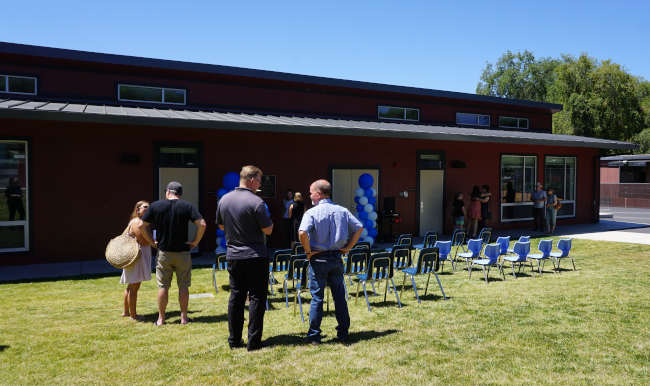
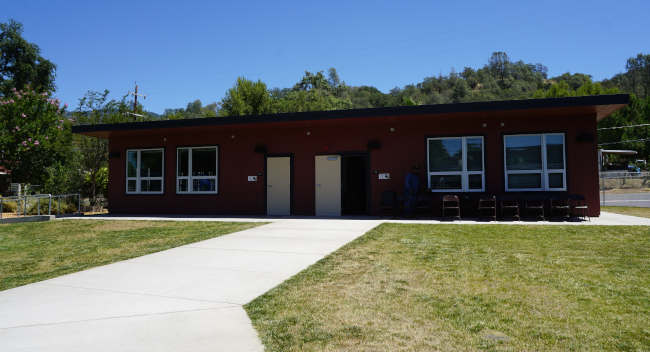
The gathering was held next to the school’s new kindergarten building. Funded by a $1.2 million Full Day Kindergarten grant the school received from the California Department of Education, construction took place throughout 2020 and students and teachers moved into it in February 2021.
It offers two state-of-the-art classrooms, spacious enough for big classes and with attached bathrooms, a big plus when dealing with the youngest students who need to make frequent trips.
The building also laid the groundwork for full-day kindergarten that begin for the district in the last school year.
Board President Dawn McAuley said the construction of the kindergarten building took so much effort; from start to finish, it was five years.
“This school is a beautiful place,” where students are safe, protected and educated, McAuley said.
Part of Brown’s send off that day included dedicating the kindergarten building in his honor. The building is now named the Michael V. Brown Kindergarten Complex.
A plaque placed on the building says: “In honor and recognition of the outstanding commitment and 32 years of distinguished service to the Lucerne Elementary School District. Mr. Brown’s exemplary leadership and commitment to the students of this school were unparalleled. He went above and beyond the scope of his position to ensure that the students of this school were given the tools to become capable and conscientious citizens. Let this building embody his legacy and be a place where the seeds of knowledge are planted, nurtured, and given the resources to grow.”
McAuley called Brown “our Johnny Appleseed.”
The seeds Brown has planted and Lucerne Elementary’s resulting accomplishments are critical to offering the community what it needs for its children. Brown said the area is considered high poverty.
On Feb. 9, Brown gave his resignation letter to the school board, which accepted it. “It was hard to write that letter.”
The board then offered the position to Megan Grant, who accepted it. Grant, an Upper Lake resident, has been Brown’s assistant principal for the past six years and has been with the district for 16 years. Her tenure began July 1, the day after Brown’s retirement.
In November, Congressman John Garamendi honored her as Lake County’s Woman of the Year, an honor for which Brown nominated her.
Grant said during the June 30 event that finding a purpose and living with unwavering dedication is what makes a job a career. “Being accountable to your purpose and taking action when the path isn’t clear is what makes a role model,” she said.
“Mike embodies dedication and has been a role model to so many people. He has this amazing ability to plant seeds in people, then come back and give that gentle push when they were ready for it, then move them into change,” Grant said. “It is easy to give advice, it is much harder to give advice at that moment when someone is ready to accept it. That is a space where a person can shape someone else's life.”
Still loving the job
In a late May interview with Lake County News, Brown explained he had a goal for when to retire.
“I wanted to retire when I still loved going to work,” he said, adding, “I think now is a good time.”
The fact that he still enjoyed his job up to that last sunny day last month — even as the last years of his career were marked with the intensity of finding the way through the unknowns of a pandemic — is something he credits to the staff, faculty, students and their families at the little school.
He noted during his remarks at the retirement event that the school’s employees — 17 teachers and 40 staff — are very cohesive.
“I’ve never seen anything like it at any other school,” he said.
Brown’s wife, Toni, a teacher in the Kelseyville Unified School District who has taught for 36 years, also is retiring this year. She also had been planning it, and after they talked about it, Brown said they decided, “Let’s just do it together.”
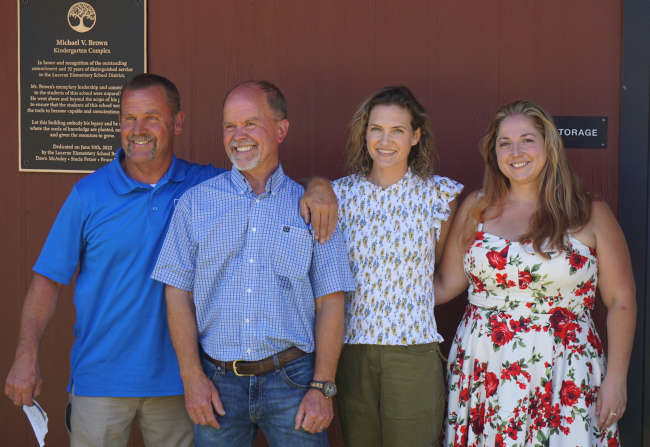
They have a growing extended family, with a new grandson, Jack, born in April to one of their daughters, and their son has two young children, all of whom were on hand to see their grandpa’s career be celebrated with the June 30 send off.
Besides time with family, Brown likes to hunt and fish, and hopes to spend a lot of time traveling.
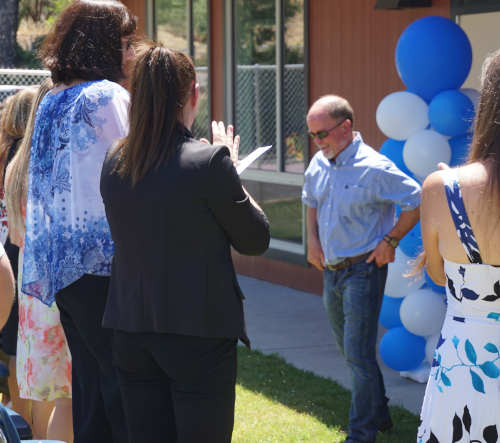
“I have places to go and fish to meet,” he told staff and friends at the building dedication.
During his tenure, Brown has seen all manner of changes and challenges, including the Great Recession, school funding challenges, new funding formulas, more learning requirements, a community challenged by a high poverty rate and, most recently, the COVID-19 pandemic.
But Brown, Grant and the rest of the staff and faculty came through the pandemic challenge by becoming leaders in the effort to return children successfully, and safely, to class, in some cases a year earlier than other districts.
Lucerne Elementary and the Upper Lake Unified School District reopened for classes at the start of the 2020-21 school year, which Brown said was the result of quickly adjusting to state requirements and using COVID money to order supplies and equipment needed to get back in class.
Brown, a believer in the importance of having children learning in person, said getting children back school early in the pandemic is one of his proudest moments.
“Online learning was a flop statewide,” he said.
Even so, he said Lucerne Elementary has families that haven’t yet had their children return to school in person.
The road to Lucerne
Brown, a Yuba City native, met his wife, Toni, when they were attending California State University, Chico, a school known for its teaching program. He was an agriculture major.
When his wife, a member of the Renfro family, wanted to return home to Kelseyville, they made the move from the valley and have remained here since.
He had been working for a moving company and also had enjoyed coaching before he decided to get his teaching degree, which he did through Dominican University.
He did his student teaching in the Kelseyville Unified School District then went to work for Lucerne Elementary, where he taught for 12 years, served as assistant principal for four years and then moved into the superintendent’s job, a position he held for the last 16 years.
When he first arrived at Lucerne Elementary, there were about 350 students. Today, Brown said there are around 300. He attributes the enrollment change to many employers leaving the county over the past few decades, leading to some families leaving the community.
In the years since, the school has dealt with lost time due to wildland fires, recessions, teacher shortages, funding cuts and then new funding and bond opportunities for schools and facilities, and now COVID.
Brown’s efforts have not just impacted students but their learning space.
In his first year, they modernized the gym. Later, in November 2016, voters passed the district’s $4 million Measure A bond, which is paying for new classrooms and other facilities. Then the new kindergarten classrooms were completed.
Brown said he actually had planned to retire two years ago. However, when the pandemic hit, he decided to stay for a few more years, taking the opposite course of some in the profession who decided instead to leave it.
Navigating new challenges
Challenges aren’t anything new or unusual for educators. However, the last two years have arguably been among the most challenging of his career — and indeed the careers of many educators.
In March 2020, at the start of the pandemic, Lucerne Elementary was closed briefly, at the same time that other schools closed. Another month would pass before Lake County Public Health confirmed the first COVID-19 case in Lake County.
Brown said that closure during the final quarter of the 2020-21 school year was Lucerne’s only closure.
However, getting his little district ready to reopen sooner rather than later was no straightforward task, with no road map. It required foresight, planning and long hours.
His partner in the work was Grant. Both worked through the entire summer of 2020, getting the necessary preparations, planning and safety measures in place in order to reopen school in August.
He said those preparations included using the first round of COVID funding to upgrade the school’s heating and cooling units, installing high grade air filters and carbon dioxide filters to improve the quality of air and its freshness.
Building projects also continued while the children were away, including new additional classrooms replacing portables. “If you’ve ever taught in a portable, you know the joy of seeing one torn down,” Brown said.
When school did reopen, there were still hurdles to clear. Temperature testing was required. Social distancing, masking and plastic barriers were in place. There also were minor COVID outbreaks.
Once they were back in school starting in August 2020, the doors remained open except for a period during February 2021, when a temporary school closure was required in response to a number of staff being exposed to the coronavirus, he said.
“It was a long year,” he said, noting during that time he substituted in classrooms when teachers couldn’t be at work.
Extra safety measures like temperature checks continued until earlier this year, when Brown said they made the decision to discontinue them. That allowed him and other staff to go back to doing their jobs.
He said he’s proud of that work to welcome children back to the campus.
“They’re really resilient,” Brown said of his students. “I think they know this is their safe place.”
What’s ahead
Brown leaves the district in good stead. Not only is Grant ready for the new leadership role, but there is the potential for more campus improvements to come.
She told Lake County News that she’s doing well and settling into the new position.
There is more work to be done under the Measure A bond, and Brown said he’s hoping that the state will allocate $10 billion for schools this year, as the school is in line for four new classrooms at a cost of $4 million to $5 million, plus modernization of the main building. There also could be another transitional kindergarten grant for the school.
The last project he saw through is the Advancement Via Individual Determination, or AVID program’s introduction.
Brown said Lucerne Elementary is the first elementary school in Lake County to pursue it, and next year, every school will be doing it at the elementary level. He said it helps children become better, motivated students, and to be more independent.
During the last week of school, staff held a farewell barbecue for him, and the children made him banners and cards. “It was adorable,” Brown said.
At his retirement send off on June 30, Brown became choked up as he spoke about watching children come back to school after the pandemic, and he offered his appreciation to his entire hardworking staff, crediting him with helping get the challenges.
He also thanked his wife Toni for putting up with all of it — including going to work earlier and staying later.
“Keep this place an amazing place to work and learn,” he told his staff, also urging them to make a difference in students’ lives and to work to improve the community.
There can’t be any more fulfilling work, he said.
What’s ahead for Brown may be best summed up in a sign that sat on his desk.
It read: “And to think, some of life's best stories haven’t even begun yet.”
Email Elizabeth Larson at
- Details
- Written by: Jaco J. Hamman, Vanderbilt Divinity School

In June 2022, I set off on a 10,650-mile, six-week motorcycle trip from Tennessee to Alaska and back again, carrying not too much more than my GPS and phone. The ride kick-started a year of travel for research – and despite the horror stories of delayed and canceled flights, I couldn’t be happier.
Just about everywhere I went, even in remote parts of the Yukon and British Columbia, folks were traveling. Many of the trailers being pulled were brand-new, suggesting the owners had bought them recently. After yet another cooped-up pandemic winter, it seems people’s appetite to get away is just as keen.
But why do we travel in the first place? What is the allure of the open road?
As a professor of religion, psychology and culture, I study experiences that lie at the intersection of all three. And in my research on travel, I’m struck by its unsolvable paradoxes: Many of us seek to get away in order to be present; we speed to destinations in order to slow down; we may care about the environment but still leave carbon footprints.
Ultimately, many people hope to return transformed. Travel is often viewed as what anthropologists call a “rite of passage”: structured rituals in which individuals separate themselves from their familiar surroundings, undergo change and return rejuvenated or “reborn.”
But travelers are not just concerned with themselves. The desire to explore may be a defining human trait, as I argue in my latest book, “Just Traveling: God, Leaving Home, and a Spirituality for the Road.” The ability to do it, however, is a privilege that can come at a cost to host communities. Increasingly, the tourism industry and scholars alike are interested in ethical travel, which minimizes visitors’ harm on the places and people they encounter.
The media inundate tourists with advice and enticements about where to travel and what to do there. But in order to meet the deeper goals of transformative, ethical travel, the “why” and “how” demand deeper discernment.
During my book research, I studied travel stories in sacred scriptures and researched findings from psychologists, sociologists, ethicists, economists and tourism scholars. I argue that meaningful travel is best understood not as a three-stage rite but as a six-phase practice, based on core human experiences. These phases can repeat and overlap within the same journey, just as adventures twist and turn.

1. Anticipating
Traveling begins long before departure, as we research and plan. But anticipation is more than logistics. The Dutch aptly call it “voorpret”: literally, the pleasure before.
How and what people anticipate in any given situation has the power to shape their experience, for better or worse – even when it comes to prejudice. Psychology experiments, for example, have shown that when children anticipate greater cooperation between groups, it can reduce their bias in favor of their own group.
But phenomenology, a branch of philosophy that studies human experience and consciousness, emphasizes that anticipation is also “empty”: our conscious intentions and expectations of what’s to come could be fulfilled or dashed by a future moment.
With that in mind, travelers should try to remain open to uncertainty and even disappointment.
2. Leaving
Leaving can awaken deep emotions that are tied to our earliest experiences of separation. The attachment styles psychologists study in infants, which shape how secure people feel in their relationships, continue to shape us as adults. These experiences can also affect how comfortable people feel exploring new experiences and leaving home, which can affect how they travel.
Some travelers leave with excitement, while others experience hesitation or guilt before the relief and excitement of departure. Mindfulness about the stages of travel can help people manage anxiety.
3. Surrendering
Travelers cannot control their journey: A flight is canceled, or a vehicle breaks down; the weather report predicts sunshine, but it rains for days on end. To some extent, they have to surrender to the unknown.
Modern Western cultures tend to see “surrendering” as something negative – as hoisting a white flag. But as a therapeutic concept, surrendering helps people let go of inhibiting habits, discover a sense of wholeness and experience togetherness with others. The perfectionist learns that a changed itinerary doesn’t mean a diminished travel experience and lets go of the fear of failure. The person with a strong sense of independence grows in vulnerability when receiving care from strangers.
In fact, some psychological theories hold that the self longs for surrender, in the sense of liberation: letting down its defensive barriers and finding freedom from attempts to control one’s surroundings. Embracing that view can help travelers cope with the reality that things may not go according to plan.
4. Meeting
Meeting, traveling’s fourth phase, is the invitation to discover oneself and others anew.
All cultures have unconscious “rules of recognition,” their own ingrained customs and ways of thinking, making it more difficult to forge cross-cultural connections. Carrying conscious and unconscious stereotypes, travelers may see some people and places as uneducated, dangerous, poor or sexual, while hosts may see travelers as rich, ignorant and exploitable.
Going beyond such stereotypes requires that travelers be mindful of behaviors that can add tension to their interactions – knowing conversational topics to avoid, for example, or following local dress codes.
In many parts of the world, those challenges are intensified by the legacy of colonization, which makes it harder for people to meet in authentic ways. Colonial views still influence Western perceptions of nonwhite groups as exotic, dangerous and inferior.
Starting to overcome these barriers demands an attitude known as cultural humility, which is deeper than “cultural competence” – simply knowing about a different culture. Cultural humility helps travelers ask questions like, “I don’t know,” “Please help me understand” or “How should I …?”

5. Caring
Caring involves overcoming “privileged irresponsibility”: when a traveler does not recognize their own privilege and take responsibility for it, or does not recognize other people’s lack of privilege.
[3 media outlets, 1 religion newsletter. Get stories from The Conversation, AP and RNS.]
Travel becomes irresponsible when tourists ignore injustices and inequities they witness or the way their travels contribute to the unfolding climate crisis. Ethically, “empathy” is not enough; travelers must pursue solidarity, as an act of “caring with.” That might mean hiring local guides, eating in family-owned restaurants and being mindful of the resources like food and water that they use.
6. Returning
Travels do end, and returning home can be a disorienting experience.
Coming back can cause reverse culture shock if travelers struggle to readjust. But that shock can diminish as travelers share their experiences with others, stay connected to the places they visited, deepen their knowledge about the place and culture, anticipate a possible return trip or get involved in causes that they discovered on their trip.
I believe that reflecting on these six phases can invite the kind of mindfulness needed for transformative, ethical travel. And amid a pandemic, the need for thoughtful travel that prioritizes host communities’ well-being is clear.
This is an updated version of an article originally published on Sept. 28, 2021.
 Jaco J. Hamman, Professor of Religion, Psychology, and Culture, Vanderbilt Divinity School
This article is republished from The Conversation under a Creative Commons license. Read the original article.
- Details
- Written by: Elizabeth Larson
Dogs available for adoption this week include mixes of Belgian malinois, border collie, bull terrier, Great Pyrenees, Labrador retriever, pit bull, poodle, shar pei, shepherd, terrier and treeing walker coonhound.
Dogs that are adopted from Lake County Animal Care and Control are either neutered or spayed, microchipped and, if old enough, given a rabies shot and county license before being released to their new owner. License fees do not apply to residents of the cities of Lakeport or Clearlake.
The following dogs at the Lake County Animal Care and Control shelter have been cleared for adoption.
Call Lake County Animal Care and Control at 707-263-0278 or visit the shelter online for information on visiting or adopting.
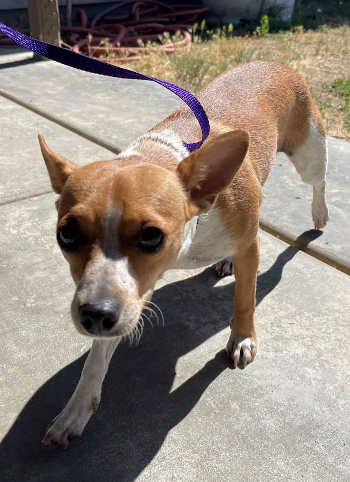
Female Chihuahua
This 3-year-old female Chihuahua has a short red and white coat.
She is in kennel No. 7, ID No. LCAC-A-3696.

Male Belgian malinois
This 1-year-old male Belgian malinois has a short black and tan coat.
He is in kennel No. 8, ID No. LCAC-A-3694.

Male pit bull
This 1-year-old male pit bull has a short brown coat with white markings.
He is in kennel No. 10, ID No. LCAC-A-3693.

Female Great Pyrenees
This 3-year-old female Great Pyrenees has a white coat.
She is in kennel No. 13, ID No. LCAC-A-3669.

‘BonBon’
“BonBon” is a 2-year-old male poodle with a long curly coat.
He is in kennel No. 15, ID No. LCAC-A-3668.

‘Autumn’
“Autumn” is a 6-year-old female treeing walker coonhound with a tricolor coat.
She is in kennel No. 16, ID No. LCAC-A-1776.

‘Cali’
“Cali” is a female pit bull terrier with a short black and white coat.
She is in kennel No. 17, ID No. LCAC-A-3571.

‘Hoss’
“Hoss” is an 8-year-old male Chinese Shar-Pei with a short tan coat.
He is in kenne lNo. 18, ID No. LCAC-A-3638.

Shar Pei-pit bull mix
This 9-year-old female shar pei-pit bull mix has a short black and white coat.
She is in kennel No. 19, ID No. LCAC-A-3622.

‘Missy’
“Missy” is a 3-year-old female pit bull terrier with a black and white coat.
She is in kennel No. 20, ID No. LCAC-A-3524.

Pit bull-bull terrier mix
This 1-year-old male pit bull-bull terrier has a short white coat.
He is in kennel No. 28, ID No. LCAC-A-3644.

Border collie-Labrador retriever mix
This young male border collie-Labrador retriever mix has a short black and white coat.
He is in kennel No. 30, ID No. LCAC-A-3646.
Email Elizabeth Larson at