 How to resolve AdBlock issue?
News
- Details
- Written by: LAKE COUNTY NEWS REPORTS
The person or person who will be appointed will serve approximately two years, with a term ending in 2024.
Those interested in being considered for appointment to serve as council member on the Lakeport City Council are invited to submit a council member vacancy application.
The application can be obtained online at www.cityoflakeport.com or at Lakeport City Hall, located at 225 Park St., Lakeport.
Qualified candidates must reside in Lakeport city limits, be at least 18 years of age and registered to vote in the city of Lakeport.
The five-member City Council serves as the legislative body of the city and is responsible for setting policy, adopting the annual budget, adopting laws, determining services to
be provided and the funding levels, and appointing citizens to its advisory boards and commissions.
Applications may be submitted electronically to
Completed applications must be returned to the Office of the City Clerk no later than Thursday, Dec. 13, at 5 p.m.
Once the application period has closed, the applications will be distributed to the City Council for review.
The City Council will decide at a future council meeting on the process to use for the appointment.
Medicaid enrollment soared by 25% during the COVID-19 pandemic – but a big decline could happen soon
- Details
- Written by: Julie Donohue, University of Pittsburgh Health Sciences and Eric T. Roberts, University of Pittsburgh Health Sciences

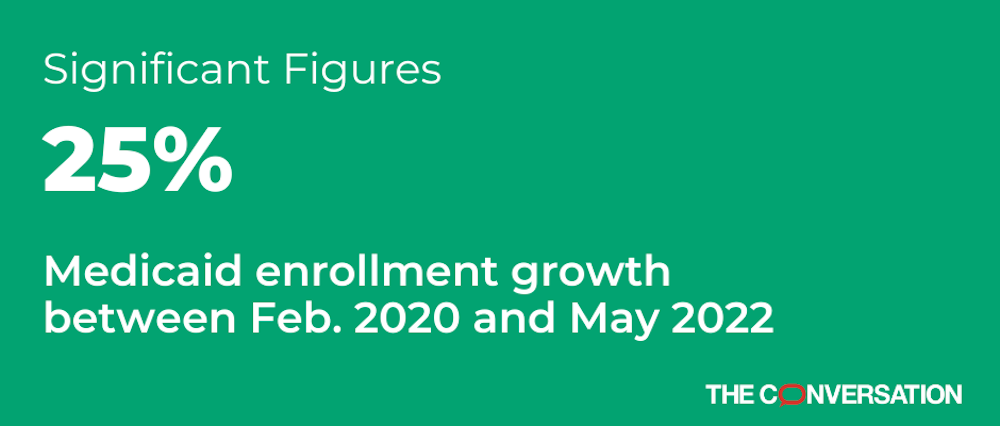
Medicaid, the government-funded U.S. health insurer for people with low incomes, grew by about 25% between February 2020 and May 2022 as policies adopted at the outset of the COVID-19 pandemic expanded the program’s reach.
All told, the number of people enrolled in Medicaid and the Children’s Health Insurance Program, or CHIP, which serves kids in families with low to moderate incomes, increased from 71 million to 89 million. That’s roughly 27% of all Americans.
The pandemic-related increase in Medicaid enrollment was slightly larger than the 24.7% increase seen after the Affordable Care Act (ACA) expanded Medicaid for adults, starting in 2014.
But unlike Medicaid expansion under the ACA, these pandemic policies are temporary. They will end once the federal government’s COVID-19 public health emergency expires. Some experts predict Medicaid enrollment could fall by as many as 15 million people when this happens, disrupting health care for many Americans.
In a new article we published in the Journal of the American Medical Association on Sept. 20, 2022, we examine how Medicaid serves Americans, analyze the program’s importance for health equity, and assess how Medicaid grew and changed during the COVID-19 pandemic.
As health policy researchers, we believe that Medicaid’s growth since 2020 highlights the program’s importance during economic and public health crises. It also underscores how painful the unwinding of these pandemic policies is likely to be to those who may end up uninsured.
Federal changes
In March 2020, Congress passed the first of several large spending packages, called the Families First Coronavirus Response Act. To help states shoulder increased Medicaid costs associated with the pandemic, that measure increased the share of Medicaid spending the federal government pays for by 6.2 percentage points in all states.
This aid has made a big difference for states, which split the costs of Medicaid with the federal government. Before the pandemic, the federal government was paying about 65% of Medicaid’s costs overall, with the precise share varying based on a state’s average income. States picked up the other 35% of Medicaid costs. These costs accounted for more than one-fourth of state budgets before the pandemic.
The extra federal money for Medicaid came with an important requirement: states accepting funds could not remove anyone from Medicaid who was enrolled as of March 2020 or gained Medicaid afterwards – as long as the official public health emergency, first declared on Jan. 31, 2020, remained in effect. These policies also applied to CHIP.
All 50 states and the District of Columbia accepted the higher federal payments in exchange for keeping Medicaid enrollment stable during the pandemic.
Greater stability
These changes helped to address longstanding instability in Medicaid coverage for many people. Before the pandemic, nearly 25% of those with Medicaid would enter or exit the program each year as their short-term circumstances changed.
People would lose Medicaid coverage when their income ticked up, their family circumstances changed, they aged out of CHIP, or they failed to complete required paperwork. Losing Medicaid coverage can lead to someone ending up without any health insurance at all, which increases the likelihood they will postpone or never get needed care. Having the same people frequently entering and exiting the program also increases the program’s administrative costs over time.
Changes to Medicaid policy in response to the pandemic made it much easier for everyone enrolled in Medicaid to keep their coverage. To illustrate, just over half of Wisconsin’s Medicaid growth in 2020 came from that state keeping existing enrollees in the program who might otherwise have lost coverage for at least a few months.
Young adults, especially those aged 18 and 19, and Americans who recently gave birth are two groups that benefited from this change in Medicaid policy.
What’s next
Even with many aspects of daily life getting back to normal, and President Joe Biden’s comments to the media about the pandemic being “over,” the official public health emergency that spurred Medicaid enrollment growth still remains in force.
When the government renewed the declaration for the 10th time in July 2022, it set a new expiration date of Oct. 13, 2022. The administration also said it would provide states with 60 days notice before it would end the federal emergency declaration, which suggests the declaration will be renewed at least one more time.
When the emergency ends, states will have to reevaluate eligibility for everyone with Medicaid within 12 months. Extra federal funding for states will also end.
These changes will have profound consequences. Millions of people will have to reestablish their eligibility for Medicaid and are at risk of losing coverage if they do not complete the required paperwork on time.
The administration may ultimately decide to renew the COVID-19 emergency declaration again, as hundreds of Americans are still dying daily from the disease. Keeping it in place would prevent a massive drop in Medicaid enrollment and make it easier to continue other COVID-19 public health policies, such as making free COVID-19 testing and vaccinations widely available.
Beyond extending the public health emergency, we believe that states and the federal government can seek new ways to minimize disruptions in coverage and to make Medicaid more accessible to the millions of Americans who depend on it for health insurance.
Julie Donohue, Professor and Chair of Health Policy and Management, University of Pittsburgh Health Sciences and Eric T. Roberts, Assistant Professor of Health Policy and Management, University of Pittsburgh Health Sciences
This article is republished from The Conversation under a Creative Commons license. Read the original article.
- Details
- Written by: Elizabeth Larson
A lightning storm began at around 7:30 p.m., and shortly after 8 p.m. heavy rain started to fall.
Over the course of an hour, between 8 and 9 p.m., nearly an inch of rain fell in the Lucerne area, based on Lake County News’ weather station.
Shortly before 8:30 p.m., flooding was reported on Lakeshore Boulevard in Lakeport.
Coinciding with the heavy rain, there was a report of a downed tree blocking the road in the 16000 block of Cobb Boulevard.
At Highway 175 and Adams Springs Road, there were rocks in the roadway at about 8:20 p.m. that were reported to be “larger than a doghouse,” according to the California Highway Patrol logs.
Pacific Gas and Electric Co. reported early in the evening that there were several power outages around Lake County, the largest impacting approximately 2,111 customers in the south county area.
By early Tuesday, most of the south county customers had been restored, with some smaller outages still pending resolution around Hidden Valley Lake, Boggs Mountain, Clearlake and Lakeport.
A hazardous weather outlook remains in effect for Lake County due to more rain that’s forecast through Wednesday.
Less than a quarter of an inch is expected on Tuesday, with the potential for a smaller amount on Wednesday, based on the Lake County forecast.
Email Elizabeth Larson at
- Details
- Written by: Elizabeth Larson
The board will meet beginning at 9 a.m. Wednesday, Sept. 21, and Thursday, Sept. 22, in the board chambers on the first floor of the Lake County Courthouse, 255 N. Forbes St., Lakeport.
The meeting can be watched live on Channel 8, online at https://countyoflake.legistar.com/Calendar.aspx and on the county’s Facebook page.
Accompanying board documents, the agenda and archived board meeting videos also are available at that link.
Each day of the hearings has a different Zoom link.
For Wednesday, the Zoom link is here; the meeting ID is 972 4365 5590, pass code 716589. The meeting also can be accessed via one tap mobile at +16694449171,,97243655590#,,,,*716589# or by dialing 669-900-6833
For Thursday, the Zoom link is here; the meeting ID is 946 4937 4295, pass code 716589. The meeting also can be accessed via one tap mobile at +16699006833,,94649374295#,,,,*145426# or by dialing 669-900-6833.
The board will consider a budget with appropriations for all funds totaling $351,946,439, an increase of $32,560,324 from the previous fiscal year, according to the memo to the board from County Administrative Officer Susan Parker and Assistant County Administrative Officer Stephen Carter.
The final recommended budget must be adopted no later than Oct. 2, based on state Government Code.
Email Elizabeth Larson at