 How to resolve AdBlock issue?
News
- Details
- Written by: Neil M. Bennett, Michael D. King and Mark A. Klee
An analysis of recent U.S. Census Bureau data shows that parts of the student debt forgiveness plan announced by the administration last month — one of the largest ever — would completely eliminate student debt for a number of borrowers.
The plan would forgive up to $10,000 in federal student debt for individuals making less than $125,000 a year and married couples making less than $250,000 a year. Additionally, the student loans of income-eligible individuals who received Pell grants would be reduced by up to $20,000.
The Census Bureau’s recently released 2021 Survey of Income and Program Participation, or SIPP, provides information about student debt balances as of December 31, 2020. Although loan balances would normally change over two years, pandemic policies allowed borrowers to temporarily pause payments without interest.
In addition, any payments made after March 2020 can be refunded and then forgiven. Because of this, amounts owed in student debt in 2020 can serve as an approximation of loan balances in 2022.
In this article, we investigate who among adults not enrolled in college with at least a high school degree will benefit — and by how much — from this proposed policy, assuming all reported student loans in the SIPP are federal and that no one’s student debt will be reduced by more than $10,000.
Who will benefit from $10,000 in student loan forgiveness?
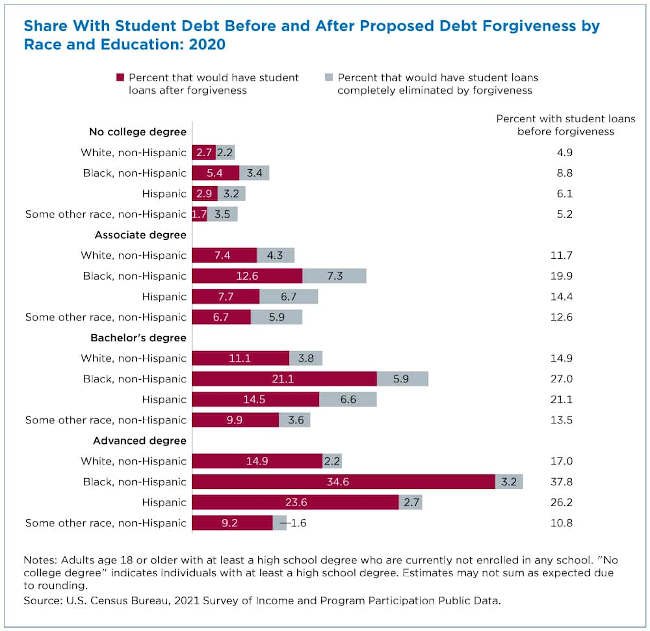
The 2021 SIPP data show that the plan to reduce student loans by $10,000 would completely wipe out balances for 29.0% of those with student debt and that certain demographic groups would benefit more than others.
Some of the largest reductions are expected among Hispanic individuals with an associate degree. A $10,000 reduction in student loans reduces the percentage with any student debt from 14.4% to 7.7%.
While the estimated erasure of student loans is largest for non-Hispanic associate degree holders who are Black alone (identified as Black through the rest of this story) — from 19.9% to 12.6% — this reduction is not statistically different from the reduction for any other race-by-education group.
Individuals with advanced degrees are expected to experience some of the smallest reductions in student loan holding, varying from 1.6 to 3.2 percentage points across race and ethnic groups. These reductions are also small compared to the percentage who held any student debt before forgiveness.
The likely reasons for the differences by education: larger amounts of debt or higher incomes making them ineligible for loan forgiveness. Advanced-degree holders on average had higher student debt ($69,000) than associate-degree holders ($22,000).
Based on income, the share of advanced-degree holders with student debt eligible for debt forgiveness ranges from 75.6% of non-Hispanics who are neither Black nor White to 85.6% of Black borrowers. People who are neither Black nor White include Asian, American Indian or Alaska Native, Native Hawaiian or Other Pacific Islander and mixed-race individuals.
However, over 90% of borrowers with an associate degree in all race groups would qualify.
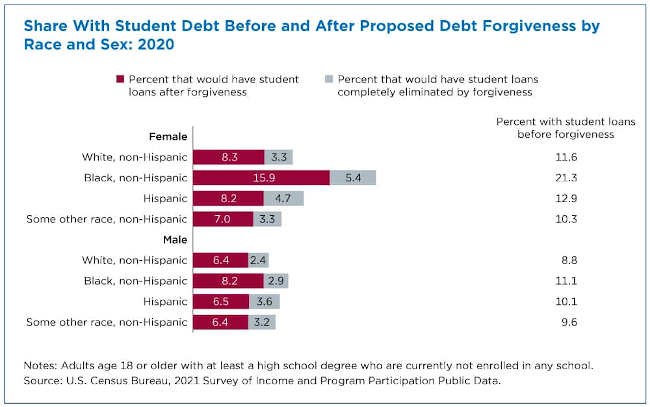
Women typically earn less than men and are more likely to not only have student debt but to owe more than men. As a result, they may have a harder time paying off student loans.
It’s estimated Black and Hispanic women are expected to experience some of the largest reductions in the percentage with any student loans from the $10,000 relief plan: 5.4 and 4.7 percentage points, respectively.
White men are expected to experience among the smallest reductions (2.4 percentage points).
How much of a difference can $10,000 in student loan relief make?
Because student debt burden is sometimes high relative to income, student loans can go hand in hand with other types of unsecured debt. This means student loan forgiveness is expected to have a significant impact on individuals’ overall unsecured debt burden.
Unsecured debt — such as student, credit card or medical debt — is not backed by an asset the way a house backs a mortgage because lenders cannot repossess someone’s education if the individual fails to pay a student loan.
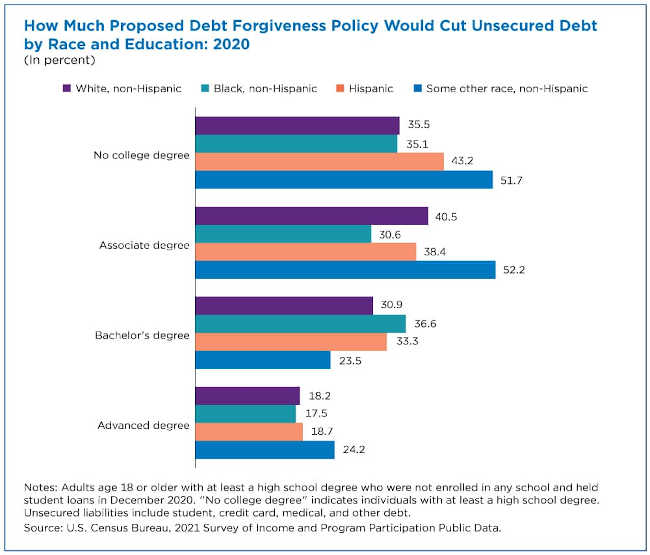
The $10,000 reduction in student debt would decrease the amount of total unsecured liabilities owed by 33.0% on average of those who have any student debt.
Hispanic individuals with a high school degree but no college degree (43.2%) and associate degrees (38.4%) are expected to experience among the greatest reduction in what they owed in unsecured loans. Non-Hispanic individuals who are neither White nor Black with a high school degree, but no college degree (51.7%) and associate degrees (52.2%) are also expected to experience among the greatest reduction of unsecured amounts owed.
The $10,000 reduction in student loans is expected to have some of the smallest impacts on unsecured amounts owed by those with advanced degrees: between 17.5% and 24.2% in unsecured debt across race and ethnic groups.
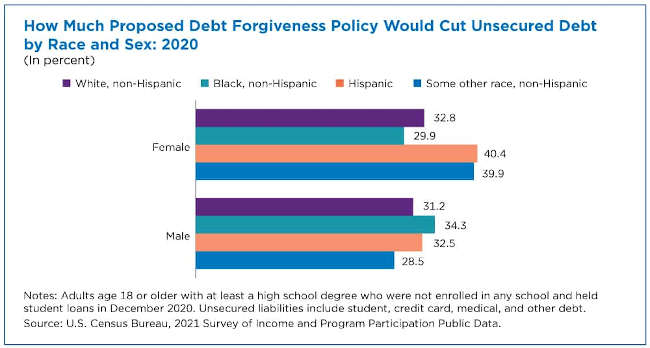
Hispanic women (40.4%) are expected to experience among the largest shares of unsecured debt relief.
About the data
The strength of SIPP data — and survey data more generally — does not lie in estimating the total number of borrowers whose student debt will be eliminated entirely or the total dollar amount of outstanding student debt that will be relieved.
Rather, the strength of SIPP data is its rich description of who will benefit and how much of a difference student loan forgiveness might make in the context of student loan borrowers’ assets and other debts.
In addition, SIPP returns to interview the same individuals over the course of several years.
Consequently, future SIPP data will show how student loan forgiveness affected sample members’ student loan balances as well as any subsequent influences on their family formation, business formation, program participation and well-being (financial or otherwise).
SIPP does not ask borrowers whether their student loans are federal or private. Estimates from other sources are that private student loans made up less than 15% of total student debt in 2012. As a result, this research assumes all student loans are federal and this assumption tends to bias the impact on debt burden upwards.
SIPP does not collect information about Pell grant recipients, who would get up to a $20,000 debt relief on federal student loans. This research assumes student debt reduction of no more than $10,000, which tends to bias the impact on debt burden downwards.
We are unable to determine the overall value of the counteracting effects from the above assumptions.
SIPP is a nationally representative, longitudinal survey administered by the Census Bureau that provides comprehensive information on the dynamics of income, employment, household composition and government program participation.
More information about SIPP data quality is available on the SIPP’s Technical Documentation page.
Neil Bennett is an economist in the Census Bureau’s Social, Economic, and Housing Statistics Division. Michael D. King and Mark A. Klee are survey statisticians in the Census Bureau’s Social, Economic, and Housing Statistics Division.
- Details
- Written by: OFFICE OF CONGRESSMAN MIKE THOMPSON
The bill passed the House by a vote of 229-203. The bill now heads to the United States Senate.
“The former president and his allies sought to overturn the will of the people and subvert the peaceful transfer of power that is fundamental to our democracy,” said Thompson. “These same bad actors conducted a coordinated effort in an attempt to exploit ambiguities in the Electoral Count Act of 1887 to refuse the count of electoral votes and deliver an alternate and false slate of electors. The Presidential Election Reform Act will take vital steps to reform the Electoral Count Act and ensure that the will of the people cannot be overturned.”
The bipartisan Presidential Election Reform Act takes a number of specific steps to safeguard our democracy.
First, this bill would clarify the role of the vice president in the joint session of Congress solely as ceremonial, reaffirming that the vice president does not have the right to reject or alter official state electoral slates.
Second, members of Congress can only object to a state’s electoral count under constitutionally protected reasons, and the objection threshold is raised to one-third of each chamber.
Third, this bill would require governors of each state to transmit to Congress the lawful election results. If the governors fail to carry out these duties, candidates may bring suit in federal court to ensure Congress receives the lawful slate of electors.
Fourth, federal law will make clear that rules governing elections cannot change after the election has occurred, preventing those who are upset with a lawful outcome from retroactively altering the outcome.
Thompson represents California’s Fifth Congressional District, which includes all or part of Contra Costa, Lake, Napa, Solano and Sonoma counties.
- Details
- Written by: Elizabeth Larson
Following brief interviews with two former council members, Bob Rumfelt and George Spurr, the council appointed Spurr to fill the seat formerly held by Mireya Turner, who resigned in August to take the Lake County Community Development Department director job on a permanent basis.
At its Sept. 6 meeting, the council had directed staff to reach out to former council members to find out if any of them would be interested in filling the remainder of Turner’s term, which expires at year’s end.
Rumfelt served for 16 years on the council, ending in 2010. Spurr left the council at the end of 2020 after serving one term.
After both Rumfelt and Spurr had spoken briefly to the council, the council began to discuss the temporary appointment. Then Rumfelt returned to the microphone and said he was pulling his hat out of the ring in favor of Spurr.
The council then voted unanimously to approve Spurr’s three-month appointment, with Administrative Services Director/City Clerk Kelly Buendia administering the oath of office to Spurr, who was immediately seated on the dais with the other four council members.
There may still be more need for additional council appointments before the year is over, however.
By the time of her resignation, Turner had already signed up to run for a third term and her name will be on the ballot in November.
If she is elected, she will need to resign her post and the council will have to make another temporary appointment, this one for two years, until the next municipal election.
Write-in candidates have until Oct. 25 to sign up to run for Turner’s seat.
In addition, Councilman Michael Green has made it broadly known that he has applied for the District 4 supervisorial seat vacated by Tina Scott. That position will be appointed by the governor.
As a result, the city has begun to seek additional applicants should it need to fill those seats.
In other business, at the request of developer Peter Schellinger, owner of Waterstone Residential, the council voted to continue a public hearing for general plan and zoning changes for his Parkside Residential Project at 1310 Craig Ave.
Schellinger is seeking approvals to build 128 new apartment units and 48 cluster homes on the 15-acre site, next to the original Parkside subdivision near Westside Community Park.
Neighbors at the Parkside subdivision have pushed back on the plan, citing issues such as traffic, wildfire risk and water use.
Schellinger said he had participated in a Zoom meeting initiated by the neighbors, who have expressed their concerns to him directly.
“We are pushing forward to try to get the financing in place,” he said, noting that there is a very unique opportunity now to take advantage of state financing.
He said he would go back and reconvene with the neighbors and would work with city staff on how he would like to proceed.
The council also set special meetings on Dec. 12 and 13 to make appointments to city commissions and committees with terms expiring this year and received an update on the city’s GIS and asset management program.
Email Elizabeth Larson at
- Details
- Written by: LAKE COUNTY NEWS REPORTS
The California Coastal Commission reported that for the past two years the event was limited to self-guided cleanups because of the pandemic, but this year’s cleanup saw more than 600 in-person cleanup sites taking place throughout the state — a return to near full capacity.
Volunteers gathered hundreds of tons of trash at beaches, shorelines, and inland waterways, cleaning up at locations in virtually all of California’s 58 counties. Cleanups took place up and down the coast, from the Oregon to Mexico border, and as far inland as Lake Tahoe.
California’s event is part of the International Coastal Cleanup, the world’s largest volunteer event dedicated to the marine environment, which is organized by the Ocean Conservancy.
With 60% of the cleanup sites reporting, the statewide count stands at 27,185 volunteers.
Those volunteers picked up 220,861 pounds of trash and an additional 29,702 pounds of recyclable materials, for a total of 250,563 pounds or 125 tons.
In Lake County, there were six cleanup sites: Lucerne Harbor Park; Rodan Slough Park, Nice; Library Park, Lakeport; Highland Springs Recreation Area, Lakeport; Konocti CrossFit, Kelseyville; and Austin Park Beach, Clearlake.
Lake County Water Resources said there were 70 Lake County volunteers, who covered 30 miles during the Cleanup Day.
They collected 2,735.66 pounds of trash and 150 pounds of recyclables, Water Resources said.
“We were amazed by the response to the call for self-guided cleanups over these past two years. But it’s not surprising — Californians cherish their coast and want to take care of it,” said the commission’s Executive Director Jack Ainsworth. “Even so, we are so pleased about returning to in-person cleanups. These events really do more than help us capture huge amounts of trash before it enters the ocean. Coastal Cleanup Day brings us together to celebrate our precious waterways and coastal resources as a community.”
Volunteers not only removed trash from the environment today, but they also kept track of all the items they removed as part of one of the world’s largest and longest-running community science projects.
This data, and the trends it displays over the many years in which it has been collected, has revealed a great deal about the extent and nature of the marine debris problem over time, and has provided California with crucial information needed to address the sources of the problem.
Based on past cleanup data, 75% of the debris that volunteers removed today was composed of plastic, a material that never completely biodegrades and has numerous harmful consequences in the environment. Plastic debris can kill wildlife, leach toxic chemicals into the environment, and even introduce them into the food chain.
The data has also shown that up to 80% of the trash on the California coast originates on land, so volunteers across the state helped prevent enormous amounts of trash from ever reaching the ocean, no matter where they participated.
Most unusual items:
Every-day debris and plastic items weren’t the only things found on Coastal Cleanup Day. Volunteers also picked up a number of “unusual” items during this year’s cleanup. The Winners of the 2022 Most Unusual Item contest are:
• Coastal California: A volunteer along the Berkeley shoreline in Alameda County found a large, framed photo of a Jack Russell Terrier.
• Inland California: A volunteer in Colusa County found a trophy with a plaque that read “Best Couples Skater 2006.”
In addition to in-person cleanups, the Coastal Commission continues its COVID-inspired push to encourage volunteers to run self-guided cleanups throughout neighborhoods across the state.
The self-guided cleanups serve the same purpose as the Cleanup Day events that took place today: to prevent trash from ever having the opportunity to reach our coast. Self-guided cleanups throughout California help to stop trash where it starts, which is primarily within urban areas most prone to stormwater runoff.
To date, 522 Californians have conducted a neighborhood cleanup, removing 2,437 pounds of trash during 211 cleanups.