 How to resolve AdBlock issue?
News
- Details
- Written by: Elizabeth Larson
Dogs available for adoption this week include mixes of Australian cattle dog, Doberman pinscher, Dogo Argentino, German shepherd, Great Pyrenees, hound, husky, pit bull, Rottweiler, shepherd and treeing walker coonhound.
Dogs that are adopted from Lake County Animal Care and Control are either neutered or spayed, microchipped and, if old enough, given a rabies shot and county license before being released to their new owner. License fees do not apply to residents of the cities of Lakeport or Clearlake.
The following dogs at the Lake County Animal Care and Control shelter have been cleared for adoption.
Call Lake County Animal Care and Control at 707-263-0278 or visit the shelter online for information on visiting or adopting.

Male pit bull terrier
This 1-year-old male pit bull terrier has a gray and white coat.
Shelter staff said is a playful young dog who does well on a leash and loves fetch. He will benefit from training.
He is in kennel No. 10, ID No. LCAC-A-3855.

Male hound mix puppy
This 6-month-old male hound mix puppy has a short brindle coat.
Shelter staff said he is very playful with a lot of energy, and he loves toys. “He is extremely treat motivated and has shown he is eager to learn all the cool tricks you could teach him.”
He is in kennel No. 15, ID No. LCAC-A-3916.

Female treeing walker coonhound-Doberman pinscher puppy
This 2-month-old female treeing walker coonhound-Doberman pinscher has a short tan coat.
She is in kennel No. 16a, ID No. LCAC-A-3924.

Female treeing walker coonhound-Doberman pinscher puppy
This 2-month-old female treeing walker coonhound-Doberman pinscher has a short tan coat.
She is in kennel No. 16d, ID No. LCAC-A-3927.

Male treeing walker coonhound-Doberman pinscher puppy
This 2-month-old male treeing walker coonhound-Doberman pinscher has a short tricolor coat.
He is in kennel No. 17a, ID No. LCAC-A-3921.

Male treeing walker coonhound-Doberman pinscher puppy
This 2-month-old male treeing walker coonhound-Doberman pinscher has a short tan and white coat.
He is in kennel No. 17b, ID No. LCAC-A-3922.

Male Rottweiler-Australian cattle dog cross
This 5-year-old male Rottweiler-Australian cattle dog cross has a short tricolor coat.
He is in kennel No. 18, ID No. LCAC-A-3942.

Female hound mix
This 1-year-old female hound mix has a short brown and white coat.
Shelter staff said she is a talkative girls that loves to be around people and will show you the true meaning of a lap dog. She enjoys toys and walks well with a leash.
“Being a younger dog means she still needs some schooling, but with positive reinforcement, she can catch on quickly,” staff said.
She is in kennel No. 19, ID No. LCAC-A-3766.

Female pit bull
This 2-year-old female pit bull has a short brown brindle coat.
She is in kennel No. 20, ID No. LCAC-A-3918.

‘Tracy’
“Tracy” is a 2-year-old female Dogo Argentino with a short white coat.
She is in kennel No. 23, ID No. LCAC-A-3952.

Female German shepherd
This 1-year-old female German shepherd has a short black and tan coat.
She is in kennel No. 24, ID No. LCAC-A-3780.

Male German shepherd
This 2-year-old male German shepherd has a black and tan coat.
Shelter staff called him a “handsome sweet dude who is motivated by treats and does well walking on a leash.
He is in kennel No. 25, ID No. LCAC-A-3870.

Female husky
This 1-year-old female husky has a cream and black coat.
She is in kennel No. 27, ID No. LCAC-A-3893.

‘Poppy’
“Poppy” is a 4-month-old female Great Pyrenees with a short white and gray coat.
She is in kennel No. 30, ID No. LCAC-A-3790.

Male German shepherd
This 1-year-old male German shepherd has a black and tan coat.
He is in kennel No. 31, ID No. LCAC-A-3930.
Email Elizabeth Larson at
- Details
- Written by: NATIONAL OCEANIC AND ATMOSPHERIC ADMINISTRATION
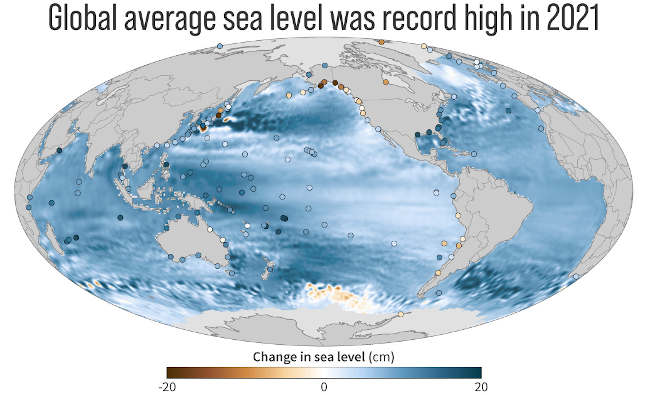
Greenhouse gas concentrations, global sea levels and ocean heat content reached record highs in 2021, according to the 32nd annual State of the Climate.
The international annual review of the world’s climate, led by scientists from NOAA’s National Centers for Environmental Information and published by the Bulletin of the American Meteorological Society, or AMS, is based on contributions from more than 530 scientists in over 60 countries.
It provides the most comprehensive update on Earth’s climate indicators, notable weather events and other data collected by environmental monitoring stations and instruments located on land, water, ice and in space.
"The data presented in this report are clear — we continue to see more compelling scientific evidence that climate change has global impacts and shows no sign of slowing,” said NOAA Administrator Rick Spinrad, Ph.D. “With many communities hit with 1,000-year floods, exceptional drought and historic heat this year, it shows that the climate crisis is not a future threat but something we must address today as we work to build a Climate-Ready Nation — and world — that is resilient to climate-driven extremes.”
"The 2021 AMS State of the Climate provides the latest synthesis of scientific understanding of the climate system and the impact people are having on it," said AMS Associate Executive Director Paul Higgins. "If we take it seriously and use it wisely, it can help us thrive on a planet that is increasingly small in comparison to the impact of our activities."
Notable findings from the international report include:
• Earth’s greenhouse gases were the highest on record. The major atmospheric greenhouse gas concentrations — carbon dioxide, methane and nitrous oxide — each rose once again to new record highs during 2021. The global annual average atmospheric carbon dioxide concentration was 414.7 parts per million (ppm). This was 2.3 ppm greater than 2020 amounts and was the highest measured in the modern observational records as well as the highest in at least the last million years based on paleoclimatic records. The annual average atmospheric methane concentration was also the highest on record, and the annual increase of 18 parts per billion (ppb) was the highest since measurements began. The annual increase in methane has significantly accelerated since 2014. The annual increase of 1.3 ppb for nitrous oxide was the third highest since 2001, contributing to a global annual average atmospheric concentration of 334.3 ppb.
• Earth’s warming trend continued. A range of scientific analyses indicate that annual global surface temperatures were 0.38 - 0.50 degrees F (0.21-0.28 of a degree C) above the 1991 -2020 average. This places 2021 among the six warmest years since records began in the mid to late 1800s. The last seven years (2015–2021) were the seven warmest years on record, and the average global surface temperature has increased at an average rate of 0.14 - 0.16 of a degree F (0.08 - 0.09 of a degree C) per decade since the start of record-keeping and at a rate more than twice as high since 1981 (0.32 - 0.36 of a degree F, or 0.18 - 0.20 of a degree C, per decade since 1981, according to a range of scientific analyses).
• Ocean heat and global sea level were the highest on record. The ocean sequesters the vast majority of the excess energy trapped in the Earth's system by greenhouse gases and other factors; estimated at more than 90% over the past half-century. Global ocean heat content, measured from the ocean’s surface to a depth of more than 6,000 feet, continued to increase and reached new record highs in 2021. For the 10th consecutive year, global average sea level rose to a new record high and was about 3.8 inches (97.0 mm) higher than the 1993 average — the year that marks the beginning of the satellite measurement record.
• La Niña conditions lowered sea surface temperatures. La Niña conditions that began in mid-2020 continued for most of 2021. The annual global sea surface temperature in 2021 was lower than both 2019 and 2020 due in part to La Niña, but was still 0.52 of a degree F (0.29 of a degree C) higher than the 1991–2020 average. Approximately 57% of the ocean surface experienced at least one marine heatwave during 2021.
• Temperatures were mixed in the Southern Hemisphere. La Niña contributed to the warmest year on record for New Zealand, but also to the coolest year since 2012 for Australia. On Antarctica, cold air within a strong, stable polar vortex contributed to the coldest winter (from April through September) on record at the South Pole. On the Antarctic Peninsula, the only part of the continent which reaches beyond the Antarctic Circle, two stations received persistent warm northerly winds; one station tied its highest annual temperature on record while the other experienced its second highest recorded temperature.
• The Arctic was cooler overall, but some records were set. The Arctic had its coolest year since 2013, but 2021 was still the 13th warmest year in the 122 year record. Extreme heat events occurred during the summer. During a massive heat wave in western North America, a temperature of 103.8 degrees F (39.9 degrees C) was recorded on June 30 at Fort Smith, Northwest Territories, Canada; this was the highest temperature ever recorded above 60 degrees North latitude. A widespread melting event on the Greenland Ice Sheet on August 14, 2021 — the latest in the season on record — coincided with the first observed rainfall in the 33 year record at the Summit Station, which sits at more than 10,500 feet (3,200 meters) above sea level. While the Arctic minimum sea ice extent was the 12th smallest extent in the 43 year record, the amount of multiyear ice — ice that survives one or more summer melt seasons — remaining in the Arctic was the second lowest on record. This indicates the Arctic’s sustained transition to a younger, thinner ice cover, which is more likely to experience complete melting in the future.
• Tropical cyclone activity was well above average. There were 97 named tropical storms during the Northern and Southern Hemisphere storm seasons last year, well above the 1991–2020 average of 87. Seven tropical cyclones reached Category 5 intensity on the Saffir–Simpson Hurricane Wind Scale. The North Atlantic hurricane basin recorded 21 named storms, the third most for the basin, behind the record 30 cyclones in 2020 and 28 in 2005. Category 4 Hurricane Ida was the most impactful storm in the Atlantic. At $75 billion (U.S. dollars) in damage, Ida was the costliest U.S. disaster of 2021 and the fifth most expensive hurricane on record since 1980. Super Typhoon Rai was the third-costliest typhoon in the history of the Philippines causing about $1 billion (U.S. dollars) in damages and more than 400 deaths.
The State of the Climate report is a peer-reviewed series published annually as a special supplement to the Bulletin of the American Meteorological Society. The journal makes the full report openly available online. NCEI’s high-level overview report is also available online.
- Details
- Written by: Robert Sanders
BERKELEY — Rings appear to be common around planets in the solar system, but the dramatic rings of Saturn have long puzzled astronomers, as has the steep tilt of the rings and the planet’s rotation axis relative to its orbit around the sun.
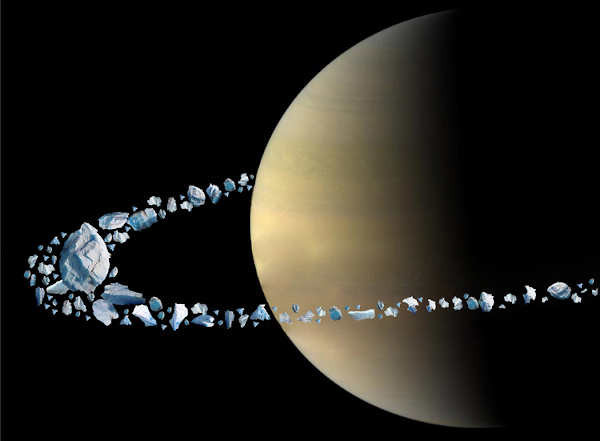
Scientists now show that the rings and the tilt are intimately linked, and that the key is a former moon of Saturn that was torn apart some 160 million years ago to form the rings. The researchers dubbed the lost moon Chrysalis because it blossomed into the rings much as a chrysalis transforms into a butterfly.
The new proposal for how Saturn became “Lord of the Rings” in our solar system and how Saturn got its axial tilt was published today in the journal Science. The lead author is Jack Wisdom, a professor of planetary science at the Massachusetts Institute of Technology, with key contributions from Burkhard Militzer at the University of California, Berkeley.
Militzer, UC Berkeley professor of earth and planetary science, was part of a team that in 2019 concluded that the rings of Saturn are relatively recent, having formed a mere 100 million years ago and perhaps even more recently.
The planet itself is as old as the solar system, about 4.5 billion years. The rings could be debris left over from the tidal destruction of a former icy moon of Saturn or the remains of a comet that strayed too close to the planet.
The new theory proposes that the rings are from a former moon and provide an estimate of how massive that moon was — about the size of Iapetus, Saturn's third-largest moon — and why the moon got so close to the planet that it was torn apart.
The researchers conclude that about 99% of Chrysalis ended up swallowed by the gas giant planet, with the remainder forming the rings.
“The tilt is too large to be a result of known formation processes in a protoplanetary disk or from later, large collisions,” Wisdom said. “A variety of explanations have been offered, but none is totally convincing. The cool thing is that the previously unexplained young age of the rings is naturally explained in our scenario.”
The dance between Saturn and Neptune
Astronomers have suspected before that Saturn’s axial tilt comes from gravitational interactions with its outer companion, Neptune, because Saturn's tilt precesses, like a spinning top, at nearly the same rate as the precession of the orbit of Neptune. Such an interaction is called a resonance.
In the new study, the researchers conclude that, for billions of years, Neptune and Saturn were in a resonant dance that caused the tilt of Saturn’s spin axis. But the outward movement of Saturn’s moon Titan — the second-largest moon in the solar system — destabilized the Saturn system, causing it to lose a moon and fall out of resonance. The result? A bright and beautiful set of rings that grace the planet today.
Like most planets, Saturn likely formed with its rotation axis perpendicular to its orbital plane. The planet’s rapid rotation slightly flattened its shape, allowing the sun and other planets to exert a torque that tilted the axis.
Saturn’s 83 known moons — in particular, Titan — provided other levers to tug on. Over the history of the solar system, such tugs not only tilted Saturn’s axis, but caused the axis to wobble, or precess, like a top. Earth’s rotation axis also precesses.
One explanation for the large tilt of Saturn’s rotation axis today — currently 26.7 degrees versus Earth’s 23.5 degrees — is that the precession is locked in a resonance with the precession of the orbit of Neptune, a planet half its size and more than three times farther from the sun than Saturn. This resonance would have turned a slight tilt of Saturn’s rotation axis into a big tilt.
Several years ago, a study concluded that the two planets are still locked in resonance, but Wisdom found it hard to confirm that result, primarily because the angular momentum of Saturn was not precisely known.
The higher the angular momentum — a product of a planet’s spin rate and its moment of inertia, that is, the distribution of mass within the planet — the more resistant a system is to torques from the sun or other planets.
“Jack came to us and said, “The only thing I don't know for sure is this angular momentum,’” Militzer said. “If it's very large, then the system is in resonance, and Neptune can do the job: We understand why the planet formed spinning vertically, and Neptune has tilted it over time. If, on the other hand, the angular momentum is small, then the whole thing falls apart, and you have to come up with some other theory why Saturn would spin on its side.”
Thanks to measurements of Saturn’s gravity field made by the Cassini mission in 2017 — the same measurements that allowed Militzer and his colleagues to estimate the mass of the rings and their age — Militzer and co-authors were able to provide a more precise determination of the planet’s moment of inertia and to calculate the angular momentum.
Surprisingly, it turned out to be just a tiny bit too small for the two planets to be in resonance today. But calculations showed that Saturn would have been in resonance if it had once had an additional moon.
So how, then, did Saturn get out of its multi-billion-year resonance with Neptune? In computer simulations, Wisdom and his colleagues tested various scenarios. The most likely, they found, is that Saturn’s moon Titan — which currently is migrating rapidly outward from the planet at some 11 centimeters per year — at some point got in resonance with the orbit of another moon, Chrysalis, destabilizing its orbit.
Chrysalis eventually came so close to Saturn that the planet’s gravity tore it apart, with a portion of it settling into a ring. Given Titan’s current migration rate, that would have happened between 100 and 200 million years ago, they determined, matching the current estimate of the age of the rings.
“You're losing this whole moon, and then you can have one less handle to jerk Saturn around,” Militzer said.
Titan’s outward migration was only discovered recently, Militzer said.
“The rapid migration of Titan gives a new possibility for explaining the tilt of Saturn,” he said. “The formula for the rate of precession of the spin axis depends on the presence of the satellites. So, the system could have escaped the resonance if Saturn used to have an additional satellite that was lost, changing the rate of precession enough to escape the resonance, but leaving the system close to the resonance.”
The researchers hope that more precise measurements of the motions of Neptune and of Saturn and its moons will confirm their hypothesis.
"It's a pretty good story, but like any other result, it will have to be examined by others," Wisdom said. "But it seems that this lost satellite was just a chrysalis, waiting to have its instability."
Other co-authors are graduate student Rola Dbouk of MIT, Professor Emeritus William Hubbard of the University of Arizona, professor Francis Nimmo and graduate student Brynna Downey of UC Santa Cruz, and Richard French of Wellesley College in Massachusetts.
The work was funded by the National Aeronautics and Space Administration and the National Science Foundation.
Robert Sanders writes for the UC Berkeley News Center.
- Details
- Written by: Rotary Club of Lakeport

LAKE COUNTY, Calif. — The 30th running of the Konocti Challenge cycling event is set to take place Saturday, Oct. 1, in Lake County for one final time.
This cycling event, produced by the Rotary Club of Lakeport, brings in hundreds of cyclists and their guests to participate in this unique and fun and fitness-oriented event.
The ride is staged from the Skylark Shores Resort in Lakeport with the festivities beginning on Friday afternoon with local wine and beer tasting and the rider packet pickup from 4 to 7 p.m.
This final ride will feature the two “Nostalgia Rides” of 20 miles and 40 miles culminating in the after ride BBQ and live music.
The cyclists will be departing Saturday morning from the Skylark between 8 and 10 a.m. The 20 mile and 40 mile routes travel through Scotts Valley and to Kelseyville. The ride route maps can be found at www.konoctichallenge.com.
The ride has significantly impacted the Lake County economy for 30 years, bringing in hundreds of thousands of dollars to the Lake County community with hotels booked to capacity, restaurants filled and the shops and wineries seeing many visitors.
“This is an amazing event for our community and we are excited to bring all of these folks to our beautiful area,” said Konocti Challenge Ride Director and Lakeport Rotarian Jennifer Strong. “While this is the end of an era, it is our opportunity for us to show off the incredible assets we have and to encourage these cyclists to come back other times during the year.”
The ride has been highly regarded as one of the best in the state as was apparent with their Cycle CA! Magazine Awards for the Best Metric Century of 2014 and the 2015 Excellence in Service Award.
If you would like to register for the event, please do so online at www.konoctichallenge.com.
The deadline to register this year is Sept. 23 and no same day registrations will be available.
The event’s longtime sponsors are Calpine Corp., Eagle One Distributing, Lake County Tribal Health, and Kelseyville Lumber.
There are also still volunteer opportunities available – contact
The Rotary Club of Lakeport meets every Wednesday from noon to 1 p.m. at O'Meara's Brewing. Follow the club on Facebook at Lakeport Rotary to keep up to date on all Rotary activities and events.