 How to resolve AdBlock issue?
News
- Details
- Written by: Lake County News reports
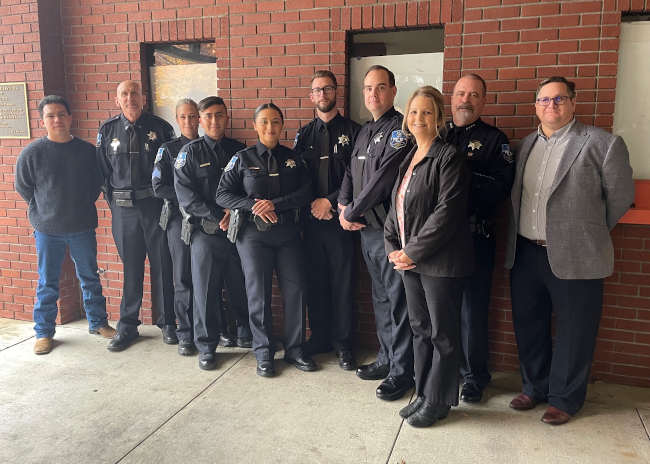
LAKEPORT, Calif. — The Lakeport Police Department welcomed two new officers following their graduation from the Santa Rosa Junior College Public Safety Training Center on Thursday.
Officers Marissa Onate and Alexis Pizano were subsequently sworn into office by Chief Brad Rasmussen, surrounded by city staff and family members who pinned their new badges on them.
Onate and Pizano, both 24 years old, were raised in Lake County and attended local schools. Both are Hispanic and speak English and Spanish.
After high school, Onate attended Santa Rosa Junior College receiving two associate degrees, one in administration of justice, and then attended Sacramento State University where she received a bachelor’s degree in administration of justice. While at these colleges Onate also worked for the campus police departments.
Before she was hired by LPD as a police trainee in July 2022, Onate served as a substitute teacher at Lower Lake High School.
During the graduation ceremonies, Onate was recognized as being tied for second place in student scenario testing.
Pizano, who immigrated to the United States at 2 years old, was a member of the local workforce in Lakeport before being hired by LPD as a police trainee in July of this year.
He also was raising his young daughter while attending the police academy.

The hiring of these officers, who went through extensive testing, background process and pre-academic agency training over the past 18 months, is part of the Lakeport City Council’s policy implementation on police retention and recruitment for our community.
They are also part of the city’s and police department’s goals of hiring to make the police department a reflection of the community it serves.
There were 43 total graduates from 16 agencies in the north coast region at this week’s academy graduation.
Some outstanding facts about this academy class are that it was No. 2 academically out of the 42 other current academy classes in California. No one failed from the class, 12 were veterans, 14 speak two languages, 18 have bachelor's degrees, five have master’s degrees and 15 were female — the most ever in a Santa Rosa Junior College Public Safety Training Center academy.
City staff attending the graduation and supporting the new officers were Rasmussen, City Manager Kevin Ingram, Lt. Dale Stoebe, Sgt. Sarah Hardisty, records and evidence Supervisor Tammy Prather, and officers Shaun Johnson, Juan Altamirano and Todd Freitas.
To learn more about the cadet hiring program, contact the Lakeport Police Department at 707-263-5491.

- Details
- Written by: Elizabeth Larson
The elections office said Friday that District 1 Supervisor Moke Simon and District 4 Supervisor Michael Green had not filed to run by the Friday deadline, nor had Sheriff Rob Howe.
Simon and Green had announced previously that they did not intend to run.
Howe, appointed by the Board of Supervisors last year to fill a portion of the term left unfinished by Sheriff Brian Martin’s retirement, also had said he did not plan to run after he completed the appointment period.
As a result, the elections office said that the nomination period to file for those offices — which will be on the March 5 presidential primary election ballot — has been extended for all qualified individuals other than the incumbent officeholders until 5 p.m. Wednesday, Dec. 13.
Those interested in more information about these offices are advised to contact the Lake County Registrar of Voters Office at 707-263-2372, 325 N Forbes St., Lakeport during regular office hours of 8 a.m. to 5 p.m. before the extended Dec. 13 filing deadline.
Email Elizabeth Larson at
- Details
- Written by: Seena Mathew, University of Mary Hardin-Baylor

Just as the shift to shorter days and colder weather can bring with it mood swings and other emotional challenges, the holiday season can also bring about somewhat predictable changes in mood and behavior.
Around this time of year, many of us experience more stress, anxiety and frustration than usual. These stressors have been linked to higher levels of heart failure and alcohol poisoning and an increase in deaths from stroke.
Learning how to recognize what brings about stress and what parts of the brain are actively involved can help with managing the stress response.
As a neuroscientist, I am often curious about the dynamic connection between behavior and the brain. I’ve learned that, biologically speaking, there are ways to manage your responses to holiday stressors through awareness of why they happen.
Harnessing the hypothalamus
Delays in itineraries, crowded airports and congested highways can easily lead to frustrations for those traveling to spend time with family or friends.
One region of the brain involved in your response to these types of stresses is the hypothalamus, a structure deep in the brain that is involved in trying to keep the body in a stable state, known as homeostasis. The hypothalamus works to regulate the autonomic nervous system, a system that coordinates involuntary responses such as heart rate, blood pressure and respiration. It is the key component of the fight-or-flight response to real or perceived threats.
When you are under stress, such as when you learn that your flight has been delayed or even canceled, your hypothalamus stimulates the release of stress hormones such as cortisol and epinephrine. These hormones in turn trigger physiological responses like increased heart rate, perspiration and feelings of irritation and frustration.
When you experience these stressors, deep breathing exercises can help stimulate the body’s parasympathetic nervous system. This is known as the “rest and digest” system because it is responsible for helping your body relax and recover from stress. By taking slow, deep breaths, you can engage the parasympathetic nervous system, which can in turn calm your nerves and reduce frustrations.
Family dynamics and interactions
Getting together with family during the holidays can bring about complicated emotions when there are conflicting personalities, unresolved issues or awkward family dynamics.
Frustrating or aggravating conversations with relatives often trigger a region of the brain known as the anterior cingulate cortex. The anterior cingulate cortex has a unique position in the brain, establishing connections with both the “emotional” limbic system and the “cognitive” prefrontal cortex.
This brain region is involved in monitoring and regulating cognitive processes, conflict resolution and error detection. It plays a role in processing frustration by signaling when there is a conflict between expectations and outcomes. The anterior cingulate cortex is also involved in what’s known as action-outcome learning, where you evaluate the consequence of an action and adjust your behavior based on feedback.
When you are feeling overwhelmed or frustrated, taking short breaks to step away from the situation can provide a fresh perspective and allow you to return with a clearer mindset. This break will allow you to reinforce this action-outcome learning, helping you learn to associate an action – a short break – with the outcome of the action, which is more relaxed breathing and a clearer mind.
Financial worries
The holiday season can put an unnecessary burden on those who are experiencing economic or financial hardship. The cost of hosting a holiday meal, buying gifts or traveling can contribute additional financial strain during an already stressful time.
The brain region primarily associated with memory and learning is the hippocampus. When you recall past experiences, such as how much you spent last year during the holidays or remember that the credit card bill is coming soon, you activate your hippocampus. The hippocampus is critical in the interplay of memory formation and recall and retrieval of individual episodic memories.
Some ways to reduce stress may be to make gifts for friends and family instead of purchasing them. To help cut down on travel costs, perhaps take a virtual holiday visit now, followed by an in-person visit later when it is less expensive or when financial strains have eased. When reminded of stressful experiences, the hippocampus sends signals to the hypothalamus and other brain regions to help restore balance in your mind. The hippocampus also aids in your adaptation to these stressors by helping you learn how to adjust your expectations. In the end, you have to remind yourself that it truly is the thought that counts most.

Loneliness and isolation
Feelings of isolation and loneliness can arise for those of us who may not have family or friends to celebrate with, or perhaps are unable to travel to see those we love.
This is where the “default network” of the brain plays a role. This network, made up of brain regions including the amygdala, is involved in thoughts of future planning, reminiscing and imagining. The amygdala is a part of the limbic system and is associated with processing of negative emotions to stimuli, such as the irritation from not being able to travel, and how you react.
Studies have shown that you can help improve your mood and reduce feelings of frustration and irritation by having a regular exercise routine. Physical activity can be an effective outlet for releasing built-up tension and stress. Aerobic exercise can also modulate connections between and within the amygdala and help reduce feelings of depression. As an added bonus, if you work out in a gym or park, you have an opportunity to be around others, which can help you feel more connected with communities of people with similar interests.
Political discussions
Family gatherings can lead to discussions about current events or politics, which can result in heated debates and disagreements among family members. These conversations can be very frustrating and even upsetting, especially in today’s polarized world.
The prefrontal cortex is an area of the brain involved in impulse control, decision-making and emotional regulation. It plays a crucial role in assessing certain situations, such as supercharged conversations, and it helps you evaluate and consider your potential actions and temper your emotional responses. Understanding what triggers your frustration in these situations is crucial to developing proactive strategies to manage or avoid them.
For instance, this might take the form of empathizing with the opposing side or perhaps stepping away from the table when voices start to rise or you feel your emotions building. The prefrontal cortex plays a dual role in regulating the relationship of your initial emotional reaction and the shift to your empathetic emotion. Your ability to build empathetic perspectives and increase cognitive control helps to further develop your prefrontal cortex, potentially making it easier to de-escalate the next time around.
One step at a time
Reducing frustration is a gradual process, and different strategies work for different people.
It is important to identify the root cause of your stress and frustration so that you can develop your own targeted coping strategies. Some examples include engaging in a hobby, listening to music, going on a walk or run, or simply practicing relaxation techniques. It is essential to experiment with various techniques and not be afraid to move away from ones that don’t work and toward ones that do.
The most important thing to remember is that retraining your brain is more of a marathon and not a sprint. It will include trial and error and open-mindedness, but if you focus on identifying your triggers and adapting your own coping strategies, it will almost certainly get better with time.
Seena Mathew, Assistant Professor of Biology, University of Mary Hardin-Baylor
This article is republished from The Conversation under a Creative Commons license. Read the original article.
- Details
- Written by: DENNIS FORDHAM

Parents typically do not want their surviving children to fight over their inheritances after the parents die. Careful planning may reduce the risk of foreseeable in-family conflicts. Let us discuss.
When real estate is involved, it is quite possible that one or more children may hope to inherit a particular piece of property. Sometimes a family discussion between parents and children about the division of real estate may allow the family to reach an agreement or at least get the children to respect the division. This is not always possible.
With later in life blended families getting family consensus may be more difficult if the couple’s two sets of children were never close to one another.
Some children may expect their biological parent to leave the assets that their parent brought into the second marriage to their own children.
Of course, a stepparent can leave his or her separate property to their own children without any concern over whether their step children (provided they are not also the step parent’s heirs) approve such gifts.
The allocation of different real properties to individual children might involve some equalizing monetary gifts if the parents want to treat all children equally.
Such monetary gifts might be funded through life insurance on the parent’s lives or by the successor trustee borrowing against the real estate.
Such equity borrowing means that the child who inherits the real property will take subject to the loan and will pay-off or refinance the debt upon distribution.
Family businesses also require special consideration because some children are personally involved in the business but other children are not.
Accordingly, consideration may be given to putting the business into a partnership or a corporation. The children who are involved in the business may be given authority over the operations by making them general partners or executive officers in the corporation.
The children who are not involved can be made passive partners or be given ownership interests that do not involve participation in the business operations.
Valuable and/or sentimental heirlooms also require special attention. Consider an historical artifact (e.g., a civil war sword) that has been in the family’s possession for many generations. It has economic and sentimental value that are difficult to offset with anything remotely equivalent.
Despite the parents’ best efforts to harmonize their children to accept their estate planning gifts it may prove impossible to reach full acceptance. If so, the parents will want to protect their estate plan against anticipated future attack.
The type of protection varies depending on the circumstances and the anticipated nature of any future attack. One possible future attack is that the disgruntled child will allege that the parent was coerced into giving the certain assets, or giving a greater inheritance, to one child than another.
The estate planning attorney may work, while the parent is alive, to document that such alleged coercion is (hopefully) unfounded.
A no contest clause can be used to dissuade a disgruntled beneficiary from contesting the trust. Under a no contest clause, if the disgruntled beneficiary contests (disputes) the terms of the trust and loses their lawsuit then they also lose what they would otherwise have inherited as their share of the trust estate.
Thus, a beneficiary must have something significant to inherit under trust for them to think carefully about possibly losing their inheritance.
It is even possible to petition the court to confirm the terms of the trust in order to force any contest to the trust while the parent is still alive and can testify. This approach may make sense in some high value estates.
What estate planning approaches are appropriate in any given family situation depends on the family relationships, the client’s wishes and the assets that are involved.
The foregoing brief discussion is not legal advice. Consult a qualified attorney or financial advisor for guidance.
Dennis A. Fordham, attorney, is a State Bar-Certified Specialist in estate planning, probate and trust law. His office is at 870 S. Main St., Lakeport, Calif. He can be reached at