 How to resolve AdBlock issue?
News
- Details
- Written by: PRESTON DYCHES
What's Up for December? The best views of the Moon and planets, the Geminid meteors are set for a great show, and a chance to observe an asteroid with your own eyes.
The Moon visits the bright planets in the sky, in turn, over the course of the month, beginning with four mornings in early December – the 7th through the 10th – when you can catch a lovely grouping of Venus, the crescent Moon, and bright star Spica in the southeast.
Then on the 17th, you'll find the crescent Moon hanging just below Saturn in the southwest for the first few hours after sunset. Most binoculars will reveal both of them in the same field of view. And for a challenge, see if you can spot Saturn's giant moon Titan as a faint dot just off to the planet's side here.
Later that week, the nearly full moon hangs out with Jupiter over two nights on the 21st and 22nd. You'll see them toward the southeast early in the night, and they travel westward across the sky together all night long.
The year's most reliable meteor shower, the Geminids, takes place annually in December. While the Perseids tend to get a bit more attention because they occur during warmer weather in the Northern Hemisphere, the Geminids usually produce more meteors. At their peak, you may even see a meteor every minute.
The shower peaks overnight on December 13 and the morning of the 14th. Viewers in the Northern Hemisphere can look for meteors as early as 9 or 10 p.m. on the 13th. The hourly number of meteors should increase after that, with the greatest number flashing through the sky between midnight and morning twilight.
Southern Hemisphere skywatchers can also see the Geminids, though they appear in the middle of the night, and at about a quarter of the Northern rate.
If you have clear skies, conditions should be ideal for this year's peak night, which is just one day after the new moon, leaving the sky nice and dark all night. The meteors appear to radiate from the constellation Gemini, but you'll see more shooting stars if you look straight overhead and take in as much of the sky as possible.
An illustrated sky chart shows the constellation Gemini (at lower left) and the upper part of Orion (at upper right). A diagonal line in the sky between Orion and one of the legs of the Gemini twins is labeled "Vesta, December 1 to December 20."
Want to see an asteroid with your own eyes? Asteroid Vesta reaches opposition this month, meaning it's located directly on the opposite side of Earth from the Sun. This is also around the time Vesta is closest to Earth, so it's at its brightest and easiest to observe.
Occasionally Vesta is close enough to Earth at opposition that you can almost see it with your eyes alone. But this year, you'll want to use binoculars or a small telescope to search it out.
NASA's Dawn spacecraft got super close to Vesta, orbiting the oval-shaped world in 2011 and 2012. It found that Vesta formed in our solar system's first couple of million years, and mapped the surface in great detail.
This December, Vesta is highest overhead around 1 or 2 in the morning (which is ideal for telescope viewing), but you can observe it as early as about 10pm, when it will appear about halfway up the eastern sky.
Locate Vesta in between the raised arm of Orion, here, and the leg of Castor in Gemini, here. On December 1st, you can find Vesta along a line between Betelgeuse and this star, Tejat. A week later Vesta has moved so that it appears along this line between Betelgeuese and Propus, here. A plain old pair of binoculars should reveal Vesta a couple of finger widths to the west of these two stars. Use your favorite skywatching app as a guide to Vesta's location within the starfield you see on whatever night you're observing.
And if you're hungry for more asteroid exploration, there's more on the way! NASA's Psyche mission recently launched on its journey to metal-rich asteroid Psyche, and our Lucy spacecraft just flew past asteroid Dinkinesh with its little satellite asteroids, at the start of November. Lucy is heading for the Trojan asteroids, a unique family of space rocks that share Jupiter's orbit and are likely to be remnants of the same primordial material that formed Jupiter and the other outer planets.
And if that sounds interesting to you, maybe you're ready to add "asteroid observer" to your list of accomplishments, as you look for Vesta in the December sky.
Stay up to date on NASA's missions exploring the solar system and beyond at science.nasa.gov.
Preston Dyches works for NASA's Jet Propulsion Laboratory.
- Details
- Written by: Elizabeth Larson
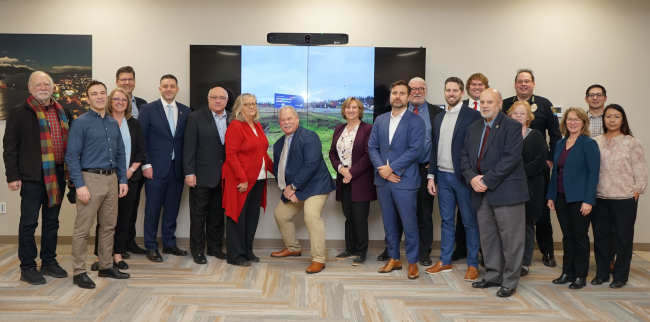
CLEARLAKE, Calif. — During a special Thursday morning meeting, the Clearlake City Council voted unanimously to sell a property at the former Pearce Field airport property to Adventist Health Clear Lake to build a medical facility, a $50 million investment expected to boost the city’s economic development and its health outcomes.
“As you know, this is something that’s been a long time coming,” City Manager Alan Flora told the council, noting during the meeting the challenges that led to finalizing the agreement.
During the meeting, which ran just under 20 minutes, the only item was the council’s consideration of the agreement to sell to Adventist three acres of property at the former airport located at 6820, 6840 and 6860 Old Highway 53, just north of Airport Road.
The purchase price: $1.
That’s in exchange for Adventist’s commitment to invest tens of millions of dollars to build the facility, plus millions more that the new clinic is expected to draw as it helps draw tenants for the commercial center the city is developing at the site.
On the three-acre property, Adventist Health plans to build a 38,000 square foot rural health clinic that would provide a wide range of medical services including family medicine, pediatrics and various specialties.
It’s expected that the new facility, once it opens in 2026, would draw up to 165,000 patient visits per year and anchor a major new commercial development at the site.
The location puts the new facility just across Highway 53 from its main hospital building.
While there’s not a commitment at this time, City Manager Alan Flora said the city is reserving an additional 10 acres in the event Adventist Health Clear Lake wants to do additional development there.
He pointed out that in the sales agreement, possible new development could include an imaging center and even a new hospital.
Flora said that, in reserving the property for that potential use, the city is giving Adventist Health Clear Lake timelines. If Adventist decides to go another direction, that will free up the land.
It was a little over five years ago that the city began discussions with Adventist Health Clear Lake about the possibility of having them be one of the anchors of this development, Flora said.
“Finally the first piece of that is coming together and is before you for consideration today,” he said.
Adventist is the largest employer in the city and probably the most important contributor to health and well being in Clearlake and throughout the county, said Flora, adding that the city is happy to partner with them.
“They really live out the vision that they express,” he said, adding, “There’s a lot more good things to come, starting with this project here.”
The purchase and sale agreement is the first step, he said.
A major investment
Flora said Adventist Health is prepared to move forward with developing the medical office building, which he said will be a $50 million investment from Adventist Health.
The city is committing to do the environmental review and provide the infrastructure to the site, Flora said.
During escrow, a number of things need to happen, including starting environmental review, which Flora said will consist of a full environmental impact report, or EIR, due to the size of the project.
An EIR is the highest level of review under the California Environmental Quality Act, and Flora said the city will complete it not just for the medical facility but also for the larger city owned property, which totals just a little over 40 acres. That environmental review is expected to start in the new year.
The 165,000 annual patient visits it’s expected to draw will be important for the additional retail development as part of the overall complex, Flora said.
Flora recognized Mayor Russell Perdock and Councilman Dirk Slooten for their work on the project over the years, as well as Colleen Assavapisitkul, president of Adventist Health Clear Lake, and Judson Howe, network president of North Coast Network at Adventist Health for their efforts.
Assavapisitkul thanked the council members for their consideration of Adventist’s proposal to do the work in collaboration with the city. “It’s an honor for us to be able to be at this point and do this work.”
Howe thanked the city for entrusting the care of their neighbors to Adventist, noting that it’s a real privilege. He also thanked Flora for providing a vision for the project moving forward.
“Serving our community is something we wake up every morning to do,” said Howe, adding that they serve communities with big health inequities.
Councilmember Joyce Overton asked how many new employees the new facility would have.
Howe estimated that, based on the patient visits, it would be about 75 full-time equivalents, with the actual employee number possibly being greater.
In addition to physicians, jobs would include a variety of positions such as environmental services and nutrition, with hourly pay ranging from $25 to $75 an hour, Howe said.
“It’s been a long time coming. This is so exciting for the city. Your investment in the community will spur economic growth. All the health statistics will become better and I’m so excited about it,” said Slooten.
He said the city and Adventist started the discussion quite some time ago. “We’ve been patient,” said Slooten, adding that on Thursday they could finally announce it.
Perdock said people in the city have been waiting for something to happen at the old airport site for growth and vision, and to be a big boost for the economy, and it’s been so long in coming. “I just want to thank you for partnering with us.”
He asked the Adventist team to give an idea of the project’s scale and scope.
Howe said primary care will be a key focus, along with behavioral health, addiction medicine and specialty services.
Assavapisitkul said that as they design the building, they are considering other services such as surgical and women’s care services. While the plans aren’t finalized yet, she said they are looking at what will be most beneficial to the community at that location.
Overton asked if there are any plans for a detox center there, which she said is a major need for those with mental health issues as well as the unhoused in the community. She said she hoped they put it in their plans.
Howe said they want to address those issues in their care continuum and are committed to that conversation.
Conrad Colbrandt, president of the Redbud Health Care District, thanked the council and Flora for their tenacity. He said the project would have never happened without Assavapisitkul, Howe and Eric Stevens, president of the Northern California Network and Hawaii State Network, pushing the effort from the corporate side.
“It’s going to be a great thing for health care in Clearlake and south Lake County,” Colbrandt said, adding it will also benefit patients and help recruit more physicians.
Colbrandt said the facility will be a great anchor tenant, and with its number of annual visits, should help the city fill out the sites at the commercial development.
Flora in turn noted that Colbrandt had “a little bit of tenacity” as well in the process.
Slooten moved to approve the sale agreement, with Councilman Russ Cremer seconding and the council voting 5-0.
After the vote, Flora said they had meant to go to the site for a picture but, due to the rainy weather, they instead planned to have the city and hospital representatives take a picture there at the council chambers with a photo of the new hospital sign at the property as a backdrop.
Flora said City Clerk Melissa Swanson had the agreement so everyone could sign it.
That was followed by a round of applause.
Key anchor projects
In a followup statement issued on Thursday evening, Adventist Health Clear Lake said that, “With a focus on providing exceptional patient care, the clinic will feature a significant number of exam rooms to accommodate the growing healthcare needs of the community. This expansion of rural health services will alleviate the crowded conditions in the existing clinics and will help to improve access to primary care as well as other specialized services to address specific medical conditions.”
"We are thrilled to embark on this partnership with the city of Clearlake," Assavapisitkul said in the written statement. “Lake County has been persistently ranked in the bottom tier of the state of California for health outcomes and health factors. By establishing this new rural clinic, we are working to meet the healthcare demands of the community to change that statistic while contributing to the local economy. This collaboration will undoubtedly enhance the overall well-being of Clearlake residents.”
Also quoted in the statement was Perdock, who said that the city’s partnership with Adventist Health “is a significant step forward in our commitment to provide increased healthcare services to our community.”
He added, “The new clinic will not only create job opportunities but also improve the quality of life for our residents and businesses. The clinic will also serve as one of the key anchors in our upcoming redevelopment of Pearce Field along with the Fairfield Inn and Suites and additional retail attractions to be announced soon.”
In July 2021, the council approved the sale of two and a half acres of the airport property to MLI Associates LLC, owned by Matt Patel, for the 75-room Fairfield Inn by Marriott hotel, with a meeting hall and event center.
That project — and the city’s plans for a new road project on 18th Avenue — hit obstacles in the form of a lawsuit filed against the city in March year by the Koi Nation of Northern California, who faulted the city’s environmental review because it adopted a mitigated negative declaration rather than completing an EIR, and arguing that the city didn’t properly consult with the tribe.
The case was argued before Judge Michael Lunas on Oct. 20. On Nov. 20, Lunas ruled in the city’s favor, finding for the city on all of its arguments, among them, that it was within its rights in making the environmental determination, that its decisions were based on facts and that the city had properly consulted with the tribe.
City officials expect that ruling to clear the way for the road and hotel project to resume.
Email Elizabeth Larson at
- Details
- Written by: LAKE COUNTY NEWS REPORTS
While the majority of the 330,000-acre monument is located in Lake County, no meeting on the expansion is planned here. Nor will it be live-streamed.
The meeting in Woodland will take place from 2 to 4 p.m. Wednesday, Dec. 13, at the Community Services Department, 2001 East St. in Woodland.
Speakers will include Nada Wolff Culver, principal deputy director, Bureau of Land Management; Karen Mouritsen, Bureau of Land Management — California director; and Wade McMaster, Mendocino National Forest Supervisor, representing Regional Forester Jennifer Eberlien.
The community meeting responds to requests from local, county, state and tribal officials, as well as pending legislation in Congress, calling for the protection of the landscape as Berryessa Snow Mountain National Monument’s expansion area to be managed by the BLM and USFS.
In September, Secretary of the Interior Deb Haaland visited Berryessa Snow Mountain National Monument and the proposed expansion area to meet with tribal leaders, local elected officials, and community members to hear about their vision for conserving the natural- and cultural-resources on BLM-managed public lands in Lake County.
The community meeting is part of the Biden-Harris administration’s commitment to support locally led conservation efforts across the country.
- Details
- Written by: LAKE COUNTY NEWS REPORTS
The Training, Retention, and Investment Now, or TRAIN, Act expands and makes permanent the Strengthening Community Colleges Training Grants program at the Department of Labor, or DOL, which provides funding to community colleges for partnerships with local employers.
“Workforce training programs help put students on a track to good-paying careers in in-demand fields,” said Thompson. “I am proud to co-author the TRAIN Act to create a competitive grant program so that schools like the Santa Rosa Junior College receive the funding they need to train workers for careers in good-paying jobs. I look forward to ensuring that workforce training programs receive the funding they deserve to set more Americans on a path to a successful career.”
“It’s important that our students are ready to pursue the steps along their desired paths when they graduate, and our community colleges need equal access to resources to support the next generation of American workers,” said McBath. “The Strengthening Community Colleges Training Grants are making monumental change in our communities, and the TRAIN Act takes an important step to protect them. I am proud to support our workforce by protecting and expanding these vital programs, and I thank my colleagues for their partnership.”
“In Connecticut, our 14 community colleges serve as an affordable bridge to higher education and long-term success for students of all ages. The TRAIN Act expands the Department of Labor Strengthening Community Colleges Training Grants they rely on to provide quality services to communities. These grants increase the capacity of community colleges in offering equitable access to training for in-demand industries,” said Hayes. “I am a graduate of Naugatuck Valley Community College and know how impactful these institutions are in increasing access to career training and education for low-income students. This legislation is the next step forward in providing more Americans a pathway toward a good-paying job and rewarding career.”
“Our vision for a better and more equitable future starts with making real investments in people and opportunities,” said Bowman. “With the TRAIN for a Better America Act introduced by Congresswoman McBath, we are connecting students to transformative educational and workforce development opportunities to prepare them for success in their careers. Solving our nation’s most pressing issues will take deep collaboration and intentional policymaking that recognizes the untapped potential in our communities and the importance of establishing and supporting local partnerships that uplift workers, students, and families. As a lifelong educator, I've seen just how impactful our schools — especially our community colleges — can be when they serve as holistic centers of growth and development for students, families, and the community at large. This legislation is a critical step forward as we seek to bring investments and resources to ensure access to high quality workforce development aligned to local needs.”
“Community colleges are essential to developing a robust workforce to meet the needs of future industries,” said Takano. “As a public school teacher for 24 years and a community college trustee for more than two decades, I understand how impactful the Department of Labor’s Strengthening Community Colleges Training Grants can be in developing career pathways and fill in gaps in barriers to completing a student’s education. I am proud to co-lead the Training, Retention, And Investment Now (TRAIN) for a Better America Act with my colleagues to codify and expand this funding for years to come.”
Community colleges have long provided vital access to higher education for low-income and nontraditional learners.
However, community colleges struggle to build the capacity they need, and many students face difficulties finding employment after graduating.
Under the Workforce Innovation and Opportunity Act’s, or WIOA, demonstration authority, DOL has begun awarding Strengthening Community Colleges Training Grants to expand online and technology-enhanced learning in industries such as health care, logistics, and cybersecurity.
These grants expand the capacity of community colleges to collaborate with employers and the public workforce development system to meet local and regional labor market demand for a skilled workforce.
DOL has awarded tens of millions of dollars in grants to community colleges around the country in 2023.
The TRAIN Act codifies and expands the Department of Labor’s Strengthening Community Colleges Training Grants, authorizing a competitive grant program that aims to build community colleges’ capacity to provide employment and training programs leading to post‐secondary credentials for in‐demand industries or occupations.
The grants provide for:
• Developing or scaling up career training, career pathways, or work‐based learning options like apprenticeships.
• Assisting individuals with barriers to employment with accessing programs.
• Providing support services to help participants complete education and training.
This bill is endorsed by the National Skills Coalition, Third Way, Progressive Policy Institute and the Association of Community College Trustees.
Thompson represents California’s Fourth Congressional District, which includes all or part of Lake, Napa, Solano, Sonoma and Yolo counties.