 How to resolve AdBlock issue?
Recreation
- Details
- Written by: California Department of Fish and Wildlife
Question: Why are Pro Bass Tournament participants allowed to keep fishing when they have five fish in their possession? When they continue to fish and they boat their sixth fish, aren't they in violation of the five-fish limit rule? I realize that they release the smallest fish, but for just a little while, they do have six fish in their possession. A rule is rule! (Craig)
- Details
- Written by: Editor
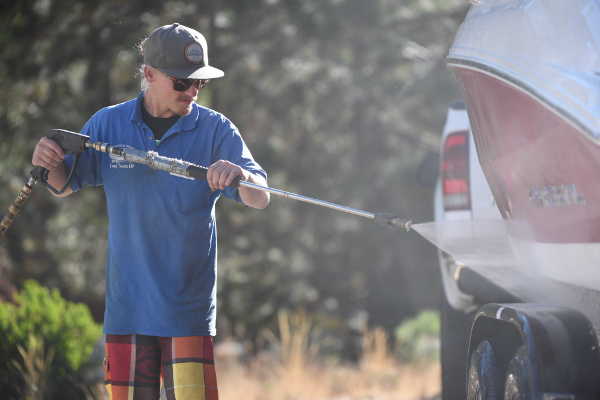
LAKE TAHOE – Roadside stations for inspections and decontaminations of motorized boats and watercraft are officially opening for the 2018 boating season.
Locations, hours of operation and opening dates are as follows.
Opening Tuesday, May 1, 8:30 a.m. to 5:30 p.m., seven days a week:
– Meyers: at the junction of US Highway 50 and Highway 89;
– Spooner Summit: at the junction of US Highway 50 and Highway 28 in Nevada;
– Alpine Meadows: Highway 89, off Alpine Meadows Road north of Tahoe City.
Opening Thursday, May 17, 8:30 a.m. to 5:30 p.m., seven days a week:
– Truckee-Tahoe: Highway 267, off Truckee Airport Road.
The agency is celebrating the success of fighting aquatic invasive species for the past 10 years. A huge part of this success is due to the boat inspection program that has allowed us to prevent new species from entering Lake Tahoe.
“The fact that we are entering our 10th season with no new invasions, proves that boat inspections are doing what they are intended to do – protect Lake Tahoe,” said Dennis Zabaglo, Tahoe Regional Planning Agency’s aquatic resources program manager. “The Tahoe RCD boat inspectors have allowed us to be ready for any invasive species that could potentially enter the lake.”
All motorized watercraft require an inspection for aquatic invasive species prior to launching into Lake Tahoe, Fallen Leaf Lake, Echo Lake and Donner Lake.
Invasive species, such as quagga mussels, New Zealand mudsnails, and hydrilla, are known to multiply quickly and colonize underwater surfaces, including docks and piers, water supply and filtration systems, buoys, moored boats, and even the beautiful rocky shoreline. They destroy fish habitat, ruin boat engines, and can negatively impact water quality and the local economy, recreation, and ecosystem.
Boats and other watercraft are the largest transporters of AIS, and the inspection program is critical to preventing their spread into Lake Tahoe and other waterbodies. Knowingly transporting aquatic invasive species into Lake Tahoe is against the law, and violators may be subject to monetary penalties.
Since 2008, Tahoe RCD inspectors have performed more than 70,000 vessel inspections and decontaminated 32,576 of them using hot water. Throughout the past 10 seasons inspectors have found hundreds of vessels containing foreign species such as mussels, snails and plant material.
“Boaters are encouraged to visit the website or call the hotline to learn how to clean, drain, and dry their boats prior to arriving at inspection stations,” said Chris Kilian, aquatic invasive species program manager for the Tahoe Resource Conservation District. “Save time and money by making sure to drain all water from the intake systems, clean out your vessel, and make sure it is dry. Taking these three simple steps will get you on the water faster.”
Annual watercraft inspection fees remain unchanged from last year. The “Tahoe In & Out” inspection ranges from $35 for personal watercraft and vessels under 17 feet and up to $121 for vessels over 39 feet.
The “Tahoe Only” inspection sticker is $30. If your vessel is not Clean, Drain, and Dry, decontaminations are available for $35. There is an additional $10 fee for the decontamination of ballast tanks or bags.
Invasive species are highly opportunistic and can be transported by non-motorized water recreation equipment as well. The Tahoe Keeper program was created to inform the paddling community about the importance of inspecting equipment, including: kayaks, paddleboards, fishing equipment, inflatable water toys, and life jackets.
For more information visit www.TahoeBoatInspections.com/tahoe-keepers.
- Details
- Written by: California Department of Fish and Wildlife
The cards must be reported even if no lobsters were taken or no attempts were made to take lobsters.
Information collected from the cards provides CDFW with data necessary to monitor and manage California's spiny lobster fishery.
Card holders should review their report cards carefully and check that the information recorded is complete and accurate.
Any 2017-2018 Spiny Lobster Report Card holder who fails to submit online or return his or her card(s) by April 30 will be charged a non-return fee of $21.60 upon purchase of a 2018-2019 Spiny Lobster Report Card.
Otherwise, he or she may choose to skip the 2018-2019 fishing season to be able to purchase a spiny lobster report card a following season at no extra cost.
If multiple spiny lobster report cards were purchased, all cards, including lost cards, should be reported to avoid the non-return fee when purchasing a spiny lobster report card next lobster fishing season.
Spiny Lobster Report Card data can be submitted online at www.wildlife.ca.gov/FishingHarvest or by mail to CDFW - Lobster Report Card, 3883 Ruffin Road, San Diego, CA 92123.
For additional information and a list of frequently asked questions about this program, please visit CDFW's California Spiny Lobster Web page.
- Details
- Written by: California Department of Fish and Wildlife
CDFW will take comments and recommendations from the public and provide updates on habitat conditions, availability of water for wetlands and possible impacts to hunter access on these public lands.
State wildlife areas to be discussed are the Gray Lodge Wildlife Area and the Upper Butte Basin Wildlife Area Complex (Little Dry Creek Unit, Howard Slough Unit and Llano Seco Unit).
The meeting is scheduled from 1 to 3 p.m. in the Gray Lodge Wildlife Area's main office conference room, 3207 Rutherford Road, in Gridley.
CDFW's North Central Region covers all or part of 17 counties in Northern California and is one of seven CDFW regions in the state.
CDFW annually provides an opportunity for licensed hunters to comment and make recommendations on public hunting programs, including anticipated habitat conditions in the hunting areas on wildlife areas, through public meetings and other outreach.