 How to resolve AdBlock issue?
News
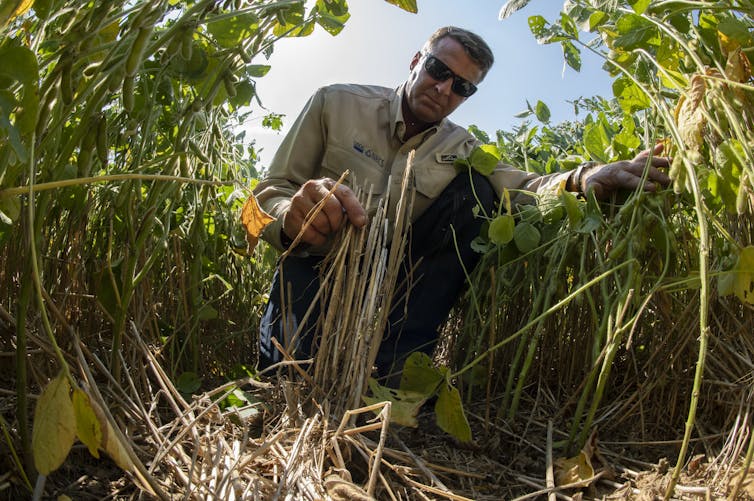
The COVID-19 pandemic and resulting economic shutdowns have severely disrupted and spotlighted weaknesses in the U.S. food system. Farmers, food distributors and government agencies are working to reconfigure supply chains so that food can get to where it’s needed. But there is a hidden, long-neglected dimension that should also be addressed as the nation rebuilds from the current crisis.
As scholars who study different aspects of soil, nutrition and food systems, we’re concerned about a key vulnerability at the very foundation of the food system: soil. On farms and ranches across the U.S., the health of soil is seriously compromised today. Conventional farming practices have degraded it, and erosion has shorn away much of it.
Iowa has lost about half the topsoil it had in 1850. Since they were first plowed, America’s farmland soils have lost about half of their organic matter – the dark, spongy decomposed plant and animal tissue that helps make them fertile.
The soil that produces our nation’s food supply is a weakened link slowly failing under ongoing strain. This breakdown isn’t as dramatic as what happened in the 1930s during the Dust Bowl, but it is just as worrying. Human history holds many examples of once-thriving agricultural regions around the world where failure to maintain soil health degraded entire regions far below their potential agricultural productivity, impoverishing the descendants of those who wrecked their land.
We believe there is an urgent need to rebuild soil health across the U.S. This can help maintain harvests over the long run and lay a solid foundation for a more resilient food system. Investing in soil health will benefit environmental and human health in ways that are becoming increasingly apparent and important.

Food production starts with soil
Soil is the foundation of the U.S. food system. Fruits, vegetables, nuts and oils come directly from plants grown in soil. Meat, poultry, dairy products and many farmed fish come from animals that feed on plants. Wild-caught fish and shellfish, which provide a tiny fraction of the typical American diet, are virtually the only exception.
As populations around the globe ballooned over recent centuries, so did pressure to force more productivity out of every available acre. In many parts of the world, this led to farming practices that degraded soil far beyond its natural fertility.
In the Southeastern U.S., for example, agricultural erosion stripped soil from hillsides a hundred times faster than the natural rate of soil formation. Today farmers in the Piedmont, from Virginia to Alabama between the Atlantic coast and the Appalachian mountains, coax crops from poor subsoil rather than the rich topsoil that early European settlers praised.
Researchers, government agencies and nonprofit groups recognize soil degradation as a national problem and have started to focus on rebuilding soil health. The U.S. Department of Agriculture’s Natural Resource Conservation Service helps farmers improve the health and function of their soils. Nongovernment organizations are recognizing the need to restore soil health on agricultural lands. And the 2018 farm bill directed new attention and funding to soil health programs.
Public health
Beyond growing food, soils support human, public and planetary health. Well before the current pandemic, experts in public health and nutrition recognized that modern agriculture was failing to sustain consumers, the land and rural communities. This insight helped spur the emergence of a new multidisciplinary field, known as food systems, that analyzes how food is produced and distributed.
But work in this field tends to focus on the environmental impacts of food production, with less attention to economic and social implications, or to links between farming practices, soil health and the nutritional quality of food. Many studies narrowly focus on greenhouse gas emissions from agriculture when addressing soils and sustainability, without including the many ecological benefits that healthy soils provide.
To be sure, man-made climate change is a major long-term threat to human and planetary health. But soil health is just as critical in its own right. Human actions have already harmed agricultural productivity in areas around the world. And when soil is degraded, food production systems are less able to weather future challenges that we can expect in a changing climate.
The study of soil health can also have its own blind spots. Often agricultural research focuses solely on crop yields or the impact of individual conservation practices, such as adopting no-till planting or planting cover crops to protect soil from erosion. Such analyses rarely consider linkages driven by dietary demand for specific foods and crops, or the effects of farming practices on the nutrient content of forage and crops that sustain livestock and humans.
Food systems experts have called for transforming food production to improve human health and make agriculture more sustainable. Some researchers have proposed specific diets that they argue would accomplish both goals. But fully understanding connections between soil health and public health will require greater collaboration between those studying food systems, nutrition and how we treat the soil.
Growing our values
Now that COVID-19 has deconstructed much of the national food supply network, it would be a mistake to pour efforts into simply rebuilding a flawed system. Instead, we believe it is time to redesign the U.S. food system from the ground up, so that it can deliver both soil health and human health and be more resilient to future challenges.
What would it take to do this? The foundation of a revised system would be adopting regenerative farming methods that integrate multiple soil-building practices, such as no-till, cover crops and diverse crop rotations to restore health to land. It would also take creating and expanding markets for more diverse crops, as well as expanding regenerative grazing and promoting reintegration of animal husbandry and crop production. And it would require investing in research into the linkages between farming practices, soil health and the nutritional quality of foods — and what that all could mean for human health.
In sum, we think it’s time to rethink the food system, based on a recognition that providing healthy diets based on healthy soils is critical to achieving a healthier, more just, resilient and truly sustainable world.
Laura Lewis, Associate Professor of Community and Economic Development at Washington State University, and Dave Gustafson, project director at the Agriculture & Food Systems Institute, contributed to this article.
David R. Montgomery, Professor of Earth and Space Sciences, University of Washington; Jennifer J. Otten, Associate Professor, Center for Public Health Nutrition, University of Washington, and Sarah M. Collier, Assistant Professor of Environmental and Occupational Health Sciences, University of Washington
This article is republished from The Conversation under a Creative Commons license. Read the original article.
You have likely seen lightning flash from a storm cloud to strike the ground. Such bolts represent only a small part of the overall phenomenon of lightning, though. The most powerful activity occurs high above the surface, in Earth’s upper atmosphere.
Up there, lightning creates brief bursts of gamma rays that are the most high-energy naturally produced phenomena on the planet. Researchers recently measured these high-energy terrestrial gamma-ray flashes, or TGFs, using instruments on the International Space Station. The work helps reveal the mechanism behind the creation of the bright flashes we call lightning.
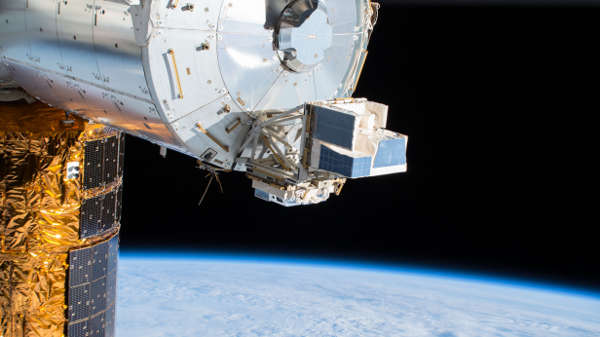
The instruments are part of the Atmosphere-Space Interactions Monitor, or ASIM, a European Space Agency Earth observation facility on the outside of the space station used to study severe thunderstorms and their role in Earth’s atmosphere and climate.
ASIM recorded other types of upper-atmospheric lightning known as transient luminous events, or TLEs, in addition to TGFs.
ASIM’s high-speed instruments helped researchers to determine the sequence of events that produces TGFs, as reported in a paper recently published in the journal Science.
“With ASIM, we see how the atmosphere and clouds bubble like a pot of stew on the stove,” said Torsten Neubert of the National Space Institute, Technical University of Denmark and lead author on the paper. “Convection brings humidity, dust and other particles into the upper atmosphere where they affect Earth’s radiation balance. Lightning is a measure of convection and can be relatively simple to put into weather and climate models.”
Lightning is a rapid discharge of electricity that temporarily equalizes opposite charges within a cloud or between a cloud and the ground. Charging of the cloud is powered by convection, with lighter ice particles carried aloft and heavier particles falling under the pull of gravity.
When these particles collide, they exchange charge, and the lighter particles carry positive charge up while heavier particles take negative charge down.
The atmosphere acts as an insulator between these electrical fields until the strength of the charge overpowers the insulating properties of the atmosphere.
Then the lightning leader – actually a long spark – forms between regions of the cloud or between the cloud and the ground, occurring so rapidly that it is hard for humans to see. When the leader connects to the ground, we see a bright flash of high current: the lightning stroke.
Neubert and his team observed a TGF occurring at the onset of a lightning current pulse, which then generated an elve.
Elves are expanding waves of ultraviolet emission in the ionosphere above a thunderstorm, like cosmic ripples from a pebble dropped into water. Measurements suggested that the onset of the current happens quickly at high amplitude and that the gamma-ray flash is generated by electric fields associated with the lightning leader. These observations provide evidence of a connection between TLEs and TGFs.
When a thunderstorm generates very high energy electrons that burst out into the upper atmosphere, they last only milliseconds but emit X- and gamma-rays that ASIM can measure. The experiment helped pinpoint what happens as these electrons are released.
“As lightning winds its way through a cloud, the atmosphere ahead may break down into a very fast pulse of very high current,” Neurbert said. “In the process, it flings out electrons, which create the bright flashes. Understanding this process opens up the inner life of lightning.”
Because lightning is dangerous, scientists tend to study it in the lab, but that cannot get to its true nature, Neubert added. “We can use this new information on how high energy radiation is generated to learn more about the processes inside lightning.”
TGFs occur at altitudes well above normal lightning and storm clouds, so measuring them is challenging. As the lowest platform in space, much lower than satellites, the space station places ASIM closer to what it measures. ASIM’s instruments also point directly downward from the space station, making it possible to catch as many of the photons in a lightning flash as possible.
Another space station instrument, NASA’s Lightning Imaging Sensor, or LIS, measured characteristics of lightning for 17 years beginning in 1997, but the satellite’s orbit covered only between 35 degrees north and south latitudes, primarily the tropics.
An identical LIS mounted on the space station in 2017 expanded that coverage to between 56 degrees north and south latitudes. LIS data helped scientists examine the relationship between lightning and severe weather.
Comparing ASIM data with that from LIS and other instruments helps make it more useful for weather predictions, Neubert says.
Ultimately, ASIM helps scientists better understand how thunderstorms affect Earth’s atmosphere.
“We soon will have continuous and almost full global monitoring of lightning from U.S., European and Chinese instruments in geostationary orbit. This coverage will improve weather and climate forecasts, provided you know how to use the data. That is where we hope ASIM helps,” Neubert said. “It’s an incredibly exciting time.”
For daily updates, follow @ISS_Research, Space Station Research and Technology News or our Facebook. Follow the ISS National Lab or information on its sponsored investigations. For opportunities to see the space station pass over your town, check out Spot the Station.
Melissa Gaskill works for the International Space Station Program Research Office at the Johnson Space Center.

LAKE COUNTY, Calif. – Lake County Public Health Officer Dr. Gary Pace said COVID-19 testing is now more available and affordable than ever in Lake County, thanks to the county’s recent partnership with Verily’s Project Baseline.
Pace said COVID-19 testing through private clinics can cost around $130, inadvertently discouraging some from getting tested.
Verily and Lake County Health Services offer free drive-thru testing at different locations around the county, open daily during the week.
Appointments are available up to 48 hours in advance, so it may look like there are no appointments available if you try to schedule further ahead.
Go to the Verily website to get screened and register.
Testing locations are in Clearlake on Mondays and Tuesdays and in Lakeport on Thursdays and Fridays.
Wednesday testing alternates between Clearlake and Middletown.
The next Middletown testing dates are Wednesday, June 10, and Wednesday, June 24.
Misconceptions about registration
There are some common misconceptions surrounding the Verily registration process:
– Google tracks your information. According to Project Baseline, their testing program will never be joined with your data stored in Google products without your explicit permission.
– You must have insurance. While the registration process asks for insurance information if you have it, insurance is not required for testing.
Pace said some have expressed frustrations surrounding the online registration process, and the county doesn’t want that to be a barrier for those who think they may have been exposed.
“We need adequate testing to ensure the health of our residents as well as to meet the governor’s mandate for reopening our beautiful county,” Pace said.
If the registration process is a barrier to testing for you, please call the Health Department at 707-263-8174 for assistance.
Isn’t COVID-19 testing pretty uncomfortable?
Pace said testing isn’t uncomfortable anymore. Initially, tests used a 6-inch nasopharyngeal swab, and some experienced discomfort or involuntary coughing.
Starting next week, far less invasive mid-turbinate swabs will be used. See “Option 2,” 1:14 into the video above.
Are there groups that should particularly consider regular testing?
People exposed to high traffic areas (workers in public buildings, grocery stores, gas stations and restaurants, residents and staff in nursing homes or congregate living situations, etc.) are at higher risk of getting COVID-19, Pace said.
Forty percent infected people never show symptoms, and people that do get sick are often contagious for a few days before symptoms appear, so testing people without symptoms is important.
“We really encourage the business community to allow your workers to get tested, and Verily is a great option,” Pace said.
Frequently asked questions on drive-thru testing are available here.
According to the latest data from the state Employment Development Department, or EDD, more than 5.6 million unemployment claims were processed since the pandemic began, and a total of $3.4 billion in benefits were paid last week alone.
In just the last three months, the EDD has paid just shy of the total unemployment benefits issued during the entire year at the peak of the Great Recession in 2010, which totaled $22.9 billion.
The EDD said that, to date, 5,174,833 Unemployment Insurance claims have been submitted by workers online for the period of March 14 to May 30.
The claims processed is a higher number, accounting for more than just those online but also those that came in by phone. That number for the same time period is 5,658,219 claims, EDD said.
Individuals claiming benefits so far total 4,015,504, according to the EDD’s latest report.
EDD introduces new help tools to assist workers
In recent weeks, EDD introduced a chat bot on Facebook (“Send Message”) as well as on the website (“EDD Help”) to answer claimants’ questions in English and Spanish, the EDD has also launched a new text message service.
The EDD has also launched a new revised page of frequently asked questions featuring the most common questions we are hearing about each week from our customers.
Here is a sampling of some of the most recent developments in serving California workers impacted by the pandemic.
What can I do if I have a question or want to know the status of my claim and I can’t get through on the call center lines?
In addition to a chat bot feature the EDD implemented on Facebook (“Send Message”) as well as website (“EDD Help”) to answer claimants’ questions in English and Spanish, the EDD has also launched a new text message service.
These texts notify individuals about updates on their UI claim including when the claim is processed in our systems and when the first benefit payment is issued on the claim.
The EDD is also now expanding this service to notify individuals when a federal extension is filed on their behalf, when we need further documents from individuals to verify their identity, and when we have received those documents verifying the identity. This will help keep individuals posted on developments with their claim and reduce the need to call for assistance, freeing up access to agents for those who have more complex issues and need to talk to a representative.
Text alerts are sent from 51074 to the phone number the claimant indicates on their UI application. There is no cost to use this service, but standard carrier fees for text messaging may apply and the service can only send a message, not reply to messages from a claimant.
Is EDD getting more staff to help keep up with the demand for benefits?
Yes, when unemployment was at a record low in February, the EDD had low federal funding and low staff. But as the workload has spiked, the EDD has received more federal funding to support a mass expedited hiring effort.
So far, the EDD has hired at least half of an initial 1,800 staff we are seeking to help process an unprecedented volume of unemployment claims, assist customers in our call centers, and review documents from claimants and employers to determine benefits.
The EDD is now also hiring an additional 1,200 for a total of 3,000 new staff over the next few weeks to bolster the delivery of critical unemployment services to Californians in need.
For more information about the positions being filled, visit the EDD Careers webpage.
If I’ve run out of my regular Unemployment Insurance benefits, how quickly can I get 13 weeks of extension benefits?
As of May 27, the EDD is regularly sweeping our system to identify claims that started on or after June 2, 2019 and all associated benefits are exhausted. If you do not have enough subsequent wages to make you eligible for a new regular UI claim, the EDD will automatically file a Pandemic Emergency Unemployment Compensation extension on your last UI claim. You will receive a notice through the mail about 5-7 days later with more information.
But for a faster process, check the Inbox of your UI Online account for an email about potential extension eligibility, and then a follow-up email within a few days about weeks available to certify for payment.
If my benefit year started before June 2, 2019, can I get extension benefits?
PEUC extension benefits are available on claims that started as early as July 2018 if you are fully or partially unemployed. Starting next month, the EDD will start mailing notices to those who used all their UI benefits sometime after July 2018 and before June 2, 2019, who were not included in Phase 1.
If you are in this group, you should not delay in applying for a new UI claim if you haven’t already done so since your benefit year has expired. If you are not eligible for a new regular UI claim, the EDD will automatically file a PEUC extension on your last UI
Claim.
Do I have to wait for an EDD Customer Account Number before I can certify my eligibility for payment?
The EDD will automatically complete your registration in UI Online for those who file their claim through UI Online and don’t have any issues requiring identity or wage verification. That means you can move more quickly to certifying your eligibility for payment rather than waiting on a notice through the mail with your EDD Customer Account Number, or EDDCAN. Look for an email that says “New Online Account Created.”
For all other claimants, look for the notice with the EDDCAN mailed to your address which you can use to finish your registration in UI Online and move to certifying for benefit payments. If you have received an Award Notice but have not received your EDDCAN email or notice, call 1-833-978-2511 from 8 a.m. to 8 p.m. seven days a week.
What can I do if my claim status shows 'pending'?
A “pending” status means a potential eligibility issue is identified on either your initial application for benefits or your certification for your benefit payment and staff will have to follow up if it can’t be automatically processed through our system.
This can occur for a number of reasons including EDD needing to first verify your identity or your wages which don’t match with our records.
In some cases a payment can be made after such a review. In other cases, the EDD is required to schedule a determination interview. You will receive a notice in the mail with the date and time of your appointment to speak with an EDD staff who will ask you questions about the eligibility issue. The staff person may also have to follow up with your employer.
Reasons that necessitate further fact-finding include your ability and availability to work, reasons for separation from your employer, and other eligibility requirements defined by law. The EDD will send you a notice in the mail if you are found ineligible for benefits, or the pending weeks will be processed and you will receive an update in the Inbox of your UI Online account.
The EDD recommends you continue to certify for any weeks that become available while your claim shows pending, in order to quicken the issuing of benefits if and when you are determined
Eligible.
I’m a full-time student who usually works part-time, but I am unemployed or have reduced hours due to COVID-19. Am I eligible for PUA benefits?
Yes, PUA benefits are available to people who work part-time, and who are unemployed, partially unemployed, or unable or unavailable to work because of one of the COVID-19 related reasons provided under the PUA program.
In addition, based on your work history, you may qualify for unemployment insurance benefits. The EDD will first determine whether you have sufficient work history to qualify for UI, and if you do not, you may qualify for PUA.
If you qualify for either UI or PUA benefits, you will receive an additional $600 in federal stimulus funds on top of your weekly benefit amount between March 29 and July 25, 2020.
I’m a full-time student who usually works during the summer months when school is not in session but I was not able to get a summer job this year due to COVID-19. Am I eligible for PUA benefits?
If you were scheduled to start or return to a summer job but the job offer fell through due to COVID-19, you may be eligible for PUA.
However, PUA does not provide benefits to people who have been unable to search for or obtain a job due to COVID-19 unless they are unemployed due to another COVID-19 related
reason provided under the PUA program.
The seventh annual California Invasive Species Action Week, or CISAW, runs from Saturday, June 6, through Sunday, June 14.
Historically, agencies, nonprofits and volunteer organizations across the state have teamed up to host events for CISAW.
This year, due to COVID-19 concerns, activities will be hosted online, including webinars, videos and Facebook live events. Visit www.wildlife.ca.gov/CISAW to view the schedule.
All Californians can help stop the spread of invasive species by taking small, everyday actions, such as landscaping with native plants, not releasing unwanted pets into the wild, reporting invasive species findings, and cleaning, draining and drying gear when recreating in bodies of water.
Additionally, the winners of CDFW’s annual California Invasive Species Youth Art Contest will be announced on social media during CISAW. The theme of this year’s contest was “Be a Habitat Hero.”
The mission of CDFW’s Invasive Species Program is to reduce the impacts of invasive species on the wildlands and waterways of California.
The program is involved in efforts to prevent the introduction of these species into the state, detect and respond to introductions when they occur and prevent the spread of those species that have been established.
For questions or more information about CISAW, please contact
Gov. Newsom will work toward a statewide standard for policing peaceful protests and ending the carotid hold.
This announcement follows the work California did last year to enact the nation’s strongest standard for police use of deadly force.
“We have a unique and special responsibility here in California to meet this historic moment head-on,” said Gov. Newsom. “We will not sit back passively as a state. I am proud that California has advanced a new conversation about broader criminal justice reform, but we have an extraordinary amount of work left to do to manifest a cultural change and a deeper understanding of what it is that we're working to advance. We will continue to lead in a direction that does justice to the message heard all across this state and nation.”
Gov. Newsom called for the creation of new standards for crowd control and use of force in protests.
He committed to working with the Legislature, including the California Legislative Black Caucus, the California Latino Legislative Caucus and other legislative leaders, in consultation with national experts, community leaders, law enforcement and journalists to develop those standards – much like the collaboration that produced AB 392 last year, California’s nation-leading use-of-force bill.
Additionally, he called for the end of the carotid hold and other like techniques in California, directing that the carotid hold be removed from the state police training program and state training materials.
He committed to working with the Legislature on a statewide ban that would apply to all police forces across the state.
Criminal justice reform has been a key priority of Governor Newsom’s first year in office. He placed a moratorium on the death penalty, citing racial and economic disparities in how it was applied. He proposed to close the Division of Juvenile Justice and proposed closing two state prisons. In his May Revision budget, he proposed expanding opportunities for rehabilitation and shortening prison time for offenders participating in treatment programs, in education programs and otherwise engaging in good behavior; as well as increasing access to higher education for young people who are incarcerated.
Gov. Newsom acknowledged on Friday that more action is needed, and stated that additional reforms around police practices, educational equity, economic justice, health equity and more must be addressed with urgency.