Dennis Fordham. Courtesy photo. Mineral rights are the ownership rights to underground resources, such as oil or natural gas. Mineral rights can be severed (separated) from the ownership of the surface land and so be owned by a different person.
Such rights can be acquired by purchase, lease, gift or inheritance, either outright or in trust.
Depending on where the mineral rights are located, the relevant state law may treat mineral rights within its state as either real property or personal property.
Examining the title instrument by which the mineral rights were acquired usually tells you whether it is real property or personal property.
Mineral rights may be transferred into a trust for ongoing management and future distribution as part of one’s estate planning.
Oftentimes, a person owns only a very small fraction or fragment of the total mineral rights associated with real property.
This often occurs because the land involved is very large and/or because mineral rights have to be repeatedly subdivided from one generation to the next. This fractionalization can be avoided by assigning mineral rights to a corporate entity for management and ownership purposes.
Interests in the corporate entity can then instead be gifted from one generation to the next.
The Division Order determines what royalties each mineral rights owner receives from the production of oil.
Ownership of mineral rights can sometimes generate valuable royalty income. Not all mineral rights, however, are productive assets. Ownership of mineral rights can sometimes be a long term wait and see game.
The good news may come unexpectedly when a letter from an oil production company asking to lease your mineral rights arrives. Owning non-productive mineral rights, however, presents a problem for a trustee because a trustee has a duty to make all trust assets productive.
Mineral rights are a special asset within one’s overall estate planning. Estate planning for Mineral rights can be done using either one’s will or trust.
However, before transferring mineral rights to a trust it is important to determine whether such transfer may affect or eliminate the income tax cost depletion allowance (tax deduction) on that ownership interest.
Special powers should be also be provided in the will or trust for a variety of reasons, including the following: to enable the representative to manage and lease the mineral rights; or to pool, consolidate, or unitize such mineral rights with others for exploration, development, management, or administration.
Combining multiple owners’ mineral rights may be necessary given fractionalization or fragmentation of the mineral rights associated with the land.
Lastly, some people own mineral rights and/or are owed unpaid oil and gas royalty income and do not even know it. Anyone wondering if they own mineral rights may wish to hire a title company to examine the chain of title in the county recorder’s office.
Also, one can also go to the state’s unclaimed oil and gas royalty website to examine for unclaimed royalty income. Otherwise, unclaimed property eventually escheats (belongs) to the state after a certain number of years.
The foregoing is a general discussion of a much more involved subject. Anyone confronting any issues discussed above should seek professional guidance and not draw any conclusions from this article.
Dennis A. Fordham, attorney, is a State Bar-Certified Specialist in estate planning, probate and trust law. His office is at 870 S. Main St., Lakeport, Calif. He can be reached at This email address is being protected from spambots. You need JavaScript enabled to view it. and 707-263-3235.
NASA's Mars 2020 Perseverance rover mission cleared its Flight Readiness Review Wednesday, an important milestone on its way to the launch pad.
The meeting was an opportunity for the Mars 2020 team and launch vehicle provider United Launch Alliance to report on the readiness of the spacecraft, along with the Atlas V rocket, flight and ground hardware, software, personnel, and procedures.
The daily launch window on Thursday, July 30, opens at 7:50 a.m. EDT.
“Our deepest thanks go to the many teams who have worked so hard to get Perseverance ready to fly during these challenging times,” said NASA Administrator Jim Bridenstine. “This mission is emblematic of our nation’s spirit of meeting problems head-on and finding solutions together. The incredible science Perseverance will enable and the bold human missions it will help make possible are going to be inspirations for us all.”
"We're pleased to be passing another milestone with the completion of the Flight Readiness Review," said Matt Wallace, deputy project manager for the mission at NASA's Jet Propulsion Laboratory, or JPL, in Southern California. "But we’ll keep our heads down through the final prelaunch activities and the opening of the launch window next week, until we're certain this spacecraft is safely on its way. Mars is a tough customer, and we don’t take anything for granted."
With all the connections between the spacecraft and Atlas V launch vehicle complete, the majority of business remaining for Mars 2020's Assembly, Test, and Launch Operations (ATLO) team involves checking out every one of the multitude of systems and subsystems onboard the rover, aeroshell, cruise stage, and descent stage.
“NASA can’t wait to take the next steps on the surface of Mars with Perseverance,” said Lori Glaze, director of the Planetary Science Division at NASA Headquarters in Washington. “The science and technology of this mission are going to help us address major questions about the geologic and astrobiologic history of Mars that we’ve been working on for decades, and we’re excited to take the whole word with us on this journey.”
At this point, the spacecraft has been powered on and will remain so around the clock," said Dave Gruel, ATLO manager for Mars 2020. "The launch operations team will continue to monitor the health of the spacecraft to ensure it’s 'Go' for launch – nothing glamorous, but an important part of the job."
The spacecraft and launch teams have one more major review to complete. Scheduled Monday, July 27, the Launch Readiness Review is the last significant checkup before the mission receives final approval to proceed with launch.
"At present, everything is green across the board," said Wallace. "Everyone involved with this endeavor, from the spacecraft team to the launch vehicle team to those working the range, are looking forward to seeing Perseverance begin its long-awaited flight to Mars."
Around 1 p.m. EDT on July 27, or approximately one hour after the Launch Readiness Review ends, the agency will hold a preflight news conference that will air live on NASA Television and the agency’s website.
Other prelaunch briefings also will take place Monday, July 27, and Tuesday, July 28. A full list of media briefings for the Mars 2020 mission launch is available here.
The Perseverance rover’s astrobiology mission will search for signs of ancient microbial life. It will also characterize the planet's climate and geology, pave the way for human exploration of the Red Planet, and be the first planetary mission to collect and cache selected samples of Martian rock and regolith (broken rock and dust).
Subsequent missions, currently under consideration by NASA in cooperation with European Space Agency, or ESA, would send spacecraft to Mars to collect these cached samples from the surface and return them to Earth for in-depth analysis.
JPL, which is managed by Caltech in Pasadena, is building and will manage operations of Perseverance for NASA. The agency's Launch Services Program, based at the agency's Kennedy Space Center in Florida, is responsible for launch management.
The Mars 2020 mission with its Perseverance rover are part of America’s larger Moon to Mars exploration approach that includes missions to the Moon as a way to prepare for human exploration of the Red Planet.
Charged with sending the first woman and next man to the Moon by 2024, NASA will establish a sustained human presence on and around the Moon by 2028 through NASA's Artemis program.
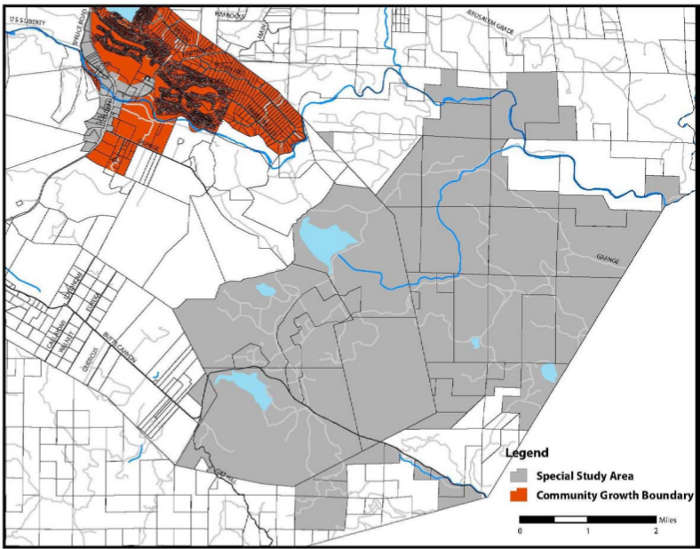
The Guenoc Valley Project boundary is the Special Study Area (shown in gray) to the southeast of the Middletown Community Growth Boundary (shown in orange) in Lake County, California. Image courtesy of the county of Lake.
LAKE COUNTY, Calif. – The Board of Supervisors on Tuesday approved what is believed to be one of the largest land use projects in the county’s history, which could eventually bring 1,400 new homes, several new hotels and close to 1,000 resort and hotel rooms to the south county.
However, the Guenoc Valley Mixed Use Planned Development Project – also known as Maha Guenoc Valley – could face a legal challenge in response to concerns raised by an environmental group that submitted letters and spoke at Tuesday’s meeting.
The Lake County Planning Commission in June approved forwarding the project to the board, which initially held a hearing on the project on July 7 but agreed to continue the matter to this week in order to allow the developer to respond to new comments.
The project, proposed by Lotusland Investment Holdings Inc., is proposed to be built on the 16,000-acre Guenoc Ranch, which consists of 69 parcels located along Butts Canyon Road. The project area excludes 360 acres which contains the Langtry winery and the estate home of the famed British actress, Lillie Langtry.
“This is the largest land use decision this board will ever make,” Supervisor Rob Brown pointed out during Tuesday’s meeting.
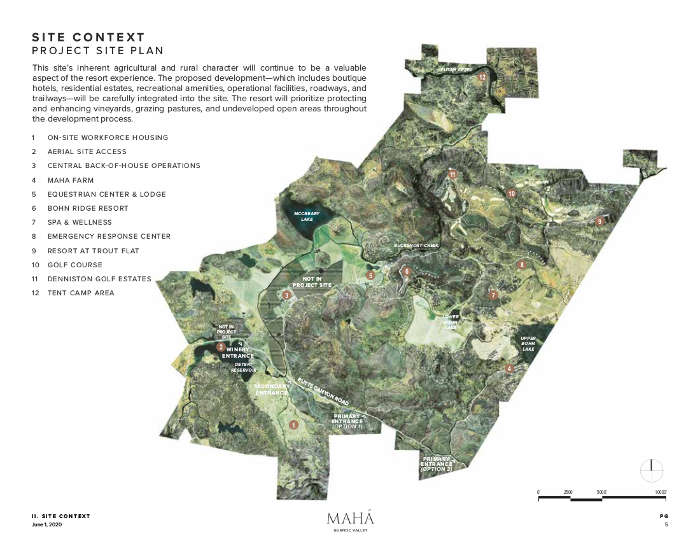
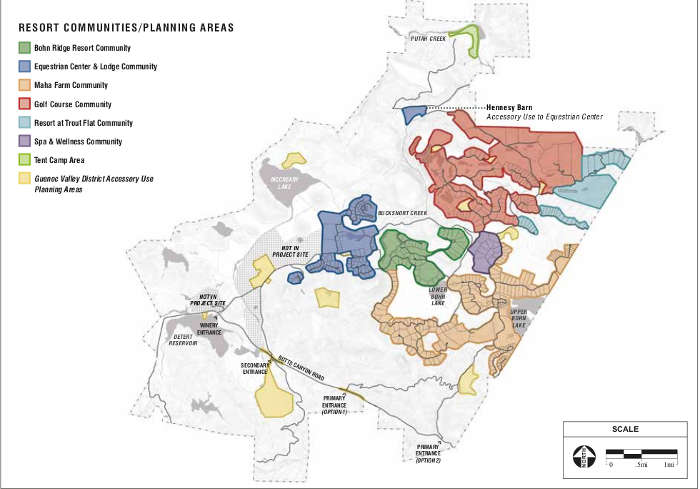
The project’s first phase covers a combined 1,415-acre footprint dispersed throughout the 16,000-acre site. It will include 385 residential villas in five subdivisions; five boutique hotels with 127 hotel units and 141 resort residential cottages; 20 campsites; up to 100 workforce housing co-housing units; resort amenities such as an outdoor entertainment area, spa and wellness amenities, sports fields, equestrian areas, a new golf course and practice facility, camping area and commercial and retail facilities; agricultural production and support facilities; essential accessory facilities, including back of house facilities; 50 temporary workforce hotel units (Entourage Hotel); emergency response and fire center, float plane dock, helipads; and supporting infrastructure, according to planning documents.
There will be five development clusters, each designed by a different architects: Maha Farm, Equestrian Center, Bohn Ridge, Trout Flat and Denniston Golf Estates.
At buildout, the project could include nearly 1,400 residential estate villas, 400 hotel units and 450 resort residential units.
Included in the plans is a fire station that will be built by the developer for use by the South Lake County Fire Protection District.
There also will be a separate off-site workforce housing site on 12.75 acres at 21000 Santa Clara Road and off-site water supply well and pipeline located adjacent to and within Butts Canyon Road.
This specific project’s plans began to emerge in the spring of 2017, nearly a year after Chinese developer Yiming Xu and his firm, Lotusland Investment Holdings of San Francisco, purchased Langtry Farms. Also in 2017, Yiming Xu donated $1 million to Hope City for the wildland fire rebuilding effort.
Since then, the complex project has been the focus of extensive study. Thousands of pages of study and environmental documents can be found on the county’s website. For Tuesday’s meeting alone, there were dozens of documents – including letters from the public – totaling hundreds of pages.
It has drawn the attention of the California Department of Justice, which submitted comments raising concerns about that agency’s belief that the project’s plans don’t adequately address wildland fire threat.
Brown said it was the first time he’d seen the Department of Justice involve itself in a development project’s consideration. County Counsel Anita Grant said several counties have received input from the DOJ over the last year or so.
In more than a dozen separate motions, covering everything from zoning and general plan amendments to the tentative subdivision map and developer agreement, the board voted 4-1 – with Brown the dissenting vote on all of them – to approve the project’s various aspects.
During the meeting, Brown raised several concerns about key aspects of the project. The one he called “the dealbreaker” was not delineating that the off-site well would be specifically designated as a “secondary” water source and including triggers that would be necessary before that water could be used instead of the groundwater source at the site itself.
Developer representatives discuss plans
During Tuesday’s hearing, which lasted several hours, the developer’s representatives discussed work including on-site nurseries to propagate native plants like milkweed – a key food for monarch butterflies – along with native redbuds, oaks and evergreen shrubs. They also have saved 250 trees that otherwise might have been removed for the project.
Land use attorney Katherine Philippakis was on hand throughout the hearing to answer questions about the project and respond to issues raised by commenters.
The DOJ wrote an initial letter to the board for its July 7 meeting that said the final environmental impact report, or EIR, didn’t adequately analyze fire risk, project alternatives or address evacuation in the case of wildland fire.
Between the two meetings, the developer removed 16 lots located at the end of long dead-end roads abutting open space. Still, the DOJ’s followup letter, dated July 20, continued to find the final EIR inadequate.
“We respectfully request that the Board of Supervisors refrain from certifying the FEIR and approving the Project until we have the opportunity to review the supplemental FEIR documentation and engage with the County on these issues,” the July 20 DOJ letter said.
Responding to the DOJ’s comments, Philippakis told the board, “This is really a model project from the perspective of wildlife prevention and defense,” and is the result of a lot of hard work by the county, South Lake County Fire Protection District and the developer’s team of experts.
She said the developer has been open to changes and proposals, recounting a discussion with Cal Fire Battalion Chief Mike Wink about helipads at the site. Philippakis said Wink told them that if they made adjustments to the side of the helipads, they could be used to land big firefighting helicopters there.
Philippakis said the developer immediately said yes and added the expanded helipads to the project commitments. She said they worked to mitigate wildfire risk from the outset.
She said they believe the project could be a model for others throughout the state. “This project could have an impact well beyond Lake County.”
While initially taken aback by the DOJ letter – which she said would been better to have been submitted during the draft EIR process – Philippakis said they were glad that it gave them the chance to clarify changes to the project, from the reduction in parcels down to a total of 385 to added loop roads. She said the latest DOJ letter didn’t identify any new mitigation measures.
She said they are at the end “of a very long road” that has involved the county, the development team and the community.
The project’s first phase – the 385 residential parcels and 250 hotel rooms – falls squarely within what Lake County envisioned for this property in the Middletown Area Plan, Philippakis said.
Public weighs in
During public comment, Peter Broderick, staff attorney for the Center for Biological Diversity, expressed concerns about what he said were late changes to the EIR and project materials, which he said they wanted time to review.
While those late changes were directed toward correcting what he called “significant shortcomings” to the plan documents, Broderick said they don’t go far enough.
“The center remains deeply concerned about the project’s significant impacts to biological resources, water quality, greenhouse gas emissions, and wildfire and public safety,” he said.
Broderick said it will have a drastic effect on wildlife and habitat, including oak woodlands, critical migration corridors, and species such as the threatened foothill yellow legged frog and western pond turtles. He added that the developer is proposing to permanently preserve only a tiny and inadequate portion of the 16,000-acre site.
He said the project proposes low density sprawl in a remote, wildland fire prone location. Broderick asked the board to deny the project or to continue the hearing and recirculate the document.
Middletown resident Rosemary Cordova, who also is a board member of the Callayomi County Water District and Middletown Area Town Hall, said she’s found the project’s leadership to be “unique and exceptionally collaborative” with the community, answering questions and making changes in response to community concerns.
Cordova said she’s never found a business more willing to communicate and collaborate with local government and while she is reserving later judgment on the project, she said she supports it and is looking forward to how it will stimulate business and growth.
She added that if groups like the Center for Biological Diversion have concerns, they should come and speak to local groups like the Guenoc project’s developers have.
Victoria Brandon, speaking on behalf of the Sierra Club Lake Group, said in response to the claim that the project is consistent with the Middletown Area Plan that the developer actually is asking for a bigger residential footprint of up to 1,400 units, along with employee housing and resort rooms.
Those additional entitlements, Brandon said, haven’t been analyzed as they’re part of the future project. But she said it isn’t consistent with the area plan, which only allows for 800 residential units.
As such, she urged the board to consider modifying the approvals to relate only to the parts of the project that have been analyzed.
Melissa Fulton, chief executive officer of the Lake County Chamber of Commerce, said the project has potential to make large changes for all of Lake County, and as such she understood the hesitancy of some people to move forward with it.
Fulton pointed out that the project will be phased and so impacts won’t be felt or implemented all at once but over a period of several years. It will provide many job and housing opportunities needed in the county.
Philippakis, responding to the Center for Biological Diversity’s comments, said that at every juncture the organization has submitted a barrage of documents at the last minute in an attempt to waylay the project.
She said “saber-rattling” is a tactic to stop the project and not to improve the quality of environmental review or the project itself. “There is no set of measures that they would accept as adequate.”
Responding to Brandon’s comments, Philippakis said they respect her but don’t agree with her. She said the requested rezone would allow up to 1,400 units, but that if the project sought that from the county in the future, it would still be up to the board to decide if it’s appropriate. She also pointed out that while the Middletown Area Plan might say 800 residential units, it doesn’t cap hotel units.
Philippakis said the project has received 317 letters of support from community members and now it was up to the board members to judge for themselves if the project was worthy on its merits. “We submit that this is a worthy project and we hope that you agree.”
Board deliberates on project
During the board discussion, Supervisor EJ Crandell said that there have been repeated requests during the project timeline for more review and he was confident in his planning commissioner. “I think we’ve had adequate time and I’m ready to move forward.”
Supervisor Bruno Sabatier said he felt the last-minute arrival of large amounts of documents raising issues with the project was politically driven.
Brown agreed with Sabatier about the last-minute submittals. “It’s a tactic. I recognize it after 20 years,” he said.
“I’m still trying to wrap my head around why the DOJ would get involved in this,” Brown added. “They’ve never been involved in any project in Lake County.”
Brown said he wanted to make sure the county didn’t make the same mistakes it had made in the 1960s and 1970s when communities like the Clear Lake Rivieras, Buckingham and Hidden Valley Lake were developed but not held to certain standards.
He wanted to know who would be responsible for monitoring issues with water use and vegetation management in the decade to come. He also wanted to include a requirement that the community couldn’t incorporate and become a city within a specified amount of time and said he felt the project should be able to have enough water on site and not use the off-site well.
Philippakis said the developer didn’t want to turn the project into a city but did want to have its own zip code. She agreed to language not allowing incorporation within a specific term.
She said the project has adequate water for its needs, but that the owner wanted another water source as an alternative for contingencies. Brown said that, in that case, it should be identified as a secondary water source.
Supervisor Tina Scott said the project developers have gone above and beyond. “We’ve heard from the community and they are excited about this project coming to Lake County.”
As a result of Brown’s requests for ongoing vegetation management, Philippakis said they could add language to the documents that will require the project to develop a funding mechanism to ensure vegetation control.
Sabatier noted that he wanted a yearly update on the project.
Brown asked fellow board members if they were interested in solidifying language on the water source that went beyond simple monitoring. “Water issues are huge in this county. We’ve been dealing with it for years up here,” he said.
Without having language in the plan that protects other people in Middletown with regard to the water source, “That’s a dealbreaker for me at this point,” Brown said.
County staff and Philippakis outlined monitoring measures but Brown said they were still inadequate. He wanted the documents to say that the off-site well will be the secondary source if the project can’t meet the yield with its primary well on site.
“That’s what I’m looking for,” he said, but ultimately the discussion didn’t lead to that language being added.
In addition to the changes in language regarding vegetation management, Philippakis agreed to Brown’s request to add in language preventing incorporation within 20 years.
Supervisor Moke Simon, in whose district the project is located, offered 16 separate motions – one of them offered twice in order to correct motion language – to approve the project. All of the votes were 4-1, with Brown voting no.
Potential for legal action
Within hours of the decision, the Center for Biological Diversity issued a statement criticizing the board for approving the luxury resort in the “fire-prone Guenoc Valley.”
“By approving this big project in a fire-prone area, Lake County put development dollars ahead of the welfare of the region’s residents and environment,” said Broderick, who had spoken to the board earlier. “Supervisors shrugged off expert warnings that this resort will put new residents and existing communities at risk. Despite California’s deadly experiences with fire, officials across the state are still astonishingly willing to OK development in wild places that are highly likely to burn.”
The center’s statement noted, “When built the project will bring thousands of new residents and visitors to this remote corner of Lake County, resulting in more than 30,000 metric tons of new greenhouse gas emissions every year and increasing the risk of wildfire,” and pointed to the concerns raised by the Calfiornia Attorney’s General’s Office.
The statement also noted that the decision leaves the public with approximately 30 days to file litigation challenging the county’s environmental review of the project.
When asked if they are considering taking action against the county, Patrick Sullivan, a spokesman for the organization, told Lake County News, “We are definitely considering various legal options.”
Grant told Lake County news on Thursday that, at that point, she hadn’t heard from the center.
What’s next in the process
The developer’s representatives, including Philippakis and Kirsty Shelton, did not respond to requests for comment from Lake County News on Thursday regarding what is ahead for the project.
However, Scott De Leon, the county’s Public Works director and interim Community Development director, explained what’s next.
“The next step would be the submittal of improvement plans for the various components of work,” he said.
“We’re anticipating them performing rough grading and perhaps some utility installation prior to the close of the grading season on Oct. 15,” De Leon said.
“We have solicited proposals from engineering firms to assist with the review of plans and construction inspection, and we should be bringing a contract to the board for that in the next couple of weeks,” he said.
Email Elizabeth Larson at This email address is being protected from spambots. You need JavaScript enabled to view it. . Follow her on Twitter, @ERLarson, or Lake County News, @LakeCoNews.
LAKE COUNTY, Calif. – Lake County’s Public Health officer has confirmed several more COVID-19 cases in the community.
On Thursday, Public Health Officer Dr. Gary Pace reported that the county’s COVID-19 case total had risen to 166.
Of those, 25 are active – and currently being monitored by Public Health staff – while 140 are recovered and one has died, Pace said.
Pace said one patient currently is hospitalized, bringing the total hospitalizations to 13.
Public Health departments across California reported more than 428,000 cases and nearly 8,200 deaths statewide as of Thursday night.
The California Department of Public Health said that local health departments have reported 20,575 confirmed positive cases in health care workers and 112 deaths statewide.
There have been 6,778,304 tests conducted in California, which represents an increase of 113,306 over the prior 24-hour reporting period, the California Department of Public Health said.
Despite documentation of 29 new local cases since Pace’s July 16 report, “COVID-19 activity remains manageable in Lake County,” he said.
Five of Lake County’s six neighboring counties – Colusa, Glenn, Napa, Sonoma and Yolo – are on the state’s watch list. The sixth neighboring county, Mendocino, will proactively restrict activities starting Friday, July 24, at 11:59 p.m.
Case counts for Lake’s neighboring counties as of Thursday night were: Colusa, 250 cases, two deaths; Glenn, 259 cases, 1 death; Mendocino, 234 cases, 4 deaths; Napa, 711 cases, 8 deaths; Sonoma, 2,404 cases, 24 deaths; and Yolo, 1,275 cases, 37 deaths.
“Given the degree to which all of our surrounding counties, and a growing number of suburban and rural communities throughout California, have been affected, we have been fortunate,” said Pace. “Maintaining this status will depend on all residents taking action to avoid inadvertent transmission of the virus.
In order to maintain local control and keep businesses open, Pace said it’s important that people practice hand washing, hygiene and social distancing; limit social gatherings, particularly indoor activities with individuals outside of your immediate household; wear masks; and comply with health orders, which are designed to limit risk.
“Masks work, and evidence is mounting that non-N95 face coverings are appropriate for even many individuals with underlying chronic lung disease,” Pace said.
He said maintaining local control also will depend on the sustained availability of clinical and other staff to provide medical care, contact tracing and case management services.
“Over the life of the pandemic, a relatively small group of people have invested hundreds of hours of overtime to ensure our communities are safe and businesses can remain open,” Pae said.
“Unfortunately, the preponderance of the evidence suggests we will be living with COVID-19 for quite some time, and more support will be needed to continue to sustain our local response,” said Pace.
Pace asks that if you are available, have relevant training or experience, and believe you can help, please write to This email address is being protected from spambots. You need JavaScript enabled to view it..
Editor's note: The Sonoma County numbers have been updated based on a late Thursday night posting from the county.
Email Elizabeth Larson at This email address is being protected from spambots. You need JavaScript enabled to view it.. Follow her on Twitter, @ERLarson, or Lake County News, @LakeCoNews.
The Makers Faire at the Middletown Art Center in July 2020. Photo courtesy of MAC staff.
MIDDLETOWN, Calif. – The Middletown Community Farmer’s Market and Makers Faire continues at the Middletown Art Center this Friday, July 24, and every Friday thereafter through Sept. 25 from 5 to 8 p.m.
The market features local fresh organic produce and makers wares including crafts, self-care items and clothing. Come support your local farmers and makers.
"Let's create community around food. The Farmer’s Market is back!" said Joe Eckhart of DeJulius Family Farm, who is co-managing the Farmer’s Market this year with his wife, Kerly.
The Middletown Community Farmer’s Market and Makers Faire is a collaborative effort of the Phoenix Club, DeJulius Family Farm and MAC, sponsored in part by Clearlake Grocery Outlet.
The MAC is located at the corner of Highway 175 and Highway 29 in Middletown. Social distancing and masking will be observed.
Find out more about programs, opportunities, and ways to support the MAC’s efforts to weave the arts and culture into the fabric of life in Lake County at www.middletownartcenter.org .
CLEARLAKE, Calif. – Clearlake Animal Control has several more new dogs ready to be adopted this week.
The following dogs are ready for adoption or foster.
“Bella.” Photo courtesy of Clearlake Animal Control. ‘Bella’
“Bella” is a female American Bully mix.
She has a short beige and tan coat.
She is dog No. 3537.
“Lady.” Photo courtesy of Clearlake Animal Control. ‘Lady’
“Lady” is a female German Shepherd mix.
She has been spayed.
She is dog No. 3683.
“Lucky.” Photo courtesy of Clearlake Animal Control. ‘Lucky’
“Lucky” is a female German Shepherd mix with a black and tan coat.
She is dog No. 4022.
“Wendell.” Photo courtesy of Clearlake Animal Control. ‘Wendell’
“Wendell” is a male American Pit Bull Terrier mix puppy with a short brown and white coat.
He is dog No. 4031.
“Wilbur.” Photo courtesy of Clearlake Animal Control. ‘Wilbur’
“Wilbur” is a male American Bully mix with a short gray and white coat.
He is dog No. 3999.
Clearlake Animal Control’s shelter is located at 6820 Old Highway 53, off Airport Road.
Hours of operation are noon to 4 p.m. Tuesday through Saturday. The shelter is closed Sundays, Mondays and major holidays; the shelter offers appointments on the days it’s closed to accommodate people.
Call the Clearlake Animal Control shelter at 707-273-9440, or email This email address is being protected from spambots. You need JavaScript enabled to view it. to inquire about adoptions.
Visit Clearlake Animal Control on Facebook or at the city’s website.
Email Elizabeth Larson at This email address is being protected from spambots. You need JavaScript enabled to view it. . Follow her on Twitter, @ERLarson, or Lake County News, @LakeCoNews.
 How to resolve AdBlock issue?