 How to resolve AdBlock issue?
News
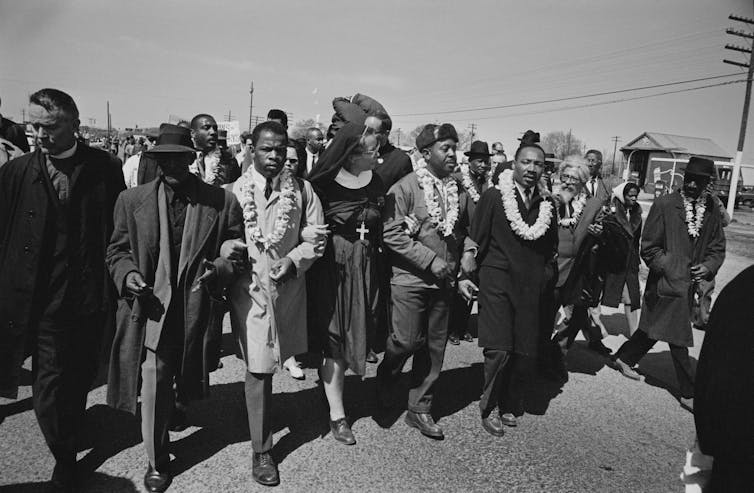
With the deaths of Rep. John Lewis and the Rev. Cordy Tindell “C.T.” Vivian, the U.S. has lost two civil rights greats who drew upon their faith as they pushed for equality for Black Americans.
Vivian, an early adviser to the Rev. Martin Luther King Jr., died July 17 at the age of 95. News of his passing was followed just hours later by that of Lewis, 80, an ordained Baptist minister and towering figure in the civil rights struggle.
That both men were people of the cloth is no coincidence.
From the earliest times in U.S. history, religious leaders have led the struggle for liberation and racial justice for Black Americans. As an ordained minister and a historian, I see a common thread running from Black resistance in the earliest periods of slavery in the antebellum South, through the civil rights movement of the 1950s and 1960s – in which Lewis and Vivian played important roles – and up to today’s Black Lives Matter movement.
As Patrisse Cullors, a founder of the Black Lives Matter movement, says: “The fight to save your life is a spiritual fight.”
Spiritual calling
Vivian studied theology alongside Lewis at the American Baptist College in Nashville, Tennessee.
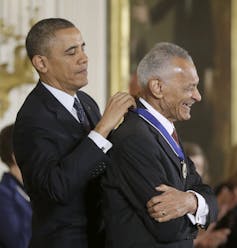
For both men, activism was an extension of their faith. Speaking to PBS in 2004, Lewis explained: “In my estimation, the civil rights movement was a religious phenomenon. When we’d go out to sit in or go out to march, I felt, and I really believe, there was a force in front of us and a force behind us, ’cause sometimes you didn’t know what to do. You didn’t know what to say, you didn’t know how you were going to make it through the day or through the night. But somehow and some way, you believed – you had faith – that it all was going to be all right.”
Fellow civil rights activists knew Vivian as the “resident theologian” in King’s inner circle due to “how profound he is in both his political and biblical exegesis,” fellow campaigner Rev. Jesse Jackson recalled.
Rejecting ‘other world’ theology
Faith traditions inform the civil rights and social justice work of many Black religious leaders. They interpret religious teachings through the prism of the injustice in the here and now.
Speaking of King’s influence, Lewis explained: “He was not concerned about the streets of heaven and the pearly gates and the streets paved with milk and honey. He was more concerned about the streets of Montgomery and the way that Black people and poor people were being treated in Montgomery.”
This focus on real-world struggles as part of the role of spiritual leaders was present in the earliest Black civil rights and anti-slavery leaders. Nat Turner, a leader in the revolt against slavery, for example, saw rebellion as the work of God, and drew upon biblical texts to inspire his actions. Likewise fellow anti-slavery campaigners Sojourner Truth and Jarena Lee rejected the “otherworld” theology taught to enslaved Africans by their white captors, which sought to deflect attention away from their condition in “this world” with promises of a better afterlife.
Incorporating religion into the Black anti-slavery movement sowed the seeds for faith being central to the struggle for racial justice. As the church historian James Washington observed in 1986, the “very disorientation of their slavery and the persistent impact of systemic racism and other forms of oppression provided the opportunity – indeed the necessity – of a new religious synthesis.”
‘Ubuntuism’
The synthesis continued into the 20th century. Religious civil rights leaders like Lewis and Vivian clearly felt compelled to make the struggle for justice a central part of a spiritual leader’s role.
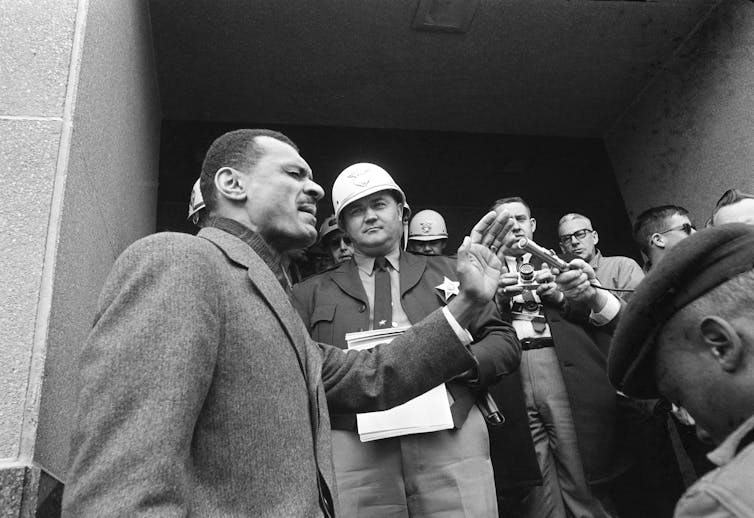
In 1965, Vivian was punched in the mouth by Dallas County Sheriff Jim Clark in an incident caught on camera and carried on national news. Vivian later said: “Everything I am as a minister, as an African American, as a civil rights activist and a struggler for justice for everyone came together in that moment.”
Though their activism was grounded in Christianity, Lewis and Vivian both forged strategic and powerful coalitions with those outside of their faith. In some ways, they transcended theologically informed ideologies with a world view more akin to Archbishop Desmond Tutu’s interpretation of “Ubuntu” – that one’s own humanity is inextricably bound up with that of others.
Lewis and Vivian personified this value in their leadership styles.
George Floyd
Racial justice remains integral to Black Christian leadership in the 21st century.
After the killing of George Floyd in police custody in Minneapolis, it was the Rev. Al Sharpton whose words were carried across the globe, calling on white America to “get your knee off our necks” at Floyd’s memorial service.
In recent years, the Rev. William J. Barber II has been such a vocal and powerful presence in protests that some Americans consider him to be a the successor to past civil rights greats.
In an interview in early 2020, Barber said: “There is not some separation between Jesus and justice; to be Christian is to be concerned with what’s going on in the world.”
John Lewis and Rev. C.T. Vivian lived those words.
Some of this information appeared in a previous article published on June 17
Lawrence Burnley, Vice President for Diversity and Inclusion, University of Dayton
This article is republished from The Conversation under a Creative Commons license. Read the original article.
Dogs available for adoption this week include mixes of border collie, Chihuahua, husky, Labrador Retriever, pit bull, shepherd and terrier.
Dogs that are adopted from Lake County Animal Care and Control are either neutered or spayed, microchipped and, if old enough, given a rabies shot and county license before being released to their new owner. License fees do not apply to residents of the cities of Lakeport or Clearlake.
The following dogs at the Lake County Animal Care and Control shelter have been cleared for adoption (additional dogs on the animal control Web site not listed are still “on hold”).
Call Lake County Animal Care and Control at 707-263-0278 or visit the shelter online at http://www.co.lake.ca.us/Government/Directory/Animal_Care_And_Control.htm for information on visiting or adopting.

Male Anatolian Shepherd
This male Anatolian Shepherd has a medium-length black coat with white markings.
He has been neutered.
He is in kennel No. 13, ID No. 13803.

‘Oso’
“Oso” is a male Boston Terrier with a short black and white coat.
He has been neutered.
He’s in kennel No. 16, ID No. 13796.

Male pit bull terrier
This male pit bull terrier has a black coat.
He is in kennel No. 18, ID No. 13772.

Male husky
This male husky has a medium-length red and white coat.
He is in kennel No. 20, ID No. 13774.

Female Chihuahua
This female Chihuahua has a short black and brown coat.
She is in kennel No. 21, ID No. 13792.

Shepherd mix
This female shepherd mix has a brindle and white coat.
She is in kennel No. 22, ID No. 13776.
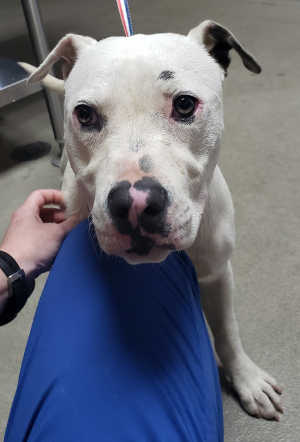
Female pit bull
This female pit bull has a short black and white coat.
She is in kennel No. 24, ID No. 13777.

Female pit bull
This female pit bull has a short black coat.
She has been spayed.
She’s in kennel No. 27, ID No. 13783.
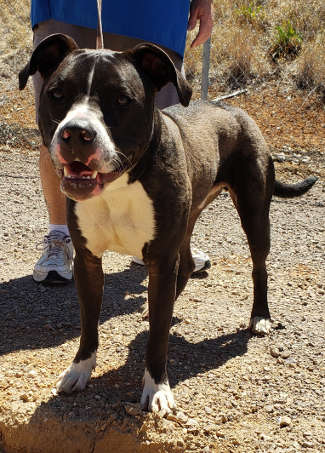
Male pit bull
This male pit bull has a short black and white coat.
He has been neutered.
He’s in kennel No. 29, ID No. 13794.
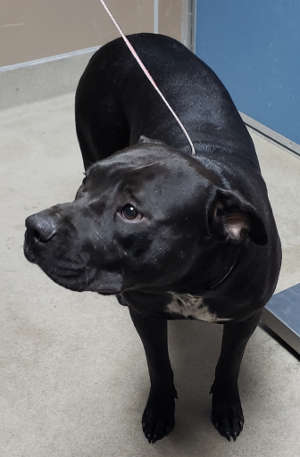
Female pit bull
This female pit bull has a short black and white coat.
She is in kennel No. 30, ID No. 13799.
Email Elizabeth Larson at
As of Saturday, Mendocino County had 194 cases of COVID-19, 11 of whom are currently hospitalized, including one who was transferred to Napa County for a higher level of care.
Per the Centers for Disease Control and Prevention guidelines, two cases of COVID-19 in a workplace constitute an outbreak.
Mendocino County Public Health reported that it is working closely with all known locations who have COVID-19 positive employees to contain the spread, including giving orders to isolate cases, and quarantine close contacts – defined as being closer than 6 feet for more than 10 minutes regardless of facial covering use – for 14 days from the last contact with a known case.
Officials said all locations have been cooperative in containment and investigation efforts.
Outbreaks have been reported at the following four locations.
Sherwood Oaks Health Center, Fort Bragg
Sherwood Oaks Health Center has had seven residents test positive for COVID-19, two of whom have been hospitalized and one of whom has died. Five employees have tested positive for COVID-19.
Ukiah Natural Foods Co-Op
Ukiah Natural Foods Co-Op has had two employees test positive for COVID-19. Further testing of co-op employees is being facilitated by Public Health.
“We are following the guidance as recommended by the Public Health Officer, Dr. Doohan, and are shutting down while working on the case investigation and contact tracing by Public Health,” said Co-Op Manager Lori Rosenberg. “Our impacted staff are quarantined, and we have hired a professional deep cleaning service to clean the entire store. We are taking staff temperatures, and ensuring enhanced efforts for social distancing and disinfecting all surfaces. Our concern at this time is for the health of staff, shoppers and the community.”
The Fort Bragg Center for Laser & Cosmetic Dentistry
The Fort Bragg Center for Laser & Cosmetic Dentistry has had one employee test positive for COVID 19.
“The employee has been isolating since July 9th and no other employees or patients have reported experiencing any symptoms,” as stated by Dr. Alan Limbird.
Dr. Limbird is working closely with public health to ensure a safe reopening for employees and patients. Mendocino County Public Health is providing outbreak testing for any patients who may have been exposed between June 22 and July 13.
Ardzrooni Vineyard, Anderson Valley
Ardzrooni Vineyard has had four employees test positive for COVID-19. Isolation and quarantine housing has been arranged for those affected by this outbreak. Outbreak testing will be offered early next week.
Indication of uncontrolled community spread, which has already been seen in Sonoma and Marin counties, includes outbreaks in skilled nursing facilities and grocery stores, officials said.
The COVID-19 surge has now hit Mendocino County, and will likely worsen until Labor Day, given state modeling data, according to Mendocino County Public Health.
“We urge you, follow the Health Officer orders, and remember to wear your mask,” said Health Officer Dr. Noemi Doohan. “They have been created to save lives.”
NASA now is targeting Oct. 31, 2021, for the launch of the agency’s James Webb Space Telescope from French Guiana, due to impacts from the ongoing coronavirus pandemic, as well as technical challenges.
This decision is based on a recently completed schedule risk assessment of the remaining integration and test activities prior to launch. Previously, Webb was targeted to launch in March 2021.
“The perseverance and innovation of the entire Webb Telescope team has enabled us to work through challenging situations we could not have foreseen on our path to launch this unprecedented mission,” said Thomas Zurbuchen, associate administrator for NASA’s Science Mission Directorate at the agency’s headquarters in Washington. “Webb is the world’s most complex space observatory, and our top science priority, and we’ve worked hard to keep progress moving during the pandemic. The team continues to be focused on reaching milestones and arriving at the technical solutions that will see us through to this new launch date next year.”
Testing of the observatory continues to go well at Northrop Grumman, the mission’s main industry partner, in Redondo Beach, California, despite the challenges of the coronavirus pandemic. Prior to the pandemic’s associated delays, the team made significant progress in achieving important milestones to prepare for launch in 2021.
As schedule margins grew tighter last fall, the agency planned to assess the progress of the project in April. This assessment was postponed due to the pandemic and was completed this week.
The factors contributing to the decision to move the launch date include the impacts of augmented safety precautions, reduced on-site personnel, disruption to shift work, and other technical challenges. Webb will use existing program funding to stay within its $8.8 billion development cost cap.
“Based on current projections, the program expects to complete the remaining work within the new schedule without requiring additional funds,” said Gregory Robinson, NASA Webb program director at the agency’s headquarters. “Although efficiency has been affected and there are challenges ahead, we have retired significant risk through the achievements and good schedule performance over the past year. After resuming full operations to prepare for upcoming final observatory system-level environmental testing this summer, major progress continues towards preparing this highly complex observatory for launch.”
The project team will continue to complete a final set of extremely difficult environmental tests of the full observatory before it will be shipped to the launch site in Kourou, French Guiana, situated on the northeastern coast of South America.
This week, the project successfully completed electrical testing of the observatory. The test highlighted a major milestone in preparation for the upcoming acoustics and vibration environmental tests of the full observatory that are scheduled to start in August.
In addition to ongoing deployments, ground system testing of the fully integrated observatory has followed immediately afterwards. Ensuring that every element of Webb functions properly before it gets to space is critical to its success.
The design of a very large space telescope and highly sophisticated instruments was required to enable Webb to answer fundamental questions about our cosmic origins outlined in the National Academy of Sciences 2000 Decadal Survey.
“Webb is designed to build upon the incredible legacies of the Hubble and Spitzer space telescopes, by observing the infrared universe and exploring every phase of cosmic history,” said Eric Smith, NASA Webb’s program scientist at the agency’s headquarters. “The observatory will detect light from the first generation of galaxies that formed in the early universe after the big bang and study the atmospheres of nearby exoplanets for possible signs of habitability.”
Early next year, Webb will be will folded “origami-style” for shipment to the launch site and fitted compactly inside Arianespace’s Ariane 5 launch vehicle fairing, which is about 16 feet (5 meters) wide.
On its journey to space, Webb will be the first mission to complete an intricate and technically challenging series of deployments – a critical part of Webb’s journey to its orbit about one million miles from Earth.
Once in orbit, Webb will unfold its delicate five-layered sunshield until it reaches the size of a tennis court. Webb will then deploy its iconic 6.5-meter primary mirror that will detect the faint light of far-away stars and galaxies.
Webb is NASA’s next great space science observatory, which will help in solving the mysteries of our solar system, looking beyond to distant worlds around other stars, and probing the mystifying structures and origins of our universe. Webb is an international program led by NASA, along with its partners European Space Agency and the Canadian Space Agency.
For more information about Webb, go to https://www.nasa.gov/webb .
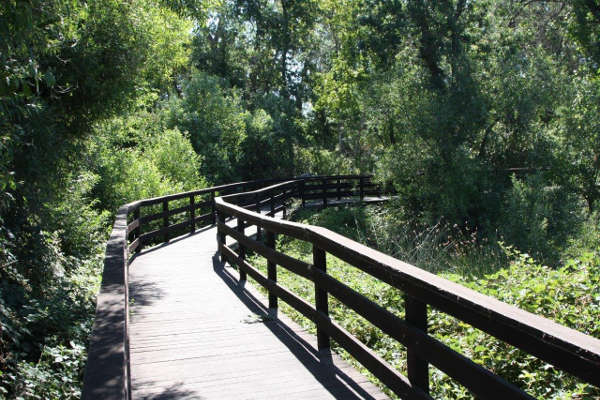
LOWER LAKE, Calif. – Anderson Marsh Interpretive Association has received a grant that will help it purchase materials necessary to repair the boardwalk on the Cache Creek Nature Trail located at Anderson Marsh State Historic Park.
Part of the cost of the materials is being provided by a $5,000 “Keeping Parks Whole” grant that AMIA has received from the California State Parks Foundation, a member-supported nonprofit that works to create support for California state parks.
“Critical funding from state resources as well as revenue generated from park visitation has been greatly jeopardized by the COVID-19 crisis, and this impact has been felt by park partners who provide financial, educational, and programmatic resources to the community,” said California State Parks Foundation Executive Director Rachel Norton. “Supporting partners like Anderson Marsh Interpretive Association with our Keeping Parks Whole Grant ensures Anderson Marsh State Historic Park will remain protected while also preparing a safe and welcoming experience when the park fully reopens.”
“The iconic wooden boardwalk on the Cache Creek Nature Trail allows access to the Cache Creek habitat at the Park, home to unique flora and wildlife,” explained Henry Bornstein, AMIA treasurer. “Due to the lack of funding, the boardwalk is suffering from serious deferred maintenance and unless repaired, it could become unavailable for guided nature walks and public-school field trips when the park fully reopens. AMIA thanks the California State Parks Foundation for its financial support.”
The repair work will be done by State Parks maintenance personnel using the materials donated by AMIA.
“California State Parks appreciates the ongoing help and support of our partner Anderson Marsh Interpretive Association,” said Park Maintenance Chief Wendy Lieberg. “In times of need, they are always there to help keep the park safe and maintained.”
In compliance with current COVID-19 guidelines, guided public tours at Anderson Marsh State Historic Park have been temporarily suspended. All of the hiking trails, however, remain open and available to the public.
Roberta Lyons, AMIA president, noted that “getting some outdoors exercise has been shown to reduce the stress that we are all now experiencing. AMIA invites the public to take advantage of the opportunity to get into nature and take a walk in the park, while observing recommended guidelines regarding social distancing, face coverings and hygiene.”
Anderson Marsh State Historic Park is located off of Highway 53 between Lower Lake and Clearlake and is open to the public during daylight hours.
More information about hiking at the Park can be found at www.andersonmarsh.org or by calling AMIA at 707-995-2658.
The Lake County Public Health COVID-19 dashboard showed on Friday that cases had risen to 140, up by three over the previous day.
Of those 140 cases, 36 are active, 103 are recovered and one has died, Public Health reported.
On Friday night, COVID-19 cases statewide totaled more than 371,000 with nearly 7,600 deaths, based on a compilation of data posted online by county public health departments.
Lake’s neighboring counties had the following case totals on Friday night: Colusa, 173; Glenn, 214; Mendocino, 177; Napa, 583; Sonoma, 2,068; and Yolo, 1,101
Lake County Public Health said three local patients currently are hospitalized and there have been a total of 12 hospitalizations for Lake County COVID-19 patients.
Tests to date total 5,770, including the 140 positive cases and 5,630 negative test results, Public Health reported.
The California Department of Public Health said Friday that 6,044,099 tests have been conducted in California, an increase of 128,591 over the prior 24-hour reporting period.
The state said local health departments have reported 18,857 confirmed positive cases in health care workers and 105 deaths statewide.
Lake County’s daily variance metrics show that it has a case rate of 67.8 per 100,000 for a 14-day period, with a 2.9 percent positivity rate – down from 4 percent earlier in the week – and an average of 159.4 tests per day.
As for hospital bed availability, 48.6 percent of medical/surgical beds and 25 percent of ICU beds are available, and 95 percent of the county’s ventilators are free.
On Friday, both Lake County’s hospitals had more than a 14-day supply of personal protective equipment on hand, Public Health said.
Email Elizabeth Larson at