LAKEPORT, Calif. – The Board of Supervisors is set to consider an agreement with a nonprofit organization that is proposing to run a temporary COVID-19 shelter for the homeless.
The meeting will begin at 9 a.m. Tuesday, July 28.
The supervisors will meet in the board chambers on the first floor of the Lake County Courthouse, 255 N. Forbes St., Lakeport, for a hybrid meeting format which also will include the opportunity for community members to continue to participate virtually.
The meeting can be watched live on Channel 8, online at https://countyoflake.legistar.com/Calendar.aspx and on the county’s Facebook page. Accompanying board documents, the agenda and archived board meeting videos also are available at that link.
To participate in real-time, please join the Zoom meeting by clicking this link at 9 a.m. The meeting ID is 942 2859 6865, password 185629.
To submit a written comment on any agenda item visit https://countyoflake.legistar.com/Calendar.aspx and click on the eComment feature linked to the meeting date. If a comment is submitted after the meeting begins, it may not be read during the meeting but will become a part of the record.
In an untimed item, the supervisors will consider an agreement between the county of Lake and Elijah House for temporary COVID-19 homeless shelter operations for a contract maximum of $234,550.
For several months, a COVID-19 homeless shelter has been operated by Hope Harbor at 2150 S. Main St. in Lakeport.
With that organization winding down its operations and the building itself reported to not be available past the end of July, the county last month issued a request for proposals seeking an organization to take over shelter operations in a portion of the former juvenile hall facility in north Lakeport.
The proposed contract said that Elijah House, based in Oroville, will operate the center from July 30 through Sept. 30.
Also on Tuesday’s agenda, at 9:02 a.m., Public Health Officer Dr. Gary Pace will update the board on the local COVID-19 situation.
At 1 p.m., the board will hold an economic development workshop with county department heads.
The full agenda follows.
CONSENT AGENDA
5.1: Approve minutes of the Board of Supervisors meetings on May 28, June 9 and July 7, 2020.
5.2: Second reading, consider and approve Guenoc Valley Mixed Use Planned Development Project (AM 18-04; DA 18-01, GPAP 18-01; RZ 18-01 & RZ 20-01; GPD 18-01; SD 18-01, SD 20-01, UP 18-49 and UP 20-02).
5.3: Approve agreement between the county of Lake and the county of Tehama to house juvenile wards for the period from April 1, 2020, through March 31, 2022, for an amount not to exceed $380,000 annually; and authorize the chair to sign.
5.4: Approve Task Order No. 1 with MGE for on-call construction management services for various HBP-Funded Bridge Projects in Lake County in the amount of $302,248.98 and authorize the chair to sign.
5.5: (a) Waive the formal bidding process, per Ordinance #2406, Purchasing Code 38.2, as it is not in the public interest due to the unique nature of goods or services; and (b) approve agreement between the county of Lake and Helico Sonoma Helicopters for Fiscal Year 2020/21 in the amount of $50,000 and authorize the chair to sign.
5.6: Approve submission of the FY20 Edward Byrne Memorial Justice Assistance Grant Program Application in the amount of $12,898, to provide funding for an extra help employee to assist with forensic processing and data collection services; and authorize the chair to sign all grant documents.
5.7: Approve contract between the county of Lake and Lake Transit Authority for local public transportation services in the amount of $45,600, from July 1, 2020, to June 30, 2021, and authorize the chair to sign.
5.8: Adopt resolution authorizing Special Districts administrator to sign and submit all award documents, certifications, and assurances required for a funding agreement for Prop 1 Integrated Regional Water Management Implementation Grant funds in the amount of $4,758,552.
5.9: Sitting as the Lake County Sanitation District Board of Directors, adopt resolution revising the Fiscal Year 2019-2020 Adopted Budget of the County of Lake by canceling O & M Reserves in the amount of $49,085 for Lands End/South Lakeport Sewer to make appropriations in Budget Unit 8351, Object Code 783.23-80 to pay for increased administration costs.
TIMED ITEMS
6.1, 9:01 a.m.: Public input.
6.2, 9:02 a.m.: Consideration of Update on COVID-19.
6.3, 10 a.m.: Consideration of the complaint of Ms. Bridget McQueen, owner of Lakeshore Estates Mobile Home Park.
6.4, 1 p.m.: Economic development workshop with county department heads.
UNTIMED ITEMS
7.2: Consideration of agreement between the county of Lake and Elijah House for temporary COVID-19 homeless shelter operations for a contract maximum of $234,550.
7.3: Sitting as Lake County Sanitation District, consideration of Change Order No. 1 with Mercer Fraser Co. for Anderson Springs Sewer Project, for an increase of $23,688 and a revised contract amount of $1,950,683 and authorize board chair to execute.
CLOSED SESSION
8.1: Conference with legal counsel: Existing Litigation pursuant to Gov. Code section 54956.9 (d)(1) – John, et al. v. County of Lake, et al.
8.2: Conference with legal counsel: Existing litigation pursuant to Gov. Code section 54956.9(d)(1) – Ugorji v. County of Lake, et al.
Email Elizabeth Larson at This email address is being protected from spambots. You need JavaScript enabled to view it. . Follow her on Twitter, @ERLarson, or Lake County News, @LakeCoNews.
CLEARLAKE, Calif. – The Clearlake Planning Commission this week will hold public hearings on updates to the city’s zoning ordinance, a proposed property sale and a potential land acquisition.
The commission will meet virtually beginning at 6 p.m. Tuesday, July 28.
Submit comments and questions in writing for commission consideration by sending them to City Clerk Melissa Swanson at This email address is being protected from spambots. You need JavaScript enabled to view it. or visit the Town Hall site and submit written comments there. Identify the subject you wish to comment on in your email’s subject line or in your Town Hall submission.
To give the planning commission adequate time to review your questions and comments, please submit written comments prior to 6 p.m. Tuesday, July 28.
The meet will be broadcast live on the Lake County PEG TV Youtube channel.
On the agenda are three separate public hearings.
The first public hearing is to consider amendments to the city’s zoning ordinance regarding the zoning map, along with the proposed adoption of new design review procedures and new design standards.
The commission also will hold a public hearing to determine if the proposed sale of a 21-acre property at 2185 Ogulin Canyon Road is consistent with the city’s general plan and exempt from environmental review.
In the last hearing, city staff will ask the commission to determine the proposed general plan consistency for the conveyance of a 0.110-acre property at 16034 26th Ave. owned by the Marin County Superior Court to the city.
Tuesday’s meeting also will include reports from City Manager Alan Flora and the commissioners.
Email Elizabeth Larson at This email address is being protected from spambots. You need JavaScript enabled to view it. . Follow her on Twitter, @ERLarson, or Lake County News, @LakeCoNews.
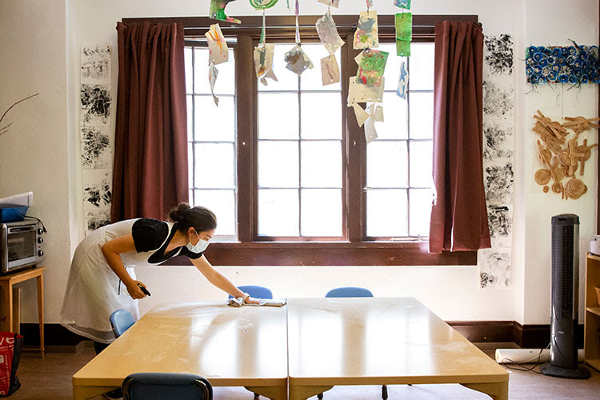
Teacher Joy Heitmann used a quiet moment to clean and disinfect tables used by preschool students at Rockridge Little School in Oakland, California. As child care centers navigate through the health and economic threats of the COVID-19 pandemic, new health and sanitation procedures are essential. Photo by Brittany Hosea-Small.
The COVID-19 pandemic is having a devastating economic and human impact on California child care centers, forcing hundreds of them to close while others remain open at the risk of illness to both children and staff, according to a new report from the University of California, Berkeley.
Among more than 950 preschools and in-home sites surveyed by the campus’s Center for the Study of Child Care Employment, or CSCCE, fully 25 percent are closed.
Among those that remain open, enrollments have plunged, and many owners are going into debt to keep their centers open for families who depend on continued child care, said the report.
“As a result of the pandemic, in California and in the whole country, we can see that child care is critically important to our economy and to parents who have to work,” said Lea Austin, CSCCE executive director. “But as child care collapses, so many other parts of our economy will be at risk.”
Bay Area Hispano Institute for Advancement Inc., or BAHIA, is a bilingual child development center founded in 1975 in West Berkeley. It has been closed since March, and executive director Beatriz Leyva-Cutler knows how such a loss can hurt her community.
If these closures multiply, Leyva-Cutler said, “low-income families will be the hardest hit. If the parents have to work outside the home, and without child care, they risk losing their jobs, which means more risk of hunger and homelessness.
“It also means that child care workers themselves face rising insecurity,” she added. “Our centers and our child care workers are essential to the economy, but the state and federal government have only scratched the surface to meet their needs. It feels like we’re invisible.”
Health or finances? Heartbreaking choices
At full strength, California’s centers and family homes care for close to a million children, according to CSCCE. Some 34,000 licensed child care facilities employ about 120,000 teachers and staff. Most are women of color, in positions that pay poverty-level wages for work that is highly important for a young child’s development and safety.
The center conducted its first survey on the impact of COVID-19 in April. In the latest, more extensive, survey, 953 respondents detailed a system in crisis, with families and care providers required to navigate complex issues of education, economics and health.
According to the report, many providers are fearful that they or their families will be infected with the virus — and that fear drives many closures. But others feel they can’t afford to shut down.
In that climate, the challenges are stark for programs that remain open:
– Eight-five percent reported reduced enrollment, with the average number of students cut roughly in half. – Seventy-seven percent reported lost income, and significant numbers of providers reported they have missed rent or mortgage payments and used personal credit cards to cover expenses. Just over 40 percent said they have, at times, been unable to pay themselves. – Even as revenues fall, 67 percent reported higher staffing costs to meet health and safety requirements. – Eighty percent reported higher costs for sanitation and protective gear.
“This is just not going to be sustainable, long term,” said Austin. “We are seeing a collapse. It's already begun, and I suspect it’s only going to be magnified as we go forward.”
‘We were hemorrhaging money’
Holly Gold spent the early years of her career in the nonprofit sector, working with young people. But 15 years ago, Gold founded the Rockridge Little School in Oakland, and it became the focal point for her deep community involvement.
As the school expanded to additional sites and enrolled more students, it won honors and a devoted local following. She paid her staff wages and benefits far above the California average.
Gold funded her gradual expansion with tuition proceeds, but she recently tapped into her home mortgage and a loan from the U.S. Small Business Administration to buy a building that needed repair. As long as the tuition funds flowed in, the numbers worked.
But then came COVID-19.
“In early March,” she recalled, “we were trying to figure out: What’s the right thing to do? How can we be open? I knew what it meant to close: complete devastation. You don’t even want to think about it. You just make decisions based on health.”
When Alameda County issued a stay-at-home order on March 15, Rockridge Little School closed.
At first, Gold continued to pay her staff their salaries and benefits. “But after a week,” she said, “we were hemorrhaging money.” She opted for layoffs, knowing that staff could get state unemployment benefits, plus the $600 weekly supplement offered under the federal CARES Act.
Weeks passed, the virus eased, and some parents urged her to reopen. Health officials signaled that, with careful management, it was safe. Gold set the date for early July and rehired some of her teachers. A number of families pledged to return.
But as the date approached, the virus surged. Some families backed out, leaving her with too many teachers. She shifted her plans, opening two sites rather than three.
Today, however, she’s in a jam: She’s behind on the rent. She owes on the SBA loan. She’s got to pay for the construction project. She received funds under the SBA’s Paycheck Protection Program, and she’s taken a personal loan. Still, the school’s expenses far exceed income.
“I’m just trying to figure it out,” she said. “We have families who say they're coming back in September, so we're trying to hold tight until then.”
‘I don’t know what to expect’
At BAHIA in West Berkeley, Beatriz Leyva-Cutler has a different baseline. The school owns its main building. A second building, for school-aged students, is owned by the city of Berkeley; as long as BAHIA provides government-subsidized care to low-income families, it pays only $1 a year, plus maintenance.
There are up to 150 children in all, ages 2 to 10. Many are from working families, where parents have sectors such as construction or restaurants, while other youngsters’ parents are professionals, in fields such as architecture, law and nursing.
Leyva-Cutler has been there 40 years, and she knows BAHIA’s funds are always tight. Still, the pandemic has hit like a hurricane: The programs have been closed since March. The 30-plus teachers and staff are still employed — that was a condition of continued state aid during the pandemic. But the halls are silent, and weeds are growing on the playground.
Typically, BAHIA receives hundreds of thousands of dollars in tuition, but those funds are gone, for now. The year’s projected $1.8 million in revenue is down to $1 million.
Leyva-Cutler, who also serves on the Berkeley Unified School District Board of Education, has been working 60 hours or more every week to keep things afloat. “We've done the small business loan and the emergency disaster impact loan,” she explained. “We're refinancing one of our buildings. We have to do whatever we can to stay operational.”
There were plans to reopen on July 6. But a teacher’s husband tested positive for the virus, then her daughter, and then the teacher herself.
The center’s reopening has been pushed into August.
The urgent need for government support
The CSCCE report makes clear that, across California, many preschools and in-home care centers are facing their own versions of this crisis. But there’s a consensus that the state and federal governments need to do more.
If California’s child care system is strong, experts say, it can play a crucial role in eventual economic recovery. But if the system is crippled, recovery efforts will suffer. So will children and their families.
“This pandemic has brought to light to how important child care is,” said Leyva-Cutler. “But, unfortunately, we've gotten used to the fact that this care is undervalued and underappreciated.”
Leyva-Cutler proposes that state agencies waive some regulations, temporarily, for centers that have had positive audits in the past. Gold, meanwhile, advocates an infusion of state funding — not just for state-subsidized centers, but for private centers, too.
Austin said the state of Vermont has done something similar: a “stabilization” fund that provides support to both state-subsidized and private day care.
For now, however, Leyva-Cutler, Gold and thousands of other child care providers in California are struggling to manage their way through deep uncertainty. They’re facing a new world: more risk, smaller classes, new rules for wearing masks, social distancing and sanitation. It will be, said Gold, “a very different way of teaching.”
For many centers, economics will compound this uncertainty, testing their creativity, patience — and survival.
This male gray tabby kitten is in cat room kennel No. 108A, ID no. 13810. Photo courtesy of Lake County Animal Care and Control. Gray tabby kitten
This male gray tabby kitten has a short coat and green eyes.
He is in cat room kennel No. 108A, ID no. 13810.
This female gray tabby kitten is in cat room kennel No. 108B, ID No. 13811. Photo courtesy of Lake County Animal Care and Control. Gray tabby kitten
This female gray tabby kitten has a short coat and green eyes.
She is in cat room kennel No. 108B, ID No. 13811.
This male gray tabby kitten is in cat room kennel No. 111A, ID No. 13807. Photo courtesy of Lake County Animal Care and Control. Gray tabby kitten
This male gray tabby kitten has a short coat and green eyes.
He is in cat room kennel No. 111A, ID No. 13807.
This female brown tabby kitten is in cat room kennel No. 111C, ID No. 13809. Photo courtesy of Lake County Animal Care and Control. Brown tabby kitten
This female brown tabby kitten has a short coat and green eyes.
She is in cat room kennel No. 111C, ID No. 13809.
This male domestic short hair cat is in kennel No. 138, ID No. 13701. Photo courtesy of Lake County Animal Care and Control. Domestic short hair cat
This male domestic short hair cat has a brown tabby coat.
He has been neutered.
He is in kennel No. 138, ID No. 13701.
This male brown tabby kitten is in kennel No. 147A, ID No. 13779. Photo courtesy of Lake County Animal Care and Control. Brown tabby kitten
This male brown tabby kitten has a medium-length coat and gold eyes.
He has been neutered.
He is in kennel No. 147A, ID No. 13779.
This female kitten is in kennel No. 147B, ID No. 13780. Photo courtesy of Lake County Animal Care and Control. Tortie kitten
This female kitten has a medium-length tortie coat and gold eyes.
She has been spayed. She is in kennel No. 147B, ID No. 13780.
Email Elizabeth Larson at This email address is being protected from spambots. You need JavaScript enabled to view it. . Follow her on Twitter, @ERLarson, or Lake County News, @LakeCoNews.
A fox captured on a “critter cam” in the author’s garden in Middletown, California, on Friday, July 10, 2020. Photo by Kathleen Scavone.
LAKEPORT, Calif. – I've been a fan of vegetable gardening since I was a kid when I marveled at the plump, red juiciness of my mom's homegrown tomatoes grown under the kitchen window.
When I was invited into my childhood friend's family garden, it just seemed magical that you could get something for nothing, as it appeared to my young eyes.
There in that little plot of rich soil was something for all of the senses. The scent of mint drifted in the air as I wandered their garden's rows, as did the spicy fragrance of carnation, lavender and penstemon.
When I was asked to help pick their golden lemon cucumbers I was surprised at the prickly skin of that strange vegetable!
Her garden also acquainted me with other novel-to-me veggies such as squash in all of their strange and delightful forms, white radishes and potatoes that were purple!
In my house, we usually ate green beans and spinach from a can, and when artichokes or corn were in season we had farm-fresh versions of those staples.
As any gardener or farmer, for that matter, can tell you, there is always something that needs to be done whether it is hoeing, weeding, thinning, transplanting or watering.
Gardening becomes a fine balancing act where you want to attract the right critters, and discourage the damaging or destructive ones.
I enjoy planting sunflowers, salvia and other pollinator-attractors, and companion plantings using marigolds to discourage bean beetles.
My motto is “something for everyone,” so that if a gopher outmaneuvers me by snaking under my raised beds somehow, or the goldfinches snack on my tender greens, my M.O. is to plant enough for all of us.
A critter-proof fence is always a necessity in order to keep out the deer, raccoons, rabbits and other hungry neighbors. Done and done.
Just when I thought I had covered all bases I began to notice the mulch had been pushed aside in several of the raised beds and holes dug into the damp soil.
A fox in Lake County, California. Photo by Kathleen Scavone.
Hmmm, I thought. Squirrels? But they never bothered my garden in the past, usually sticking to acorns and other typical squirrel food. Whatever it was that was digging in the garden was not disturbing the plants, but merely the mulch and soil surrounding the plants.
As I patted down the mini-excavations and replaced the mulch I decided to position a critter-cam in the garden to solve the mystery.
Then, mystery solved – it was a fox! A gray fox! Maybe he'd been looking for the little tree frogs I'd seen in the more damp areas of the garden.
I'd seen foxes around the area throughout the years and even witnessed them pouncing on a plethora of frogs one year, but had forgotten they were so adept at climbing as well as squeezing through such small openings.
These beautiful creatures, speckled gray on top with reddish colors underneath, usually dine on small birds, animals and insects along with the occasional nibble of fruit.
Gray foxes are not often seen during the daylight hours, as they are snug in their burrows or hollow trees.
Gray foxes are members of the Canidae family and are one of only two members with the ability to climb trees and, I'm surmising, my garden fence.
The other member with climbing ability is the Asian raccoon dog which, of course, we do not have here in California.
A gray fox has specially adapted claws to help him hook onto a tree's bark in the wild.
Fossil evidence found in Arizona supplies proof that foxes have been around for millions of years.
The male fox is called a tod, or dog and a group of foxes is known as an earth, leash or skulk.
There are native red foxes that populate the Sierra Nevada and the Cascade Mountains and they are a threatened species.
The non-native red fox is an introduced species that poses a threat to certain ecosystems since they are highly adaptable. The red foxes were brought here for fur farming and hunting in the past.
The gray fox gestation phase is close to 53 days, and a litter may range from one to seven kits or pups.
If you happen to hear a “yipping, barking” sound, you just may have heard a fox.
Kathleen Scavone, M.A., is a retired educator, potter, freelance writer and author of “Anderson Marsh State Historic Park: A Walking History, Prehistory, Flora, and Fauna Tour of a California State Park” and “Native Americans of Lake County.”
LAKEPORT, Calif. – Expanding its services to residents of Lake County, Lake Family Resource Center announced that it will now be overseeing operations of the Lakeport Senior Center.
“Seniors comprise almost 25 percent of Lake County’s overall population,” said Executive Director Lisa Morrow. “While undertaking such an expansion of services in the midst of a pandemic certainly presents its challenges, we are excited to now be serving this important section of our community – especially during these challenging times.”
During pandemic restrictions, the Senior Center Wellness program continues with classes such as Tai Chi offered via Zoom.
Meals on Wheels is still serving the Northshore and has expanded its services to also include those who previously joined the senior center for onsite dining.
Seniors interested in Wellness Zoom classes or those wanting to sign up for meal delivery should call the senior center at 707-263-4218 or Lake Family Resource Center at 707-279-0563.
The Meals on Wheels Thrift Store located in Lakeport is open. New thrift store hours will be Monday through Friday from 9 a.m. to 4 p.m.
Once it’s safe to do so, Lake Family Resource Center looks forward to reopening the Activities Center for group meals, a variety of wellness classes and workshops and other gatherings.
Lake Family Resource Center officials said they also look forward to adding robust programming and services to reach out to and engage seniors in a variety of ways.
“We not only look forward to continuing current programming, we’re excited about exploring additional programming. We envision support groups, more wellness activities as well as home visits for the seniors of Lake County,” said Morrow.
She also wants to engage seniors as volunteers to rock infants and provide comfort to the youngest of the clients served by Lake Family Resource Center.
“With the addition of the senior population to our clients, we are now extremely well-rounded, serving every facet of our community from Pre-K through gray,” Morrow said. “This gives us an outstanding opportunity to enrich the lives of many community members of every age group.”
The Lakeport Senior Center will remain its own separate nonprofit organization with Lake Family Resource Center managing its operations and administration through a contract.
Denise Johnson, a lifetime resident of Lake County, will be the senior center’s director of operations. Johnson has been with Lake Family Resource Center for almost four years, functioning as the housing services coordinator, a program she herself developed.
Prior to joining the Lake Family Resource Center, Johnson was employed by the District Attorney’s Office as a victim services advocate for elders experiencing abuse.
Lake Family Resource Center has been serving Lake County families since 1995 to achieve safe, sustainable, healthy families and community. A 501c3 nonprofit organization, most services are provided at no cost and are funded through government grants and community donations.
Before this expansion with the Lakeport Senior Center, Lake Family Resource Center served approximately 1,400 families and 4,500 individuals each year.
For more information about the center and its services, call 707-279-0563 or visit its website.
 How to resolve AdBlock issue?