 How to resolve AdBlock issue?
News

LAKE COUNTY, Calif. – A Lakeport woman credits faith, training and focus with helping her to save the life of a 3-year-old boy found unresponsive in the pool at a local resort over Labor Day weekend.
Lydia Meraz, a 20-year employee of WorldMark Clear Lake Resort in Nice, resuscitated 3-year-old Darius Apar after the child was pulled from the swimming pool by his mother.
At 10 a.m. Tuesday Meraz will receive a commendation from the Lake County Board of Supervisors in recognition of her heroic actions.
The story has a happy ending, but as resort General Manager Greg Bennett pointed out, “It was very, very close.”
Bennett said there were moments when they didn’t think the child was going to make it. “It was quite a battle to get him to breathe again.”
Meraz, who serves as the resort’s guest services manager, was in her office taking care of invoicing and some other duties on Sunday, Sept. 6, when she said she heard a woman screaming for help.
Getting up from her desk, Meraz told her team members to call 911 while she set out to find out what was happening.
She said she didn’t know if someone was having a seizure or heart attack, or being stabbed. “I didn’t know what I was getting myself into.”
Meraz, along with team members Diana Starkey and Ali Staub, arrived at the pool to find a hysterical Adelia Apar, who told her that her son Darius wasn’t breathing.
Adelia Apar had been swimming laps when she turned around and found the child face down in the pool, Meraz said.
When Meraz arrived, the child was lying next to the pool. He was unconscious and blue. “I’ve never been exposed to anything like that.”
Meraz told everyone to stand back and then got down on her knees next to the child. She said she prayed, asking Jesus to help her save the boy’s life.
At that point, Meraz said it was like she was in a bubble. “It got really quiet around me.”
She began cardiopulmonary resuscitation on Darius. At the second round of compressions, Meraz said she saw him starting to come back. On the third set of compressions, she prayed that he would pull through, and he started to cough.
Meraz quickly turned him over onto his side, he began throwing up water, opened his eyes and started to cry.
“I told him, ‘you’re going to be just fine,’” and then Meraz said she started to cry, too.
The child’s family immediately came to her side, calling her their guardian angel.
Bringing the child back “was an amazing feeling,” and it means a lot to her, Meraz said.
The rest of the WorldMark team set up roadblocks and guided the ambulance and first responders to the scene. Bennett said both Adelia Apar and her son were taken to the hospital for treatment.
The next day, the Apar family came back to see Meraz, bringing her flowers, and there were more hugs and tears. She said Darius gave her a kiss on the cheek.
Meraz said the Apars have told her she’s now an extended member of their family. Adelia Apar has even sent her Darius’ preschool picture.
Bennett said the day after the incident, Darius was back swimming, now with a brand new life jacket, and the whole family was able to have a good time. “That’s all you can ask for,” he said.
In a high-stress situation, how did Meraz remain calm?
Both Bennett and Meraz said the resort puts a strong emphasis on training for its staff. Bennett said CPR training is required for guest services, housekeeping, maintenance and management. “It paid off in this particular case, that’s for sure,” he said.
Meraz gave special credit to her trainer, Kimberly Miinch of Emergency Care Training and Supply in Middletown, for helping prepare her.
She said she remembered having told Miinch that she wasn’t sure she would be able to act to save someone if necessary. Meraz said Miinch reassured her that she could do it when the time came.
The day after she saved Darius, Meraz said Miinch called her. Miinch had heard scanner traffic about the incident and called to check in.
Meraz said she told Miinch that her training had made all of the difference.
Also important for Meraz is her faith in God, which she said was another key to saving the little boy.
“I give it all to the Lord,” she said.
Email Elizabeth Larson at
Officials said the August Complex reached 832,891 acres on Saturday, with containment edging up to 31 percent.
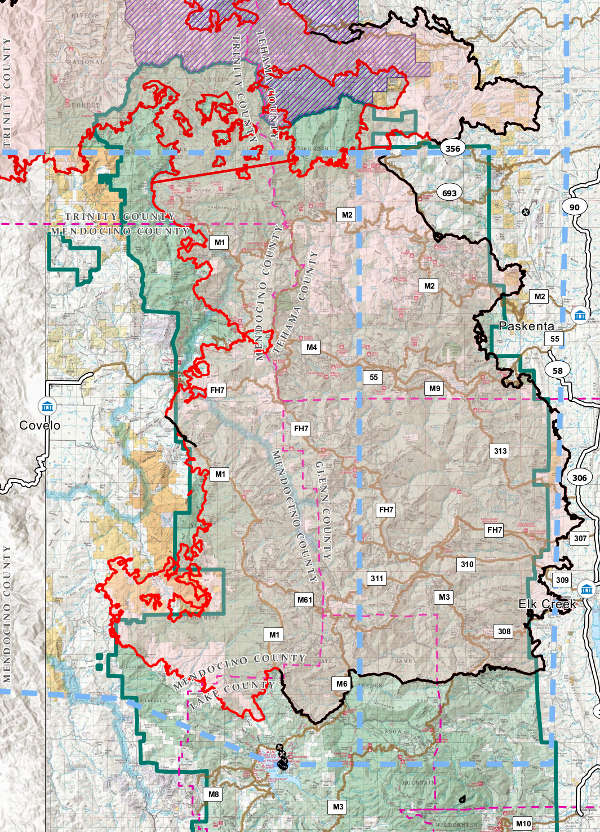
Burning on the Mendocino, Shasta-Trinity and Six Rivers National Forests, the complex – which began Aug. 17 – is threatening 1,595 structures and has destroyed 35, officials reported.
The Forest Service said the complex is expected to be fully contained on Nov. 15.
Approximately 1,884 personnel are assigned, the Forest Service said.
Officials said crews continue to make good progress on the South Zone of the August Complex. The entire east side of the complex is now contained.
On Friday, crews constructed additional line to the west and northwest of Lake Pillsbury. Once completed, these lines will be used as both primary and alternate locations for containment of the fire, the Forest Service said.
Fire crews also initiated burning operations to the north of Pillsbury Ranch, removing vegetation between control lines and the main fire perimeter. Additional burning is planned to be completed during favorable weather and other conditions, officials said.
Once completed, officials said this work will provide a secure line and added protection for the residents of Lake Pillsbury and the surrounding community.
Structure protection measures have been implemented where property may be impacted by the fire, as well as throughout the Lake Pillsbury and surrounding areas, officials said.
Burning operations are being accomplished both by ground and air. The Forest Service said aerial ignitions are being completed utilizing a dispenser that launches small plastic spheres – like ping pong balls – through an opening in a helicopter.
The spheres are filled with a chemical that reacts and ignites after a short delay. The Forest Service said this type of ignition allows for burning or firing operations in terrain that may be difficult or unsafe for firefighters to reach by ground.
Officials said the planned ignitions are intended to burn in a more mosaic pattern and lower intensity than in an uncontrolled wildfire.
In the South Zone of the August Complex, the Forest Service said evacuation orders are in effect for Mendocino and Lake counties.
In Lake County, mandatory evacuations remain active for Pillsbury Ranch and the entire Lake Pillsbury basin.
The Forest Service said recent changes to evacuation orders include Mendocino County reducing four of the evacuation zones on the west side of the fire to an evacuation warning, while Glenn County lifted the evacuation order within the Mendocino National Forest on Friday.
Residents and property owners may return to their properties but should use extreme caution when entering the burn area, as hazards may be present, the Forest Service said. Individuals should have proof of property ownership or other documentation upon request while accessing the forest area. Contractors of private property owners should have documentation of the property being accessed and permission from the landowner.
On the complex’s West Zone, the Mendocino County Sheriff’s Office reported that Sheriff Matt Kendall is seeking assistance from the Governor's Office in obtaining California National Guard resources to assist with fire suppression efforts.
That’s in response to Cal Fire having a 53-percent decrease in its Type 1 hand crews that are staffed by inmates from the California Department of Corrections and Rehabilitation.
The California National Guard is trained to assist Cal Fire Type 1 hand crews in establishing and maintaining fire lines and will not be used for any law enforcement related purposes if deployed to Mendocino County as requested by Sheriff Kendall, officials said.
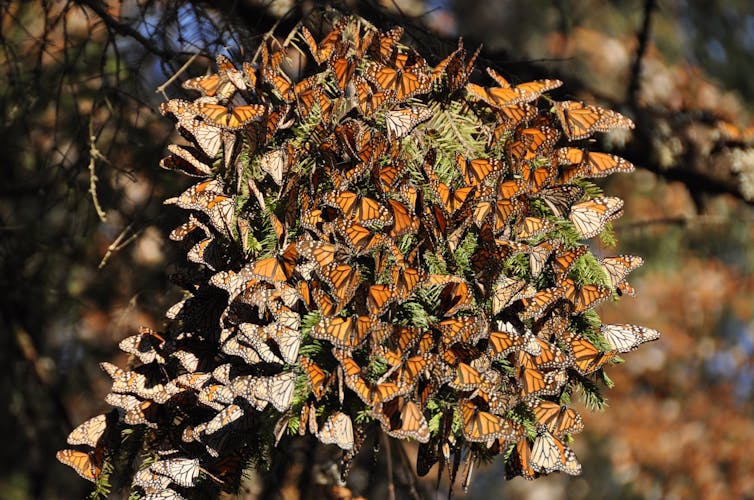
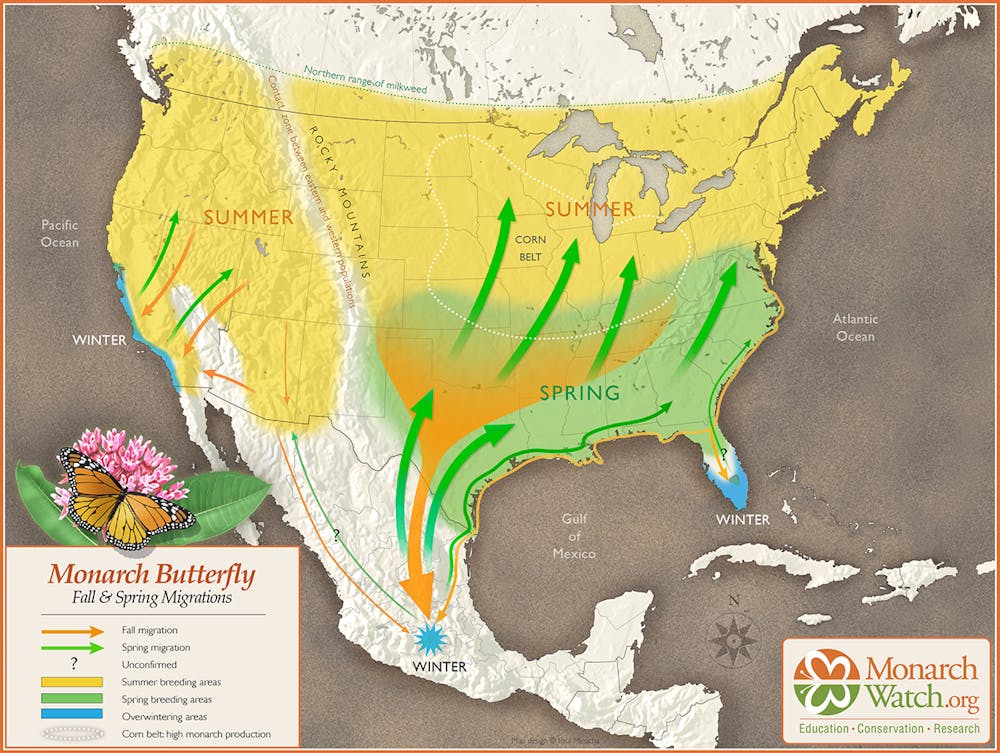
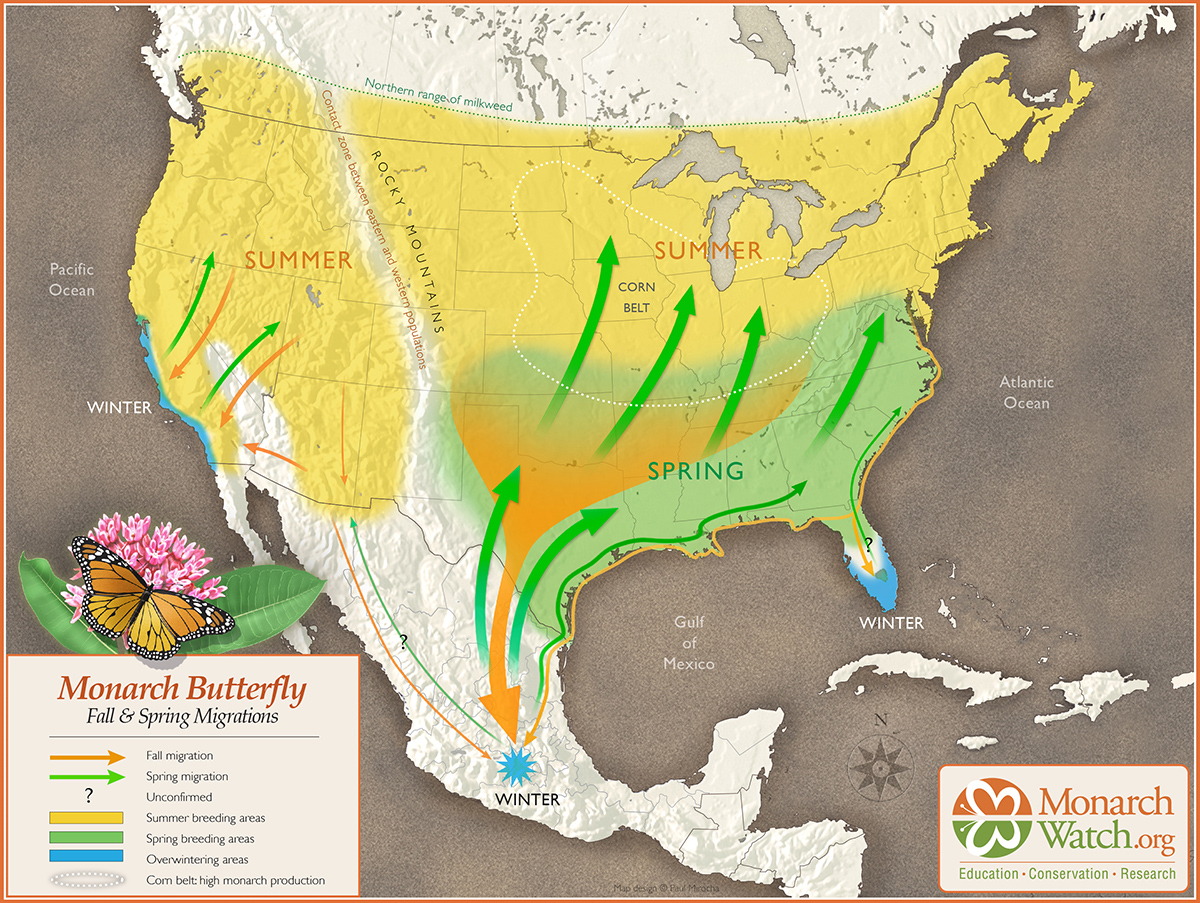
One of nature’s epic events is underway: Monarch butterflies’ fall migration. Departing from all across the United States and Canada, the butterflies travel up to 2,500 miles to cluster at the same locations in Mexico or along the Pacific Coast where their great-grandparents spent the previous winter.
Human activities have an outsized impact on monarchs’ ability to migrate yearly to these specific sites. Development, agriculture and logging have reduced monarch habitat. Climate change, drought and pesticide use also reduce the number of butterflies that complete the journey.
Since 1993, the area of forest covered by monarchs at their overwintering sites in Mexico has fallen from a peak of 45 acres in 1996-1997 to as low as 1.66 acres in the winter of 2013-2014. A 2016 study warned that monarchs were dangerously close to a predicted “point of no return.” The 2019 count of monarchs in California was the lowest ever recorded for that group.
What was largely a bottom-up, citizen-powered effort to save the struggling monarch butterfly migration has shifted toward a top-down conversation between the federal government, private industry and large-tract landowners. As a biologist studying monarchs to understand the molecular and genetic aspects of migration, I believe this experiment has high stakes for monarchs and other imperiled species.
Millions of people care about monarchs
I will never forget the sights and sounds the first time I visited monarchs’ overwintering sites in Mexico. Our guide pointed in the distance to what looked like hanging branches covered with dead leaves. But then I saw the leaves flash orange every so often, revealing what were actually thousands of tightly packed butterflies. The monarchs made their most striking sounds in the Sun, when they burst from the trees in massive fluttering plumes or landed on the ground in the tussle of mating.
Decades of educational outreach by teachers, researchers and hobbyists has cultivated a generation of monarch admirers who want to help preserve this phenomenon. This global network has helped restore not only monarchs’ summer breeding habitat by planting milkweed, but also general pollinator habitat by planting nectaring flowers across North America.

Scientists have calculated that restoring the monarch population to a stable level of about 120 million butterflies will require planting 1.6 billion new milkweed stems. And they need them fast. This is too large a target to achieve through grassroots efforts alone. A new plan, announced in the spring of 2020, is designed to help fill the gap.
Pros and cons of regulation
The top-down strategy for saving monarchs gained energy in 2014, when the U.S. Fish and Wildlife Service proposed listing them as threatened under the Endangered Species Act. A decision is expected in December 2020.
Listing a species as endangered or threatened triggers restrictions on “taking” (hunting, collecting or killing), transporting or selling it, and on activities that negatively affect its habitat. Listing monarchs would impose restrictions on landowners in areas where monarchs are found, over vast swaths of land in the U.S.
In my opinion, this is not a reason to avoid a listing. However, a “threatened” listing might inadvertently threaten one of the best conservation tools that we have: public education.
It would severely restrict common practices, such as rearing monarchs in classrooms and back yards, as well as scientific research. Anyone who wants to take monarchs and milkweed for these purposes would have to apply for special permits. But these efforts have had a multigenerational educational impact, and they should be protected. Few public campaigns have been more successful at raising awareness of conservation issues.
The rescue attempt
To preempt the need for this kind of regulation, the U.S. Fish and Wildlife Service approved a Nationwide Candidate Conservation Agreement for Monarch Butterflies. Under this plan, “rights-of-way” landowners – energy and transportation companies and private owners – commit to restoring and creating millions of acres of pollinator habitat that have been decimated by land development and herbicide use in the past half-century.
The agreement was spearheaded by the Rights-of-Way Habitat Working Group, a collaboration between the University of Illinois Chicago’s Energy Resources Center, the Fish and Wildlife Service and over 40 organizations from the energy and transportation sectors. These sectors control “rights-of-way” corridors such as lands near power lines, oil pipelines, railroad tracks and interstates, all valuable to monarch habitat restoration.
Under the plan, partners voluntarily agree to commit a percentage of their land to host protected monarch habitat. In exchange, general operations on their land that might directly harm monarchs or destroy milkweed will not be subject to the enhanced regulation of the Endangered Species Act – protection that would last for 25 years if monarchs are listed as threatened. The agreement is expected to create up to 2.3 million acres of new protected habitat, which ideally would avoid the need for a “threatened” listing.
Many questions remain. Scientists are still learning about factors that cause monarch population decline, so it is likely that land management goals will need to change over the course of the agreement, and partner organizations will have to adjust to those changes.
Oversight of the plan will fall primarily to the University of Illinois, and ultimately to the U.S. Fish & Wildlife Service. But it’s not clear whether they will have the resources they need. And without effective oversight, the plan could allow parties to carry out destructive land management practices that would otherwise be barred under an Endangered Species Act listing.
A model for collaboration
This agreement could be one of the few specific interventions that is big enough to allow researchers to quantify its impact on the size of the monarch population. Even if the agreement produces only 20% of its 2.3 million acre goal, this would still yield nearly half a million acres of new protected habitat. This would provide a powerful test of the role of declining breeding and nectaring habitat compared to other challenges to monarchs, such as climate change or pollution.
[Deep knowledge, daily. Sign up for The Conversation’s newsletter.]
Scientists hope that data from this agreement will be made publicly available, like projects in the Monarch Conservation Database, which has tracked smaller on-the-ground conservation efforts since 2014. With this information we can continue to develop powerful new models with better accuracy for determining how different habitat factors, such as the number of milkweed stems or nectaring flowers on a landscape scale, affect the monarch population.
North America’s monarch butterfly migration is one of the most awe-inspiring feats in the natural world. If this rescue plan succeeds, it could become a model for bridging different interests to achieve a common conservation goal.
D. André Green II, Assistant Professor of Ecology and Evolutionary Biology, University of Michigan
This article is republished from The Conversation under a Creative Commons license. Read the original article.
Dogs available for adoption this week include mixes of American Bulldog, Belgian Malinois, border collie, Chihuahua, German Shepherd, husky, Labrador Retriever, pit bull, pug and terrier.
Dogs that are adopted from Lake County Animal Care and Control are either neutered or spayed, microchipped and, if old enough, given a rabies shot and county license before being released to their new owner. License fees do not apply to residents of the cities of Lakeport or Clearlake.
The following dogs at the Lake County Animal Care and Control shelter have been cleared for adoption (additional dogs on the animal control Web site not listed are still “on hold”).
Call Lake County Animal Care and Control at 707-263-0278 or visit the shelter online at http://www.co.lake.ca.us/Government/Directory/Animal_Care_And_Control.htm for information on visiting or adopting.

German Shepherd-Belgian Malinois mix
This male German Shepherd-Belgian Malinois mix has a medium-length black and brown coat.
He is in kennel No. 3, ID No. 14034.

Male Chihuahua
This male Chihuahua has a short black and tan coat.
He is in kennel No. 6a, ID No. 14038.

Female Labrador Retriever
This female Labrador Retriever mix has a short black coat with white markings.
She is in kennel No. 9, ID No. 13989.

Female pit bull terrier
This female pit bull terrier has a short gray and white coat.
She is in kennel No. 18, ID No. 13990.

‘SnowBall’
“SnowBall” is a male Chihuahua with a short white coat.
He has been neutered.
He’s in kennel No. 22, ID No. 14019.

Male pit bull terrier
This male pit bull terrier has a short tan coat.
He is in kennel No. 25, ID No. 14023.

Belgian Malinois mix
This female Belgian Malinois mix has a short brindle coat.
She is in kennel No. 26, ID No. 14024.
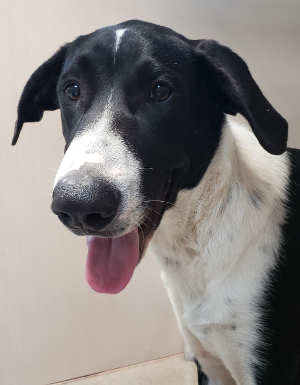
Male border collie
This young male border collie has a short black and white coat.
He is in kennel No. 27, ID No. 14052.

Female German Shepherd
This female German Shepherd has a medium-length black coat.
She has been spayed.
She is in kennel No. 28, ID No. 13995.

‘Lilly’
“Lilly” is a female pit bull-husky mix with a short brown and white coat.
She is in kennel No. 29, ID No. 13991.
Email Elizabeth Larson at
The Sun is stirring from its latest slumber. As sunspots and flares, signs of a new solar cycle, bubble from the Sun’s surface, scientists wonder what this next cycle will look like.
The short answer is, probably a lot like the last — that is, the past 11 years of the Sun’s life, since that’s the average length of any given cycle.
But the longer story involves a panel of experts that meets once a decade, a fleet of Sun-studying satellites, and dozens of complicated models — all revolving around efforts to understand the mystifying behavior of the star we live with.
NASA scientists study and model the Sun to better understand what it does and why. The Sun has its ups and downs and cycles between them regularly. Roughly every 11 years, at the height of this cycle, the Sun’s magnetic poles flip — on Earth, that’d be like if the North and South Poles swapped places every decade — and the Sun transitions from sluggish to active and stormy. At its quietest, the Sun is at solar minimum; during solar maximum, the Sun blazes with bright flares and solar eruptions.
Solar cycle predictions give a rough idea of what we can expect in terms of space weather, the conditions in space that change much like weather on Earth. Outbursts from the Sun can lead to a range of effects, from ethereal aurora to satellite orbital decay, and disruptions to radio communications or the power grid.
NOAA’s Space Weather Prediction Center is the U.S. government’s official source for space weather forecasts, watches, warnings, and alerts: With accurate predictions, we can prepare.
The work that researchers at NASA and around the world do to advance our solar activity models helps improve those forecasts. In turn, solar cycle forecasts give us a sense of how stormy the Sun will be over the next 11 years and how much radiation spacecraft and astronauts may face during heavy bouts of solar activity.
Modeling the Sun is a tricky business because scientists don’t fully understand the internal churning that causes this magnetic flip-flop. Computer models use equations to represent the Sun, but the star manages to elude them. If the Sun were a machine, it would have countless knobs and dials whose functions and sensitivities remain unknown.
“Over the last 40 years, we’ve come to observe the Sun in much greater detail,” said Lika Guhathakurta, program scientist of the Heliophysics Division at NASA Headquarters. “It’s produced a wealth of information, but quantifying and modeling the solar cycle remains challenging. We’re working against how variable the Sun is, and the complexity of what happens inside the Sun.”
Without fully understanding how the magnetic field, which drives solar activity, moves inside the Sun, scientists have to make some assumptions. The plight of solar modelers could be likened to that of weather forecasters — if they tried to forecast the weather by looking at just the upper atmosphere, and not the critical layers below.
There are many approaches to modeling the Sun in order to develop solar cycle predictions. Some models use ground-based observations spanning hundreds of years; others may use satellite data, which has only been available for the past four decades or so.
In recent years, some researchers have incorporated machine-learning tactics. Models may focus on different precursors scientists have identified are linked to solar activity: Earth’s magnetic field, which responds to the Sun’s, and the strength of the magnetic field at the Sun’s poles are most common.
“Part of the scientific process is whittling these questions down, and working in parallel on the same problem in different ways,” said Maria Weber, an astrophysicist at Delta State University in Cleveland, Mississippi. Each model is one tool among many. “We might find there are different tools that can get us the same outcome, and then you could pick the type that best suits you.”
It’s the job of the Solar Cycle Prediction Panel — co-sponsored by NASA and NOAA, the National Oceanic and Atmospheric Administration — to evaluate all of these models and release an official prediction representing the scientific community’s best efforts.
Meeting every decade since 1989, the panel brings together experts from around the world, including Weber, who served on the panel for Solar Cycle 25. The discussions are known to occasionally get heated, a sign of the complex task at hand and the fervor each scientist has for their favorite models.
In the end, the scientists wrote their predictions on a little piece of paper, Weber said, and the debating began. “Ultimately, we all had to agree, whittling down and adjusting our estimates, so that people felt it best reflected everything we knew up to that point,” she said.
In March 2019, only the fourth time such a panel had convened, the 12 experts considered some 60 different models. In recent years, one seems to be especially successful: the polar magnetic field model. This uses measurements of the magnetic field at the Sun’s north and south poles. The idea is that the magnetic field at the Sun’s poles acts like a seed for the next cycle. If it’s strong during solar minimum, the next solar cycle will be strong; if it’s diminished, the next cycle should be too.
Together, they predicted dates for Cycle 25’s start and peak, and the peak sunspot number, an indicator of how strong the cycle will be. The more sunspots, the higher the sunspot number, and the more solar eruptions a cycle is expected to unleash.
Currently, the Sun’s poles are about as strong as they were at the same point in the last solar cycle, which scientists interpret as signs that Solar Cycle 25 will play out in similar fashion to Cycle 24. Solar Cycle 24 was a feeble cycle, peaking at 114 sunspots (the average is 179). Solar Cycle 25 is now underway and expected to peak with 115 sunspots in July 2025.
Lisa Upton, co-chair of the Solar Cycle 25 Prediction Panel and solar physicist at Space Systems Research Corporation in Westminster, Colorado, compared their task to hurricane forecasting. Meteorologists often consult several models, each spitting out its own possible path a hurricane could take.
“One of the lessons there is you don’t put too much faith in one model, but see what all of the models together can tell you and teach you,” Upton said. As a whole, a group of predictions is more likely to land on the right path.
Some have taken novel approaches to making these predictions. Scientists recently published a new way to survey the solar cycle: Instead of the traditional linear view of time, they used a mathematical technique to map the last 18 solar cycles onto a circle. What emerged was a more orderly pattern of behavior than expected from the Sun.
Their so-called solar clock is like a typical clock, where each roughly 11-year cycle can be described over 12 hours. Instead of the time of day, certain “times” correspond to high solar activity. Right now, the scientists say, it’s about 3 o’clock, near the first uptick in activity that comes at the beginning of each solar cycle. The scientists reported their findings in Geophysical Research Letters.
“The most active Sun — in terms of solar eruptions — happens between 5:30 and about 10:00, when there’s a sharp drop-off in activity as the Sun moves toward minimum,” said Robert Leamon, a solar scientist on the study, based at NASA’s Goddard Space Flight Center in Greenbelt, Maryland. “Once we know where we are on the solar clock and can calculate the speed of the cycle we’re in, we can make much more precise predictions about when the next cycle of solar activity will start and stop.”
According to their clock, the Sun’s next quiet period will begin around the first half of 2027.
If Solar Cycle 25 meets the panel’s predictions, it should be weaker than average. Cycle 25 is also expected to end a longer trend over the past four decades, in which the magnetic field at the Sun’s poles were gradually weakening.
As a result, the solar cycles have been steadily weaker too. If Solar Cycle 25 sees an end to this waning, it would quell speculations that the Sun might enter a grand solar minimum, a decades-to-centuries long stretch of little solar activity.
The last such minimum — known as the Maunder minimum — occurred in the middle of what’s known as the Little Ice Age from the 13th to 19th centuries, causing erroneous beliefs that another grand minimum could lead to global cooling.
“There is no indication that we are currently approaching a Maunder-type minimum in solar activity,” Upton said. But even if the Sun dropped into a grand minimum, there’s no reason to think Earth would undergo another Ice Age; not only do scientists theorize that the Little Ice Age occurred for other reasons, but in our contemporary world, greenhouse gases far surpass the Sun’s effects when it comes to changes in Earth’s climate.
Eventually, scientists would like to issue weekly forecasts for the Sun, just like meteorologists do for Earth. But solar cycle and space weather forecasting have far to go. There are still questions about the Sun’s interior to answer and important data to collect.
“One of the things that’s exciting about being a solar physicist is that we’re at the forefront of this — there’s still all these questions that have yet to be answered,” Upton said. “There are still a lot of rocks to unturn.”
Solar Cycle 25 will continue to unfold, and scientists will keep tinkering with their models and watching to see how close their predictions come. It will be another five to six years before they can say who was right — or wrong — all along.
Lake County Fair Board cancels Lakeport Speedway contract with NCRA; work underway to resolve issues

LAKE COUNTY, Calif. – The Lake County Fair Board has canceled its contract with the Northern California Racing Association for the Lakeport Speedway, a move that the fair’s CEO said is meant to allow the fair to pursue a new contract for the track’s operation.
Fair CEO Sheli Wright said the Fair Board of Directors took the action at its Sept. 8 meeting after reviewing the current contract with NCRA for operating the Lakeport Speedway.
Wright said that the fair board, taking into consideration NCRA’s ongoing complaints about the speedway contract, voted unanimously to cancel the contract “in the hopes of meeting changing times and current needs.”
Dan Camacho, NCRA’s president-elect who takes office on Jan. 1, said the fair gave NCRA a 30-day notice on Tuesday.
He said the contract between NCRA and the fair has had some issues that need to be resolved and that the fair is trying to figure out a way to work with the association.
The news of the contract’s cancellation has upset local racers and racing enthusiasts, including Mike Sullivan, the speedway’s 2020 modified champion, who on Facebook criticized the decision, noting the work he and others have put into the facility.
Sullivan said he, his employees and “a very dedicated group of NCRA members as well have all busted their butts to make everything so much better after it was left and such state disarray,” referring to change in track management that took place in 2019.
On the NCRA Facebook page on Friday, the association posted an update in response to community concerns, explaining that it had requested the fair extend the contract. However, “due to the way the contract was written and errors that were beyond our control unfortunately the best option for the fairgrounds was to null the contract and given [sic] us our 30 notice. At this time the fairgrounds is working with us to get the situation resolved. We appreciate everyone’s support right now! We will keep everyone posted as the situation changes.”
Wright emphasized that the Lakeport Speedway is not closing, noting that the fair board waited until after NCRA completed its race series before voting to give notice.
“The directors believe this is the first step in the process of acquiring a new contract that could be beneficial to both the fair and appealing to the local racers,” Wright said.
She said canceling the contract does not preclude NCRA getting another contract, it’s just a cancellation of this particular contract which was scheduled to end in December of this year.
Race season is usually through October. This year, however, NCRA gave notice that their last race of the season would be Sept. 12, Wright said.
The speedway’s season didn’t get underway until late May, when Lake County Public Health Officer Dr. Gary Pace let them go forward with “test and tune” practice sessions, as Lake County News has reported.
Camacho said that the speedway wasn’t allowed to have anyone in the stands this year, but instead live-streamed the races on Facebook.
Over the summer months of racing, Camacho said viewership grew until, by the last race, they had 3,600 viewers.
“It was actually a lot of fun,” Camacho said of the live-streamed races.
The challenges NCRA faced this year due to COVID-19 followed major changes in 2019, when the speedway underwent a change in promoters.
As for next steps, Wright told Lake County News that the fair board isn’t yet sure of what process it will follow.
Camacho also said he didn’t know when talks might open with the fair for a new speedway contract.
However, there appears to be plenty of time to work out a new contract between the fair and NCRA, whose season in 2021 is expected to start in April or May, Camacho said.
“I think we have a good relationship with the fairgrounds,” and there are just a few things that need to be worked out, Camacho said.
At this point, Camacho said NCRA isn’t getting indications from Public Health about whether they could once again have live audiences when the racing season opens in the spring.
Email Elizabeth Larson at