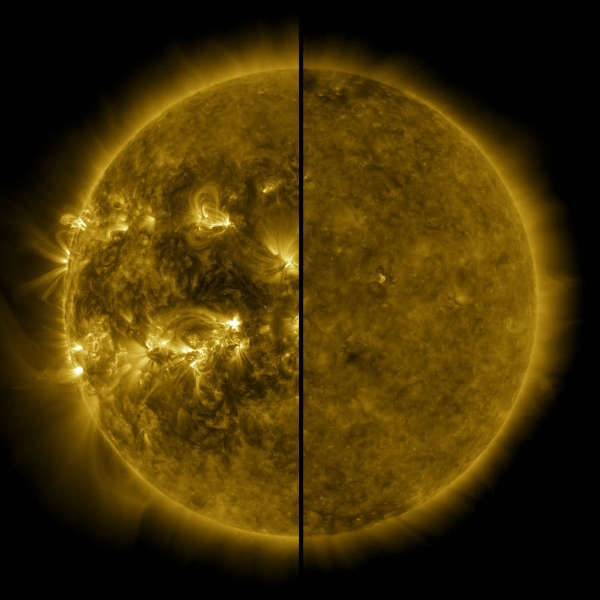
This split image shows the difference between an active sun during solar maximum (on the left, captured in April 2014) and a quiet sun during solar minimum (on the right, captured in December 2019). December 2019 marks the beginning of Solar Cycle 25, and the Sun’s activity will once again ramp up until solar maximum, predicted for 2025. Credits: NASA/SDO. Solar Cycle 25 has begun. During a media event on Tuesday, experts from NASA and the National Oceanic and Atmospheric Administration, or NOAA, discussed their analysis and predictions about the new solar cycle – and how the coming upswing in space weather will impact our lives and technology on Earth, as well as astronauts in space.
The Solar Cycle 25 Prediction Panel, an international group of experts co-sponsored by NASA and NOAA, announced that solar minimum occurred in December 2019, marking the start of a new solar cycle.
Because our sun is so variable, it can take months after the fact to declare this event. Scientists use sunspots to track solar cycle progress; the dark blotches on the sun are associated with solar activity, often as the origins for giant explosions – such as solar flares or coronal mass ejections – which can spew light, energy and solar material into space.
“As we emerge from solar minimum and approach Cycle 25’s maximum, it is important to remember solar activity never stops; it changes form as the pendulum swings,” said Lika Guhathakurta, solar scientist at the Heliophysics Division at NASA Headquarters in Washington.
NASA and NOAA, along with the Federal Emergency Management Agency and other federal agencies and departments, work together on the National Space Weather Strategy and Action Plan to enhance space weather preparedness and protect the nation from space weather hazards.
NOAA provides space weather predictions and satellites to monitor space weather in real-time; NASA is the nation’s research arm, helping improve our understanding of near-Earth space, and ultimately, forecasting models.
Space weather predictions are also critical for supporting Artemis program spacecraft and astronauts. Surveying this space environment is the first step to understanding and mitigating astronaut exposure to space radiation.
The first two science investigations to be conducted from the Gateway will study space weather and monitor the radiation environment in lunar orbit. Scientists are working on predictive models so they can one day forecast space weather much like meteorologists forecast weather on Earth.
“There is no bad weather, just bad preparation,” said Jake Bleacher, chief scientist for NASA’s Human Exploration and Operations Mission Directorate at the agency’s Headquarters. “Space weather is what it is – our job is to prepare.”
Understanding the cycles of the sun is one part of that preparation. To determine the start of a new solar cycle, the prediction panel consulted monthly data on sunspots from the World Data Center for the Sunspot Index and Long-term Solar Observations, located at the Royal Observatory of Belgium in Brussels, which tracks sunspots and pinpoints the solar cycle’s highs and lows.
“We keep a detailed record of the few tiny sunspots that mark the onset and rise of the new cycle,” said Frédéric Clette, the center’s director and one of the prediction panelists. “These are the diminutive heralds of future giant solar fireworks. It is only by tracking the general trend over many months that we can determine the tipping point between two cycles.”
With solar minimum behind us, scientists expect the sun’s activity to ramp up toward the next predicted maximum in July 2025. Doug Biesecker, panel co-chair and solar physicist at NOAA’s Space Weather Prediction Center, or SWPC, in Boulder, Colorado, said Solar Cycle 25 is anticipated to be as strong as the last solar cycle, which was a below-average cycle, but not without risk.
“Just because it’s a below-average solar cycle, doesn’t mean there is no risk of extreme space weather,” Biesecker said. “The sun’s impact on our daily lives is real and is there. SWPC is staffed 24/7, 365 days a year because the sun is always capable of giving us something to forecast.”
Elsayed Talaat, director of Office of Projects, Planning, and Analysis for NOAA’s Satellite and Information Service in Silver Spring, Maryland, described the nation’s recent progress on the Space Weather Action Plan as well as on upcoming developments, including NOAA’s Space Weather Follow-On L-1 observatory, which launches in 2024, before Solar Cycle 25’s predicted peak.
“Just as NOAA’s National Weather Service makes us a weather-ready nation, what we’re driving to be is a space weather-ready nation,” Talaat said. “This is an effort encompassing 24 agencies across the government, and it has transformed space weather from a research perspective to operational knowledge.”
For more information on NASA programs and activities, visit https://www.nasa.gov.
LAKEPORT, Calif. – The Lake County Sheriff’s Office said it is monitoring an inmate in the Lake County Jail who has tested positive for COVID-19.
This is the third case of COVID-19 to be confirmed in the jail since the start of the pandemic, Lt. Corey Paulich reported.
On Monday, medical staff at the Lake County Jail were notified by Lake County Public Health Officer Dr. Gary Pace that an inmate who came into the facility within the previous three days had tested positive for the COVID-19 virus, Paulich said.
Paulich said this new COVID-19 case is the only one currently being tracked in the inmate or staff population in the Lake County Jail.
The inmate was and remains asymptomatic. After jail medical staff learned of the positive test, Paulich said the inmate was placed in isolation for the 14 days necessary to ensure they are no longer contagious.
The inmate was initially housed in a dorm which normally would hold up to 15 inmates, but to allow for social distancing was only housed with two other inmates in the dorm, Paulich said.
The inmates housed with the inmate who tested positive were also tested for the virus. Paulich said all three inmates have been moved to a separate isolation area where they will be housed for 14 days while jail staff awaits their test results. None of these inmates are showing any signs of illness.
Paulich said Inmates are provided masks and directed to wear them when they are moving through shared living spaces within their housing units.
“We have provided cleaning supplies in all housing units so inmates can disinfect the common areas as frequently as they feel is necessary,” Paulich said.
The inmate who tested positive was assigned a work detail to clean common areas of the jail. Inmates who are assigned work details are required to wear masks and gloves while completing that work, Paulich said.
Paulich said the Lake County Sheriff’s Office is working continuously with Lake County Public Health to ensure its protocols are medically appropriate.
Upon learning of the positive test, Dr. Pace, jail medical staff and jail managers met to develop a plan for isolation, testing and contact tracing, Paulich said.
Paulich said the Lake County Sheriff’s Office has and continues to prioritize the safety of inmates and staff during this pandemic.
NORTHERN CALIFORNIA – Critically dry fuels are challenging firefighters as they continue their suppression efforts on the August Complex, with the Lake Pillsbury area in northern Lake County to be a focus on operations on Tuesday.
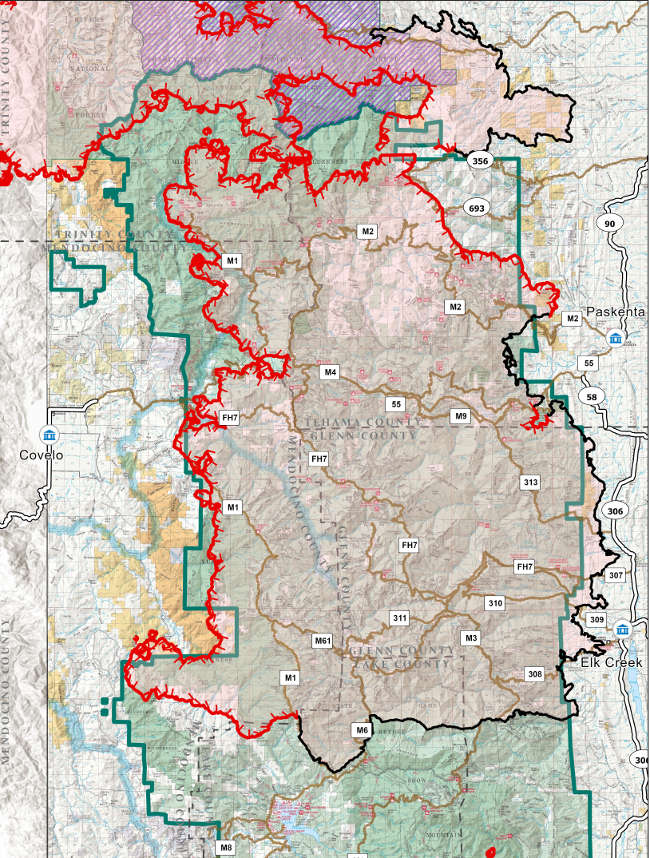
The total acreage for the August Complex is now at 794,801 acres with 30-percent containment, the Forest Service reported. It is burning on the Mendocino, Shasta-Trinity and Six Rivers National Forests.
The acreage associated with the South Zone – formerly the Doe fire – is 522,957 acres, officials said.
The focus of Tuesday’s firefighting efforts is in Lake County in the Lake Pillsbury Basin, the Forest Service said.
The Forest Service said a considerable amount of work is taking place in this area. Two structure protection groups have been established to help protect infrastructure in the basin. Work by these groups includes installing hose lays, supplying water dip tanks for helicopters, and putting in dozer lines where appropriate.
Close coordination between the Forest Service and Cal Fire is taking place between the efforts in the west and southwest areas of the fire.
The evacuation orders for Pillsbury Ranch and the Lake Pillsbury Basin, which were issued by the Lake County Sheriff’s Office, remain in effect.
On the east side of the fire, officials said a burnout operation began Monday afternoon in the area of the Salt Creek Conservation Camp. This operation will continue Tuesday as weather conditions allow. The completion of this burnout operation will tie the fire perimeter into the dozer built fire line that was previously constructed.
In the northern area of the South Zone, good progress has been made in containing the fire in the Elder Creek area on the eastern side of the Crane Mills property. Mop up activities continue along the fire perimeter in this area by the 14th Brigade Engineer Battalion from Joint Base Lewis-McChord in Washington State, the Forest Service reported.
As to weather in the complex area, the Forest Service said smoke will be clearing on Tuesday with mostly sunny skies. Relative humidity will be 15 to 20 percent, with temperatures in the upper 70s to upper 80s. Southwesterly winds will continue at 10 to 15 miles per hour with gusts up to 20 miles per hour.
Moisture will begin arriving in the area starting Wednesday, raising, humidity levels, which will help with suppression efforts, officials said.
In addition to Lake County, evacuation orders also are in effect for Mendocino, Glenn, Humboldt and Trinity counties. Evacuation information can also be found at Inciweb.
Due to unprecedented and historic fire conditions throughout the state, the USDA Forest Service Pacific Southwest Region extended its temporary closure of all 18 National Forests in California through Sept. 21.
The August Complex as mapped on Tuesday, September 15, 2020. Map courtesy of the US Forest Service.
LAKE COUNTY, Calif. – The father of a man murdered during a home invasion robbery in July 2017 has joined forces with the Lake County Sheriff’s Office to offer a $15,000 reward for information leading to the arrest and conviction of the individuals responsible for the killing.
David Sheldon Shalett, 34, of Kelseyville was fatally shot as two suspects robbed his State Street home in Kelseyville early on the morning of July 19, 2017.
Investigators have pointed to an added degree of cruelty in the crime: Lt. Corey Paulich said when the two masked gunmen entered Shalett’s home, Shalett begged them not to do anything because he had children in the residence.
Despite that, Shalett was shot to death in front of his two children, ages 9 and 11.
“The suspect knew the kids were there and watching,” Det. Jerry Pfann of the Lake County Sheriff’s Major Crime Unit told Lake County News. “That’s what makes it such an egregious case.”
Pfann said there are persons of interest in the case but the sheriff’s office doesn’t want to identify them.
The individuals responsible for killing Shalett are believed to still be in Lake County, Pfann added.
At its Aug. 25 meeting, the Board of Supervisors unanimously approved a resolution to authorize the $5,000 portion of the reward that comes from the county, which includes leftover funds donated for a reward for the January 2013 killing of Forrest Seagrave in Kelseyville.
Larry Shalett, David Shalett’s father, is offering $10,000 of his own money in addition to the county’s reward funds.
In the resolution the board approved, it states that David Shalett was murdered “in front of his children and several other people.”
Pfann told Lake County News that the sheriff’s office also has requested a reward of up to $50,000 from the Governor’s Office, but that so far hasn’t been approved. “I don’t know how soon we’ll get an answer on that.”
Pfann said the crime was marijuana-related, as was a burglary across the street a short time earlier.
Based on sheriff’s office reports on the murder to date, two masked gunmen entered Shalett’s home in the 5000 block of State Street. One of the individuals shot Shalett and stole a small amount of marijuana before fleeing on foot, running south.
Authorities described the shooter as a male, approximately 5 feet 6 inches to 5 feet 7 inches tall, wearing a dark hooded sweatshirt.
When deputies and firefighters arrived at Shalett’s home just before 3:30 a.m. on the report of a male gunshot wound victim, Shalett had already died, the sheriff’s office reported.
During the investigation, Paulich said detectives located a home across the street from Shalett’s that also had been burglarized that morning. Surveillance video at that second residence showed a burglary occurring shortly before Shalett’s murder.
The surveillance video released by the sheriff’s office in the days after the murder, showing the earlier burglary, is posted on this page.
“We do believe those are the suspects responsible for killing Mr. Shalett,” Paulich said.
The case ultimately was assigned to Pfann, who has worked it for three years.
“We put a ton of work into this,” he said, with help from outside agencies.
Just how much work? Paulich told the Board of Supervisors that the effort to date has involved investigators interviewing more than 100 people, serving dozens of search warrants and putting in close to 1,000 hours of investigative time.
However, so far, they haven’t been able to bring the case to a resolution by getting enough evidence to bring the suspects to justice, he said.
“It’s one thing to be able to file a case, it’s another thing to be able to get a conviction,” Pfann said.
The case is now three years old and Pfann is set to retire this month.
He said solving Shalett’s murder has been a priority for him.
“We just need that little bit more to make it a case,” Pfann said.
Supervisors take action to approve reward
In order to allow the county’s $5,000 portion of the reward to go forward, the Board of Supervisors approved the necessary resolution on Aug. 25 that authorized the use of funds collected from the community to be used in the Shalett case.
Sheriff Brian Martin told the Board of Supervisors than when the board first accepted the funds for the reward in the Seagrave murder several years ago, a resolution approved at that time included language that unused funds could be used for future rewards.
Martin said everyone who submitted money for the reward was contacted and all but one agreed to have their money rolled over for future reward efforts.
“We do know that there are people out there who have information that can help us with that, but sometimes people don’t come forward because it’s the right thing to do, sometimes they need a motivation,” Paulich said, adding they hoped the total reward of $15,000 will be that motivation.
Supervisor Rob Brown pointed out that the Seagrave reward was successful in leading to an arrest – that of Jonathan Antonio Mota of Kelseyville, who in October 2016 was sentenced to life in prison plus 10 years for killing Seagrave at the convenience store where he worked.
In the Seagrave case, Brown said one of the informants didn’t want to take the reward but wanted it to be used for “something like this.”
Martin said the reward can’t be paid without the concurrence of both the sheriff’s office and the District Attorney’s Office, explaining that the information has to be useful.
Supervisor Bruno Sabatier moved to approve the resolution, which was seconded by Supervisor EJ Crandall and approved 5-0 by the board.
Victim's father seeks justice
Larry Shalett, David Shalett’s father, said he was working with the sheriff’s office to get the reward launched this spring. “But things got lost in the COVID and everything else.”
Now, with his $10,000 and $5,000 more from the county approved, he’s looking for a long-hoped-for break in the case.
Last week Larry Shalett, who lives in Colorado, was in Lake County to meet with Pfann, catch up with him before his retirement and find out what the plan is going forward for handling the investigation.
Larry Shalett said he’s anxious to see the information about the reward get out to the community, adding he hopeful it will bring in some leads.
He said his son, who had lived in Florida previously, came to California in about 2010 with his wife and children, looking to make a new life and pursue new opportunities.
As for what he thinks happened, Larry Shalett said his son was victimized by local gang members. “I know the police have ideas on exactly what happened,” he said, adding that he didn’t want to speculate about the specifics.
Despite what they’ve experienced, he said his two grandchildren are doing well, going to school and “doing kid things.”
“They’re pretty resilient,” he said.
He said the hope now is that people involved with the individuals who committed the crime will share the information they have with authorities.
In a statement he wrote about the reward that he asked to be published, Larry Shalett said, “The horror of this event and the damage to the children can not be overstated. Through this tragedy our family remains grateful to the many good people of Lake County who have provided support during this difficult time. The sheriff’s office and Social Services have been especially helpful with the many personal and financial challenges resulting from this crime. Still, these gangster criminals remain at large, ever offending in the community.”
He added, “Time or distance will not stop me from seeking justice for David but I need your help assisting law enforcement in identifying these predators.”
How to contact the sheriff’s office
Anyone with information about the murder of David Shalett is encouraged to contact the Lake County Sheriff’s Office and ask to speak to a detective.
“We’d like to hear from them so that we can give Mr. Shalett’s family some closure on this case,” said Paulich.
Methods Paulich said to use to contact the agency include coming to the main office at 1220 Martin St. in Lakeport, calling the main administrative number at 707-262-4200 or the nonemergency Central Dispatch number at 707-263-2690.
Individuals also can email Paulich at This email address is being protected from spambots. You need JavaScript enabled to view it. or send a private message on the sheriff’s office Facebook page.
Informants can remain anonymous if desired.
Email Elizabeth Larson at This email address is being protected from spambots. You need JavaScript enabled to view it.. Follow her on Twitter, @ERLarson, or Lake County News, @LakeCoNews.
LAKEPORT, Calif. – The Board of Supervisors will hold its annual budget hearings this week to consider the $292 million final recommended budget for the 2020-21 fiscal year.
The hearings are scheduled for 9 a.m. Wednesday, Sept. 16, and will continue on Thursday, Sept. 17, if necessary.
The supervisors will meet in the board chambers on the first floor of the Lake County Courthouse, 255 N. Forbes St., Lakeport, for a hybrid meeting format which also will include the opportunity for community members to continue to participate virtually.
The meeting can be watched live on Channel 8, online at https://countyoflake.legistar.com/Calendar.aspx and on the county’s Facebook page. Accompanying board documents, the agenda and archived board meeting videos also are available at that link.
To participate in real-time, join the Zoom meeting Sept. 16 by clicking this link at 9 a.m. The meeting ID is 932 2053 1970, password 301945.
For the Sept. 17 meeting, join by clicking this link. The meeting ID is 921 6335 9913, password 258258.
To submit a written comment on any agenda item please visit https://countyoflake.legistar.com/Calendar.aspx and click on the eComment feature linked to the meeting date. If a comment is submitted after the meeting begins, it may not be read during the meeting but will become a part of the record.
In her memo to the board, County Administrative Officer Carol Huchingson reported that the final recommended budget for the new fiscal year totals approximately $292,261,503, which represents an increase of $34,012,659 when compared to the Fiscal year 2019-20 Adopted Budget amount of $258,248,844.
“In light of the COVID-19 pandemic, this recent cycle of budget preparation has been quite unusual,” Huchingson wrote.
Huchingson said that in late March the board approved staff’s recommendation to make changes to the scheduled budget hearings for this fiscal year cycle and to flip the extended budget hearing process – during which the board receives detailed presentations from county department heads – from the recommended budget to the final recommended budget.
While staff previously had informed the board of potential impacts from the COVID-19 crisis, Huchingson said the county has begun to receive federal CARES Act funding and state realignment backfill, which is helping alleviate some of the financial pressure.
Huchingson said that at the time of the recommended budget discussions in June, the board contemplated 10-percent cuts to county departments in anticipation of negative financial impacts resulting from the pandemic.
“Absent CARES Act and Realignment Backfill, the County would be facing dire financial circumstances with likely reductions to staffing and services the public relies upon,” said Huchingson.
Out of an abundance of caution, Huchingson said general fund departments have been held to the same net county cost in Fiscal Year 2020-21 as they received in FY 2019-20.
Email Elizabeth Larson at This email address is being protected from spambots. You need JavaScript enabled to view it.. Follow her on Twitter, @ERLarson, or Lake County News, @LakeCoNews.
For the first time since America’s COVID-19 outbreak started, a federal public health agency released county-level testing data.
On Sept. 3, the Centers for Medicare & Medicaid Services, or CMS, published a dataset showing COVID-19 test positivity rates broken out by U.S. county.
While this dataset has not been highly publicized, it provides key information about the state of COVID-19 testing and outbreak control across the country, as originally reported by Stacker Media.
A test positivity rate describes the percentage of tests conducted in a particular area that return a positive result. For example, if 1,000 people in a New York county are tested for COVID-19 in a particular week and 10 of those people test positive, the county would have a positivity rate of 1%. Meanwhile, if 25 people in an Oklahoma county are tested and 5 test positive, the test positivity rate for that county is 20%.
These positivity rates are typically reported for a short period of time, either one day or one week, and are used to reflect a region’s testing capacity over time. If a region has a higher positivity rate, that likely means either many people there have COVID-19, the region does not have enough testing available to accurately measure its outbreak, or both. If a region has a lower positivity rate, on the other hand, that likely means a large share of the population has access to testing, and the region is diagnosing a more accurate share of its infected residents.
Test positivity rates are often used as a key indicator of how well a particular region is controlling its COVID-19 outbreak. The World Health Organization recommends a test positivity rate of 5% or lower. This figure, and a more lenient benchmark of 10%, have been adopted by school districts looking to reopen and states looking to restrict out-of-state visitors as a key threshold that must be met.
Stacker has visualized the positivity rates reported by the CMS. These figures reflect average weekly test positivity for the week of Aug. 27 to Sept. 2. CMS has categorized counties according to their positivity rates:
Green: test positivity under 5% in the past week (or with fewer than 10 tests in the past week). Yellow: test positivity between 5% and 10% in the past week. Red: test positivity greater than 10% in the past week.
The new data showed that Lake County, California, was in the yellow category of between 5 and 10 percent for that week, which aligns with positivity rates reported by Lake County Public Health for that week.
The visualizations also include state-level positivity rates for the same time period, sourced from the COVID Tracking Project at The Atlantic, and county-level case and death counts from the most recent week of data available (Sept. 3 to Sept. 9), sourced from the New York Times COVID-19 data repository.
 How to resolve AdBlock issue?